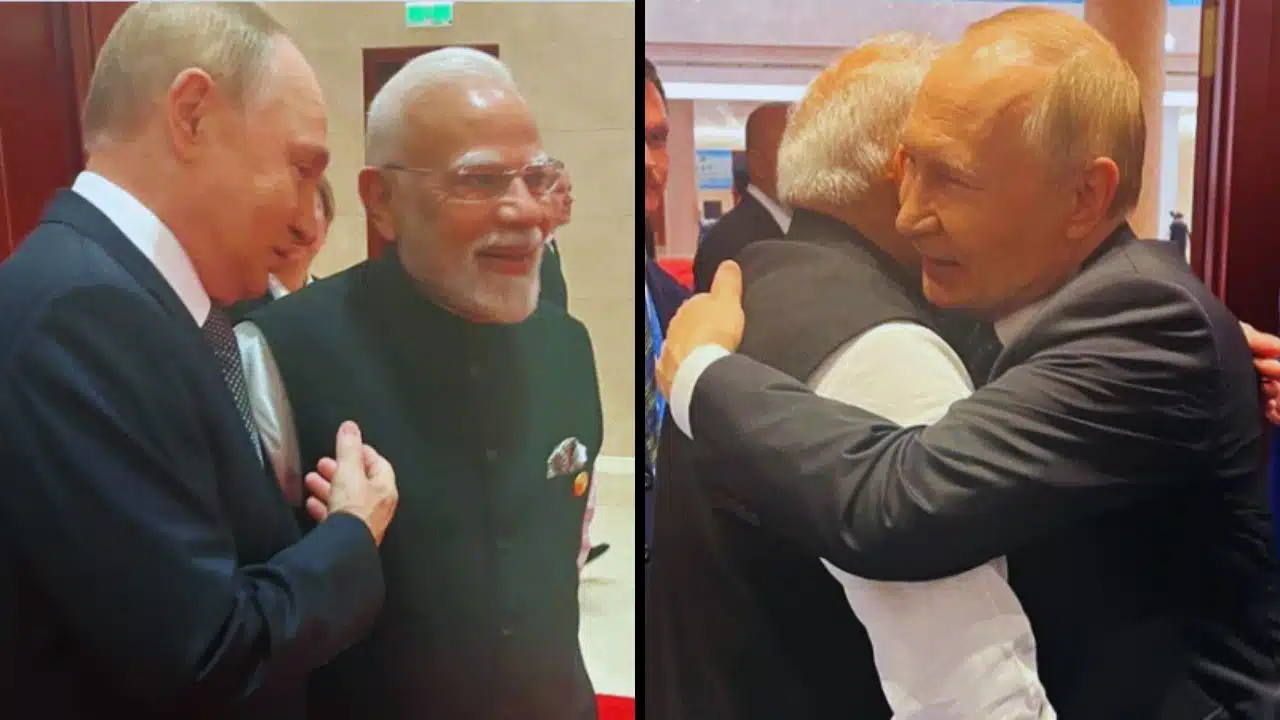
Prime Minister Narendra Modi and Russian President Vladimir Putin made global headlines on Sunday, August 31, 2025, when they greeted each other with a warm hug at the Shanghai Cooperation Organisation (SCO) Summit in Tianjin, China. The moment of camaraderie, captured by cameras at the entrance of the summit venue, quickly spread across social media platforms, symbolizing not just personal warmth but also the deep historical ties between India and Russia.
Modi later amplified the moment by sharing photos on his official X (formerly Twitter) account with the caption: “Always a delight to meet President Putin!” The post garnered millions of views within hours, reflecting the intense global interest in the meeting of two leaders who continue to balance their relations with both the West and the Global South.
This embrace was not only symbolic but also significant, as it set a positive tone before their scheduled bilateral talks on the sidelines of the summit.
Modi–Putin Bilateral: Energy, Defence, and Global Shifts
According to officials, the Modi–Putin talks are expected to focus on:
- Energy ties: India has remained one of the largest buyers of Russian crude oil despite Western sanctions. This trade relationship has been central to India’s energy security but also a source of tension with the United States.
- Defence cooperation: Russia continues to be a critical supplier of military equipment to India. Discussions are likely to cover new joint production ventures and technology transfers.
- Geopolitical coordination: Against the backdrop of Donald Trump’s decision to impose 50% tariffs on Indian goods — a move linked to India’s oil trade with Moscow — the two leaders are set to evaluate strategies for maintaining strategic autonomy in a multipolar world.
Indian officials emphasized that the talks are not merely transactional but reflect a broader partnership rooted in trust, history, and a shared vision of resisting unilateral economic pressures.
Modi, Putin, and Xi: Trilateral Diplomacy in Action
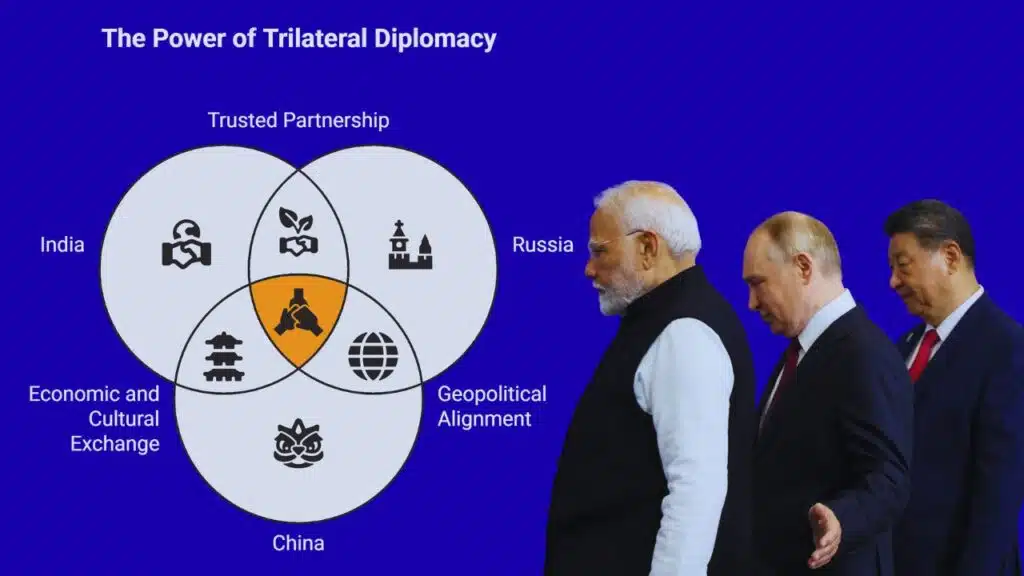
Beyond the one-on-one meeting, the summit showcased lighter, friendlier exchanges between Modi, Putin, and Chinese President Xi Jinping. Images of the three leaders smiling, shaking hands, and engaging in animated conversations dominated international media coverage.
On X, Modi described these moments with a message: “Interactions in Tianjin continue! Exchanging perspectives with President Putin and President Xi during the SCO Summit.”
The optics were important. With Washington pursuing an aggressive trade war, and the Ukraine conflict reshaping global alignments, the India–Russia–China triangle at Tianjin projected a message of collaboration, mutual respect, and resistance to Cold War–style divisions.
India–China Dialogue: First Visit in Seven Years
Modi’s presence in China is especially significant because it marks his first visit in seven years, following the 2020 Galwan Valley clashes, which strained bilateral ties. His meeting with Xi Jinping carried both symbolism and substance.
In their talks, Modi:
- Called for stronger cooperation between India and China, framing both nations as victims of terrorism who should jointly work to eliminate the threat.
- Raised concerns over cross-border terrorism, urging Beijing to act responsibly in regional security.
- Discussed de-escalation at the border, emphasizing the importance of peace along the Line of Actual Control.
- Pitched for trade and connectivity measures, including restoration of direct air links, easier visa policies, and expanded people-to-people ties.
Xi responded by stressing that India and China are “development partners, not rivals”, highlighting the need for joint growth and stability in Asia. The willingness to restart dialogue, despite lingering distrust, is seen as a step toward stabilizing one of Asia’s most complex bilateral relationships.
SCO Summit: A Platform for Multipolarity
The Shanghai Cooperation Organisation, founded in 2001, has grown into one of the world’s largest regional blocs. Its current members include China, India, Russia, Pakistan, Iran, Kazakhstan, Kyrgyzstan, Tajikistan, Uzbekistan, and Belarus, with several others as observers or dialogue partners.
At Tianjin, President Xi Jinping used his opening remarks to call for:
- Strengthening energy, infrastructure, and digital cooperation, with a focus on artificial intelligence and scientific research.
- Challenging unilateral sanctions and tariffs, framing them as destabilizing to global growth.
- Building a fairer global governance system, where no single bloc dominates world affairs.
Xi also pledged 2 billion yuan (about $280 million) in aid and 10 billion yuan in loans to SCO member states.
President Putin, for his part, endorsed Xi’s call, urging members to expand trade in national currencies and reduce reliance on Western financial systems. He underlined Russia’s readiness to supply energy resources at stable prices to SCO partners, implicitly offering alternatives to Western-led sanctions.
The Modi–Putin hug at the SCO Summit was more than a personal gesture — it reflected the evolving geopolitics of Asia in 2025. For India, it was a message of strategic autonomy: continuing energy ties with Russia, re-engaging with China, and resisting U.S. trade coercion. For the SCO, the Tianjin summit signaled its ambition to become a forum where major powers chart out an alternative world order — one based on cooperation, multipolarity, and resistance to unilateral dominance.
As images of Modi, Putin, and Xi smiling together spread across the globe, the SCO gathering served as both a diplomatic spectacle and a reminder that the world is no longer unipolar. The embrace may have been brief, but its message was long-lasting: India, Russia, and China are determined to shape their own path, even amid global turbulence.
The Information is Collected from India Today and NDTV.