
Microsoft has announced the public testing of its first large-scale, in-house artificial intelligence model, marking a significant step in the company’s long-term strategy to reduce dependence on its close AI partner, OpenAI.
The new system, called MAI-1-preview, is being tested on LMArena, a public evaluation platform where different AI models are ranked based on performance. While Microsoft continues to support and integrate OpenAI’s technology across its products, this move signals that the company wants to strengthen its own AI research and product independence.
Why Microsoft Is Building Its Own Models
For years, Microsoft has leaned heavily on OpenAI’s advanced models to power AI features in Bing, Windows 11, and its Copilot assistant. It has invested over $13 billion in OpenAI, providing both funding and cloud infrastructure through its Azure platform.
But as the AI industry evolves, the partnership has shifted. OpenAI has begun working with other cloud providers, including Google, Oracle, and CoreWeave, to meet the rising demand for its ChatGPT service, which now reaches over 700 million users every week.
At the same time, Microsoft has formally listed OpenAI as a competitor in its annual regulatory report, alongside tech giants like Google, Amazon, Apple, and Meta. This means that while the partnership remains important, both companies are pursuing their own strategies that could eventually put them in direct competition.
Inside the MAI-1-Preview Model
The MAI-1-preview model represents Microsoft’s first foundation model trained end-to-end within its own AI research unit. According to the company, the model was refined using around 15,000 NVIDIA H100 GPUs, and the training was further supported by a cluster of NVIDIA GB200 chips. This scale of compute power places Microsoft’s effort in line with other top AI labs developing frontier models.
The model is currently focused on text-based tasks. Microsoft has stated that MAI-1-preview will soon be integrated into certain Copilot features for consumers, beginning with text use cases. The company’s goal is to collect real-world feedback and improve the system’s accuracy, reliability, and efficiency before rolling it out more broadly.
On the LMArena leaderboard, the model currently ranks 13th for text workloads, behind offerings from OpenAI, Google, Anthropic, DeepSeek, Mistral, and Elon Musk’s xAI. This ranking highlights the competitiveness of the global AI race and the challenges Microsoft faces in catching up with established leaders.
Expanding Microsoft’s AI Division
The development of MAI-1-preview is being led by Mustafa Suleyman, CEO of Microsoft AI. Suleyman is a well-known figure in the AI world: he co-founded DeepMind, which was later acquired by Google, and more recently launched the startup Inflection AI, before joining Microsoft in 2023. Along with him, Microsoft has recruited a large team of AI experts, including around two dozen researchers from Google’s DeepMind.
Under his leadership, Microsoft has been expanding its AI research group rapidly, signaling the company’s ambition to become not just a major user of AI, but also a leading creator of foundation models.
Microsoft’s Previous AI Work
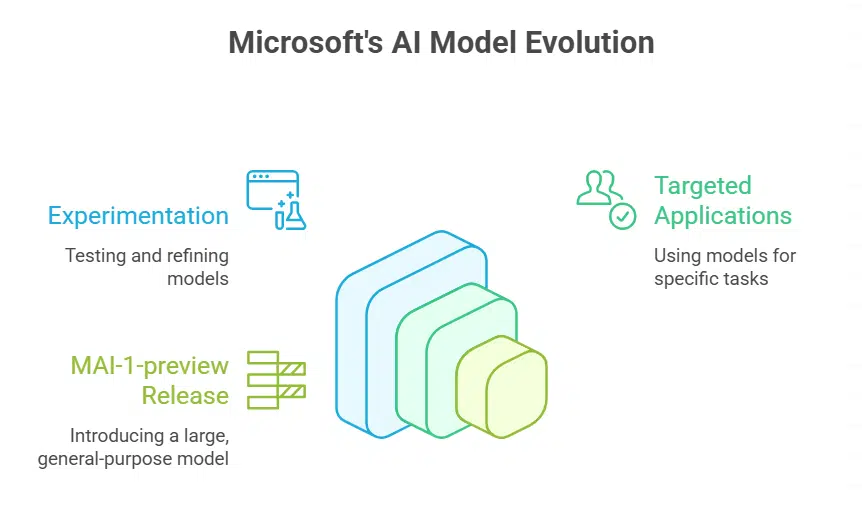
Before MAI-1-preview, Microsoft’s internal AI development was largely limited to small-scale, open-source language models known as the Phi series. These lightweight models were useful for experimentation and targeted applications, but they did not compete with the massive foundation models built by companies like OpenAI or Anthropic.
The release of MAI-1-preview changes that, as it represents Microsoft’s first large, general-purpose model designed to serve as a backbone for consumer applications at scale.
A Turning Point for Microsoft’s AI Future
Microsoft’s move into training its own large models is more than just a technical milestone—it reflects a strategic shift. By developing in-house foundation models, the company reduces its reliance on outside partners and ensures greater control over how AI is integrated into its core products.
At the same time, Microsoft is not abandoning OpenAI. The partnership remains strong, and Microsoft’s Azure cloud continues to serve as a primary platform for running OpenAI’s powerful GPT models. However, by investing in its own research, Microsoft is preparing for a future in which it can compete more directly in the AI market and respond more flexibly to consumer needs.
With Copilot now integrated into Windows, Office, and Bing, Microsoft has a direct channel to bring these innovations to billions of users. If MAI-1-preview and future in-house models prove successful, Microsoft could begin shifting more of its AI ecosystem to its own technologies, creating a stronger balance between partnership and independence.
At a Glance: Microsoft’s New AI Push
| Feature | Details |
|---|---|
| Model Name | MAI-1-preview |
| Type | First fully in-house foundation model |
| Training Hardware | ~15,000 NVIDIA H100 GPUs + GB200 cluster |
| Focus Area | Text-based workloads; consumer-facing Copilot features |
| Testing Platform | Public evaluations on LMArena |
| Ranking | 13th in text tasks (as of launch) |
| Leadership | Mustafa Suleyman, former DeepMind co-founder and Inflection AI CEO |
| Strategic Goal | Reduce dependence on OpenAI, expand Microsoft’s AI independence |
The launch of MAI-1-preview highlights Microsoft’s big ambitions in AI. While OpenAI remains a close partner, Microsoft is now positioning itself as a company capable of building cutting-edge models independently.
This shift is especially important as AI competition intensifies, with rivals like Google, Anthropic, Meta, and Mistral releasing increasingly powerful models. By leveraging its global infrastructure, vast user base, and new in-house expertise, Microsoft is preparing to deliver AI experiences that are not only faster and more efficient, but also tailored specifically to its products and long-term vision.
In short, MAI-1-preview is not just another model—it marks the beginning of Microsoft’s transformation from a partner of AI pioneers to a pioneer in its own right.