
In 2026, the “Paper Ceiling” has not just cracked—it has shattered. With tuition for a four-year degree hitting record highs while the half-life of a technical skill shrinks to just 2.5 years, the math no longer favors the university. This analysis explores why a $300 certificate is currently outperforming a $100,000 diploma in the ROI economy.
Key Takeaways
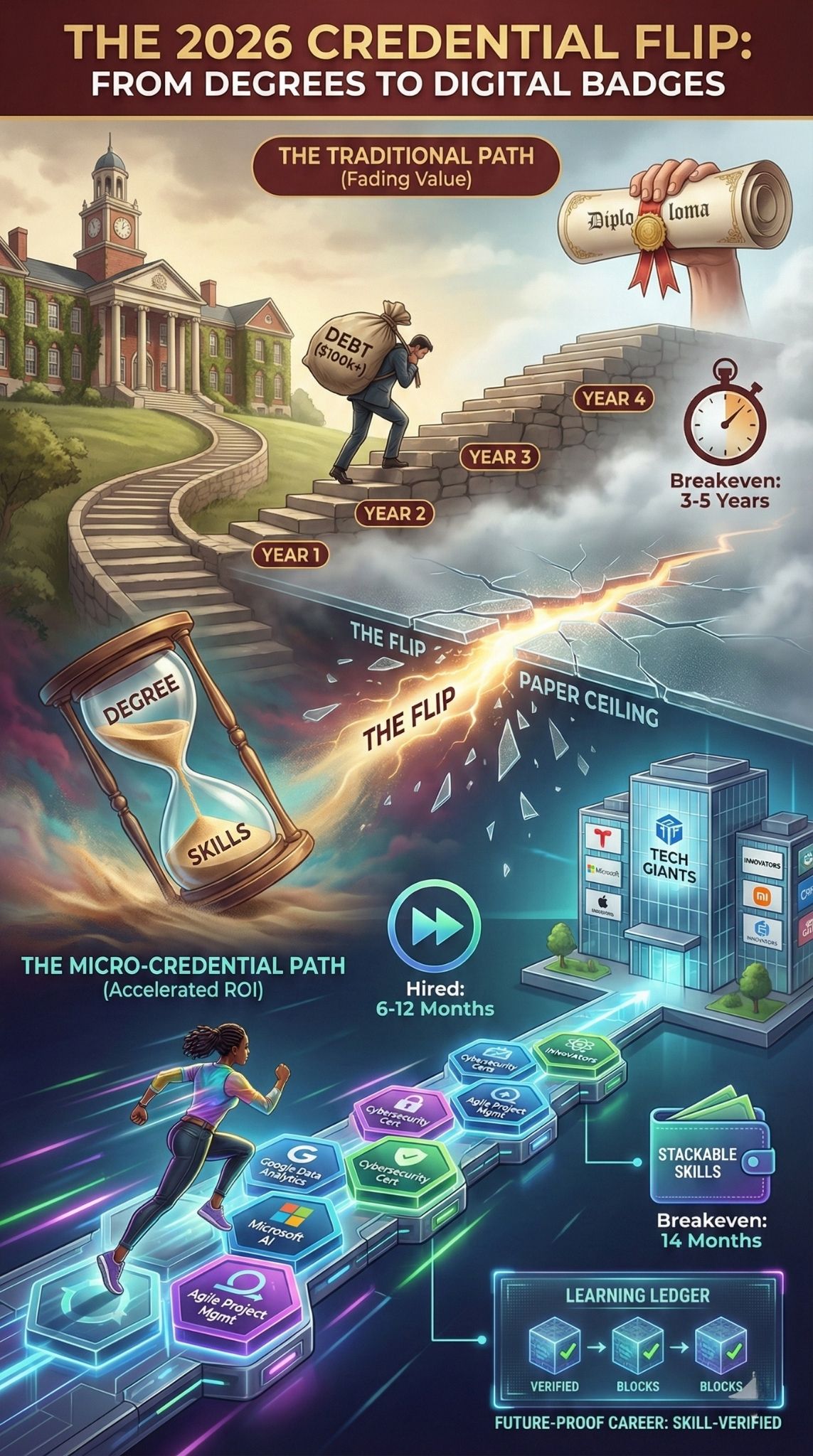
- The ROI Tipping Point: In 2026, the breakeven point for a micro-credential holder is 14 months, compared to 3-5 years for a traditional university graduate.
- The “Paper Ceiling” Removal: 19% of U.S. job listings have officially dropped degree requirements, with major tech and retail giants leading the shift.
- Corporate Curriculums: “Big Tech” (Google, Microsoft, IBM) has effectively become the new Ivy League for entry-level technical roles, setting the standard for curriculum relevance.
- The Hybrid Survival: Forward-thinking universities are no longer fighting micro-credentials; they are absorbing them, with 77% of students now demanding degrees that include industry certifications.
- The AI Accelerator: The explosion of Generative AI has rendered static four-year curriculums obsolete faster than they can be updated, making agile, “just-in-time” learning the only viable option for staying employed.
The “Credential Flip”: How We Got Here
To understand the 2026 landscape, we must look at the “Degree Inflation” bubble that peaked in the late 2010s. For decades, the Bachelor’s degree was the default gatekeeper—a proxy for intelligence and grit, regardless of the job’s actual requirements. However, the post-pandemic economy of 2020-2024 accelerated a shift that analysts call the “Credential Flip.”
Driven by a labor shortage and a massive skills gap in AI and cybersecurity, companies began tearing down the “Paper Ceiling”—the invisible barrier preventing non-degree holders from accessing high-wage jobs. By 2025, the rise of “Skills-First Hiring” platforms allowed employers to verify coding ability or project management skills directly, bypassing the university proxy entirely. Today, in 2026, we are witnessing the consolidation of this trend: the degree is no longer the ticket to the middle class; the verified skill is.
The ROI Reality Check
The primary driver of the micro-credential boom is simple arithmetic. In 2026, the cost of a private four-year university education has continued to outpace inflation, while the cost of digital upskilling has remained flat or decreased due to AI-driven personalization.
For the Class of 2026, the “Opportunity Cost” of a degree is the killer. Spending four years out of the workforce to learn skills that may be obsolete by graduation is a financial gamble fewer families are willing to take. Micro-credentials offer a “stackable” alternative: learn a specific skill, get hired, earn money, and then “stack” another credential later.
The Financial Math: Class of 2026 (Degree vs. Micro-credential)
| Metric | Traditional 4-Year CS Degree | “Stackable” Micro-Credential Path | Impact / Analysis |
| Total Cost (Avg) | $43,800 – $160,000+ | $2,000 – $15,000 | 90% Savings: Credentials offer a debt-free entry to the workforce. |
| Time Investment | 4 Years (Full-time) | 6 – 12 Months (Part-time) | Speed to Market: Credential holders enter the workforce 3 years earlier. |
| Curriculum Update Speed | Every 2-4 Years | Every 3-6 Months | Relevance: Tech changes faster than accreditation boards can meet. |
| Breakeven Point | 3 to 5 Years post-grad | 14 to 18 Months post-cert | ROI Velocity: Faster return on investment for credential holders. |
| Entry Salary (Tech) | $65,000 – $75,000 | $55,000 – $70,000 | Narrowing Gap: The “Degree Premium” has shrunk to <10% in tech. |
| 2026 Market Value | High Signal for “General Potential” | High Signal for “Immediate Utility” | Utility Wins: Employers prioritize what you can do now. |
Analyst Note: While degree holders still command a slight premium in starting salary, the gap has narrowed to negligible levels in tech sectors. When factoring in student loan interest, the micro-credential path often yields a higher net worth by age 30.
The “Just-in-Time” Economy vs. The 4-Year Lag
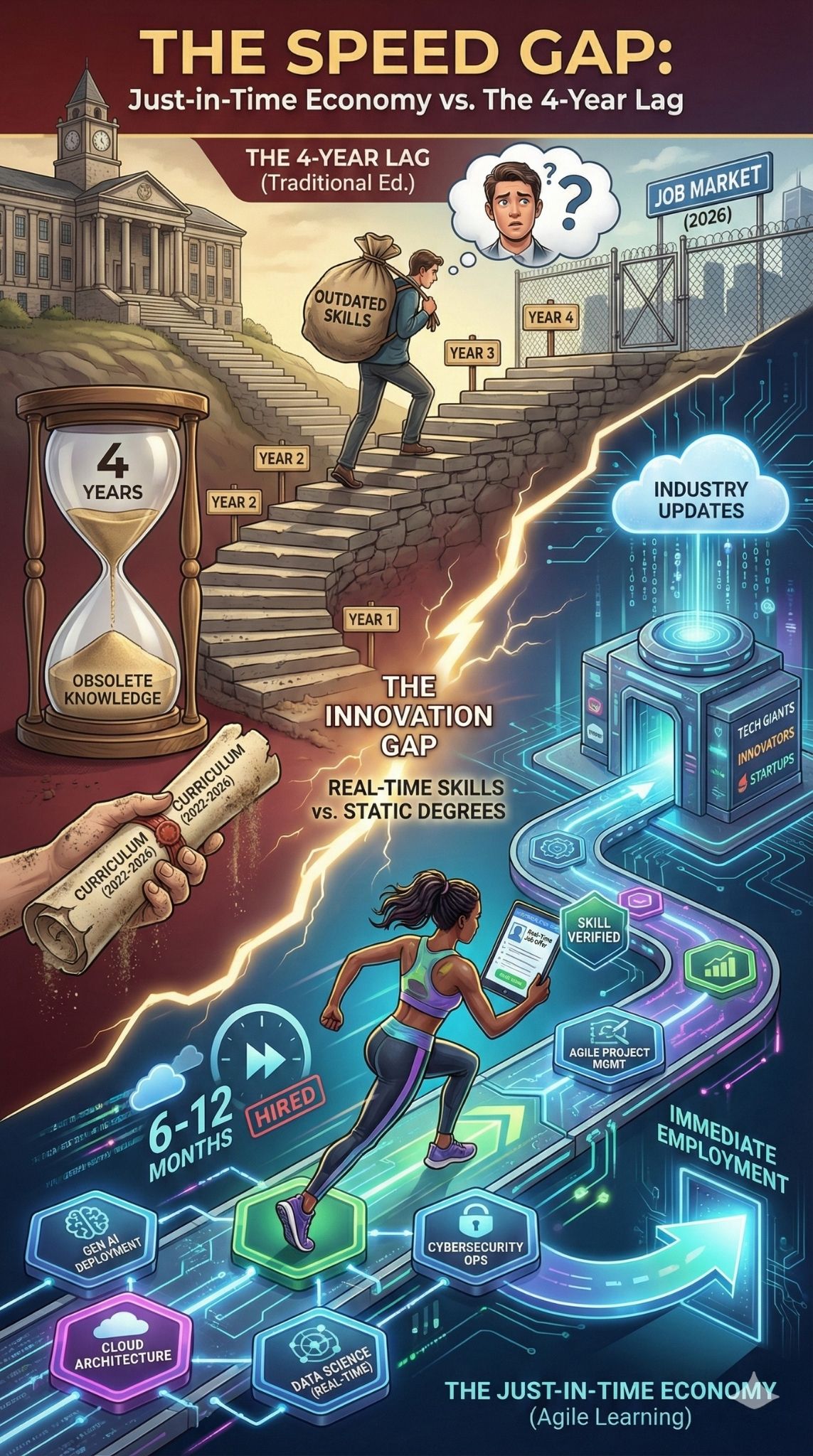
The speed of technological evolution has broken the traditional education model. In 2026, a curriculum written in 2022 is historical fiction, not training. This is particularly true for Generative AI, Green Tech, and Bioinformatics.
Universities, bound by accreditation boards and tenured bureaucracy, struggle to pivot. In contrast, micro-credential providers (Coursera, Udacity, and direct-to-enterprise platforms) operate on software cycles. If a new AI framework is released in January, a certification course is available by March.
This agility gap has forced employers to view micro-credentials not as a “consolation prize” for those who couldn’t afford college, but as a superior indicator of current competency. A 2026 Computer Science graduate might understand the theory of neural networks, but a candidate with a specialized 2026 “GenAI Deployment” certificate knows how to implement them today.
The Skill Half-Life Crisis (2026)
| Skill Category | Estimated Half-Life (2020) | Estimated Half-Life (2026) | Why the Shift? |
| Software Development | 5 Years | 2.5 Years | AI coding assistants (Copilot, etc.) change workflows monthly. |
| Data Science | 4 Years | 2 Years | Automated ML tools render manual modeling obsolete faster. |
| Marketing | 5 Years | 1.5 Years | Algorithms and platforms (TikTok, AI SEO) shift quarterly. |
| Accounting/Finance | 10+ Years | 5 Years | AI automation is eating entry-level auditing/reporting tasks. |
| Human Skills (Soft Skills) | 20+ Years | 25+ Years | Empathy & leadership are the only “future-proof” assets left. |
The New Gatekeepers (Big Tech as Educators)
The most significant disruption in the 2026 education market is the dominance of corporate-issued credentials. Google, Microsoft, Amazon, and Salesforce have effectively vertically integrated their talent pipelines.
They realized that waiting for universities to produce qualified candidates was inefficient. Instead, they built their own “Career Certificates.” These are not just educational products; they are hiring filters. A Google Data Analytics Certificate is now weighted more heavily by many tech recruiters than a generic Business degree from a mid-tier university.
Employer Sentiment Shift (2021 vs. 2026)
| Sentiment Metric | 2021 Perspective | 2026 Perspective | Implication for Job Seekers |
| Degree Requirement | “Bachelor’s Required” (Strict) | “Skills Verified or Equivalent Exp.” | Access: The door is open for non-traditional candidates. |
| Trust in Online Certs | Low / Skeptical | High (96% say it strengthens app) | Validity: Online certs are now a standard, respected credential. |
| Hiring Algorithms | Filtered by University Ranking | Filtered by Keyword/Skill Match | Visibility: Keywords matter more than alma mater prestige. |
| Salary Offerings | Degree holders paid 20%+ premium | Skill-verified holders paid 10-15% premium | Equity: Pay is increasingly based on output, not pedigree. |
| Primary Hiring Fear | “Candidate lacks discipline” | “Candidate lacks relevant skills” | Focus: Show proof of work (portfolios) to alleviate fears. |
The Institutional Pivot (If You Can’t Beat Them, Join Them)
Not all universities are losing. The “Winners” of 2026 are the institutions that abandoned the “Ivory Tower” model in favor of the “Hybrid University.”
Leading universities have begun embedding industry micro-credentials into their degree programs. A student might graduate with a B.A. in Marketing, but their transcript also includes a Meta Social Media Marketing Professional Certificate and a Salesforce Administrator badge.
This hybrid model solves two problems: it gives the university the prestige of the degree and the student the employability of the certificate. Data shows that 77% of students in 2026 prefer these hybrid programs. The “Losers” are the small, private liberal arts colleges that refused to adapt, facing enrollment cliffs as students flock to cheaper, skills-first alternatives.
The “Signal” Evolution
The shift to micro-credentials represents a fundamental change in “Signaling Theory.” Historically, a degree signaled three things: intelligence, conformity, and social class. In 2026, the labor market has become more utilitarian.
The signal has shifted from Pedigree (Where did you go?) to Proficiency (What can you do?). This democratization is flattening social hierarchies in hiring. A candidate from a rural area who cannot afford to relocate for college can now compete for remote roles by stacking high-value credentials. However, this also introduces a new challenge: the “Wild West” of quality control. With thousands of certificates available, the market is relying heavily on brand names (e.g., Google, IBM, MIT) to verify quality, potentially creating a new form of elitism based on which certificate you hold.
Key Statistics: The State of the Market (2026)
- $117 Billion: The projected value of the global micro-credential market this year.
- 90%: The percentage of employers willing to pay a higher starting salary to candidates with relevant micro-credentials.
- 19%: The percentage of U.S. job listings that have completely removed degree requirements.
- +6.6%: The enrollment growth in undergraduate certificate programs, contrasted with a decline in traditional Master’s degrees.
Future Outlook: The “Wallet” of the Future
As we look toward 2030, the concept of a “transcript” will disappear, replaced by the Learning Ledger.
We are moving toward blockchain-verified “Digital Wallets” where a worker holds their verified skills. This wallet will contain a mix of assets: a 4-year degree (the foundation), six industry certificates (the current tech stack), and dozens of “nano-badges” for soft skills like leadership or empathy.
What Happens Next?
- The Death of the “General Ed” Requirement: To cut costs and time, universities will slash general education requirements, focusing strictly on core competencies to compete with bootcamps.
- Subscription Education: Instead of tuition, universities will move to a “Netflix Model”—a monthly subscription for lifelong access to updated micro-credentials.
- Government Regulation: Expect the Department of Education to step in to regulate micro-credentials, creating a “Standard Unit of Credit” to allow seamless transfer between corporate certs and university degrees.
The degree isn’t dying, but its monopoly is over. In 2026, it is just one product on a shelf now crowded with faster, cheaper, and often more effective options.