The Meta Connect 2025 conference, held on September 17–18, marked a defining moment for the company’s roadmap. Over two days, Meta detailed its most advanced smart glasses lineup to date, demonstrated new tools for virtual reality creators, introduced real-world scanning technology that turns physical spaces into digital replicas, and explained its broader vision for AI-powered personal computing.
The event underscored Meta’s intent to accelerate the transition from experimental products to consumer-ready wearable AI devices. From the launch of smart glasses with in-lens displays to advanced generative AI design tools for Horizon Worlds, the announcements collectively highlight Meta’s aim to dominate the emerging intersection of artificial intelligence, augmented reality (AR), and virtual reality (VR).
Ray-Ban Display: Smart Glasses With a Lens-Integrated Screen
The headline launch of Connect 2025 was the Ray-Ban Display, a pair of AI-enabled smart glasses equipped with a built-in display inside the right lens. Unlike earlier Ray-Ban models, which mainly offered voice assistants, cameras, and open-ear speakers, this new version pushes toward genuine augmented reality.
Core features include:
-
A discreet waveguide display for showing navigation prompts, live translations, messaging notifications, and media previews.
-
A neural wristband based on electromyography (EMG) signals, allowing subtle hand movements to control apps without pulling out a phone.
-
A high-resolution camera mounted near the hinge for photos and short-form video recording.
-
Microphone and speaker arrays for hands-free calls, music, and real-time transcription.
-
Battery life of six hours, with recharging through a protective case.
The design remains consistent with Ray-Ban’s Wayfarer styling, aiming to normalize advanced AR technology in a familiar form factor. The glasses are priced at US$799 and go on sale in the United States starting September 30, 2025, with international launches planned for 2026.
Oakley Meta Vanguard: Built for Sports and Active Use
In collaboration with Oakley, Meta introduced the Oakley Meta Vanguard, a performance-oriented model optimized for athletes and outdoor enthusiasts. Unlike the Ray-Ban Display, it does not include an in-lens screen but focuses instead on durability, fitness integration, and extended power.
Notable highlights include:
-
A center-mounted action camera for recording first-person footage during runs, bike rides, and workouts.
-
Seamless syncing with Garmin and Strava, offering live performance metrics like pace, heart rate, and distance.
-
Upgraded water resistance and robust build quality to withstand outdoor conditions.
-
Enhanced speaker output for clearer audio during movement.
-
Nine hours of continuous battery life, suitable for endurance sports.
The Oakley Meta Vanguard is priced at US$499 and will be available beginning October 21, 2025, initially in the United States and Canada.
A Rapidly Growing Product Family
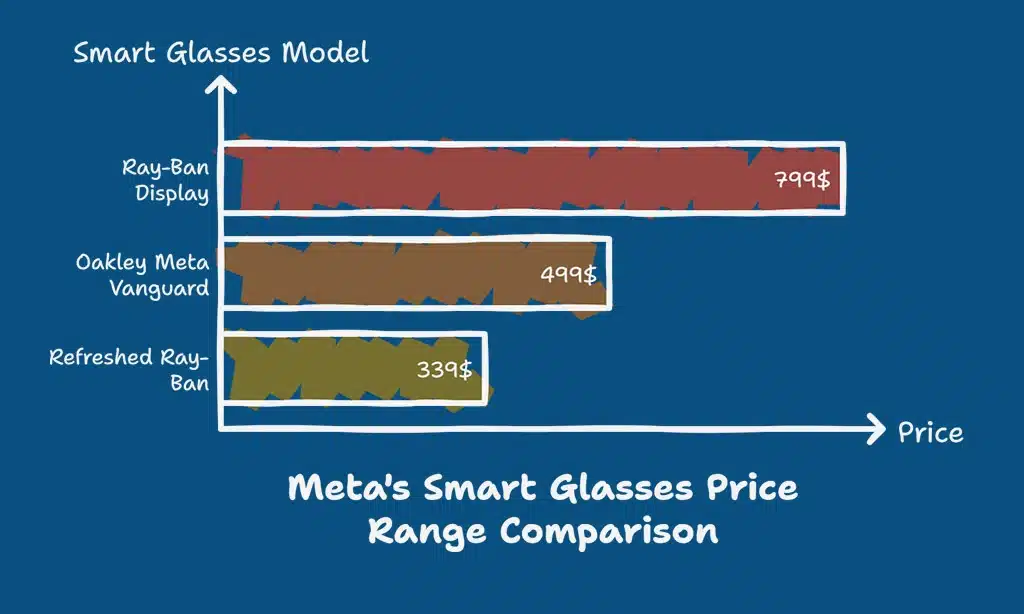
Meta has expanded its smart glasses portfolio from a single Ray-Ban product in 2023 to four distinct models in 2025, covering different price ranges and user needs. The updated line includes:
-
Ray-Ban Display with in-lens AR features ($799).
-
Oakley Meta Vanguard designed for sport ($499).
-
Refreshed Ray-Ban camera-and-audio glasses, priced between $299 and $379, with improved cameras, microphones, and battery life.
This diversification reflects Meta’s strategy to establish itself as the market leader in wearable AI technology, while gradually introducing more advanced AR functions to mainstream consumers.
Horizon Worlds: A Stronger Platform for Creators
Beyond hardware, Meta introduced significant software upgrades to its Horizon Worlds ecosystem, focusing on creator empowerment and accessibility.
Key upgrades include:
-
A new game engine that enhances graphics rendering, providing more realistic lighting, animation, and textures.
-
The launch of the Meta Horizon Studio, a creation platform with built-in generative AI tools. Creators can use text prompts to automatically generate 3D objects, surface textures, environmental skyboxes, or background music.
-
An integrated AI assistant that interacts with creators in natural language, making it possible to edit environments, adjust non-playable character behavior, or modify gameplay logic in real time.
-
Generative avatar tools that allow for the creation of custom clothing and accessories, which can also be monetized within Horizon Worlds.
The aim is to lower barriers for developers and hobbyists, cutting down the time required to build detailed environments from weeks to hours.
Hyperscape Capture: Turning Real Rooms Into Virtual Spaces
Meta also pushed forward its Hyperscape Capture technology, now entering public beta. The system enables users to scan a real-world room with a Quest 3 or Quest 3S headset and generate a photorealistic VR replica.
At launch, users can explore these recreated spaces individually, but support for multi-user visits through private links is scheduled for later in the year. Early demonstrations, such as a digital version of Gordon Ramsay’s kitchen, show the technology’s potential for education, entertainment, and collaborative work.
Meta envisions Hyperscape as a practical gateway into the metaverse, making virtual experiences more relatable by starting with spaces users already know.
Meta’s Long-Term Vision: AI as Everyday Superintelligence
At the center of all these announcements is Meta’s belief that AI-powered wearables will become the next major computing platform. The company is positioning smart glasses as the primary interface for ambient AI, combining visual input, real-time translation, contextual search, and assistant-driven support.
This vision aims to move beyond smartphones and bulky headsets toward technology that is lightweight, fashionable, and useful throughout the day. The Ray-Ban Display and Neural Wristband demonstrate early progress, though limitations in display brightness, software maturity, and mainstream adoption remain.
Meta frames this as progress toward “personal superintelligence”—a computing environment where AI seamlessly assists without breaking immersion in the real world.
Market Context and Challenges
While the announcements drew attention, analysts have noted several challenges Meta must address:
-
Pricing and accessibility: At $799, the Ray-Ban Display is a premium product. Lower-cost models may be key to driving mass adoption.
-
Battery limitations: Six hours of use remains below what many consumers expect from an all-day wearable.
-
Privacy and data security: Always-on cameras and microphones raise concerns about surveillance, requiring clear transparency and strong safeguards.
-
Competition: Rivals such as Apple (Vision Pro line), Google (revived AR projects), and Snap are pursuing similar strategies in the wearable space.
Despite these obstacles, Meta’s multi-device approach positions it to remain at the forefront of wearable AI innovation.
Pricing, Availability, and Release Timeline
-
Ray-Ban Display: $799, shipping in the U.S. from September 30, 2025.
-
Oakley Meta Vanguard: $499, launching October 21, 2025 in the U.S. and Canada.
-
Updated Ray-Ban models: $299–$379, available now in select markets.
-
Hyperscape Capture (Beta): Available starting September 2025 for Quest 3 and Quest 3S owners in the U.S., with expanded features rolling out in 2026.
-
Horizon Engine and Horizon Studio: Gradual rollout to creators in the U.S., UK, and Canada, with additional markets to follow.
Building Toward Everyday AI Wearables
Meta Connect 2025 marked one of the company’s most ambitious showcases to date. By combining hardware innovations like display-enabled glasses, creative platforms powered by generative AI, and real-world VR scanning tools, Meta is shaping a future where AI and AR become part of daily life.
The announcements highlight rapid progress: in just two years, Meta’s smart glasses line has grown from a niche accessory into a diverse family of products. Whether this momentum translates into widespread adoption will depend on balancing price, practicality, and privacy.
Still, the conference made clear that Meta intends to keep smart glasses, AI, and immersive platforms at the core of its business, positioning itself as a leader in the next era of personal computing.