Modern life looks connected, productive, and fast. Yet behind the screens and busy schedules, many people feel exhausted, anxious, and emotionally drained. Burnout, chronic stress, and low mood have quietly become part of the daily routine for millions of people. The problem is not only that we feel this way. It’s that we often don’t realise how our own habits are quietly harming our mental wellness.
Mental wellness is not just the absence of a diagnosed mental illness. It’s the ability to think clearly, manage emotions, cope with normal stress, maintain healthy relationships, and feel a sense of purpose. When everyday habits work against these foundations, even strong and high-functioning people start to crack.
In this article, we’ll walk through 9 common mental wellness mistakes to avoid—and what to do instead. You’ll recognise many of these patterns in your own life or in people around you. The goal is not to feel guilty, but to gain awareness and build healthier, more sustainable mental health habits.
What Is Mental Wellness, Really?

Mental wellness often gets confused with “feeling happy all the time”. In reality, it’s much deeper and more practical.
You can think of mental wellness as your day-to-day capacity to:
- Understand and manage your emotions
- Stay focused enough to work, study, or make decisions
- Handle stress without feeling constantly overwhelmed
- Maintain healthy relationships
- Feel that your life has some direction or meaning
It exists on a continuum. On one end, you may feel energetic, focused, and emotionally stable. In the middle, you might be coping but tired and easily irritated. At the other end, you may feel so overwhelmed that normal tasks feel impossible.
Small, repeated “mental health mistakes” push us slowly down this continuum—from thriving to surviving to struggling. The good news: the same small daily choices can pull us back towards balance and resilience.
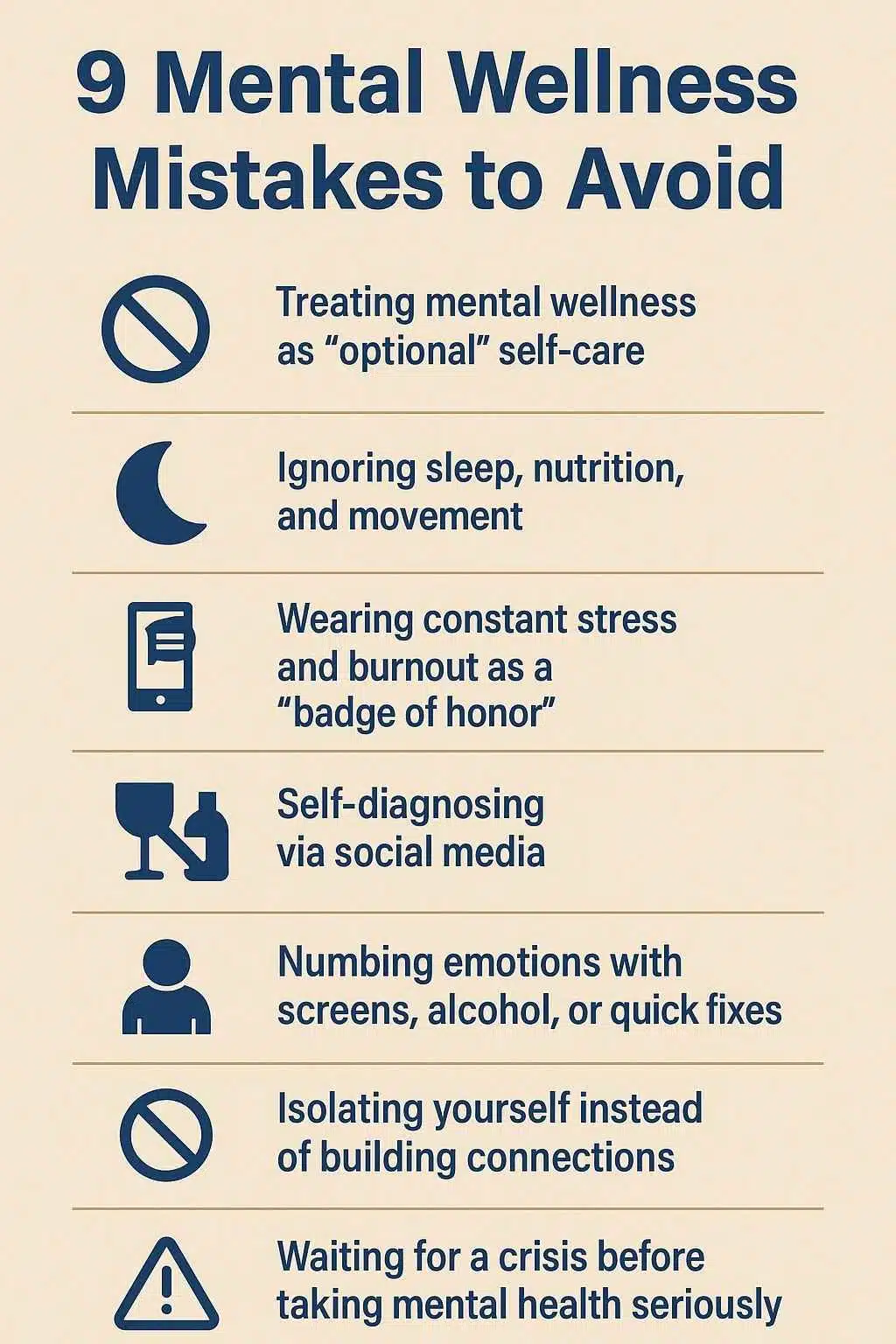
At a Glance: 9 Common Mental Wellness Mistakes
Here is a quick overview of the mental wellness mistakes to avoid:
- Treating mental wellness as optional self-care, not daily health
- Ignoring sleep, nutrition, and movement
- Wearing constant stress and burnout as a badge of honour
- Self-diagnosing via social media instead of seeking proper help
- Numbing emotions with screens, alcohol, or quick fixes
- Isolating yourself instead of building supportive connections
- Living without boundaries at work and at home
- Waiting for a crisis before taking mental health seriously
- Treating mental wellness as a solo project
Let’s look at each one in detail—and how to replace these mental health mistakes with realistic, healthier habits.
1. Treating Mental Wellness as “Optional” Self-Care
Many people think of mental wellness as something “extra”:
- A face mask on the weekend
- A spa day once a year
- A long vacation that never really comes
In this model, self-care is what you do after you are already burnt out.
How it looks in real life
You push through long days, tell yourself you “don’t have time” to rest, and only slow down when you reach a breaking point. Mental wellness shows up on your calendar only when everything else is done.
Why does it harm your mental health
When mental wellness is treated as optional, stress quietly builds. Over time, this affects mood, concentration, sleep, relationships, and physical health. It’s like skipping basic maintenance on a car and only visiting the mechanic when the engine fails.
A healthier habit instead
Treat mental wellness like brushing your teeth: non-negotiable daily hygiene, not a luxury.
- Add small “mind breaks” to your day—2–5 minutes of deep breathing or stretching
- Check in with your mood once or twice a day
- Protect at least one simple daily habit that supports your emotional wellbeing (a walk, journaling, quiet tea, prayer, or reflection)
When mental wellness becomes part of your normal routine, it stops being a crisis-only issue.
2. Ignoring Sleep, Nutrition, and Movement
One of the biggest mental health mistakes is focusing only on thoughts and emotions, while ignoring the body that carries them.
How it looks in real life
You try affirmations and productivity hacks, but:
- Sleep is irregular
- Meals are rushed or skipped
- Physical activity is rare
You blame your mind for being “weak” or “lazy”, when in reality your body is simply running on empty.
Why does it harm your mental health
Sleep, food, and movement directly influence mood, focus, memory, and stress levels. Poor sleep alone can increase irritability, anxiety, and difficulty concentrating. Skipping meals or relying on ultra-processed food swings your energy and mood. A sedentary lifestyle reduces resilience and can increase feelings of depression.
A healthier habit instead
You don’t need a perfect wellness routine.
You need a basic, realistic foundation:
- Aim for a consistent sleep window as often as you can
- Focus on regular meals with some whole foods, not strict diets
- Include gentle movement most days—walking, stretching, light exercise
Think of these as core mental wellness habits, not just physical health choices.
3. Wearing Constant Stress and Burnout as a Badge of Honour
“Busy” has become a status symbol. Many people feel proud of being overworked, as if exhaustion proves their value.
How it looks in real life
You:
- Work late most nights
- Feel guilty resting
- Joke about burnout as if it’s normal
- Say “I’ll slow down after this project” every month
Stress becomes your default state.
Why does it harm your mental health
Chronic stress keeps your body in a constant “fight or flight” mode. Over time, this affects sleep, digestion, immunity, hormones, and brain function. Emotionally, it shows up as irritability, numbness, anxiety, and eventually burnout.
When burnout appears, even simple tasks feel impossible. You’re not “weak”; your system is overloaded.
A healthier habit instead
Redefine productivity to include recovery:
- Add micro-breaks: a few minutes of walking away from your desk, looking out of a window, or breathing deeply
- Plan work in realistic blocks instead of endless to-do lists
- Honour rest as part of success, not a reward for it
Seeing burnout warning signs (constant exhaustion, loss of motivation, cynicism) as red flags—rather than proof you are “working hard”—can protect your long-term mental health.
4. Self-Diagnosing via Social Media
Social media has brought mental health conversations into the mainstream. That’s positive. But it’s also created a new risk: self-diagnosing based on short videos and posts.
How it looks in real life
You watch content about ADHD, anxiety, depression, OCD, or trauma. Suddenly, every behaviour seems like a symptom. Friends label themselves using clinical terms after one viral video. Some never seek professional guidance; others panic over labels that may not fit.
Why does it harm your mental health
Self-diagnosis can:
- Increase anxiety and fear
- Lead you to underestimate serious conditions
- Make you miss other medical or psychological issues
- Push you into unsuitable self-treatment
Short-form content cannot replace a comprehensive mental health assessment. It offers awareness, not diagnosis.
A healthier habit instead
Use mental health content online as a starting point for reflection, not a final answer.
- Notice what resonates, then track your experiences over time
- If symptoms persist or interfere with daily life, consult a professional
- Treat diagnostic labels with respect—they are tools, not trends
You deserve more than a 30-second explanation of your inner world.
5. Numbing Emotions with Screens, Alcohol, or Quick Fixes
Everyone wants relief from pain. The problem starts when relief becomes escape.
How it looks in real life
After a hard day, you:
- Scroll for hours on your phone
- Binge-watch series until late at night
- Overeat, smoke, or drink to “take the edge off.”
- Tell yourself, “I just don’t want to think anymore.”
These behaviours provide temporary comfort, but the underlying stress or sadness remains unresolved.
Why does it harm your mental health
Numbing emotions prevents your brain from processing them.
Over time:
- Stress becomes chronic
- Mood becomes unstable
- Sleep quality drops
- You may develop unhealthy dependencies
What starts as innocent coping can quietly become harmful.
A healthier habit instead
You don’t have to eliminate enjoyable activities. The key is intentional use.
- Set gentle limits: for example, one episode instead of a full season
- Try to name your feelings before numbing them: “I feel lonely”, “I feel nervous.”
- Replace some numbing behaviours with processing behaviours: journaling, talking to someone, walking, creative work, or simple stretching
The goal is not to remove comfort, but to add conscious coping.
6. Isolating Yourself Instead of Building Connections
One of the biggest mental wellness mistakes to avoid is pulling away from others when you need them most.
How it looks in real life
When you feel low or stressed, you:
- Stop replying to messages
- Cancel plans at the last minute
- Tell yourself you don’t want to “burden” anyone
- Stay alone with overthinking and self-criticism
Isolation can feel safe in the short term, but it often deepens sadness and anxiety.
Why does it harm your mental health
Humans are social creatures.
Supportive relationships can:
- Reduce stress
- Improve emotional resilience
- Provide perspective when your thoughts feel heavy
- Remind you that you are not alone
Isolation removes one of the strongest protective factors in mental health: connection.
A healthier habit instead
You don’t need a huge social circle. A few safe connections matter more than many shallow ones.
- Choose one or two people you trust and stay in touch, even briefly
- Send a short message instead of waiting for “the right moment.”
- Be honest in small steps: “I’ve been stressed lately”, “I’m not okay, but I’m glad we’re talking.”
Connection is not about being cheerful; it’s about being real with someone who cares.
7. Living Without Boundaries at Work and at Home
In a world of smartphones and remote work, boundaries can vanish quietly.
How it looks in real life
You:
- Reply to work messages late at night
- Say yes to every request
- Feel responsible for everyone else’s emotions
- Have no clear line between “work time” and “personal time.”
Over time, you lose the sense of where you end, and others begin.
Why does it harm your mental health
Lack of boundaries leads to:
- Chronic stress and exhaustion
- Resentment and frustration
- Reduced self-respect and self-trust
- Higher risk of burnout
When you never protect your own needs, your mental wellness erodes in the background.
A healthier habit instead
Healthy boundaries are not selfish; they are essential.
- Define your “off” hours and stick to them when possible
- Practise saying “no” in low-risk situations
- Protect small non-negotiables: sleep, meals, time with loved ones, hobbies
- Communicate your limits calmly instead of waiting until anger explodes
Work-life balance and mental health are deeply connected. Clear boundaries protect both.
8. Waiting for a Crisis Before Taking Mental Health Seriously
Many people treat mental health like a fire alarm: only relevant when the building is already burning.
How it looks in real life
You:
- Ignore ongoing symptoms—low mood, worry, fatigue
- Tell yourself “it’s just a phase” for months or years
- Seek help only when you can’t function, or when a relationship or job collapses
By then, you may need more intensive support and a longer recovery period.
Why does it harm your mental health
Like physical health, mental health responds better to early intervention.
When you wait for a crisis, you:
- Suffer longer than necessary
- Increase the risk of complications (for example, substance use to cope)
- Make recovery slower and more complex
A healthier habit instead
Treat early warning signs with respect, not denial.
- Watch for patterns: constant exhaustion, persistent sadness, ongoing anxiety, loss of interest in usual activities
- Take small, proactive steps: improving sleep, adjusting workload, talking to someone you trust
- Consider consulting a professional earlier, not later
Caring for your mental wellness early is a sign of strength, not weakness.
9. Treating Mental Wellness as a Solo Project
Another silent mistake: believing you must “fix” yourself alone.
How it looks in real life
You:
- Keep everything inside
- Avoid asking for help out of pride or fear
- Believe that strong people never struggle
- Assume others won’t understand
This mindset often comes from stigma, upbringing, or cultural messages about mental health.
Why does it harm your mental health
When you face every struggle alone:
- Problems feel bigger than they are
- You lose access to support and perspective
- Shame and secrecy grow, making it harder to reach out
Mental wellness is personal, but it is not purely individual.
A healthier habit instead
See mental wellness as a shared responsibility:
- Reach out to friends or family when you’re going through a hard time
- Consider peer support groups, community circles, or faith communities
- Use mental wellness apps, books, or courses as additional support tools
- Seek professional help when self-help is not enough
You are the main driver of your mental health journey, but you don’t have to travel alone.
How to Start Fixing These Mental Wellness Mistakes Today
You don’t need to change everything at once. In fact, trying to overhaul your entire life in a week is another hidden mental health mistake.
Here’s a simple, practical way to begin.
1. Do a quick self-audit
Look at the nine mental wellness mistakes and ask:
- Which three describe me most accurately right now?
- Which one is causing the most damage to my daily life?
Be honest but gentle. Awareness is the first step.
2. Choose one habit to work on this week
Pick only one area to change first.
For example:
- Going to bed 30 minutes earlier
- Taking a 10-minute walk after lunch
- Saying no to one non-essential request
- Limiting late-night scrolling
Small, specific actions are more powerful than huge, vague goals.
3. Create a simple daily mental wellness checklist
Keep it short and realistic.
For example:
- Slept at least X hours
- Moved my body in some way
- Connected with at least one person
- Took a 5-minute break just for myself
- Ate at least one nourishing meal
You can adjust the items to match your life, but seeing them written helps you stay accountable.
4. Use tools wisely
If you like structure, you can use planners, mood-tracking apps, or simple notes on your phone. The goal is to support your mental health habits, not obsess over them.
5. Decide in advance when you’ll seek extra help
Write down your personal red flags.
For example:
- “If I feel this low for more than two weeks, I will talk to a professional.”
- “If my work or relationships start to suffer, I will reach out for help.”
This removes guesswork later, when you may feel too overwhelmed to decide.
When to Seek Professional Help
Self-help strategies and lifestyle changes are valuable, but they are not always enough.
Consider seeking professional help if you notice any of these:
- Persistent sadness, emptiness, or anxiety that lasts for weeks
- Loss of interest in activities you used to enjoy
- Sleep problems that don’t improve (too much or too little)
- Strong feelings of hopelessness or worthlessness
- Thoughts of self-harm or of not wanting to live
- Heavy use of alcohol, drugs, or other behaviours to cope
- Difficulty functioning at work, school, or home
If you are in immediate danger or having thoughts of harming yourself or others, treat it as an emergency. Contact local emergency services or crisis support in your country. You do not have to go through a crisis alone.
FAQs About Mental Wellness Mistakes
Can small daily changes really improve my mental wellness?
Yes. Mental wellness is built from small, repeated behaviours. Better sleep, simple movement, short breaks, and honest conversations can noticeably improve your mood and resilience over time.
How long does it take to feel a difference?
Everyone is different, but some people report feeling slightly better within a few days of improving sleep, food, and movement. Bigger changes in mood and stress levels may take weeks or months. Consistency matters more than speed.
Are mental wellness apps enough on their own?
Apps can support awareness and routine, especially for tracking mood, practising breathing exercises, or building habits. However, they are not a substitute for therapy or medical care when symptoms are strong or long-lasting.
What if my family or workplace doesn’t support mental health conversations?
Start by protecting your own boundaries and habits quietly. Seek support from friends, online communities, or professionals if your immediate environment is not understanding. One supportive person can make a big difference.
Is feeling stressed every day just part of modern life?
Stress is normal. Constant, intense stress is not. You may not be able to change every external pressure, but you can adjust how you respond, set limits, and seek support when needed. Chronic stress should be treated as a health issue, not a personality trait.
Final Thoughts: Protecting Your Mental Wellness in a High-Pressure World
Life is not getting slower. Information, expectations, and responsibilities keep growing. That’s exactly why it is so important to recognise and avoid common mental wellness mistakes.
You don’t need a perfect routine or flawless self-discipline. You need awareness, small daily choices, and a willingness to ask for help when life feels heavy.
If you remember only three things from this article, let them be these:
- Mental wellness is daily health, not a luxury.
- Small, consistent habits beat dramatic, short-term changes.
- You don’t have to navigate your mental health journey alone.
Choose one mistake to work on today. Protecting your mental wellness is not selfish—it is one of the most responsible things you can do for yourself and for the people who rely on you.