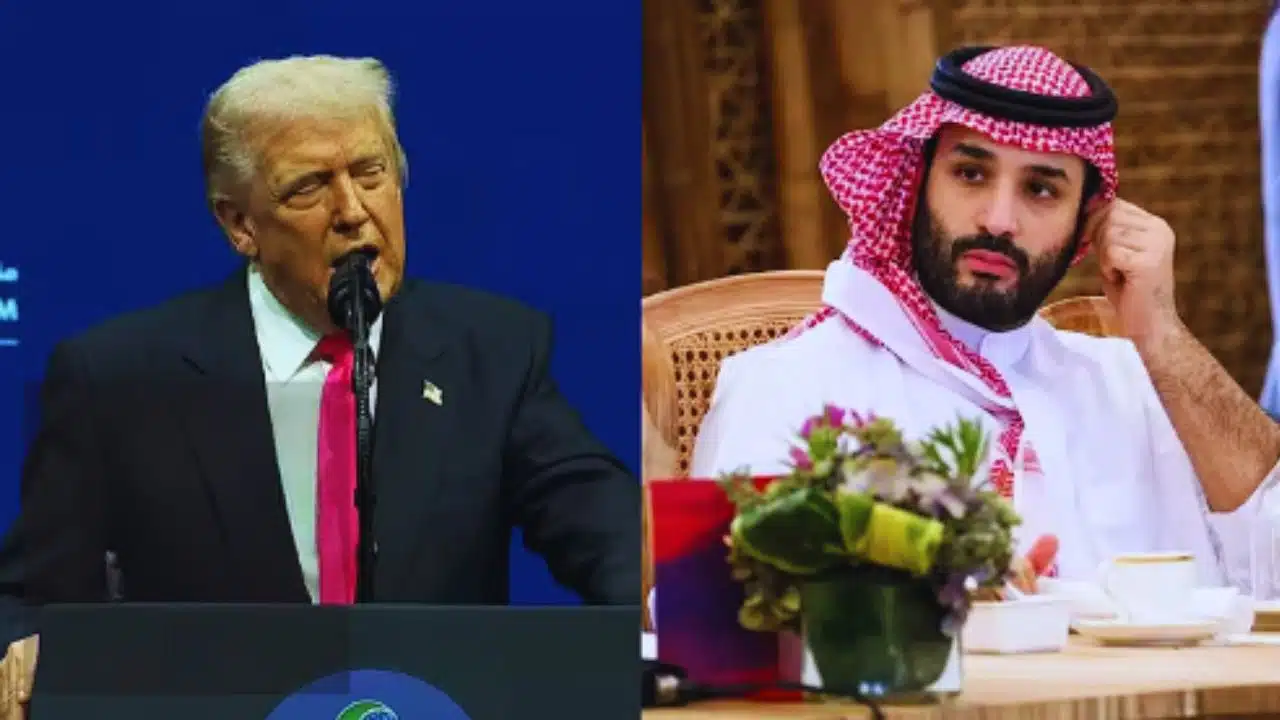
President Donald Trump has formally designated Saudi Arabia as a Major Non-NATO Ally (MNNA), a significant diplomatic upgrade announced during a lavish White House dinner on Tuesday evening. This decision comes alongside Saudi Crown Prince Mohammed bin Salman’s commitment to invest nearly $1 trillion in the United States over the coming years, marking a pivotal moment in bilateral relations strained by past events like the 9/11 attacks and the 2018 killing of journalist Jamal Khashoggi. The move aligns with Trump’s “America First” agenda, aiming to bolster US economic growth, create jobs, and enhance security cooperation in the Middle East by drawing Riyadh deeper into the American orbit. By elevating Saudi Arabia to this status, the US is signaling a strategic reset, treating the kingdom on par with longstanding allies like Israel, which could reshape regional power dynamics and influence global investment flows.
The announcement highlights a blend of high-stakes diplomacy and celebrity glamour, as Trump and the crown prince leveraged star power to underscore their warming ties. Elon Musk, the tech mogul behind Tesla and SpaceX, was among the prominent guests, while Prince Salman personally invited soccer icon Cristiano Ronaldo, turning the event into a media spectacle that captured worldwide attention. This personal outreach builds on Trump’s history of using informal, high-profile meetings to forge deals, as seen during his first term when he visited Riyadh in 2017 to launch a $110 billion arms package. Now, with Trump back in office, the partnership is expanding into new frontiers like artificial intelligence and renewable energy, reflecting Saudi Arabia’s Vision 2030 reforms under the crown prince to diversify beyond oil.
Understanding the Major Non-NATO Ally Designation
The Major Non-NATO Ally status is a prestigious US foreign policy tool established under the 1987 Arms Export Control Act, designed to reward strategic partners outside the North Atlantic Treaty Organization with enhanced military and economic perks without the full obligations of a defense pact. As of 2025, 19 countries hold this designation, including Israel (since 1987), Jordan, Kuwait, Qatar, Egypt, Pakistan, Brazil, Kenya, Tunisia, and others like Australia, Japan, and South Korea, which joined in 1987 and 2022 respectively. For Saudi Arabia, becoming the 20th MNNA represents a “powerful symbol” of deep friendship and respect, as described by the State Department, but it also carries practical implications that could transform US-Saudi collaboration.
At its core, the status grants priority access to US defense articles and services, allowing Saudi Arabia to bypass some export licensing hurdles that non-allies face, which streamlines arms sales and technology transfers. This includes eligibility for cooperative research and development on defense projects, where costs are shared between the US Department of Defense and the partner nation, fostering innovations in areas like cybersecurity and unmanned systems. Saudi Arabia can now stockpile US war reserve materials on its territory—outside of American bases—for rapid deployment in regional crises, a benefit that has proven vital for allies like Israel during conflicts. Additionally, the designation permits priority delivery of excess Department of Defense supplies, from basic rations and vehicles to advanced naval vessels, ensuring quicker support in times of need.
Economically, MNNA status opens doors to financing through the Foreign Military Sales program and eases operations for US defense contractors within the kingdom, including tax incentives and regulatory simplifications. For Saudi Arabia, this means accelerated access to civil nuclear technology for peaceful energy production, joint ventures in critical minerals like lithium and rare earths essential for batteries and electronics, and collaborations in emerging fields such as artificial intelligence and quantum computing. Trump emphasized during the dinner that these privileges would “leap forward” military ties, specifically enabling sales of the F-35 Lightning II stealth fighter jets—a deal valued at billions and previously restricted to preserve Israel’s qualitative military edge in the region. Critics, however, warn that arming Saudi Arabia more robustly could exacerbate humanitarian issues, such as its ongoing involvement in Yemen, where US-supplied weapons have been linked to civilian casualties.
This designation also addresses historical tensions, rehabilitating Saudi Arabia’s image in Washington after the 9/11 attacks—in which 15 of the 19 hijackers were Saudi nationals—and the Khashoggi murder, which US intelligence attributed to the crown prince’s direct approval. Trump downplayed these issues at the event, dismissing questions about Khashoggi by saying, “a lot of people didn’t like that gentleman,” a stance that drew sharp rebukes from progressive lawmakers like Rep. Ilhan Omar and Sen. Bernie Sanders, who called it a “disgusting display” prioritizing arms profits over human rights. Despite the controversy, the move underscores Saudi reforms, including women’s rights advancements and anti-corruption drives, which the crown prince has used to court Western investment.
The Lavish White House Dinner and Star-Studded Guest List
The black-tie dinner in the White House East Room was a glittering affair, honoring Crown Prince Mohammed bin Salman and attended by over 140 elite guests from technology, finance, sports, and politics, blending deal-making with diplomatic theater. The evening began with a ceremonial welcome, complete with a military flyover and horseback parade, setting a tone of pomp and circumstance reminiscent of Trump’s first-term summits. Trump, in his opening remarks, described the gathering as a celebration of “unbelievable dignitaries” and extended a personal welcome to the crown prince, breaking Saudi royal protocol with repeated handshakes and shoulder pats that highlighted their growing rapport.
Tech titans dominated the invite list, reflecting the summit’s focus on innovation-driven investments. Nvidia CEO Jensen Huang, whose company leads in AI chips, discussed potential partnerships in semiconductors; OpenAI President Greg Brockman explored AI ethics and deployment in the Gulf; Apple CEO Tim Cook addressed supply chain resilience; IBM CEO Arvind Krishna highlighted quantum computing; Dell CEO Michael Dell focused on data centers; and Coinbase CEO Brian Armstrong touched on cryptocurrency regulations. Finance leaders included Citigroup CEO Jane Fraser, who oversees global banking ties; hedge fund manager Bill Ackman of Pershing Square Capital Management, known for activist investing; and Blackstone CEO Stephen Schwarzman, whose firm manages trillions and has deep Saudi connections through prior deals. Elon Musk’s attendance was particularly notable, as he mingled with Ronaldo and even joined a viral selfie with Trump, the crown prince, and FIFA President Gianni Infantino, symbolizing the intersection of tech innovation and global sports.
Cristiano Ronaldo’s presence, arranged by Prince Salman, added a layer of soft power, appealing to younger demographics and sports enthusiasts worldwide. The Al-Nassr forward, who plays in Saudi Arabia’s top league, thanked Trump on Instagram for the invitation, posting photos where Trump introduced him to his son Barron, an avid soccer fan who reportedly lit up at the meeting. Dressed in his traditional dishdasha robe and ghutra headscarf secured by an egal cord, the crown prince injected humor into the proceedings, joking that those betting on him wearing a Western suit would “lose money,” which elicited laughs and eased the formal atmosphere. The crown prince’s remarks praised the “bigger and wider” economic horizons, noting newly signed agreements to deepen ties across sectors. This event not only sealed the MNNA announcement but also served as a platform for side deals, including preliminary talks on AI data centers and green hydrogen projects.
The $1 Trillion Investment Pledge and Accompanying Economic Deals
At the heart of the partnership is Saudi Arabia’s ambitious pledge to invest up to $1 trillion in the US over the next decade, a figure that doubles the $600 billion commitment from Trump’s May 2025 visit to Riyadh and is spearheaded by the kingdom’s Public Investment Fund (PIF). The White House fact sheet portrays this as a cornerstone of the “America First” strategy, projecting it to generate hundreds of thousands of jobs in manufacturing, energy, and tech while replenishing US treasuries through procurement and direct capital inflows. PIF, managing over $1 trillion in assets as one of the world’s largest sovereign wealth funds, has already invested about $170 billion in the US since 2017, supporting 172,000 jobs in states like California and Texas through stakes in companies like Uber, Lucid Motors, and data center projects.
The investment package encompasses a broad Strategic Defense Agreement that includes Saudi contributions to offset US military expenses in the Gulf, such as basing costs for American troops. In exchange, the US will supply nearly 300 Abrams tanks, enhancing Saudi ground forces, alongside training programs to integrate these assets with American systems for better interoperability. Beyond hardware, the deals extend to non-defense sectors: civil nuclear cooperation for small modular reactors to power desalination and cities; joint extraction of critical minerals from Saudi deposits to secure supply chains for electric vehicles; and AI initiatives, including PIF funding for US startups in machine learning and autonomous systems. Trump hailed these as “historic,” noting they build on Vision 2030 by channeling Saudi petrodollars into American innovation, potentially including a massive data center hub in the kingdom powered by US tech.
Skeptics, however, question the feasibility of the $1 trillion figure, pointing out that Saudi Arabia’s GDP stands at around $1.1 trillion, making the pledge equivalent to nearly the entire annual economic output and likely spread thinly over years. While PIF’s assets provide a buffer, experts like those at the Foundation for Defense of Democracies note that such commitments often face delays due to oil price volatility and domestic priorities. Nonetheless, the uptick from $600 billion demonstrates momentum, with immediate actions like a $575 billion procurement deal for US goods in aviation, healthcare, and renewables already inked. This influx is expected to crimp Saudi commitments elsewhere, such as the recent hike from $10 billion to $100 billion in India for energy and infrastructure, as PIF reallocates to prioritize US ties.
Geopolitical Ripples Across the Middle East and Beyond
The US-Saudi clinch extends far beyond Washington and Riyadh, sending shockwaves through global alliances and rivalries. In the Middle East, approving F-35 sales to Saudi Arabia risks eroding Israel’s mandated “qualitative military edge,” a US policy since 1968 to ensure Jerusalem’s superiority against Arab states, potentially complicating normalization efforts despite shared MNNA status. The crown prince reiterated during talks that establishing a Palestinian state could accelerate Saudi-Israeli ties, echoing US goals but highlighting ongoing hurdles like the Gaza conflict. For Iran, the bolstered defense pact signals a harder US line, with Trump toning down de-escalation rhetoric and focusing on containing Tehran’s influence through Saudi-led coalitions.
Globally, the partnership dilutes China’s sway in the Gulf, a vital node in Beijing’s Belt and Road Initiative where Saudi Arabia has invested heavily in ports and railways. By integrating Riyadh—and fellow MNNA Pakistan—into the US defense ecosystem, Washington is countering Beijing’s economic inroads, as Saudi firms pivot toward American tech for 5G networks and smart cities. In South Asia, India faces recalibrated Saudi investments; while the $100 billion PIF pledge supports projects like the West Coast refinery, the US focus may delay expansions in renewables and tech, prompting New Delhi to diversify toward the UAE and Qatar. Europe, too, watches closely, as enhanced US-Saudi energy ties could stabilize oil markets but challenge EU human rights stances on arms exports.
Overall, this renewed alliance rehabilitates Saudi Arabia’s standing, fostering mutual prosperity amid shared threats like terrorism and great-power competition, though it invites scrutiny over ethics and long-term delivery. As Trump and bin Salman deepen their bond, the deals promise to redefine security architectures, with ripple effects felt from the Persian Gulf to Silicon Valley.