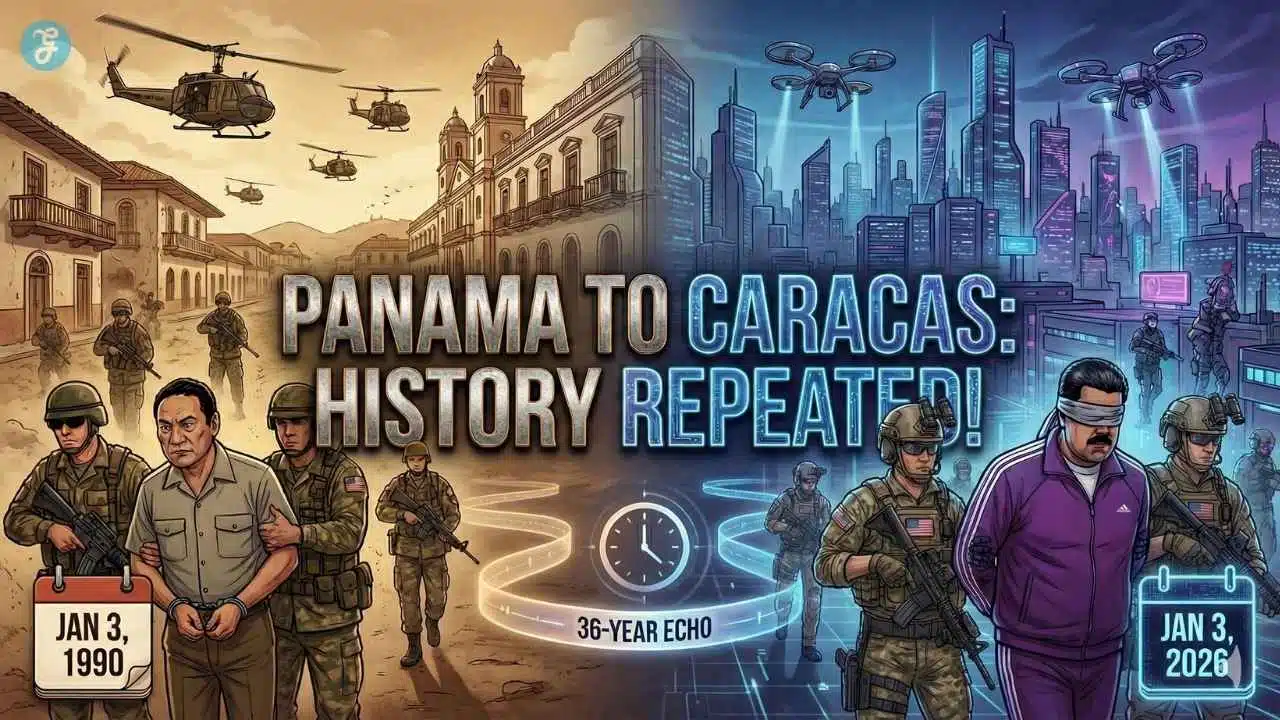
History does not just rhyme; sometimes, it keeps an exact calendar. On the humid night of January 3, 1990, a bizarre siege in Panama City came to an end. General Manuel Antonio Noriega, the military dictator of Panama, formerly clad in crisp uniforms adorned with unearned medals, walked out of the gates of the Vatican Embassy. He was wearing an ill-fitting t-shirt.
He surrendered to United States soldiers who had spent days blasting heavy metal music, Van Halen’s “Panama” and The Clash’s “I Fought the Law”, at the building to break his psychological resistance. He was cuffed, put on a helicopter, and flown to Florida to face drug trafficking charges. Exactly thirty-six years later, to the very day, January 3, 2026, the calendar struck again.
In the pre-dawn darkness of Caracas, Venezuela, the roar of American rotors replaced the rock music. There was no prolonged siege, no diplomatic standoff at an embassy. In a lightning-fast operation codenamed “Absolute Resolve,” elite US special operations forces breached the sanctuary of Venezuelan President Nicolás Maduro. Within an hour, the man who had defied Washington for over a decade was airborne, headed toward the same fate as Noriega: a federal courtroom on American soil.
The astonishing precision of the date, a span of exactly 13,149 days between the capture of two Latin American strongmen, begs us to look beyond mere coincidence. It forces a confrontation with a stark geopolitical reality that has simmered for decades and has now boiled over.
Key Takeaways
-
The 36-Year Echo: Maduro’s capture occurred exactly 36 years to the day after Noriega’s surrender, resurrecting the “Noriega Precedent.
-
Legal Loophole (Ker-Frisbie): The US utilized a Supreme Court doctrine that validates trials regardless of capture method, effectively bypassing diplomatic immunity.
-
Sledgehammer vs. Scalpel: The strategy evolved from mass invasion (Panama 89) to surgical cyber-warfare and elite extraction (Venezuela 26).
-
The “Donroe Doctrine”: US policy has shifted from “restoring democracy” to direct resource administration (“running the country”) to monetize oil assets.
-
The “Headless Beast”: Decapitating the regime leaves the cartel-embedded military (FANB) intact, creating a high risk of violent warlordism.
The Resurrection of Precedent
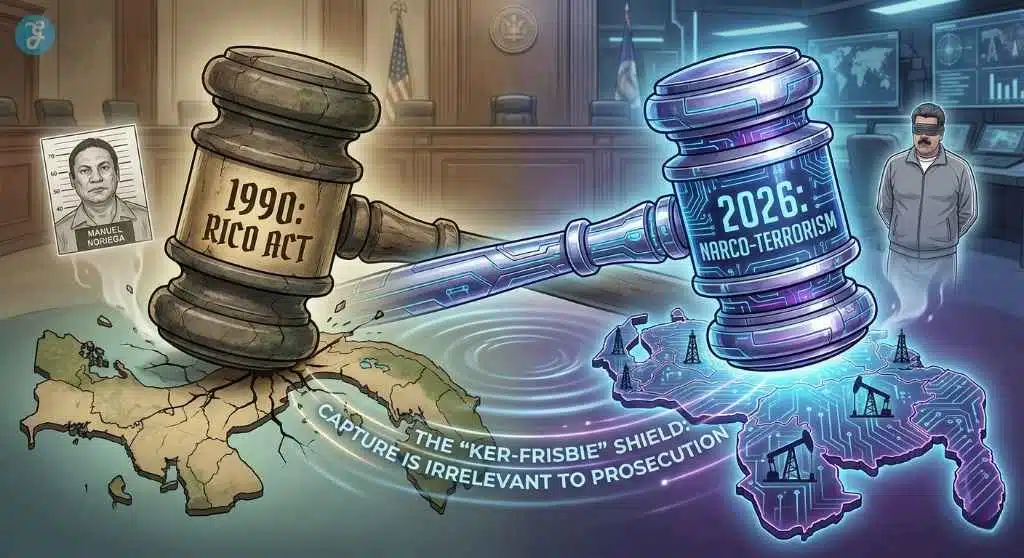
The capture of Maduro is not a novel event; it is a resurrection. It is the ultimate fulfillment of what can be called the “Noriega Precedent”, a legal and military doctrine that asserts the United States has the unilateral authority to strip foreign heads of state of their sovereign immunity by recasting them not as political leaders, but as common criminals running a racketeering enterprise.
Yet, while the justification, narcoterrorism, remains identical across three and a half decades, the American soul powering the machine has utterly transformed. In 1990, President George H.W. Bush framed the invasion of Panama as a moral crusade to “restore democracy” and protect the integrity of the Panama Canal treaties. It was an act of imperial stewardship, framed in the language of international order.
In 2026, the pretense of stewardship has vanished. President Trump’s declaration that the US will now “run the country” and monetize Venezuelan oil to pay for the operation heralds a darker, more transactional era. It is the debut of the “Donroe Doctrine”, an aggressive, mercenary update to the 19th-century Monroe Doctrine. Under this new framework, the Western Hemisphere is not merely an area of American protection, but a portfolio of American assets to be managed, seized, and liquidated if necessary.
The 36-year echo between Panama and Caracas is the sound of the post-Cold War diplomatic rulebook being shredded. It is a statement that, in the eyes of Washington, the line between a foreign president and a cartel boss is merely a matter of an indictment.
The Historical Parallel (The “Tale of the Tape”):
| Category | Panama (1990) | Venezuela (2026) |
| Target | Gen. Manuel Noriega | Pres. Nicolás Maduro |
| Capture Date | January 3, 1990 | January 3, 2026 |
| Operation Name | Operation Just Cause | Operation Absolute Resolve |
| Primary Charge | Drug Trafficking & Racketeering | Narco-Terrorism & Corruption |
| Capture Location | Vatican Embassy (Surrender) | Fuerte Tiuna (Extraction) |
| Status of Target | Former CIA Asset | Anti-American Antagonist |
The Pretext: Lawfare as the First Strike
Before the first paratrooper jumped over Panama, or the first stealth drone crossed into Venezuelan airspace, the war had already begun inside a quiet room in Florida. The most potent weapon in the modern American arsenal is not a missile; it is a grand jury indictment.
The strategy employed in both 1990 and 2026 is a form of “lawfare”, the use of legal systems to achieve military or geopolitical ends. The genius of this approach, from Washington’s perspective, is that it depoliticizes regime change. It transforms a complex diplomatic crisis involving national sovereignty into a simple “cops and robbers” narrative easily digested by the public.
The 1988 Miami Roadmap
In February 1988, two years before the invasion of Panama, federal grand juries in Miami and Tampa handed down indictments against General Manuel Noriega. The charges were stunning in their implications: they alleged that the de facto leader of a sovereign nation was functionally an employee of the Medellín drug cartel.
The Department of Justice (DOJ) utilized the Racketeer Influenced and Corrupt Organizations Act (RICO), a statute designed to take down Mafia families. The legal theory was audacious: the government of Panama was not a government at all, but a “continuing criminal enterprise.” US Attorney Leon Kellner famously declared at the time, “The General is not a diplomat; he is a drug lord.” By categorizing Noriega as a gangster, the US pre-emptively stripped him of the “Head of State” immunity guaranteed under international custom. A president cannot be arrested; a racketeer must be.
The 2020 New York Blueprint
The road to Maduro’s capture in 2026 was paved with the exact same legal stones. In March 2020—six years before Operation Absolute Resolve—the US Attorney for the Southern District of New York (SDNY) unsealed a superseding indictment against Nicolás Maduro and his inner circle.
The charges echoed history with eerie fidelity: narco-terrorism, corruption, and drug trafficking. The DOJ alleged that Maduro was the leader of the Cartel de los Soles (Cartel of the Suns), a drug-trafficking organization embedded within the Venezuelan military high command.
But the 2020 indictment added a modern, sinister twist geared toward the current American psyche. Attorney General William Barr explicitly stated that Maduro and his allies intended to “flood the United States with cocaine” to undermine the health and stability of the American people. It was framed not just as greed, but as asymmetric chemical warfare.
By the time the helicopters launched in 2026, the legal battlefield had been prepped for years. The “Noriega Precedent” had been dusted off and updated. The argument was simple: Maduro had forfeited his right to preside over Venezuela because he had turned the apparatus of the state into a weapon against the United States. The indictment was the permission slip for the invasion.
The Legal Shield: The “Ker-Frisbie” Doctrine
While the indictment provides the reason for the capture, a relatively obscure pair of Supreme Court rulings provides the shield. Legal scholars know it as the Ker-Frisbie Doctrine, and it will be the first line of defense for the Department of Justice when Maduro appears in the Southern District of New York.
The doctrine originates from two cases: Ker v. Illinois (1886) and Frisbie v. Collins (1952). In plain English, the Supreme Court held that the “power of a court to try a person for crime is not impaired by the fact that he had been brought within the court’s jurisdiction by reason of a ‘forcible abduction’.” In other words, it doesn’t matter how the police get you to the courtroom—whether by extradition treaty, trickery, or kidnapping—once you are in the chair, you can be tried.
This legal loophole is the secret engine of American extraterritorial power. It was the exact precedent used to deny Manuel Noriega’s motion to dismiss in 1990. Noriega’s defense team argued that the invasion of Panama was a violation of international law that should invalidate the trial. The judge, citing Ker-Frisbie, essentially shrugged. The court ruled that the manner of his capture was a diplomatic issue for the executive branch to solve, not a legal issue that affected his guilt.
By relying on this doctrine again in 2026, the US is sending a chilling message: International Law applies to diplomats; Domestic Law applies to defendants. And once the US military converts you from the former to the latter, the manner of your conversion becomes legally irrelevant.
The Operations: Sledgehammer vs. Scalpel
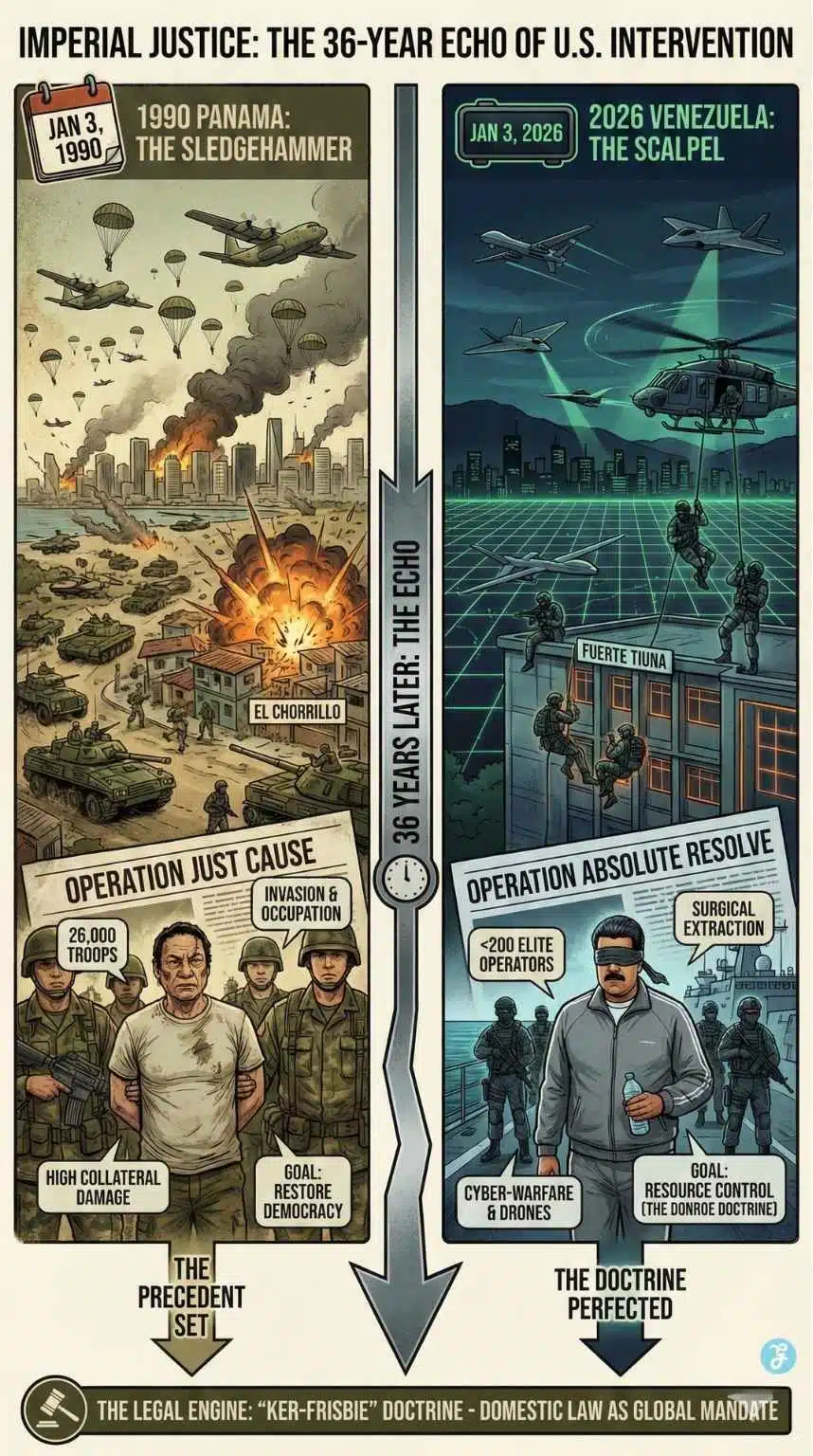
While the legal justifications mirror each other perfectly, the military applications of the Noriega Precedent show a dramatic evolution in American power and appetite for risk over 36 years.
1989: Operation Just Cause (The Sledgehammer)
When George H.W. Bush decided to execute the warrant on Noriega in December 1989, he used a sledgehammer. The Berlin Wall had fallen only a month prior; the Soviet Union was crumbling. The US needed to demonstrate that the end of the Cold War did not mean the end of American dominance.
Operation Just Cause was a massive, overwhelming invasion. Over 26,000 US troops—some already stationed in the Canal Zone, others parachuting in under fire—swarmed the small nation. It was the largest American combat operation since Vietnam.
The results were catastrophic for Panama’s infrastructure. The poor neighborhood of El Chorrillo, located next to Noriega’s headquarters, was incinerated during the initial assault, leaving thousands homeless and an unknown number of civilians dead. Estimates range from the official US count of roughly 200 up to several thousand according to human rights groups.
It was messy, loud, and destructive. The final act, the psychological siege of the Vatican Embassy with deafening rock music, was a bizarre spectacle that highlighted the brute-force nature of the era. The goal was not just to grab Noriega; it was to smash the Panamanian Defense Forces completely and remake the country.
2026: Operation Absolute Resolve (The Scalpel)
Thirty-six years later, the American public has zero appetite for massive ground invasions, nation-building, or high casualty counts, exhausted by decades of “forever wars” in the Middle East. President Trump understood that any action against Maduro had to be fast, deniable until it was over, and made for television.
Operation Absolute Resolve was a scalpel. Instead of 26,000 troops, it likely involved fewer than 200 elite operators from Tier 1 units like Delta Force and DEVGRU (SEAL Team 6), supported by massive air and cyber power.
According to initial reports, the operation began not with bombs, but with a cyber-blackout that blinded Venezuelan air defenses and crippled communication networks in Caracas. Swarms of autonomous drones likely confused remaining radar systems, creating a corridor for the insertion teams.
The raid on Maduro’s complex at Fuerte Tiuna was designed as a “decapitation strike.” The goal was extraction, not occupation. By the time the sun rose over Caracas, the primary target was gone, and US forces had retrograded back to naval vessels in the Caribbean.
The visual contrast completes the evolution. The enduring image of 1990 is Noriega, defeated and sweaty, surrendering after days of noise pollution. The enduring image of 2026 is the “proof of life” photo tweeted by the President: Maduro, blindfolded and zip-tied in a grey tracksuit aboard a US warship, hours after being asleep in his own bed. The message of the scalpel is perhaps more terrifying than the sledgehammer: no walls, no army, and no amount of distance can protect you if you are on the indictment list.
Tactical Evolution (Sledgehammer vs. Scalpel):
| Metric | Operation Just Cause (1989) | Operation Absolute Resolve (2026) |
| Strategy Style | “The Sledgehammer” (Massive Invasion) | “The Scalpel” (Surgical Raid) |
| Troop Levels | ~26,000 Conventional Troops | < 200 Elite Special Operators |
| Key Tactics | Paratrooper drops, urban combat, psychological siege (noise). | Cyber-blackout, drone swarms, night-vision extraction. |
| Collateral Damage | High (Entire neighborhoods destroyed). | Minimal (Targeted compound only). |
| Public Visibility | Weeks of televised ground war. | “Dark” operation; confirmed after fact. |
The Weaponization of Humiliation
The psychological dimension of modern warfare has evolved from the auditory to the visual. In 1990, the US military used noise, blasting heavy metal to break Noriega’s dignity, reducing a dictator to a man unable to sleep. In 2026, the weapon is the image.
The “proof of life” photo of Nicolás Maduro is a masterclass in the weaponization of humiliation. By showing him in a generic grey tracksuit, blindfolded and holding a plastic water bottle, the US stripped him of every symbol of authority.
There was no presidential sash, no uniform, no podium. The visual language communicated absolute dominance: This is not a President; this is a detainee.
This imagery serves a dual purpose. Domestically, it feeds the “tough on crime” narrative of the administration. Internationally, it shatters the aura of invincibility that authoritarian leaders cultivate. It tells the Venezuelan populace, and the world, that the “Revolution” ended not with a bang, but with a zip-tie. In the age of social media, destroying a leader’s meme-potential is as vital as destroying his radar systems. The grey tracksuit will likely become the defining historical symbol of the end of Chavismo.
The Strongmen: Parallel Lives
To understand why history repeated itself so precisely, we must look at the men at the center of the target reticles. Manuel Noriega and Nicolás Maduro were vastly different personalities facing different geopolitical landscapes, yet they shared a fatal flaw: hubris regarding their relationship with the United States.
Noriega: The “Useful Idiot”
Manuel Noriega was a creature of the Cold War’s dark underbelly. For decades, he was on the CIA payroll. He was Washington’s man in Panama, a vital conduit for intelligence on Cuba and a facilitator for US aid to the Contra rebels in Nicaragua. He allowed the US Southern Command to operate freely from Panama.
Noriega’s fatal error was believing that his utility as an intelligence asset bought him eternal immunity for his criminal sideline businesses. He believed he knew where too many of Washington’s bodies were buried to ever be taken down. He was wrong. When his brutality became too public, specifically the beheading of opposition figure Hugo Spadafora, and his drug running became a political liability for the Bush administration during the “War on Drugs” era, his CIA protection card expired. He never saw the pivot coming until the paratroopers were landing.
Maduro: The Survivor
Nicolás Maduro was never a US asset. He was the chosen heir of Hugo Chávez, inheriting the “Bolivarian Revolution” and its foundational anti-American stance. Unlike the charismatic Chávez, Maduro was a former bus driver lacking natural political talent. Yet, he proved to be an unexpected survivor. He weathered attempts at democratic uprising, a US-backed interim presidency (Juan Guaidó), crushing economic sanctions, hyperinflation that forced citizens to forage for food, and multiple coup attempts.
Maduro’s fatal error was miscalculating the protective power of a “multipolar world.” He mortgaged Venezuela’s oil assets to China and invited Russian military advisors and Iranian operatives into Caracas, believing these great-power patrons provided a nuclear umbrella against direct US intervention.
He failed to realize that in 2026, under the “Donroe Doctrine,” ideological alliances meant less to Washington than resource control. His Russian patrons were bogged down elsewhere, his Chinese patrons preferred economic leverage over military confrontation, and he was left exposed.
Both men believed international borders and the norms of sovereignty would protect them from US domestic law. Both discovered that for the superpower to the north, sovereignty is merely a suggestion.
The Aftermath: Democracy vs. Dominion
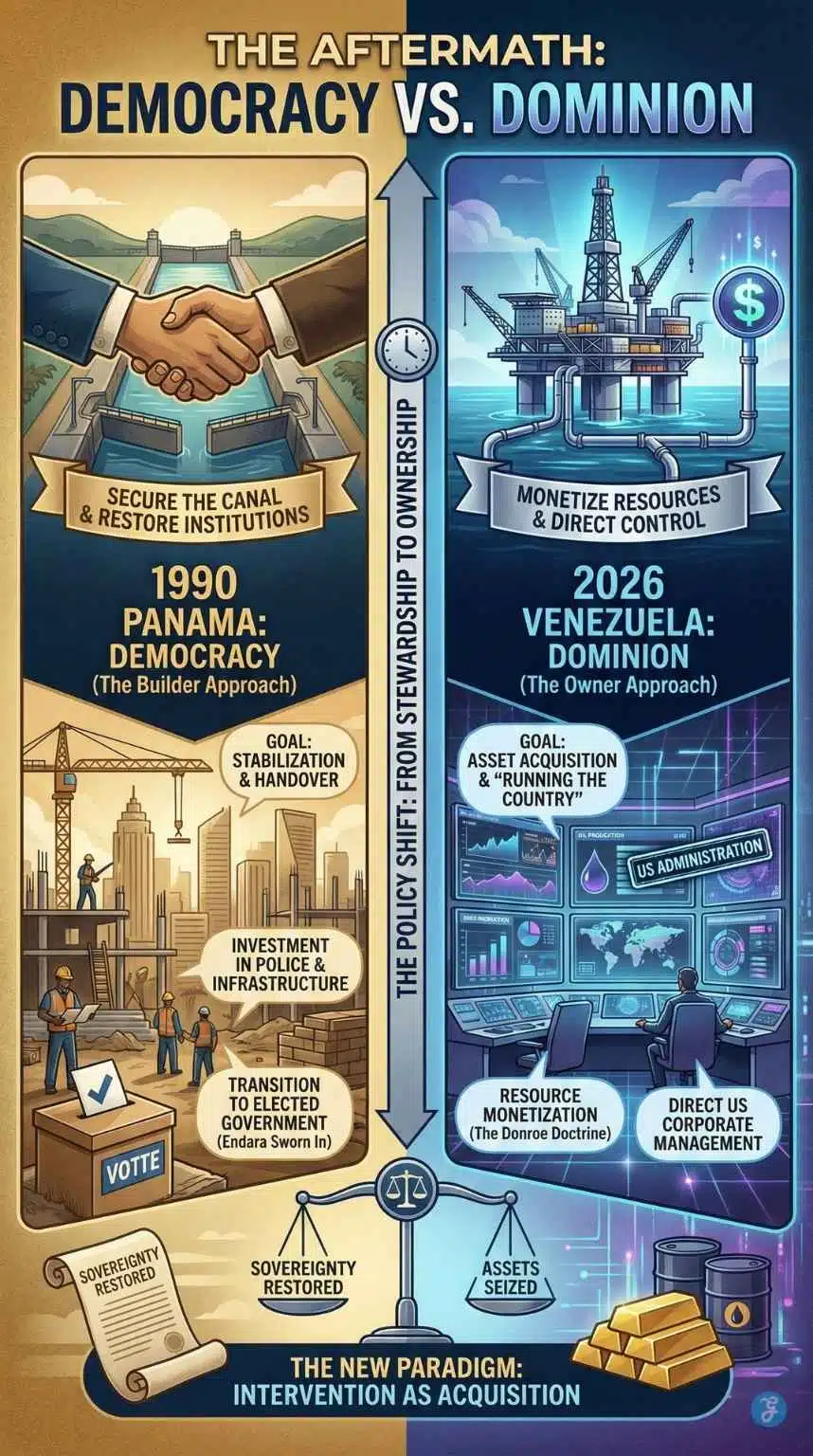
While the legal frameworks and targets bear striking similarities, the most disturbing divergence between 1990 and 2026 lies in the aftermath. The why has shifted fundamentally, signaling a change in America’s self-conception on the world stage.
1990: The “Builder” Approach
In the immediate aftermath of Operation Just Cause, the US focus was on stabilization and a quick transition to a friendly, legitimate government. Within hours of the invasion beginning, Guillermo Endara—who had legitimately won the presidential election months earlier, only to have Noriega annul the results—was sworn in as President on a US military base.
The Bush administration, despite the destruction caused by the invasion, poured resources into rebuilding the Panamanian police force and preparing the country for the eventual handover of the Panama Canal at the end of the decade. The rhetoric, and largely the policy, was focused on restoring democratic institutions and securing a strategic waterway for global commerce. It was an imperial action, certainly, but one cloaked in the mantle of responsibility.
2026: The “Owner” Approach (The Donroe Doctrine)
The aftermath of Operation Absolute Resolve presents a starkly different reality. There was no legitimately elected opposition leader waiting in the wings to be sworn in; the Venezuelan opposition had been fractured and exiled years prior.
Instead of talk of “restoring democracy,” President Trump’s address to the nation focused on acquisition. His blunt declaration that the US will “run the country” temporarily and his explicit mention of sending in US oil companies to “start making money” turn the operation into a hostile corporate takeover.
This is the “Donroe Doctrine” in action. It views the Monroe Doctrine’s assertion of US primacy in the hemisphere not merely as a defensive shield against foreign powers, but as an offensive deed of ownership.
Unlike Panama, whose primary asset was a canal that needed to remain open for everyone, Venezuela sits atop the largest proven oil reserves on the planet. The implication that Venezuelan resources will be used to directly reimburse the United States for the cost of the military operation introduces the concept of the “monetization of intervention.” It shifts the role of the US military from the self-proclaimed “Global Policeman” to something closer to a Global Repo Man—seizing assets to settle accounts defined by US courts.
The Doctrine Shift (Builder vs. Owner):
| Feature | Bush Doctrine (1990) | “Donroe Doctrine” (2026) |
| Stated Goal | “Restore Democracy” | “Run the Country” |
| Resource Policy | Protect the Canal (Open Access) | Monetize Oil (Direct Control) |
| Economic Model | Aid & Institution Building | Asset Seizure & Reimbursement |
| Immediate Outcome | Installed elected President (Endara) | US Military Administration |
| Role of the US | “Global Policeman” | “Global Asset Manager” |
The “Headless Beast”: The FANB Dilemma
President Trump’s assertion that the US will “run the country” glosses over a terrifying reality: the Venezuelan state is not a standard bureaucracy; it is a militarized criminal syndicate. Operation Absolute Resolve removed the CEO, but the Board of Directors remains heavily armed.
The National Bolivarian Armed Forces (FANB) boasts over 100,000 active personnel, heavily equipped with Russian Sukhoi jets and S-300 air defense systems. But unlike the Panamanian Defense Forces of 1989, which were largely loyal to Noriega personally, the FANB is loyal to the Cartel de los Soles structure itself. High-ranking generals control lucrative mining arcs, food distribution networks, and drug routes.
By removing Maduro without a ground invasion to disarm the FANB, the US has created a “Headless Beast.” The immediate risk is not just resistance to the US administration, but a fracture into warlordism. If General Padrino López or other high-ranking commanders decide that “running the country” cuts into their profits, the US faces a scenario less like Panama (a quick police action) and more like Iraq post-debaathification, a heavily armed insurgency born from the remnants of the state. The “surgical” extraction may have saved US lives on Day One, but it has guaranteed a chaotic and potentially bloody Day Two.
Frequently Asked Questions (FAQs)
1. Is it actually legal for the US to kidnap a foreign president?
Under International Law (specifically the UN Charter), it is illegal; sitting heads of state have absolute diplomatic immunity, and military attacks on sovereign soil are acts of war. However, under US Domestic Law, it is permitted via the Ker-Frisbie Doctrine. This legal precedent establishes that once a defendant is physically in a US courtroom, the judge does not have to care how they got there. To the US Department of Justice, Maduro is not a president; he is an indicted “narco-terrorist” subject to arrest.
2. Why did this happen exactly 36 years later to the day?
While officially unconfirmed as deliberate, the timing is almost certainly a geopolitical message. By striking on the exact anniversary of Noriega’s surrender (Jan 3), Washington is signaling that the 1989 intervention was not a one-time anomaly but a standing rule. It reinforces the psychological narrative that no adversary, regardless of how entrenched, can outlast American memory or reach.
3. What is the “Donroe Doctrine”?
This is the unofficial term for President Trump’s updated, transactional version of the Monroe Doctrine. The original 1823 doctrine was about protecting the Western Hemisphere from European colonization. The “Donroe Doctrine” (2026) pivots to ownership and management. It asserts that the US has the right not only to intervene in Latin American nations but to “run” their economies and extract resources (specifically oil) to reimburse the US Treasury for the cost of the intervention.
4. Will the Venezuelan military (FANB) fight back?
They might not fight for Maduro, but they may fight for themselves. The Venezuelan military is deeply embedded in the country’s economy, mining, and drug trade (the Cartel de los Soles). The “decapitation” strike removed their leader but left the armed structure intact. The immediate danger is not a unified war against the US, but the fracturing of the military into rival warlords fighting for control of turf and trafficking routes, leading to potential civil chaos.
5. What happens to Venezuela’s oil now?
Under the new administration’s plan, it effectively becomes a US-administered asset. President Trump has stated that US oil companies will “go in” to fix infrastructure and monetize production. The goal is to redirect revenue that previously went to the Maduro regime (and its allies in Russia and China) directly into US-controlled accounts, ostensibly to stabilize the country and pay for the military operation. This would likely involve a de facto blockade to prevent any non-US-approved exports.
Final Words: The Imperial Gavel
The thirty-six years that separate the surrender of Manuel Noriega from the capture of Nicolás Maduro span a generation of geopolitical shifts, technological revolutions, and changing political winds. Yet, the core reality remains unchanged: Latin America is still viewed through the lens of proprietary interest by its northern neighbor.
The execution of Operation Absolute Resolve on the exact anniversary of Noriega’s surrender serves as a punctuation mark on the post-Cold War era. It confirms that the “Noriega Precedent” was not a one-off historical anomaly borne of the War on Drugs. It has become standard operating procedure.
The implications are profound. The United States has effectively globalized its own criminal justice system. An indictment penned by a prosecutor in Manhattan is now functionally a global arrest warrant, backed by hypersonic missiles and stealth operators. The concepts of national sovereignty, diplomatic immunity, and international borders are rendered null and void if a US Grand Jury decides otherwise.
As the world digests the image of Nicolás Maduro in federal custody, the message to other adversarial leaders, from Tehran to Pyongyang, is unmistakable. The imperial gavel can fall anywhere, at any time, and the distance between a presidential palace and a prison cell is shorter than ever before.