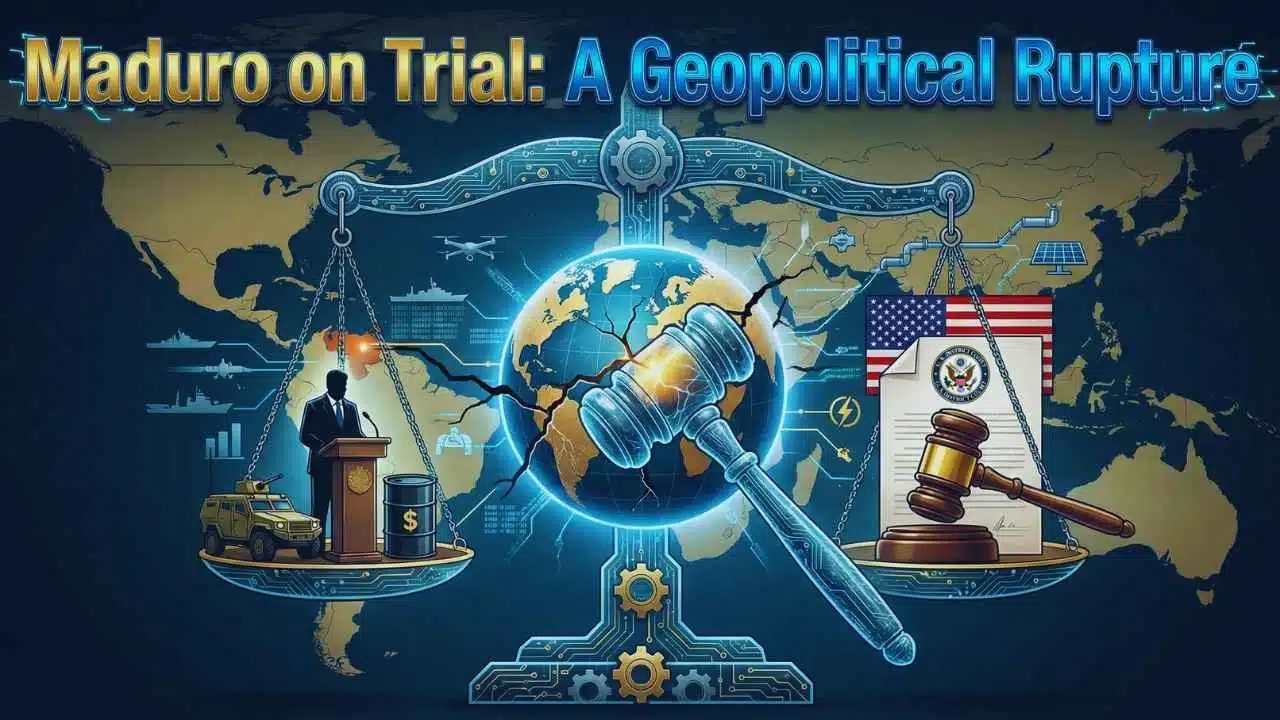
Maduro’s first U.S. court appearance is not just a courtroom drama. It is a test of how far Washington will go to remake the hemisphere by force, how markets price regime change in an oil state, and whether international law can restrain a superpower when it claims security is at stake in 2026, now.
How We Got Here?
The immediate trigger is extraordinary: Nicolás Maduro, described by U.S. officials and multiple news accounts as “ousted” after a U.S. strike-and-capture operation, is scheduled to appear in federal court in Manhattan to face narco-terrorism and drug-trafficking charges, alongside his wife, Cilia Flores.
Those charges are not new. The core indictment dates to March 2020, when U.S. prosecutors alleged Maduro and senior officials led or enabled a network tied to cocaine trafficking, including relationships with armed groups and cartels, and framed it as “narco-terrorism.” The novelty is not the case’s existence, but Washington’s decision to physically bring a foreign leader into U.S. custody via a military operation inside Venezuela.
The operation also arrives after years of sanctions calibration and reversal. U.S. policy oscillated between pressure and conditional relief tied to electoral commitments, including Treasury’s licensing approach for oil-sector transactions. A CRS sanctions overview notes that after limited relief tied to the 2024 election pathway, President Trump later moved to unwind key oil permissions, including the Chevron license referenced in February 2025.
In other words, the court date sits atop a decade-long stack of unresolved questions: how to deal with an entrenched authoritarian system accused of state-enabled crime, how to prevent a failed-state spiral, and how much coercion the U.S. is willing to use in a hemisphere that has become newly central to migration, energy, and drug politics.
What Makes This Moment Different?
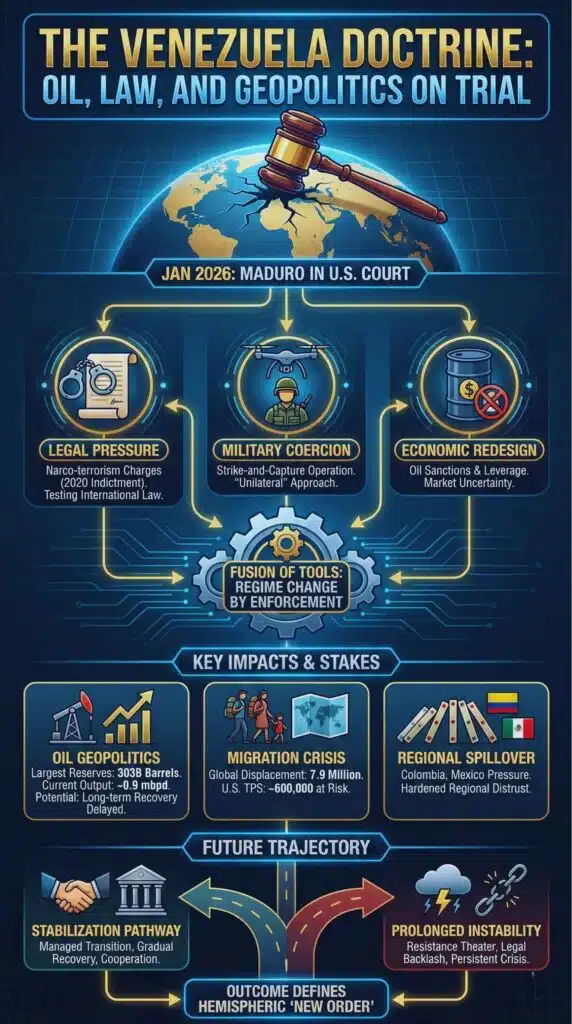
The headline event is nominally legal, a defendant arriving before a judge. But the real story is the fusion of three tools that normally operate in separate lanes:
- Criminal prosecution (narco-terrorism case)
- Military coercion (strike and capture)
- Economic redesign (oil-sector leverage and sanctions posture)
Reuters reports Trump signaling more strikes if Venezuelan authorities do not cooperate, and also threatening action beyond Venezuela, including references to Colombia and Mexico. Bloomberg’s framing of an “emboldened” approach underscores the broader implication: Venezuela is being used as proof-of-concept for a more unilateral U.S. foreign policy in the Western Hemisphere.
That combination is what raises the stakes. It is one thing to indict. It is another to seize. It is yet another to hint that the same model could be applied elsewhere.
Key Statistics Shaping The Incentives
- Venezuela holds the world’s largest proven oil reserves, cited at 303 billion barrels.
- Venezuela’s output has fallen dramatically from historical peaks, with recent production widely cited around 800,000 to 900,000 bpd, while other datasets show ~1.142 million bpd in November 2025.
- The Venezuelan displacement crisis stands near 7.9 million refugees and migrants globally.
- In the U.S., the TPS population at issue is roughly 600,000 Venezuelans, according to Axios’ reporting on DHS commentary and the policy shift.
Those numbers explain why Venezuela is never just “Venezuela” in Washington debates. It is oil, migration, and transnational crime in one geography.
A Compressed Timeline Of Escalation
| Period | What Changed | Why It Matters Now |
| Mar 2020 | U.S. announces narco-terrorism charges against Maduro and others | Built the legal foundation for prosecution, regardless of diplomatic stalemate |
| Oct 2023 to Apr 2024 | Sanctions relief via licenses, then wind-down steps (GL 44A) | Shows sanctions used as bargaining chips tied to political commitments |
| Feb 2025 | Policy swing: Chevron license rescission referenced by CRS | Signals return to maximal pressure and a more confrontational baseline |
| Dec 2025 | Expanded sanctions targeting tankers linked to Venezuelan oil | Moves pressure from paperwork to logistics and enforcement |
| Jan 3 to Jan 5, 2026 | Strike-and-capture, then Manhattan court appearance | Converts a long-running indictment into a geopolitical rupture |
Legality And Sovereignty: The Precedent Problem
Even critics who despised Maduro’s governance often treated sovereignty as a guardrail. This operation challenges that guardrail directly.
Reuters reports the legality of the capture becoming a focal point at the United Nations, with UN Secretary-General António Guterres warning about a “dangerous precedent,” and legal experts highlighting the absence of UN authorization, host-state consent, or a clear self-defense basis. The New Yorker’s interview with Yale law professor Oona Hathaway captures the same anxiety from a U.S. legal scholar’s angle: the worry is not only what happens to Maduro, but what standard this sets for powerful states going forward.
This is where the case stops being “anti-drug enforcement” and becomes system-level. If “drug trafficking” can justify cross-border seizure of leadership figures, then the concept is portable. Russia or China could cite similar logic in their near abroad. Regional powers could cite it against neighbors. The U.S. might argue its unique capabilities make it the only actor that can responsibly do this. International law’s skepticism is precisely about “unique exceptions” becoming contagious.
A second legal fault line is immunity. The AP notes defense arguments are expected to raise head-of-state or former head-of-state immunity, echoing historical comparisons like Manuel Noriega’s failed immunity defense. But this case occurs in a messier legitimacy context: the U.S. does not recognize Maduro’s claimed mandate, which may shape prosecutorial arguments even if it does not erase the underlying immunity doctrine debates.
Bottom line: the trial may be “about drugs,” but the international reaction will be “about rules.”
The Real Target: Governance Model, Not Just A Man
Removing Maduro does not automatically remove “Madurismo,” the coalition of security services, party apparatus, and economic gatekeepers that kept the system alive through sanctions and crisis.
Reuters describes a volatile environment inside Venezuela, with loyalists denouncing the operation and uncertainty around what cooperation or stabilization would mean in practice. That matters because the U.S. has repeatedly learned that removing a leader is easier than governing what comes after.
A useful lens is state capacity. Venezuela’s administrative and industrial backbone has been hollowed out for years. Even optimistic energy analysts tie any production recovery to massive investment, sanctions clarity, and institutional repair. Reuters’ energy piece, citing JPMorgan and Goldman Sachs, frames a transition as a potential production increase over years, not weeks.
This is where “court appearance” becomes a misleading anchor. The decisive events may occur in Caracas boardrooms, military units, and oilfields, not in the Southern District of New York.
Oil Geopolitics: Why Markets Care Even If They Dislike The Method?
There are two competing oil narratives.
One narrative says the strike is an oil grab by another name. The Guardian reports Trump emphasizing Venezuelan oil as central to his justification, a framing that reinforces long-standing Venezuelan claims about resource motives.
The other narrative says oil is a stabilizer: unlock production, lower prices, reduce incentives for illicit networks, and give any transition government revenue.
Reuters’ analysis captures the market-oriented version: Venezuela’s reserves are enormous, output is far below potential, and a transition could raise supply enough over time to depress prices, with Goldman estimating a possible long-run price impact if production reaches 2 million bpd.
But both narratives run into the same hard constraint: time and trust.
- Time, because heavy crude recovery requires refurbishing infrastructure, restoring PDVSA capacity, stabilizing power supply, and securing investment.
- Trust, because investors will demand clarity on ownership, contracts, sanctions risk, and whether the post-Maduro order is durable or reversible.
Production Scenarios Markets Are Quietly Modeling
| Scenario | 2026 Output Baseline | 2-Year View | Longer-Term View | What Must Go Right |
| Status quo disruption | ~0.9 mbpd | Flat to modest change | Limited recovery | Sanctions remain tight, instability persists |
| Managed transition | ~0.9 mbpd | 1.3 to 1.4 mbpd | Stepwise gains | Security improves, limited sanctions easing, investment begins |
| Full reintegration | ~0.9 mbpd | Faster gains | Up to ~2.5 mbpd over a decade | Major capital inflows, legal certainty, OPEC and U.S. alignment |
The key analytical point is that the option value of Venezuelan barrels is rising even if near-term output does not. That option value affects OPEC strategy, refinery planning, and geopolitics.
From “War On Drugs” To “War On Networks”: The Security Rationale Expands
The Trump administration’s public argument merges drugs, gangs, and migration into one security package. Reuters describes allegations tying Maduro’s network to major transnational criminal groups and frames the operation as a response to narcotics and criminal flows.
This framing tracks a broader U.S. trend: treating crime networks as quasi-state adversaries. The advantage is political clarity at home. The risk is analytical overreach. Drug economies are resilient, and removing a patron does not remove demand, routes, or substitute suppliers.
There is also a credibility issue. If the public justification slides from “drug enforcement” to “we will run the country” or “we want the oil sector opened,” it becomes harder to persuade allies that the action is narrow and rule-bound. Reuters reports Trump explicitly describing U.S. ambitions to run or shape the country’s direction, which invites backlash even among governments that opposed Maduro.
This matters because regional cooperation is essential for any durable anti-trafficking outcome. Alienate neighbors, and trafficking routes adjust, not disappear.
Regional Spillover: Colombia, Mexico, Cuba, And The Migration Shock
The most immediate spillover is political and psychological. If Venezuela becomes the precedent, leaders in Colombia and Mexico hear “conditional sovereignty.” Reuters reports Trump making threats that implicate both countries, which escalates diplomatic risk and may harden nationalist responses.
The second spillover is human. Venezuela already anchors the world’s largest displacement wave in the Americas, nearing 7.9 million people abroad. Any renewed instability or state breakdown would almost certainly push new outward flows, pressuring Colombia, Peru, Ecuador, Brazil, and Caribbean routes.
Then the U.S. immigration dimension arrives. Axios reports DHS Secretary Kristi Noem defending ending TPS for Venezuelans even amid upheaval, with the TPS population around 600,000. If Venezuela is unstable, ending protections can generate a two-track crisis: humanitarian pressure at the border and legal pressure in U.S. courts.
Who Gains Leverage, Who Loses It?
| Actor | Short-Term Leverage Gain | Short-Term Risk | What They’ll Push For |
| U.S. executive branch | Maximum coercive leverage | International legal backlash, regional distrust | Compliance by Venezuelan institutions, oil-sector access, anti-drug outcomes |
| Venezuelan opposition and moderates | Potential opening | Fragmentation, legitimacy disputes | Transitional roadmap, guarantees, aid |
| Venezuela’s security elites | Bargaining power | Sanctions and prosecution exposure | Immunity deals, preservation of assets |
| Neighboring states | Diplomatic relevance | Spillover instability | Non-intervention guarantees, refugee support |
| Oil market participants | New optionality | Legal and sanctions uncertainty | Clear rules for trading and investment |
Great Power Competition Returns To The Hemisphere
The UN reaction reported by Reuters highlights Russia and China denouncing the operation, while U.S. allies respond more cautiously. The strategic implication is not that Moscow or Beijing can reverse the operation, but that they can:
- Amplify the illegality narrative in multilateral forums
- Offer alternative economic lifelines to Venezuelan actors who resist U.S. demands
- Use the precedent rhetorically to defend their own actions elsewhere
For Washington, the bet is that the hemisphere’s economic gravity still points north, and that even skeptical governments will adapt because they need U.S. trade, finance, or security cooperation.
But that is not cost-free. A U.S.-led “new order” that relies on force can reduce voluntary cooperation. It can also make Latin American leaders more willing to hedge with China on infrastructure, technology, and financing, even if they remain security-aligned with Washington.
Expert Perspectives: The Strongest Arguments On Each Side
The case for the operation, in its most defensible form, runs like this: a regime accused of narco-terrorism and systematic criminality forfeits normal diplomatic deference, and prosecution plus coercion can break impunity. The 2020 indictment and subsequent U.S. actions were built around that “criminal enterprise” framing.
The case against it is broader and more structural: even if the allegations are true, unilateral military capture violates sovereignty, undermines international law, and invites copycat behavior. Reuters summarizes UN-level concern and expert views that the action is widely regarded as illegal absent authorization or self-defense.
A third critique is pragmatic: even if legality is ignored, the post-capture phase can become a prolonged, messy stabilization mission. Market analysts’ timelines imply that oil recovery is slow and investment-heavy, which means the “quick win” story is likely to disappoint voters and allies.
The most neutral synthesis is this: the U.S. may win the tactical moment, but the strategic outcome depends on whether it can produce a legitimate Venezuelan governance pathway without turning the country into a permanent ward or battlefield of influence.
What Comes Next: Milestones To Watch?
1) The Courtroom Clock
The early hearings will reveal the government’s posture: are prosecutors signaling a long trial, or opening doors to cooperation deals that could implicate other officials and networks. The immunity arguments previewed in reporting are a central hinge, because they determine whether the trial becomes a clean legal event or a prolonged constitutional and international-law dispute.
2) The UN And Diplomatic Front
The UN Security Council discussion, legitimacy arguments, and allied statements will shape whether this becomes an isolated rupture or a sustained diplomatic cost. Reuters already frames the precedent as the core fear.
3) The Oil Sector Signal
Watch for specific, written policy: sanctions posture, licensing changes, and whether the U.S. can credibly promise contract stability. The OFAC licensing history shows how quickly permissions can be granted, modified, or wound down. Markets will not price “Venezuela is back” without durable rules.
4) Internal Venezuelan Settlement
If security elites splinter, there may be a negotiated transition. If they unify against perceived occupation, Venezuela becomes a resistance theater. Reuters reporting on threats of further strikes suggests the U.S. is prepared to escalate if it does not get cooperation, which increases the risk of a prolonged conflict dynamic.
5) Migration And TPS Fallout
Any instability spike will ripple into regional shelters, labor markets, and border politics. UNHCR’s 7.9 million figure underscores how little slack exists. The TPS decision cited by Axios adds a domestic U.S. accelerant to what is already a hemispheric humanitarian system under strain.
Why This Matters Beyond Venezuela?
Maduro’s U.S. court appearance is a symbol, but the larger event is the apparent normalization of regime change by enforcement: using indictment, strike, and economic restructuring as one integrated policy.
If the U.S. pulls off a legitimate Venezuelan transition that lowers violence, stabilizes migration, and unlocks gradual oil recovery, policymakers will call it a template. If it produces prolonged instability, international legal blowback, and only marginal improvements in drugs or migration, it will become a cautionary tale that hardens regional distrust for a generation.
Either way, the hemisphere is entering a phase where sovereignty debates are no longer academic, oil is once again a strategic lever, and “security” is being defined expansively enough to justify actions that were once considered unthinkable.