You may worry about lost packages and bad data. That issue can slow your global supply chain. Fact: Seven startups, like Panora and Terminal Africa, use blockchain technology. They use smart contracts to boost supply chain visibility.
This post will list seven web 3.0 startups. It will show how they use telematics, digital identities, and cloud-based software to automate and secure shipments. You will see ways to boost decentralized trust with ERP systems.
Keep reading to learn more.
Key Takeaways
- Panora began in 2022 in Singapore with 6 staff. It uses AI to guide warehouse picks and cuts errors while speeding picks by 20 %–40 %. Terminal Africa and partner Trella (founded 2019 with 50 staff in eight countries) use IoT sensors, smart contracts, and machine learning on a public blockchain to log every handoff and cut wait times by a third.
- ThreeFold builds an open grid of blockchain nodes and peer-to-peer storage. API3 is a first-party Web3 oracle that feeds live sensor data onto blockchains. Developers use these tools to track goods without a central server.
- Pravica offers encrypted Web3 messaging tied to smart contracts and identity tools. Its SDK adds private chat and file sharing to fleet or port systems. AlphaWallet logs each asset handoff on mobile devices and dApp browsers. BlueCargo (2018 in Los Angeles, 35 staff) raised $4 M seed and $11 M Series A to finance freight with crypto.
- Pachama uses earth imaging and blockchain to track carbon footprints in real time. Smart contracts record each shipment’s emissions on a public ledger. Auditors can verify proof of carbon in minutes for clear, sustainable logistics.
Panora: AI-Driven Warehouse and E-Commerce Integration
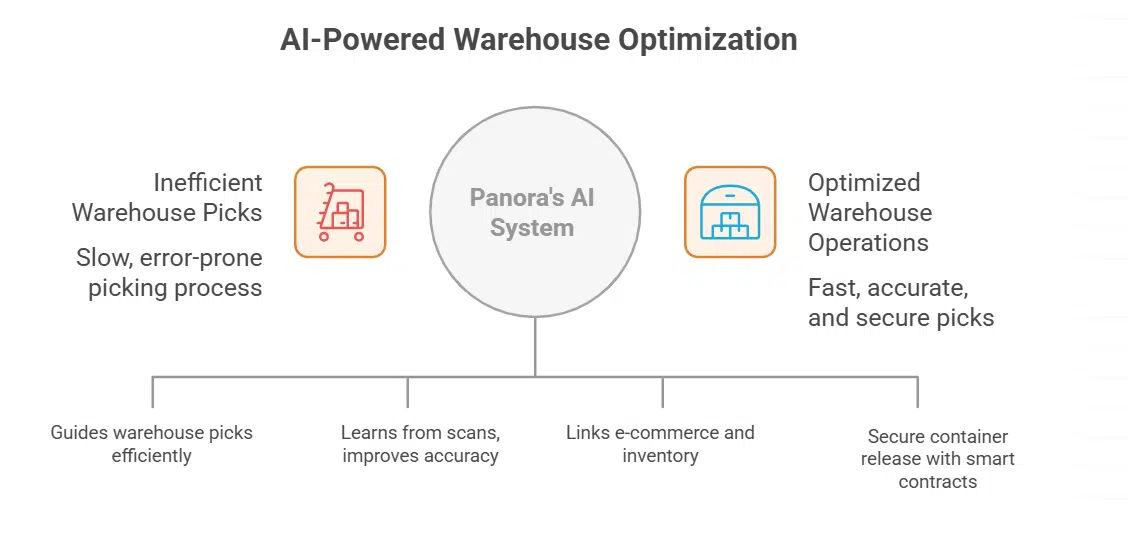
Panora started in 2022 in Singapore with six employees. It uses mobile artificial intelligence to guide warehouse picks. It cuts errors and speeds picks by 20 to 40 percent. The system learns from scans via machine learning.
It fits right into supply chain management workflows.
Panora links e-commerce sales and inventory data in real time. It taps a universal API to sync major platforms. The tool boosts data management and situational awareness. Teams can track orders in global supply chains.
It plans to layer blockchain technology and smart contracts for secure container release next. Developers gain new developer tools for deeper integration.
Terminal Africa: Streamlining Cross-Border Logistics
Terminal Africa runs a blockchain network that links shippers across Africa. It taps smart contracts to speed customs clearance. IoT sensors feed live cargo data to a public blockchain.
Machine learning forecasts delays before they happen. The startup partners with Trella in Cairo. Trella, founded in 2019, counts 50 employees. It connects shippers to carriers in eight countries.
Developers plug in APIs and cloud management tools. Generative AI plans routes through rugged land transport hubs. Every handoff logs on chain to cut paperwork errors.
Operations teams track temperature, humidity and location for food safety. Secure container release kicks off via a crypto wallet link. Peers share proof of custody in a p2p ledger.
This cuts theft and billing gaps. The platform bumps efficiency and trims wait times by a third. Users rely on hybrid cloud and AIops. B2B clients plug into one supply chain portal.
Self-sovereign identity tools guard the data. Smart contracts handle revenue and cash flow. Ports, dry hubs, and ship lanes gain real-time updates.
ThreeFold: Building Decentralized Infrastructure for Supply Chains
ThreeFold builds open grid nodes for supply chain management. It uses blockchain technology to give power back to users. The network runs smart contracts and peer to peer storage. It helps startups run decentralized apps without a central server.
Supply chain startups can tap the grid to track goods from farm to fork.
Nodes connect across continents in a web of secure data. Builders use Ethereum blockchain or custom ledgers for tracking. They rely on decentralized trust to avoid single points of failure.
A developer can link a food safety sensor or last mile tracker. ThreeFold reflects a trend in supply chain startups toward decentralized infrastructure.
API3: First-Party Web3 Oracle Solutions for Logistics Transparency
A first-party Web3 oracle, API3 feeds live data from sensors onto blockchain. It cuts out middlemen and boosts traceability in supply chain management.
Logistics teams tap developer tools to link temperature, location, and cargo status. On-chain rules trigger secure container release and flag anomalies in maritime logistics. This setup also helps track food safety and last-mile delivery with decentralized trust.
Pravica: Enhancing Secure Communication in Logistics with Web3
Pravica helps logistics firms send messages on Web3 networks. Its Web3-based platform secures data with encryption keys. The system ties messages to smart contracts and identity management.
Stakeholders can track shipment updates without leaks. This setup cuts risks in supply chain management and maritime logistics.
Developers use an SDK to add private chat and file transfer tools. Their teams plug this code into fleet management or port systems. Peer-to-peer (p2p) apps run on decentralized trust nodes.
Nodes record events on chain for full transparency. The design taps blockchain technology and boosts secure container release.
AlphaWallet: Web3-Enabled Wallets for Supply Chain Transactions
AlphaWallet runs as a Web3 wallet on mobile devices and in dApp browsers. It uses blockchain technology and smart contracts to log each asset handoff. Supply chain managers tap it to release containers securely, track tokens, and confirm payments.
SUKU uses similar wallets to boost sustainability and ethical practices. CargoCoin, founded in 2017 in Bulgaria, adds smart contract–based escrow to decentralize global trade.
Shopping.io arrived in 2020 in the USA, linking wallets to top e-commerce platforms. Users snag discounts, free shipping, VIP passes, and token airdrops on major sites. SkydropX adds wallet payments to its automated shipping, label printing, tracking, and returns.
BlueCargo, based in Los Angeles since 2018 with 35 employees, handles freight financing via crypto and scored $4 M seed plus $11 M Series A. Getcho and Forge, both born in 2024, focus on high-value goods delivery and duty drawback automation.
Pachama: Leveraging Blockchain for Sustainable Logistics Practices
Pachama uses blockchain technology to track carbon footprints in global supply chain management. The startup partners with earth imaging and connected modules to gather real time data.
Smart contracts record each shipment’s details on a digital ledger. That process boosts transparency and cuts unwanted emissions.
Proof of carbon gets stored on the ledger for clear audit trails. Auditors can check that data in minutes. Clients gain insight into carbon tracking and show corporate responsibility.
That approach makes sustainable logistics possible.
Key Benefits of Web3 Adoption in Logistics Startups

Blockchain and smart contracts give startups rock-solid traceability, so teams can track every box, every pallet. They tap machine learning and developer tools for real-time insights, cutting errors and boosting trust in global shipments.
Enhanced Transparency and Traceability
Many consumers track food with scan tags and blockchain technology. Walmart launched a system in 2018 that tracks spinach and lettuce shipments from farms to stores. IBM Food Trust system began in 2019 connecting growers, shippers, and grocers.
Managers use smart contracts to log each handoff in supply chain management. Stakeholders view real time data at every step.
De Beers tracks gem provenance with chain records. Everledger logs luxury items across global trade lanes. OriginTrail protocol uses a blockchain service to share proof across partners.
ZEGOFOOD replaces barcodes with scan tags plus chain ledgers for clean eating goods. This model boosts transparency and slashes fraud in logistics startups.
Improved Data Security and Decentralization
Blockchain technology locks every record in a tamper proof ledger, cutting fraud and data tampering risks. Maersk/IBM TradeLens secures global shipping documentation with smart contracts, boosting maritime logistics trust.
Guardtime deploys over 150 cryptography experts to guard supply chain systems, and Peer Ledger speeds real time data sharing in B2B networks, raising security and ethical standards.
Supply chain startups tap decentralized trust to lock data in place, and regulators spot an immutable trail for audits, speeding compliance.
Chronicled automates pharma chargeback settlement in the food supply chain, setting accurate drug pricing with clear records. Akiri routes healthcare data in secure channels, so teams move patient info without leaks.
Blockhead Technologies builds a SaaS wall around fuel and mining shipments, letting providers set strict access rules and audit logs. This blend of smart contracts, blockchain innovation, and developer tools transforms data security and decentralization.
Challenges Faced by Web3 Logistics Startups
Many startups hit resistance to change in traditional supply chains, as legacy partners stick to old methods. They need to train stakeholders on new tools and build scalable platforms to win trust.
Investors see steep development costs, from $15,000 to several million dollars, so firms must prove a strong business case. Firms must pick a niche, research market needs, and forge industry partnerships to share investments.
Some join Y Combinator for funding, mentorship, and b2b connections. Teams face a maze of global rules, from food safety standards to net neutrality laws. Start-ups need to clear each compliance hurdle before they roll out solutions.
Technical hurdles pop up when apps try to link with old code. These firms must sync new supply chain management systems with legacy APIs. Many use smart contracts on a base layer ledger to cut out middlemen.
Data feeders and digital ID services still tend to clash. Interoperability snags stall maritime logistics and safe box unlocking. Testing and validation come before any broad scale launch.
Firms juggle AI-powered analytics and on-chain audits to boost transparency. That juggling act can drain funds and slow down revenue management.
The Future of Web3 in the Logistics Industry
AI, IoT, blockchain technology, and green methods will drive future innovation in logistics. Smart contracts will speed up supply chain management tasks. Firms will link sensors to track goods in real time.
They will shrink fraud, boost global teamwork, and slash red tape. These ideas will shape the next decade.
Startups will roll out automated vehicles that aim for Level-3 autonomy. A firm founded in May 2020 leads the effort. Mason won prizes for its robotics and software tools. Breadfast now counts about 6,000 staff, while SkydropX employs 320 people.
Blockchain technology will handle documentation, smart contracts, and compliance in real time.
Takeaways
These crews spark fresh fire in supply chain management. They weave blockchain technology and smart contracts into every step, cutting red tape. They launch developer tools and machine learning that zip through data piles.
They guard info like a vault and plant green goals in each link. They swap clunky cash paths for slick Web3 wallets. The logistics world looks ready to blast off, and we can hitch a ride.
FAQs on Logistics Startups Leveraging Web3 Technology
1. What do logistics startups gain from blockchain technology?
They get clear logs, like a digital notary. They track every step in supply chain management. They mix public and private blockchain technologies. They show application of blockchain and spark blockchain innovation.
2. How do smart contracts speed up secure container release?
Smart contracts cut red tape, they auto check papers, they lock and release with code. That speeds secure container release for maritime logistics.
3. How do web3 startups use generative ai and machine learning?
Some web3 startups from y combinator (yc) hit the ground running with generative ai, machine learning, and developer tools, they feed data into artificial intelligence (ai) to spot delays, boost routes, and cut costs with emerging technologies.
4. Can non-fungible tokens (nfts) help track products in the agricultural sector?
Non-fungible tokens (nfts) act like a digital tag for each product batch. They log farm runs, check food safety, link with synthetic biology seeds, and boost corporate social responsibility.
5. Why is decentralized trust key for supply chain solutions?
Decentralized trust means no single weak link, many peers hold the log. It slashes fraud, lifts operational efficiency, and drives supply chain solutions.
6. How does layer-1 blockchain support b2b supply chain startups?
Layer-1 blockchain sets up a main highway, no toll jams, it brings fast blocks and low fees. It fits b2b supply chain startups that need financial technology and secure rails.