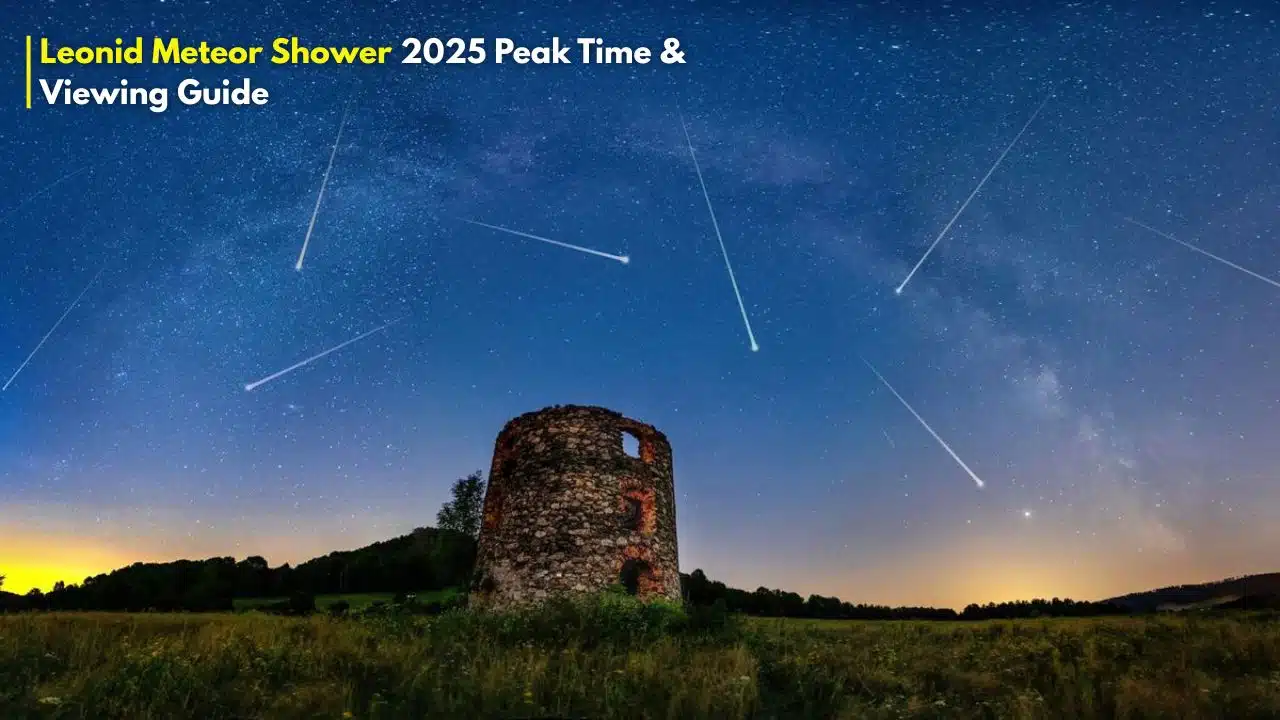
The annual Leonid meteor shower reaches its zenith tonight, promising skywatchers one of the best viewing windows in years thanks to a fortuitous lunar calendar. While 2025 is not predicted to be a “meteor storm” year, the near-total absence of moonlight means observers across the Northern Hemisphere could catch up to 15 bright, ultra-fast meteors per hour in the pre-dawn darkness of Tuesday morning.
3-Second Quick Take
- Peak Timing: Late night Monday, Nov. 17 through pre-dawn Tuesday, Nov. 18.
- Moon Phase: Waning Crescent (~5% illuminated).
- Impact: Minimal light interference (Excellent).
- Expected Rate: 10–15 meteors per hour (ZHR).
- Velocity: 71 km/s (Known for fast, bright fireballs).
- Where to Look: Radiating from the constellation Leo (East), but visible across the entire sky.
Dark Skies, Bright Streaks
Unlike last year, when a bright moon washed out fainter meteors, tonight’s conditions are near-perfect. The moon is currently a thin waning crescent—just days away from the New Moon on November 20—and will not rise until the early morning hours, leaving the sky pitch-black for the majority of the night.
“The darker the skies, the better your chances of seeing the really faint meteors,” says Ashley King, a planetary scientist (paraphrased from Natural History Museum archives). For 2025, the peak coincides with this ideal lunar window, making it a “must-watch” for casual astronomers even with the modest hourly rates.
What is Happening?
The Leonids occur when Earth plows through the dusty debris trail left by Comet 55P/Tempel-Tuttle. This small comet, roughly 3.6 kilometers across, orbits the Sun every 33 years. It last swept through the inner solar system in 1998 and isn’t due back until 2031.
Currently, Earth is passing through the “streams” of dust ejected during previous passages. When these tiny grains of sand and ice hit our atmosphere, they vaporize instantly.
What makes the Leonids distinct is their speed. Hitting the atmosphere at a blistering 71 kilometers per second (158,000 mph), they are among the fastest meteors known. This high kinetic energy often results in persistent “trains”—glowing trails of ionized gas that can linger in the sky for several seconds after the meteor has vanished.
Managing Expectations: A Shower, Not a Storm
It is crucial to distinguish between a meteor shower and a meteor storm.
- The History: The Leonids are famous for the Great Meteor Storm of 1833, where observers reported up to 100,000 meteors per hour, falling “like snowflakes.” Similar outbursts occurred in 1966 and roughly around the 1999-2001 return.
- The Reality Tonight: We are currently in the “quiet” phase of the 33-year cycle. Experts project a Zenithal Hourly Rate (ZHR) of about 15 meteors per hour. However, because the Leonids are often bright fireballs, a count of 10-15 per hour is still a spectacular show from a dark location.
Note: Recent space weather reports indicate high solar activity this week. While unrelated to the meteors, some high-latitude observers might catch a rare “doubleheader” of meteors and faint aurora borealis if geomagnetic conditions hold.
Official Viewing Advice
Robert Lunsford of the American Meteor Society (AMS) notes that while the radiant is in the constellation Leo (specifically the “Sickle” asterism), staring directly at it is a mistake. Meteors near the radiant appear short and stubby due to foreshortening.
For the best view, follow these steps:
- Timing: The shower is active now, but the radiant rises around midnight. The prime window is between 2:00 AM and 5:00 AM local time on Tuesday morning, November 18.
- Direction: Look roughly 45 degrees away from the radiant (Leo). This allows you to see meteors with longer, more dramatic tails.
- Equipment: Put the telescope away. Binoculars and telescopes narrow your field of view. The human eye is the best instrument for capturing the wide expanse of the sky.
- Adaptation: It takes 20 to 30 minutes for your eyes to fully adjust to the dark. Avoid looking at your phone screen, as the white light will reset your night vision immediately.
Impact on Satellites
While beautiful to watch, the Leonids pose a minor risk to orbital infrastructure. Due to their high relative velocity, even microscopic dust grains pack a significant punch. Major space agencies, including NASA and ESA, typically orient satellites such as the Hubble Space Telescope to minimize the cross-section exposed to the incoming stream during the peak hours.
Data Watch: The 2025 Context
| Feature | Details for Nov 17-18, 2025 | |
| Moon Illumination | ~5% to 9% (Waning Crescent) | |
| Comet Status | 55P/Tempel-Tuttle (Outbound, near aphelion) | |
| Next “Storm” Potential | Unlikely until roughly 2033 or 2099 |
What to Watch Next
If you miss tonight’s peak due to clouds, the shower technically runs until November 30, though rates drop off sharply after tonight. The next major celestial dates on the 2025 calendar are:
- Nov 20: New Moon (Darkest skies of the month).
- Dec 13-14: The Geminids. Usually the strongest shower of the year (120+ meteors/hour), but in 2025, the Geminids will contend with a 30% illuminated moon, making tonight’s dark-sky Leonids a unique opportunity.
Conclusion
While 2025 isn’t a year for the history books in terms of sheer volume, the combination of fast, bright fireballs and a near-absent moon makes tonight’s Leonid peak a high-value event for skywatchers. Wrap up warm, find a spot away from city streetlights, and look up.