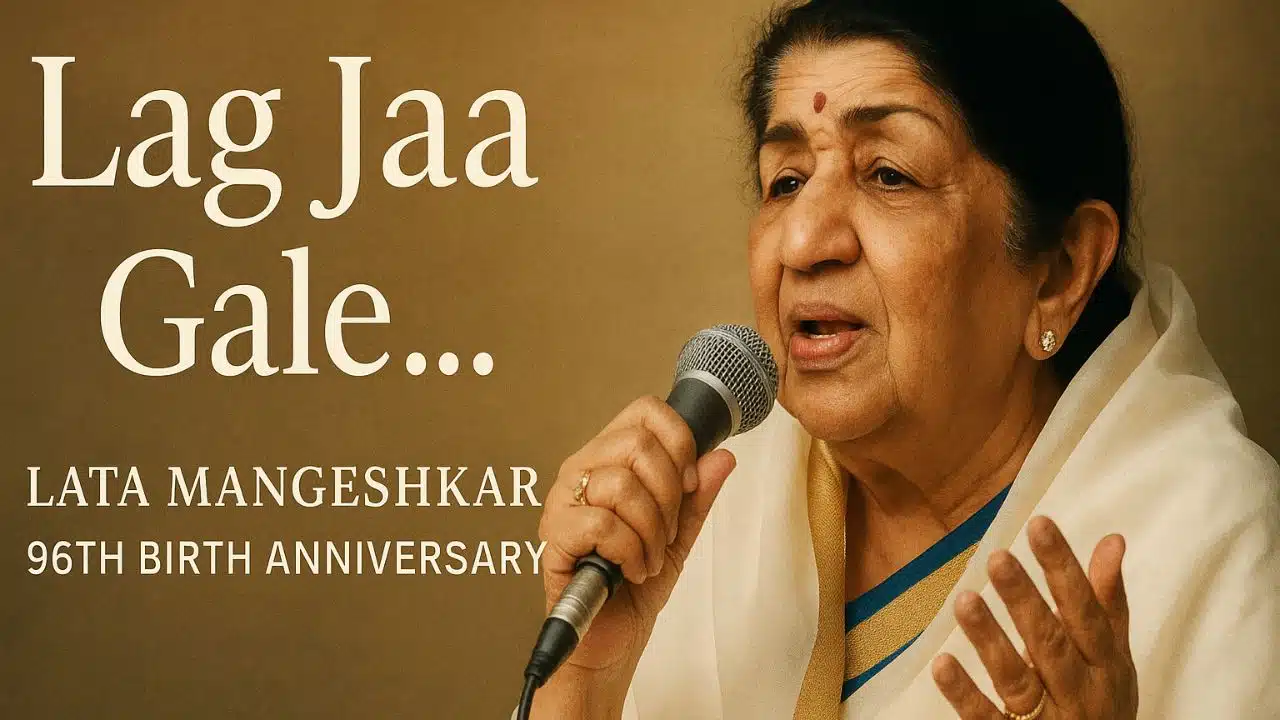
Few voices in history have managed to capture the essence of an entire nation. Lata Mangeshkar voice was one of them. Known as the Nightingale of India, she wasn’t just a playback singer—she was the voice that gave life to Indian cinema for over seven decades.
From her humble beginnings in the 1940s to her timeless songs that still resonate today, Lata’s influence stretched far beyond melodies. Her voice became a cultural symbol, shaping not only Indian music but also the way stories were told on screen.
On her 96th birth anniversary, it’s worth asking: how did Lata Mangeshkar voice manage to shape generations of Indian cinema?
Lata Mangeshkar Voice: A Voice That Found Its Place
Lata Mangeshkar was born in 1929 in Indore. Her father, Pandit Deenanath Mangeshkar, was a classical musician, and from a young age, Lata was surrounded by music. But destiny pushed her into playback singing when her father passed away in 1942. As the eldest, she had to support her family.
Her first big breakthrough came in 1949 with Aayega Aanewala from Mahal. Sung for actress Madhubala, the haunting melody turned into a nationwide sensation. People wanted to know who this mysterious new singer was—and thus began Lata’s reign in Bollywood.
The Golden Era of Indian Cinema (1950s–1970s)
In the 1950s and 1960s, Bollywood heroines found their identity through Lata’s voice. Whether it was Nargis in Mother India, Madhubala in Mughal-e-Azam, or Meena Kumari in Pakeezah, her songs became the heartbeat of their performances. She made characters immortal with her singing, often becoming more memorable than the dialogues themselves.
Collaborations with Legendary Composers
Lata’s partnerships with composers defined Bollywood’s golden soundscape. With S.D. Burman, she created soulful melodies. With Madan Mohan, she mastered classical-based songs. With Shankar–Jaikishan, she delivered romantic anthems. Each collaboration was unique, but what remained constant was her ability to adapt her voice to the composer’s vision.
A Symbol of Emotional Depth
Her songs carried unmatched emotional power. For example:
-
Lag Jaa Gale (Woh Kaun Thi?, 1964) became the epitome of longing.
-
Pyar Kiya To Darna Kya (Mughal-e-Azam, 1960) was a bold declaration of love and defiance.
-
Ajeeb Dastan Hai Yeh (Dil Apna Aur Preet Parai, 1960) perfectly captured bittersweet emotions.
These songs elevated cinema, making music a central pillar of storytelling.
Lata in the 1980s and 1990s: Transitioning with Time
Even as Bollywood evolved, Lata’s voice remained relevant. She sang for actresses like Sridevi, Rekha, and Madhuri Dixit. Songs like Hawa Hawai (Mr. India, 1987) and Dil Deewana (Maine Pyar Kiya, 1989) proved her adaptability.
Keeping Her Relevance Intact
In the 1970s and 1980s, she often collaborated with R.D. Burman and Laxmikant–Pyarelal, producing evergreen hits like Tere Bina Zindagi Se Koi (Aandhi, 1975). Despite newer voices emerging, no singer could replace her.
Iconic Heroines & Their Songs by Lata
| Actress | Film | Iconic Song Sung by Lata |
|---|---|---|
| Madhubala | Mahal (1949) | Aayega Aanewala |
| Nargis | Mother India (1957) | O Ganga Maiya |
| Meena Kumari | Pakeezah (1972) | Chalte Chalte |
| Hema Malini | Seeta Aur Geeta | Kya Mil Gaya |
| Sridevi | Mr. India (1987) | Hawa Hawai |
| Madhuri Dixit | Dil To Pagal Hai | Koi Ladki Hai |
Crossing Into the 2000s: A Timeless Voice
By the 2000s, Lata was in her seventies, but her voice still had the power to touch hearts. With A.R. Rahman, she recorded Lukka Chuppi (Rang De Basanti, 2006), a mother’s heart-wrenching farewell. It was proof that her artistry transcended age.
She sang for younger stars like Kajol and Preity Zinta, proving that her voice belonged to every generation.
Beyond Bollywood: Regional & Patriotic Influence
Lata was not just Bollywood’s voice; she was India’s. She sang in over 36 Indian languages, including Marathi, Bengali, and Assamese. Her Marathi songs are still revered for their purity, while her Bengali hits became cultural treasures.
One of her most iconic contributions was Ae Mere Watan Ke Logon (1963), performed after the Indo-China war. The song was so powerful that it moved Prime Minister Jawaharlal Nehru to tears. It became India’s unofficial anthem of patriotism.
The Lata Effect: Shaping Generations
Every playback singer after her was measured against her. She set the bar for clarity, emotion, and range. Singers like Alka Yagnik, Shreya Ghoshal, and Sunidhi Chauhan often cite her as their ultimate inspiration.
Elevating Cinema as an Art Form
Before Lata, film songs were often considered fillers. With her entry, songs became the emotional backbone of storytelling. They expressed what dialogues could not. Directors relied on her voice to bring depth to their narratives.
Iconic Songs Across Eras
No single list can hold everything. These picks show breadth—romance, devotion, pride, and quiet reflection. They also highlight moments when voice, composition, and story clicked. Use them as entry points, then wander further using your app’s “related” tabs.
| Era | Song | Film/Year | Composer | Why it endures |
| 78-rpm/early | “Aayega Aanewala” | Mahal (1949) | Khemchand Prakash | Gothic romance mood; benchmark for playback craft |
| Vinyl 1960s | “Pyar Kiya To Darna Kya” | Mughal-e-Azam (1960) | Naushad | Daring declaration of love; grand orchestration |
| Vinyl 1960s | “Lag Ja Gale” | Woh Kaun Thi? (1964) | Madan Mohan | Pure melody; lasting evergreen |
| Radio/patriotic | “Ae Mere Watan Ke Logo” | Stage, 1963 (Delhi) | C. Ramchandra / Kavi Pradeep | National memory; famed Nehru reaction |
| 1970s duet | “Tere Bina Zindagi Se” | Aandhi (1975) | R. D. Burman (lyrics: Gulzar) | Gentle, reflective duet with Kishore Kumar |
Awards and National Honors
Awards mark excellence, but they also mark time. Recognition arrived across decades, from early film trophies to the nation’s highest civilian honors. What stands out is the pattern: consistent quality, constant impact, and a bond with listeners that never faded.
| Award | Year |
| Bharat Ratna | 2001 |
| Padma Vibhushan | 1999 |
| Dadasaheb Phalke Award | 1989 |
| Padma Bhushan | 1969 |
| National Film Awards (Best Female Playback) | 1973, 1975, 1991 |
| Filmfare Awards (competitive) | 1959, 1963, 1966, 1970 |
Legacy That Lives On
Even in today’s era of streaming and AI-driven playlists, Lata Mangeshkar remains relevant. Platforms like YouTube, Spotify, and Instagram Reels ensure that her melodies reach Gen Z and Gen Alpha.
Young artists remix her classics, but the originals remain unmatched. Her songs continue to play at weddings, festivals, and national events, reminding us that legends never truly fade.
Takeaways
Lata Mangeshkar wasn’t merely a singer—she was the soul of Indian cinema. Her voice carried the emotions of characters, shaped the golden era of Bollywood, and set the gold standard for playback singing. She united generations through music, creating a legacy that will live on forever.
Even today, when one listens to Lag Jaa Gale or Ae Mere Watan Ke Logon, it feels as though Lata’s voice is whispering across time—a reminder that music, when sung with sincerity and devotion, never dies.