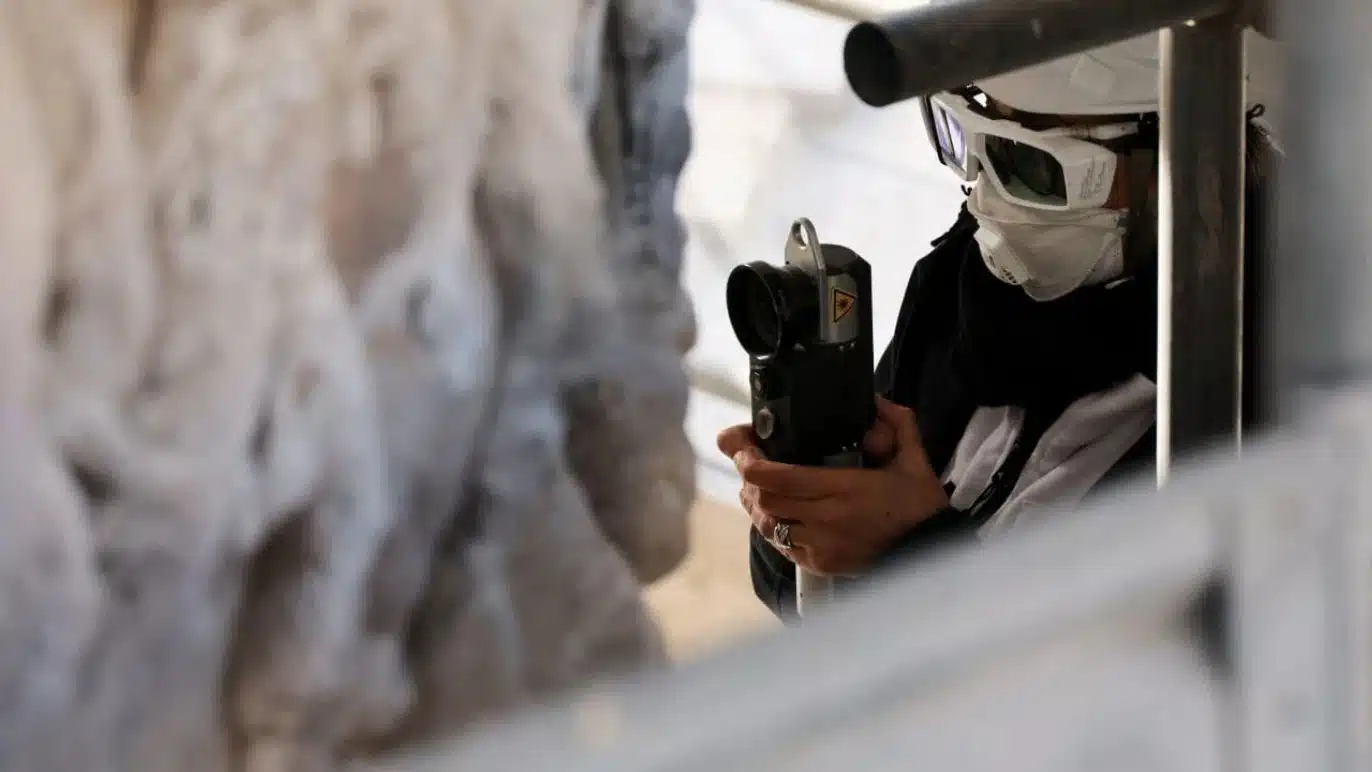
For the first time in over four decades, Rome’s iconic Trajan’s Column — one of the city’s most treasured monuments — is undergoing an extensive cleaning using cutting-edge laser technology. The project, led by experts from the Italian Ministry of Culture in collaboration with conservation scientists, is restoring the column’s marble brilliance without compromising its intricate carvings that tell the story of Emperor Trajan’s victories.
This historic conservation marks a fusion of ancient art and modern science — a literal “illumination” of history through light. The restoration is more than just cleaning; it represents a new chapter in how we protect heritage in an era where technology increasingly serves as both a tool and a guardian of human history.
The Monument That Defines Roman Glory
Standing tall at nearly 30 meters (almost 100 feet) in Rome’s Forum of Trajan, the column was completed in 113 AD to commemorate Emperor Trajan’s successful campaigns in Dacia (modern-day Romania). Crafted from about 20 colossal Carrara marble drums, it spirals upward with more than 155 scenes carved in stunning relief, depicting over 2,500 individual figures.
The narrative carved into its surface reads like a stone documentary — chronicling the complex military, engineering, and administrative might of ancient Rome. Above all, it stands as a monument to the power of visual storytelling in antiquity.
While it has withstood nearly two millennia of weather, pollution, and urban growth, the column’s delicate reliefs have long suffered from soot, biological growth, and urban grime. The current laser cleaning project is the most comprehensive effort since the 1980s, when chemical and mechanical methods were still dominant in conservation work.
From Brushes to Beams: The Shift in Preservation Methods
The use of lasers in art conservation has revolutionized how restorers approach ancient marble, bronze, and stone. Traditional cleaning methods — involving brushes, solvents, and sometimes abrasive tools — risk removing or damaging the original layer of ancient stone or pigment.
Laser cleaning, introduced to restoration circles in the late 20th century, changed everything. It operates on a simple but precise principle: a beam of controlled laser light vaporizes or ablates the layer of dirt, pollutant, or biological residue without touching the underlying structure. The difference lies in tunable frequency and energy — adjusted to remove the unwanted layer with surgical accuracy.
In this case, researchers are employing dual-laser systems, combining infrared and ultraviolet frequencies, capable of distinguishing between contaminants and authentic marble surfaces. This approach allows the column’s sculpted details — from Trajan’s legionnaires to the Dacian prisoners — to re-emerge in high relief as if newly carved.
Why the Cleaning Is Happening Now
Rome’s air may look clearer than during the smog-heavy days of the 1970s, but urban pollution is still a constant enemy to marble. Nitrogen oxides from traffic, fine particulate matter, and even biological factors such as microalgae and lichens contribute to slow degradation.
According to officials from the Central Institute for Restoration (ICR), the cleaning is part of a larger initiative to digitally monitor and maintain Rome’s major monuments over the next decade. The column’s cleaning marks the pilot phase of a broader restoration policy focused on combining conservation science with real-time environmental monitoring.
Advanced sensors are being installed around the site to track humidity, temperature, air composition, and microvibrations. These data streams will inform future interventions before damage becomes critical — a concept known as preventive conservation.
Inside the Restoration Process
The restoration team, composed of Italy’s top conservators, laser engineers, and art historians, began their meticulous work earlier this year. The process unfolds in stages:
-
Documentation and Mapping:
Every inch of the column’s surface is surveyed using ultra-high-resolution photogrammetry, 3D scanning, and infrared imaging. This creates a detailed digital twin for analysis and public access. -
Testing Laser Parameters:
Before large-scale cleaning, small test areas are cleaned using various laser intensities. Conservators analyze micro-residues under microscopes to ensure only surface grime is being removed — not the marble’s natural patina. -
Layer-by-Layer Cleaning:
Using specialized laser heads mounted on adjustable scaffolding, operators slowly move the beam across the reliefs. The process produces a subtle popping sound as microscopic particles vaporize — a symphony of light undoing centuries of pollution. -
Post-Cleaning Analysis and Protection:
After each area is treated, scientists perform spectral analysis to study color restoration and surface chemistry. A protective layer — fully reversible and transparent — may be applied to minimize future dust adherence and water stagnation.
This is painstaking work. Cleaning even a small section of the relief takes days, and the entire process will span several months, projected to conclude by mid-2026.
Rediscovering Forgotten Details
As dirt layers are lifted, conservators are already rediscovering previously obscured elements — details carved so delicately that they seemed faded only months ago. Scenes showing bridges, encampments, and tools of war now display sharper contours and depth.
Art historians are particularly thrilled about this laser renewal because it will provide greater clarity for digital replicas and study models. Projects like this intersect with digital preservation, allowing millions worldwide to experience ancient Rome in augmented reality or virtual campuses.
The Italian National Research Council (CNR) has already confirmed that data captured during the restoration will contribute to Europe’s Digital Heritage Portal, offering downloadable 3D models, historical insights, and digital tours.
Balancing Science with Soul
Art conservation isn’t just about cleaning stone; it’s about interpreting the intent of the original artist and respecting the passage of time. This concept of patina respect — maintaining some natural aging as part of the monument’s story — is central to the Rome project.
Laser cleaning, fortunately, offers exceptional control, allowing conservators to leave faint weather traces intact while removing harmful deposits. It’s a balance between restoration and authenticity — preserving both the column’s integrity and its human history.
Dr. Elisabetta Campanelli, a chief conservator involved in the project, explained that the goal is not to “make it look new” but “to make it look alive again — as close as possible to how Romans might have seen it in sunlight 1,900 years ago.”
A Legacy of Emperors and Engineers
Trajan’s Column was part of the grand architectural complex that celebrated Roman engineering and imperial ideology. Designed by Apollodorus of Damascus, the structure exemplified the blend of artistry and structural genius that characterized Roman civilization.
The column originally served not just as propaganda but as the emperor’s tomb marker — his ashes were once kept in a chamber at its base. In the centuries following Rome’s decline, the column became a beacon of continuity amid ruins.
Its distinctive spiral frieze, wrapping around 23 times, influenced countless commemorative monuments throughout Europe, from Napoleon’s Vendôme Column in Paris to Nelson’s Column in London.
That such an architectural narrative still stands in its original place — while most of ancient Rome transformed into a modern capital — speaks to the city’s layered identity as both a living metropolis and an open-air museum.
Rome’s Broader Push for Technological Restoration
Italy’s Ministry of Culture has committed billions of euros through the National Plan for Cultural Heritage Conservation to apply advanced technology to its heritage protection programs. Over the past five years, restoration studios in Florence, Milan, and Rome have integrated AI-powered imaging, machine learning defect detection, and laser spectroscopy into their workflow.
What once required months of manual surface analysis can now be completed in hours. For example:
-
AI algorithms detect microcracks invisible to the naked eye.
-
Infrared scanning differentiates between genuine pigments and later additions.
-
Predictive modeling simulates environmental stress over decades.
The Trajan’s Column restoration serves as a loud statement that heritage conservation is no longer an afterthought — it’s an actively evolving science contributing to the country’s cultural and economic vitality.
The Challenges of Restoring History in a Living City
Rome is unique in its challenge: ancient monuments co-exist alongside traffic circles, residential blocks, and tourist crowds. Maintaining equilibrium between accessibility, preservation, and sustainability is a logistical feat.
Scaffolding around the column is carefully designed to allow pedestrian flow while maintaining low vibration levels. Work schedules are adjusted to minimize sound pollution. Even the choice of power for laser systems — mostly renewable energy sources — reflects Rome’s green heritage policy.
Authorities face public scrutiny as well. Some citizens worry that high-tech methods could “sterilize” the historical appearance of monuments. Officials counter that transparency and reversibility, two pillars of modern conservation ethics, guide every decision.
Visual Transformation: What the Public Will See
As restoration progresses, visitors to Rome’s Forum area can already view side-by-side sections of cleaned versus untreated marble — a stark contrast that reveals the project’s impact.
The whitened surfaces gleam under the Mediterranean sun, enhancing visibility of even minuscule carvings. Historians say these visual recoveries may help scholars reinterpret aspects of Roman storytelling, armor design, and ceremonial depiction.
To engage the public, the Culture Ministry has launched an immersive exhibition, “Light on Empire,” showcasing laser cleaning in action through live video feeds and 3D renderings displayed near the site. Visual comparisons before and after cleaning illustrate how the invisible hand of technology brings the past closer to the present.
Funding and International Collaboration
This monumental cleaning effort is estimated to cost around €2.5 million, funded jointly by Italy’s public heritage budget and private sponsorships, including support from credit institutions and cultural foundations.
International agencies such as UNESCO, the European Heritage Label, and ICOMOS (International Council on Monuments and Sites) have shown interest in documenting the restoration as a model for global heritage conservation.
Collaborations with academic partners, including the Politecnico di Milano and Sapienza University of Rome, ensure that student researchers gain first-hand training in heritage technology — an investment in the next generation of conservators.
Lessons from Past Cleanings
The last major cleaning of Trajan’s Column took place in the early 1980s, using chemically-based poultices and low-pressure water. While successful in removing surface grime, those methods couldn’t avoid minute dissolution of calcium carbonate — inevitably dulling the stone’s finish.
Since then, restoration science has evolved dramatically. Lasers now offer non-contact, non-chemical, and selective removal — eliminating the risk of escalating chemical reactions or uneven color patches.
Over the years, this technique has been used to clean Michelangelo’s sculptures, Florence’s Baptistry doors, and even the Acropolis in Athens. Rome’s current use signals the mainstream adoption of laser cleaning as a new global standard.
Digital Legacy: Bringing the Column Online
Parallel to the physical cleaning, the column is being scanned in ultra-high resolution, producing a virtual 3D model accessible online. This model will include overlays showing which scenes correspond to specific military events from Trajan’s two Dacian campaigns.
This virtual archive aims to serve educators, researchers, and even filmmakers seeking accurate recreations of Roman history. Visitors will also be able to explore the monument digitally in multiple languages — part of Italy’s commitment to opening its heritage to the world.
When complete, the digital twin will allow users to zoom into individual figures, read QR-linked annotations, and even simulate the lighting conditions of ancient Rome at different times of the day and year.
The Symbolism of Light in Roman Culture
Beyond the technical achievement, there’s symbolic resonance in using lasers — pure light — to preserve Rome’s past. Light in Roman myth and architecture often symbolized clarity, wisdom, and divine presence. Temples, sundials, and public forums were aligned with solar events to embody the connection between empire and cosmos.
In a sense, the laser beams returning the column to brilliance continue that age-old relationship between Rome and light — between human ingenuity and cosmic continuity.
Heritage Meets the Future
The success of this restoration could shape how future projects unfold across Europe. Already, Vatican City and Florence are considering similar laser applications for St. Peter’s façade and Giotto’s frescoes.
Moreover, Rome’s experiments align with the European Commission’s Green Restoration Plan, encouraging eco-friendly technologies that reduce chemical and water consumption. Laser systems, powered by renewables and producing minimal waste, meet these sustainability metrics perfectly.
As cultural institutions embrace digitization, these laser-driven restorations ensure that what’s preserved is not just for display, but also for education, tourism, and collective identity.
Public Engagement and Global Interest
Social media buzz has surrounded the project ever since laser demonstrations began. Drone footage and time-lapse videos show technicians wearing protective goggles, guiding bright beams across marble warriors frozen in eternal combat.
Heritage enthusiasts and travelers are flocking to witness this historic event in person. Travel agencies are incorporating “Restoration Tours,” where visitors can observe conservation work live — transforming cultural maintenance into public spectacle.
Meanwhile, historians and curators emphasize that such visibility helps demystify the complex science behind art conservation and highlights the importance of funding for preserving world heritage sites.
The Broader Conversation: Technology and Authenticity
A larger philosophical question underlies projects like this: when we use technology to restore ancient works, how much modern intervention is too much? Should monuments look as they did when built, or as they’ve naturally aged through centuries?
Italy’s new generation of conservators embraces a middle path. The principle of “minimum intervention, maximum reversibility” seeks to restore clarity without rewriting history. Every photon that touches the column is calibrated not merely to clean, but to respect — ensuring the final result remains faithful to the object’s accumulated memory.
How the Cleaning Benefits Research and Tourism
Apart from aesthetic rejuvenation, the project holds immense benefits for academic research. Newly visible inscriptions may yield insights into Roman language variants or artistic workshops behind the column’s production.
Tourism also stands to gain enormously. The renewed monument, coupled with interactive exhibitions and digital access, could boost site visitation, particularly among younger travelers interested in tech-driven cultural experiences.
Economists project a potential 10–15% rise in footfall across Rome’s archeological area following major restorations like this. Such increases contribute significantly to local businesses, tourism revenue, and long-term site upkeep.
Voices from the Field
Experts worldwide are unanimous in their praise.
Dr. Marco Leone, a conservation scientist from Florence, called the project “a textbook application of science serving heritage — demonstrating lasers as tools of empathy, not erasure.”
Cultural historian Lydia Sforza added, “It’s easy to think of technology as modern intrusion, but in Rome, it becomes an act of continuity. The laser’s precision mirrors the precision of the ancient chisel.”
Even residents of the Eternal City who pass the monument daily express pride. “To see it shining again feels like seeing our ancestors breathe,” said one Rome local.
Looking Ahead: The Next 2,000 Years
Once cleaning concludes, the Italian government plans to maintain the column through periodic low-intensity laser refreshes, avoiding the need for another large-scale intervention for at least half a century. AI-driven predictive maintenance will monitor weather patterns and pollution exposure to trigger early warnings.
As restoration enters the digital age, Rome’s monuments are increasingly becoming living laboratories — test cases for global cultural sustainability. In the coming decades, expect similar projects to incorporate robot-assisted cleaning, AI-guided micro-restoration, and virtual-reality storytelling embedded directly on-site.
The future, in other words, may look remarkably like the past — illuminated by both marble and light.
Reawakening a Masterpiece
When the last scaffolds descend and sunlight strikes the newly cleaned surface of Trajan’s Column, Rome will witness more than a brightened monument — it will see the revival of an ancient voice, once muted by time and soot, now made clear again through the brilliance of light.
This restoration stands as a reminder that technology, when grounded in respect for history, does not replace tradition — it reawakens it. In that regard, every laser pulse is not merely cleaning stone; it is whispering across centuries, reconnecting the Eternal City with its eternal past.