
India’s equity markets have seen a lot of action in 2025 and different segments have performed differently. For investors using PMS strategies understanding the Large Cap, Mid Cap and Small Cap dynamics is key to making informed decisions. This article will help you understand the performance trends, risk profiles and suitability of each segment to align your investments with your financial goals.
Market Capitalization Segments
- Large Cap: Companies with market cap above ₹20,000 crore. These are established companies with stable earnings and a large market presence.
- Mid Cap: Companies with market cap between ₹5,000 crore and ₹20,000 crore. They offer growth but with moderate risk.
- Small Cap: Companies with market cap below ₹5,000 crore. These companies can give high returns but are more volatile and risky.
Performance in 2025
2025 has been a volatile year with global and domestic factors at play.
Large Cap PMS
- Performance: Large Cap PMS strategies gave an average return of 5.52% in FY2025, a big drop from 37.43% in FY2024.
- Stability: Large Cap stocks were relatively stable despite the market turbulence.
Mid Cap PMS
- Performance: Mid Cap PMS strategies struggled, with an average return of -11.06% in February 2025.
- Volatility: Mid Cap stocks were more volatile due to economic uncertainty and valuation concerns.
Small Cap PMS
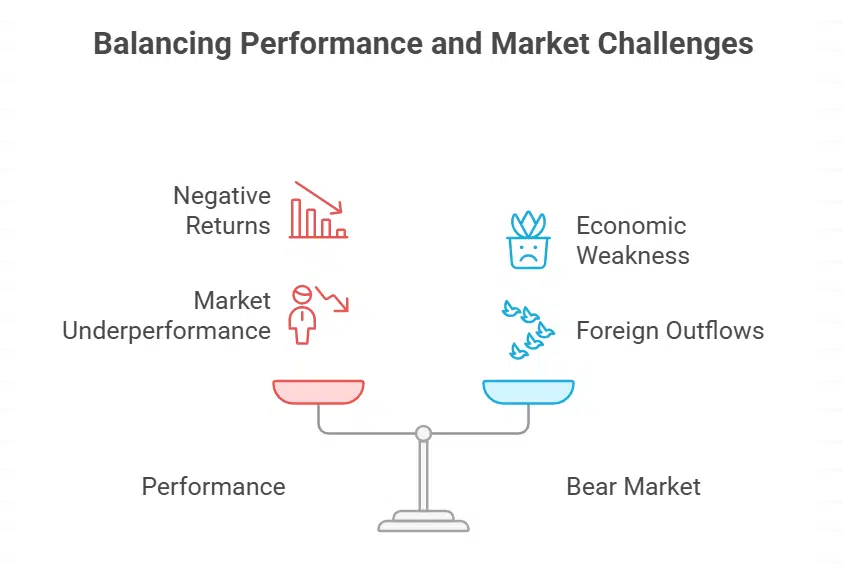
- Performance: Small Cap PMS strategies suffered the most, with an average return of -12.37% in February 2025.
- Bear Market: Small Cap stocks entered a bear market, down 20% from their all time highs, due to weak economic growth and foreign outflows.
Comparison
| Segment | Average Return (FY2025) | Volatility | Risk Level | Ideal Investor Profile |
| Large Cap | 5.52% | Low | Low | Conservative investors seeking stability |
| Mid Cap | -11.06% | Medium | Medium | Investors with moderate risk appetite |
| Small Cap | -12.37% | High | High | Aggressive investors seeking high returns |
Factors Affecting Performance
Economic Indicators
- GDP Growth: Slower economic growth impacted mid and small-cap companies more due to their domestic demand sensitivity.
- Interest Rates: Rising interest rates increased borrowing costs for smaller companies.
Valuation Concerns
- Overvaluation: Mid and small-cap segments were trading at valuations much higher than their 10-year averages and hence corrected.
Investor Sentiment
- Shift to Safety: Amid market volatility, investors moved to large-cap stocks, perceived as safer investments.
Suitability Based on Investor Profiles
Large Cap PMS
- Pros:
- Stable returns
- Lower volatility
- High liquidity
- Cons:
- Limited growth potential compared to smaller caps
- Ideal For: Investors looking to preserve capital and get steady returns.
Mid Cap PMS
- Pros:
- Balanced growth and risk
- Higher returns than large caps
- Cons:
- Market volatility
- Less liquidity than large caps
- Ideal For: Investors with moderate risk appetite seeking growth.
Small Cap PMS
- Pros:
- High growth potential
- Opportunity to invest in emerging companies
- Cons:
- High volatility
- Lower liquidity
- More susceptible to economic downturns
- Ideal For: Aggressive investors with long term horizon and high risk tolerance.
Expert View
Hari Shyamsunder says mid and small-cap stocks will outperform large-cap stocks as India’s underlying growth trends are positive for smaller companies. He believes the structural growth in India is creating a conducive environment for smaller companies to do well and hence better returns in these segments compared to larger peers.
Conclusion
Large Cap PMS have shown stability in 2025 and are good for conservative investors. Mid and small-cap are facing challenges but offer higher returns with higher risk. Investors should assess their risk appetite, investment horizon and financial goals and choose the right PMS strategy. Diversification across market caps can also help in balancing risk and return.
Disclaimer: Past performance is not a guarantee of future results. Consult your financial advisor before investing.