You open a language app, eager to learn. One minute you are repeating phrases to your phone, and the next, you wonder if those robotic voices truly help or just make things weirder. Are you really learning, or just playing a game? Many learners feel stuck picking between high-tech apps and real people for lessons.
Here is a fact: Today, AI helps at nearly every stage of learning new words and grammar. But can it replace the connection you get from a real conversation?
This post breaks down exactly how AI tutors and human teachers compare in 2026. It explores teaching styles, feedback quality, and the real value each option offers for your time and money.
Not sure which one aligns with your goals? Settle in and take a closer look at everything you need to know before making a decision.
Overview of Language Learning Apps
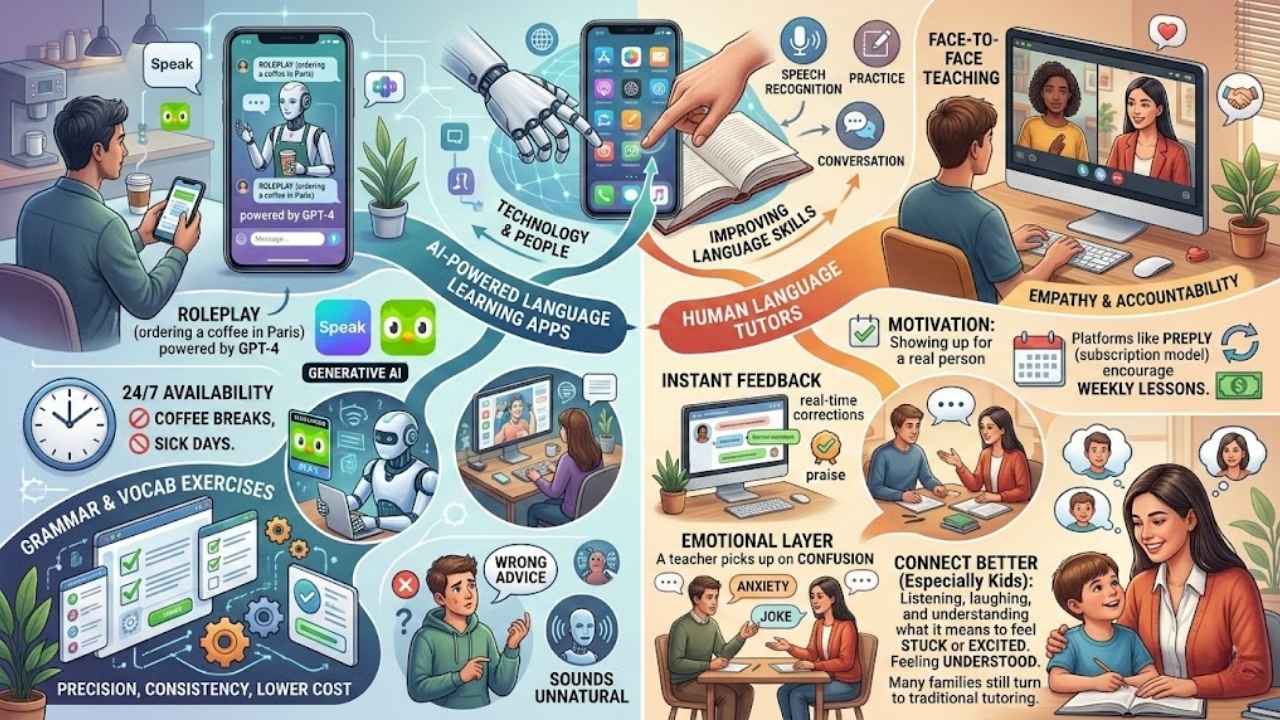
Language learning apps use smart technology and real people to help users improve their skills. Some focus on speech recognition, others on practice or conversation, all promising quicker and easier language acquisition.
The rise of AI-powered language apps
AI-powered language apps like Speak and Duolingo are shaking up digital learning. These apps use artificial intelligence at almost every stage of language acquisition, from speech recognition to creating grammar and vocabulary exercises.
Generative AI has changed the game completely. Apps like Duolingo Max now use GPT-4 to power features like “Roleplay,” where you can practice ordering a coffee in Paris without leaving your couch. It works around the clock without coffee breaks or sick days.
Teachers now lean on these tools to help learners grow their skills quickly. Even so, sometimes AI gives wrong advice about grammar or vocabulary, which trips up students. Some people notice that practicing with bots makes them speak slower or in ways that sound unnatural.
Still, more users turn to these educational technologies since they offer precision, consistency, and lower costs compared to hiring human tutors for one-on-one sessions. Meanwhile, companies push hard to make AI smart enough to replace traditional tutors entirely.
The role of human tutors in traditional language learning
Human tutors play a huge part in language learning. They do much more than just correct grammar or help with vocabulary exercises, though teachers also use AI to make these lessons.
Real teachers bring empathy and hold students accountable for their work. This accountability is key. Platforms like Preply use a subscription model to encourage weekly lessons because they know that showing up for a real person is a powerful motivator.
Face-to-face teaching methods give instant feedback but add an emotional layer that bots cannot match. Human tutors pick up on confusion or anxiety; they offer praise at the right moment or crack a joke when nerves run high.
Language isn’t only about words. It is about feeling understood in real life too. Many families still turn to traditional tutoring because kids connect better with someone who listens, laughs, and understands what it means to feel stuck or excited about learning new things.
Comparing AI Tutors and Human Tutors
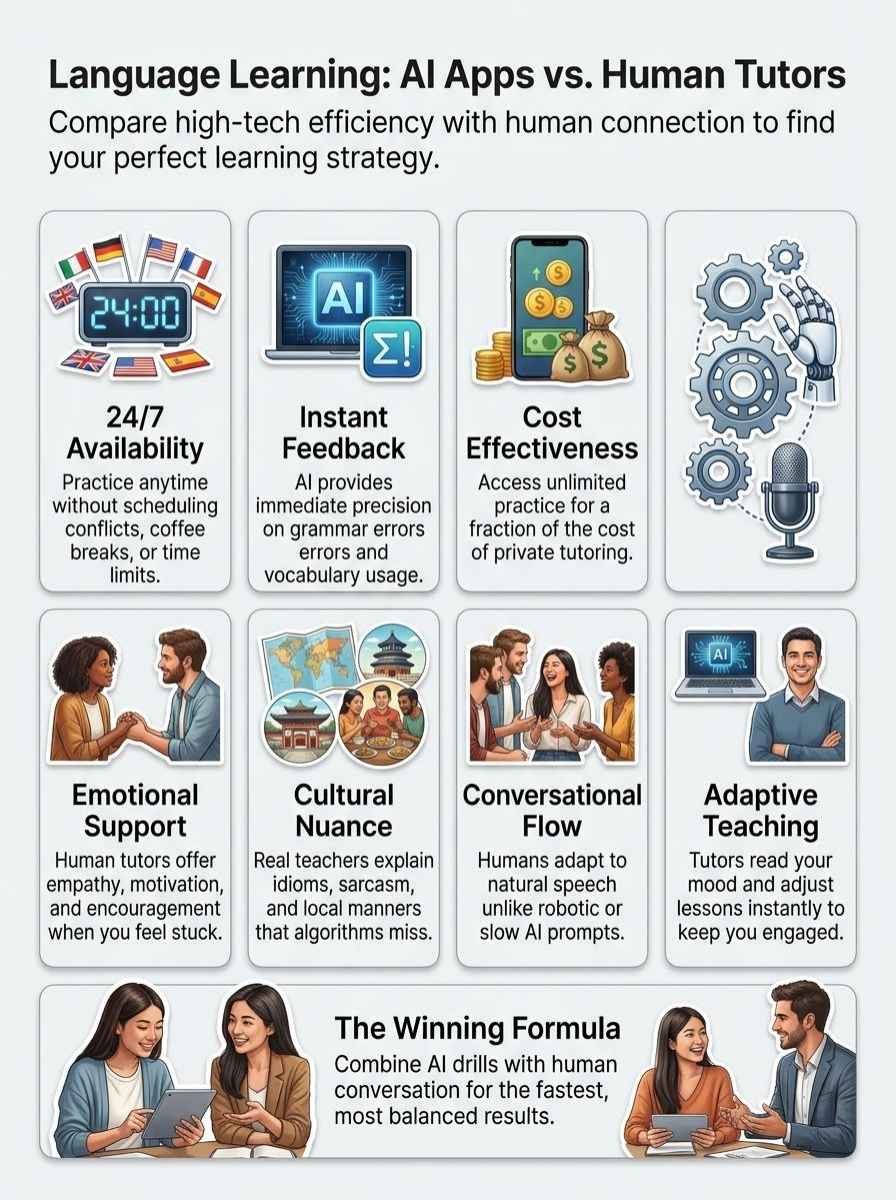
AI tutors and human tutors both help you learn, but their ways can feel worlds apart. Some learners crave a friendly face, while others prefer fast answers from an app. Let’s see what sets them apart.
Teaching methodologies
AI technology powers most language apps these days, handling drills for grammar and vocabulary. These educational apps create lessons based on speech recognition, instant feedback, and consistent repetition.
Users repeat words or short phrases to train pronunciation. Apps like Speak encourage users to talk 5 to 10 times more than traditional methods by using constant, rapid-fire prompts. This builds muscle memory fast.
Human tutors use a mix of conversation, storytelling, and real-life role play. They adjust their teaching style based on mood or progress. They might crack a quick joke if stress gets high or switch topics if your attention slips.
Tutors catch subtle mistakes that AI might miss and can make learning feel less like a math test and more like chatting at a café. Both methods shape how we pick up new languages but focus on different things: AI delivers precision while people provide heart.
Personalization in learning
AI-powered language learning apps use smart algorithms to track user progress and adapt lessons. Each learner gets practice based on their own skill level or mistakes, almost like having a digital coach that remembers every step you take.
Apps such as Speak and Duolingo adjust vocabulary and grammar exercises in real time, using speech recognition to spot weak areas fast. This brings instant feedback with each activity.
Human tutors often notice your mood or struggles before you even speak up. They offer emotional support, celebrate small wins, and can adjust teaching styles with a personal touch no screen can match.
AI may give unmatched precision and constant attention, but it sometimes provides unusual advice or encourages slow talking instead of natural conversation flow. Both approaches aim for personalized instruction. One uses data points while the other reads the room like only a person can do.
Feature Comparison at a Glance
| Feature | AI Tutor (e.g., Duolingo Max, Speak) | Human Tutor (e.g., iTalki, Preply) |
|---|---|---|
| Cost | $10 – $30 per month | $10 – $40+ per hour |
| Availability | 24/7, Instant | Scheduled appointments |
| Feedback Style | Instant correction on grammar/pronunciation | Nuanced, cultural, and conversational |
| Primary Focus | Vocabulary, drills, basic speaking | Complex conversation, culture, idioms |
Feedback and corrections
AI language tutors spit out instant feedback on grammar and word choices. Apps like Duolingo or Speak use AI technology to correct mistakes fast, track progress, and even nudge you to keep going.
Sometimes, these apps give wrong advice or teach learners to speak too slowly. Even with speech recognition tools, AI can struggle with natural conversation flow.
Human tutors offer real-time feedback based on your personality and needs. They spot small errors that an app might miss, catch awkward pauses in your sentences, and help fix them right away.
Tutors bring emotion and empathy into lessons; they encourage students after a tough day or celebrate tiny victories together. This emotional support keeps motivation alive for many learners using hybrid learning methods that mix human instruction with digital tools.
Advantages of AI Language Tutors
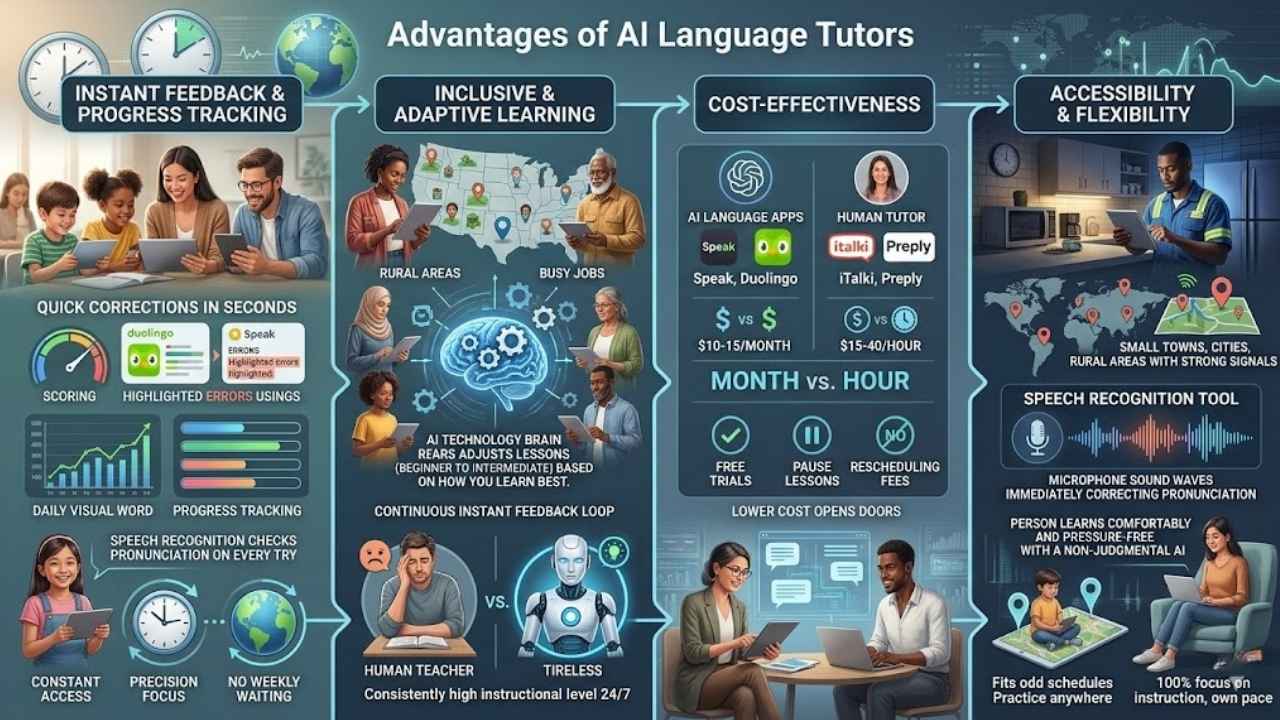
AI tutors never need a coffee break and help learners practice anytime, anywhere. Kids and adults can track progress with just a few taps, making language goals feel closer than ever.
Instant feedback and progress tracking
AI-powered language learning apps offer quick corrections within seconds. Students speak or type answers, and the app scores them at lightning speed. Tools like Duolingo and Speak highlight grammar errors right away, saving time and keeping learners focused.
These educational apps track new vocabulary words learned, showing graphs and progress bars so users can see improvement day by day.
Human tutors cannot match this nonstop attention to detail. Apps use speech recognition to check pronunciation on every try. You do not need to wait for a weekly lesson or feedback session.
Progress tracking helps students stay engaged since each small win feels rewarding. AI dedicates 100% of its focus on instruction, delivering precision that rarely fades with time or mood swings.
Inclusive and adaptive learning
AI language learning apps open doors for many people. Anyone with a phone or computer can join, making digital learning easy and wide-reaching. These educational apps use speech recognition to adjust grammar exercises and vocabulary activities based on how you learn best.
Students from different backgrounds, abilities, and ages get instant feedback, which helps keep lessons just right for their skill level.
Some apps like Duolingo or Speak work hard to let kids in rural areas or adults with busy jobs practice anytime of day. AI tutors focus fully on instruction; they do not get tired or distracted.
While human tutors split attention between lesson plans and understanding feelings, AI technology sticks closely to tracking results. Every student receives the same level of instructional support at all hours, even late at night. No need to wait for an appointment again!
Cost-effectiveness and accessibility
Apps like Speak and Duolingo make language learning cheaper than hiring private tutors. You can pay as little as $10 to $15 a month to use these educational apps.
Compare that to a human tutor. On platforms like iTalki or Preply, a single hour with a professional teacher often costs $15 to $40. That means one month of an AI app costs less than one hour with a human.
AI technology helps break down walls by offering instant feedback and grammar exercises at any time of day, no matter where you live. This opens up digital learning for people in small towns, busy cities, or even rural areas with only basic internet.
Many learners start with free trials before paying anything. It is easy to pause lessons if life gets hectic. There is no need to reschedule or lose money like you might with traditional tutoring.
Speech recognition tools help you practice saying new words right away instead of waiting for your next class. People who work odd hours find online education fits their schedules better than waiting for classroom sessions on set days and times.
AI language tutors focus 100% on instruction, making sure everyone can learn at their own pace without judgment or pressure from another person watching over them.
Limitations of AI Language Tutors
AI language tutors can trip up on jokes, sarcasm, and small talk, so stick around to see where real people still shine.
Challenges in understanding nuance and emotion
AI technology in language learning can miss jokes, sarcasm, or hints in speech. For example, someone might say “Great job,” but mean the opposite. AI-powered apps like Duolingo and Speak often take words at face value.
This causes confusion because these apps sometimes teach slow or unnatural ways of talking that do not match real-life conversation.
Human tutors pick up on tone, hesitation, and mood shifts right away. They know if a student is frustrated or needs encouragement. Digital learning systems focus only on grammar and vocabulary exercises without picking up emotion or intent behind phrases.
Insider Tip: Be careful with idioms. AI models often translate idioms literally, which can lead to awkward moments. Always double-check slang with a real person before using it in a business meeting!
Studies show learners respond better to feedback with empathy, something machines still struggle to imitate. Even though AI gives instant feedback and precise corrections, it cannot smile back after a bad joke or give a high-five for effort.
Lack of real-life conversational dynamics
AI language tutors often miss the spark you get from real talks with people. They sometimes push learners to speak slower, which sounds unnatural in busy conversations. Even though apps like Speak and Duolingo use speech recognition and smart feedback, they cannot mimic quick reactions, strong emotions, or those fun mix-ups that happen in face-to-face chats.
Human teachers can change their tone and pace to fit a lively debate or an excited story. AI struggles with this.
Real-life conversation is more than repeating words or perfecting grammar exercises. It is about reading body language, feeling surprise or humor, and picking up on sarcasm. These are little things only a person catches in real time.
AI-powered educational apps offer unmatched precision for practice drills but fall short during rapid back-and-forth exchanges you find outside the app screen. Skills built using only digital tools might leave students unprepared for real-world language twists that make learning both messy and memorable.
Ethical considerations and biases in AI
AI-powered language learning apps like Duolingo and Speak change how people learn new languages, but they come with blind spots. Sometimes these educational apps give the wrong feedback about grammar or vocabulary, leaving learners scratching their heads.
A machine can make you repeat phrases slower than needed, which sounds odd in real conversations. Speech recognition tools often miss unique accents or dialects too, showing that AI technology is far from perfect.
Bias creeps in through the data used to train learning technology systems. If developers feed an app mostly Western English accents or certain cultural phrases, it may favor one group over another without meaning to.
This issue affects digital learning for millions of users worldwide. Human tutors naturally catch those quirks and treat every person as an individual. In contrast, algorithms look at trends in numbers instead of faces and stories.
A hybrid learning approach lets human tutors provide emotional support while AI focuses on delivering instruction with precision and speed. Each fills gaps left by the other side.
Advantages of Human Tutors
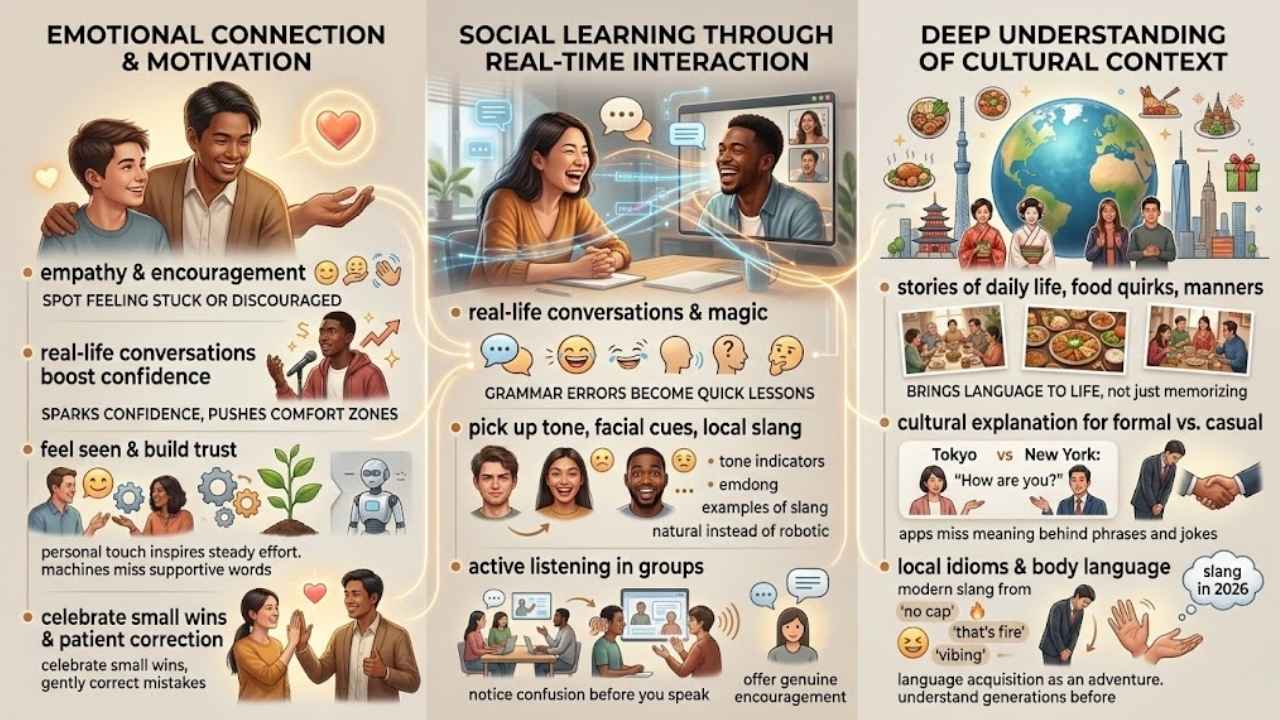
Face-to-face chats with a real person can spark quick learning and boost your confidence. Laughter, smiles, and small talk turn lessons into friendly conversations that stick with you.
Emotional connection and motivation
Human tutors bring empathy, humor, and encouragement to each lesson. They spot when a student feels stuck or discouraged. Real-life conversations spark confidence and push learners past their comfort zones.
Students often work harder because they feel seen by a person who cares about their success. That personal touch builds trust and inspires steady effort.
AI language learning apps like Speak or Duolingo can deliver clear instructions while tracking progress in real-time, but machines miss the warm smiles and supportive words that lift spirits during hard days.
Learners sometimes need more than instant feedback; they crave meaningful connection that motivates daily practice. In many cases, students show better engagement with human tutors who celebrate small wins and gently correct mistakes with patience. This is something even the smartest AI cannot fully offer yet.
Social learning through real-time interaction
Sitting face-to-face with a tutor brings the magic of real-life conversation. Laughter, nods, and puzzled looks can turn grammar errors into quick lessons. Students pick up on tone, facial cues, and even local slang.
These moments help language acquisition feel natural instead of forced or robotic.
In group settings or one-on-one online teaching sessions, learners practice active listening as well as speaking skills together. A tutor may notice confusion in your eyes before you even speak up.
This emotional connection boosts motivation and confidence for many students. Unlike pure AI technology, a human offers instant encouragement or correction that feels genuine, sometimes with a smile or small joke to break the ice.
Deep understanding of cultural context
Human tutors bring language to life. They sprinkle in stories about daily routines, holidays, food quirks, and manners. These little things often get lost with AI-powered apps like Speak or Duolingo.
An app might ace speech recognition and grammar correction but miss the meaning behind a phrase or why certain jokes land better in one country than another.
For example, a human tutor explains why saying “How are you?” sounds different in Tokyo than it does in New York City. A smile, a wave of the hand, or a slight bow have deep roots that only someone raised inside the culture can explain well.
- Context Clues: Tutors explain when to be formal vs. casual.
- Local Idioms: Learn the slang people actually use in 2026.
- Body Language: Understand non-verbal cues that apps can’t see.
Even complex idioms make sense after hearing how locals use them over coffee or at family gatherings. Language acquisition becomes more than memorizing vocabulary; it grows into an adventure filled with real emotion and understanding shaped by generations before us.
Human tutors pass down these lessons naturally. They do not rely on algorithms for cultural depth or context clues that shape words into windows of experience instead of just lines on a screen.
The Ideal Approach: Combining AI and Human Instruction
Pairing AI with human tutors creates a learning path that feels both smart and warm. It is like having a helpful robot assistant and a wise friend by your side while you practice new words.
Hybrid learning models
Hybrid learning models blend the strengths of AI technology and human tutors to boost language acquisition. AI covers grammar exercises, vocabulary development, and instant feedback while tracking your progress day or night.
Human tutors step in for real-life conversation practice, emotional support, and sharing cultural context that no app can teach alone. Duolingo and Speak are racing to create digital tools that match traditional tutoring, but mixing both forms offers better results than choosing just one.
These models adapt quickly. You get personalized instruction from AI apps plus rich social learning with a teacher. It is kind of like having your cake and eating it too! Students report feeling more motivated with hybrid approaches because they enjoy variety along with accountability.
Language learning turns into an experience that is tech-smart yet deeply human at heart.
Simple Hybrid Schedule for Busy Learners
| Day | Activity | Tool |
|---|---|---|
| Mon – Fri | 15 mins vocabulary & grammar drills | AI App (Duolingo/Speak) |
| Saturday | 45 mins conversation practice | Human Tutor (iTalki/Preply) |
| Sunday | Watch a movie or read news | Immersion |
How AI complements human tutors
AI lends a powerful hand to human tutors by handling repetitive tasks like grammar and vocabulary exercises. Language apps track progress, offering instant feedback with unmatched precision.
This frees teachers to focus on what technology cannot replace: empathy, encouragement, and real-time social learning. AI systems dedicate 100 percent of their attention to instruction, while human tutors give much-needed emotional support and cultural knowledge.
In places where speech recognition slows students down or offers awkward advice about language use, teachers step in to correct mistakes and provide context that machines miss. Apps such as Duolingo and Speak push for more digital lessons but still rely on humans for deeper understanding and accountability.
Both sides play key roles in hybrid learning models seen as the winning formula for modern language acquisition.
Future of Language Learning
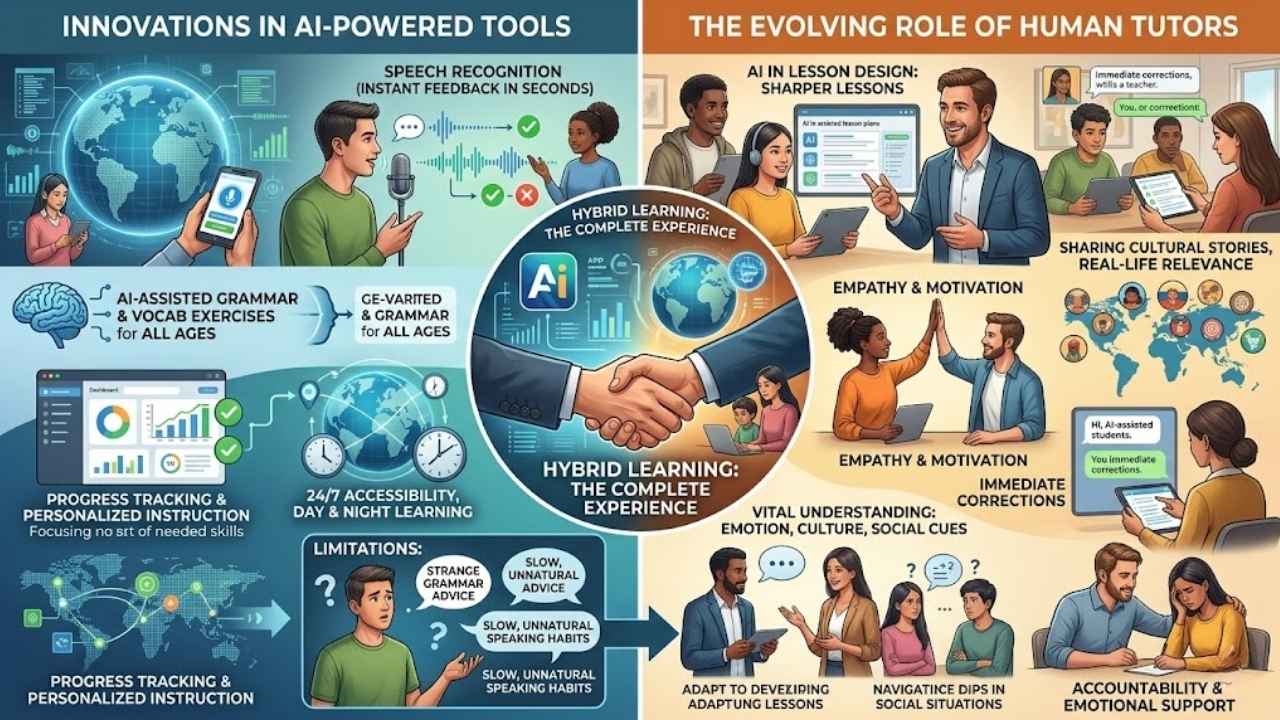
Fresh ideas in AI language tools keep surprising learners, changing how people study words and phrases. Human tutors find new ways to coach, making lessons more lively. Curious about what comes next?
Innovations in AI-powered tools
AI-powered language learning apps are racing ahead, adding fresh tricks to their toolkits. Apps like Speak and Duolingo now use speech recognition algorithms that hear your words, check for mistakes, then give instant feedback within seconds.
Teachers use AI engines daily to create new grammar and vocabulary exercises for students of all ages.
Some newer apps track your progress using smart data tools, offering personalized instruction so you work on the skills you truly need. These digital platforms run day and night, making language learning more accessible than ever before.
Even so, AI sometimes slips up with strange advice about grammar or vocabulary and may suggest a slow speaking style that feels odd in real life. Still, these innovations challenge traditional tutoring while giving learners precise support at each step.
The evolving role of human tutors
Human tutors are changing their approach as AI technology becomes common in language learning apps. Many teachers now use AI to design grammar and vocabulary exercises, making lessons sharper than ever before.
Still, students often need more than just drills and instruction. Human tutors bring empathy and motivation, something no app can match. While apps like Duolingo and Speak aim to use AI for every step, real-life educators keep learners engaged by sharing stories or correcting speech on the spot.
AI can provide fast feedback but sometimes makes mistakes with grammar advice or encourages slow, unnatural speaking habits. Human instructors offer accountability and emotional support that keeps frustration at bay during tough lessons.
These days, hybrid learning is catching on. It mixes instant digital help from language learning apps with human guidance for a complete experience. Teachers remain vital because they understand emotion, culture, and social cues while adapting lessons if progress slows down or confidence dips.
Final Thoughts
Choosing between AI language apps and human tutors is like picking between a fast train and a friendly guide on your journey to fluency. Both get you moving, but in different ways.
AI brings speed, instant feedback, and easy access right to your phone or laptop. On the flip side, a tutor offers support, real talk, and that much-needed nudge when motivation dips.
Mixing both gives you smart practice with real conversation. This helps grammar stick while building confidence to speak freely.
Why not try blending these tools for better results? Your goals are within reach if you mix tech’s efficiency with the personal spark of live teaching. Give it a go and see how far you can go!