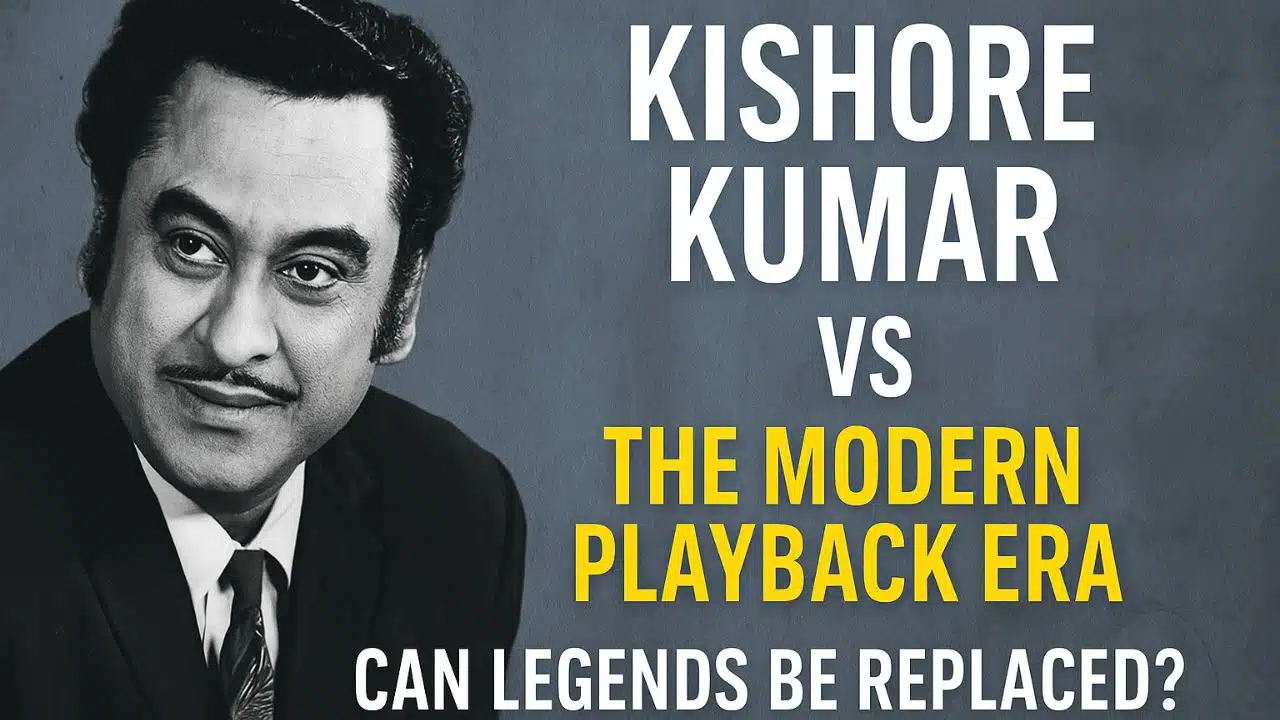
On August 4, 2025, the world remembers Kishore Kumar—India’s most beloved and eccentric playback singer—on what would have been his 96th birthday. Decades may have passed since his golden voice graced the silver screen, but his songs continue to echo through time, loved by young and old alike.
From romantic ballads to joyful jingles, his voice wasn’t just heard—it was felt. Even today, you’ll find his songs playing on Spotify, trending in YouTube reels, and remixed in Bollywood films. So, as we celebrate his legacy, a question naturally arises: Can a voice like Kishore Kumar’s ever be replaced in today’s playback-driven, digitally tuned music industry?
To find the answer, let’s take a closer look at the man himself and the modern musical world he continues to influence.
Kishore Kumar’s Legacy: More Than Just a Voice
To call Kishore Kumar merely a playback singer would be a massive understatement. He was a one-man orchestra—a singer, actor, lyricist, composer, producer, and director, all wrapped in a wildly creative and sometimes mysterious personality. Born Abhas Kumar Ganguly in Khandwa, Madhya Pradesh, he entered the Hindi film industry during an era when legends like Lata Mangeshkar and Mohammed Rafi were dominating the musical scene. Yet, Kishore carved out his own identity with a voice so unique, it didn’t need formal training to be recognized as genius.
Kishore’s singing was marked by emotional depth, playful improvisation, and genre-bending adaptability. He could sing a tragic song like “Zindagi Ka Safar” with raw vulnerability, deliver a romantic anthem like “Pal Pal Dil Ke Paas” with soulful ease, and flip the mood with humorous gems like “Ek Chatur Naar” from Padosan. His voice wasn’t confined to one category—it told stories, mimicked characters, and evoked feelings that even the best-trained vocalists might struggle to recreate.
He sang in multiple languages—Hindi, Bengali, Marathi, Assamese, Gujarati, and more—becoming a pan-Indian icon whose voice united listeners across regions. He was also one of the first singers who refused to be pigeonholed by studio conventions. His performances felt alive, unpredictable, and human.
Unlike many singers today who are often typecast into specific genres or singing styles, Kishore Kumar didn’t just sing songs—he lived them. Whether it was the mischievous “Khaike Paan Banaraswala” or the philosophical “Aanewala Pal,” his renditions are still unmatched in their spontaneity and emotional intelligence.
For millions, Kishore Kumar isn’t just a singer from the past—he is a timeless voice that continues to resonate across decades.
The Modern Playback Scene: Auto-Tune, Algorithms, and Audience Shifts

Today’s playback singing landscape looks vastly different from Kishore Kumar’s era. Technology has advanced, music production has become more streamlined, and consumer behavior has shifted dramatically. With platforms like Spotify, Apple Music, JioSaavn, and YouTube, songs now chase algorithmic trends, viral potential, and social media reach—often at the cost of artistic individuality.
Modern playback singers such as Arijit Singh, Shreya Ghoshal, Jubin Nautiyal, Armaan Malik, and Neha Kakkar have carved their own fanbases and dominate the digital charts. Their voices are polished, their renditions technically perfect, and their reach global. Yet, much of this perfection is now aided by Auto-Tune, pitch correction tools, and layered studio engineering that refine raw vocals into flawless products.
Playback singing today is no longer only about emotional storytelling—it’s a blend of market strategy, streaming optimization, and collaborative branding. Many hit songs are less about melody and more about virality—crafted to fit Instagram reels or Spotify playlists with 30-second hooks designed to grab attention fast.
Even the relationship between actors and singers has changed. In Kishore Kumar’s time, playback singers had a distinct identity, and their voices became synonymous with the actors they sang for. Kishore’s voice, for example, was the soul behind Rajesh Khanna, Amitabh Bachchan, and Dev Anand. Today, actors often lip-sync to multiple voices in a single film, diminishing that once-iconic pairing of actor and voice.
Additionally, the audience’s listening habits have changed. Many listeners consume music passively—through playlists, algorithmic radio, or background music—rather than sitting with a record and absorbing every word, every note, as they might have done in Kishore’s era.
This isn’t to say modern singers lack talent—far from it. They’re incredibly skilled, many are classically trained, and they work hard in a fast-paced, high-pressure industry. But in a world where commercial success often outweighs emotional depth, it’s worth asking: Are today’s voices touching hearts the way Kishore Kumar once did with a single note?
Emotional Expression vs Technical Perfection
One of the most defining contrasts between Kishore Kumar’s era and today’s playback scene is the shift from emotionally raw performance to technically refined execution.
Kishore Kumar didn’t rely on vocal processing or multiple takes to create magic—his voice carried emotion effortlessly. When he sang “Mere Mehboob Qayamat Hogi”, the heartbreak in his voice wasn’t engineered—it was lived. The imperfections, the breathiness, the unfiltered passion—they didn’t need editing. They were the very things that made his performances real.
Compare that with today’s mega-hits like “Tum Hi Ho” by Arijit Singh or “Raataan Lambiyan” by Jubin Nautiyal. While beautifully sung and technically excellent, these tracks often go through multiple layers of sound engineering—pitch corrections, harmony overlays, and reverb effects—to achieve sonic perfection. The result is polished and pleasing but sometimes emotionally distant.
Kishore’s genius lay in the imperfections that made his songs human. He would laugh in the middle of a romantic song, stretch a note longer than usual, or add a spontaneous hum that wasn’t in the original score. These unpredictable quirks gave his music a soul—something many modern recordings, despite their technical brilliance, often lack.
In today’s playback culture, many singers are bound by studio constraints—the tempo, the beat, the producer’s vision, and the director’s brief. Kishore, on the other hand, had the freedom to mold a song with his own instincts. He wasn’t just delivering lyrics—he was communicating feelings.
This isn’t to criticize today’s singers—many, like Arijit Singh and Shreya Ghoshal, have moved audiences to tears. But there’s an undeniable difference between emotional spontaneity and calculated perfection. Kishore Kumar had the rare ability to cry, laugh, flirt, and even philosophize—all through his voice, without needing visual cues or heavy orchestration.
In a world where music often aims to be flawless, Kishore Kumar reminds us that it’s the flaws that make a song unforgettable.
Adaptability and Creativity: Kishore Kumar the Innovator
What made Kishore Kumar truly extraordinary wasn’t just his voice—it was his unparalleled creativity and fearless adaptability. He wasn’t merely a playback singer handed a mic and a tune. He was a mad genius—someone who lived and breathed music, comedy, performance, and spontaneity.
While most singers of his time focused solely on vocals, Kishore took things further. He composed, wrote lyrics, directed films, produced music, and even acted in numerous hits. His artistic influence extended well beyond the recording booth. He directed iconic comedies like “Badhti Ka Naam Daadi” and starred in evergreen hits like “Chalti Ka Naam Gaadi”, which featured not just his acting but his signature vocal charm.
In songs like “Ek Chatur Naar” (with Manna Dey), Kishore turned a simple duet into a theatrical performance, blending mimicry, improvisation, and comedic timing in a way that’s virtually unthinkable in today’s tightly scripted studios.
What’s remarkable is that Kishore could mold his voice to fit any mood, actor, or genre. One moment he would sing like a heartbroken lover (“Yeh Shaam Mastani”), the next like a playful friend (“Paan Banaras Wala”), and then switch to philosophical musings (“Zindagi Ke Safar Mein”)—all with equal mastery.
Today’s playback singers, no matter how talented, often stay confined to certain styles or genres. Few dare to be unpredictable. Fewer still write, act, or direct their own creative projects while remaining relevant as singers.
In this way, Kishore Kumar was not just a voice—he was a creative force. He could transform an ordinary tune into a memorable experience, not through editing or effects, but through sheer instinct, wit, and a fearless sense of fun.
That rare blend of multifaceted talent, improvisational brilliance, and emotional connection is what makes Kishore not just a legend but a class apart—an artist who redefined what it meant to be a playback singer.
Cultural Relevance: Why Kishore Kumar Is Still Streaming in 2025

In an age dominated by digital-first artists and fleeting chart-toppers, it’s astonishing that a singer who passed away in 1987 is still being discovered, streamed, and celebrated by audiences in 2025. But that’s exactly what’s happening with Kishore Kumar.
His timeless tracks continue to rack up millions of streams on Spotify, YouTube, Apple Music, and JioSaavn. Whether it’s “O Mere Dil Ke Chain” playing in a romantic wedding reel or “Zindagi Ek Safar Hai Suhana” accompanying a nostalgic vlog, Kishore’s voice has found new life in the digital era.
Young listeners across India and the global South Asian diaspora are not only rediscovering his songs but actively remixing, covering, and curating them into modern playlists. Some of his tracks trend on retro-themed Instagram reels, and others make it into lo-fi remixes that Gen Z plays during late-night study sessions.
Moreover, film directors and music producers frequently revisit his classics, either through re-creations or through background scores inspired by his melodies. Even if the remixes spark controversy, they are proof of his continued relevance in pop culture.
The reason is simple: Kishore’s songs are emotionally universal. They speak of love, longing, laughter, and life—feelings that transcend time and language. His voice doesn’t just entertain; it comforts, reminds, and uplifts.
In a way, Kishore Kumar has become a musical bridge—connecting generations, genres, and geographies. While today’s singers often ride the wave of seasonal fame, Kishore’s voice is eternally fresh, echoing through speakers and hearts with undiminished charm.
Takeaways: Can Legends Be Replaced?
So, can Kishore Kumar be replaced?
The short answer is—No.
You can digitally clone a voice, remix a track, or reimagine a melody. But you can’t replicate emotion, instinct, or artistic soul. Kishore Kumar wasn’t just a playback singer—he was an era, an emotion, a musical storyteller who transcended boundaries.
While today’s playback singers are brilliant in their own right, and many have touched hearts globally, the human warmth, humor, and raw emotion Kishore brought to his music remain unmatched.
On his 96th birthday, the best tribute we can offer is this truth: Legends like Kishore Kumar are not made twice. They are not replaced—they are remembered.