

If you work from home in Dubai, you already know the problem: the sun hits your windows, your laptop runs hot, the AC works overtime, and your monthly utility costs jump fast. The good news is you can stay comfortable and still reduce DEWA bill in Dubai without turning your home office into an icebox.
This guide gives you eight practical, renter-friendly and owner-friendly ways to cool a home office in Dubai’s summer. The strategy is simple: cut heat coming in, reduce heat produced inside, and then run your cooling system smarter—based on what DEWA and UAE cooling experts often recommend, including the widely promoted 24°C thermostat target.
| What you’ll solve | Why it matters in Dubai | What to expect |
| Overheating home office | High outdoor heat + strong sun gain | More stable indoor comfort |
| AC running nonstop | Heat leaks + poor airflow | Shorter run-time |
| Rising DEWA costs | Cooling is a major load in summer | Lower electricity use over time |
Before You Start: a 10-minute “Cool Audit” for your home office
Before buying anything, do a quick audit. Most “my AC is expensive” problems are really “my room is letting heat in” problems.
Check these in 10 minutes:
- Window direction: west-facing windows often feel brutal in late afternoon.
- Gaps: under the door, around window frames, balcony doors.
- Curtains: thin decorative curtains rarely block heat.
- AC basics: thermostat setpoint, fan mode, filter cleanliness.
- Electronics heat: two monitors + a gaming PC can heat a small room quickly.
| Audit item | What to look for | Quick fix |
| Window sun exposure | Direct sunlight on desk/wall | Move desk + close curtains |
| Air leaks | Drafts, warm air entering | Weatherstrips / door sweep |
| AC settings | Very low setpoint (18–22°C) | Start closer to 24°C |
| Filter | Dust buildup | Clean/replace filter |
1. Set the AC “sweet spot” instead of overcooling
Dubai’s most repeated energy-saving advice is also one of the simplest: set your AC to around 24°C. DEWA has promoted “Set your AC to 24°C” campaigns for years, and it’s regularly cited as a comfort-and-efficiency balance.
Why 24°C works in real life
- Your AC does not need to fight as hard against the outdoor heat.
- The compressor cycles more efficiently.
- Your room stays comfortable when paired with airflow (fans).
Also, several UAE-focused guides note that each 1°C lower can raise energy use by about 5%. That means 22°C can cost noticeably more than 24°C over a month of long workdays.
Practical settings for a home office
Try this baseline:
- Working hours: 24°C in Auto mode
- Short breaks: keep it steady (don’t swing 5–6 degrees constantly)
- Leaving the room: raise the setpoint a little, or use a timer
If you’re sensitive to heat, don’t force yourself to suffer. The trick is to use airflow to make 24°C feel cooler (we’ll cover that in Tip 4).
| AC action | Why it helps | Common mistake |
| Set thermostat near 24°C | Balance comfort + efficiency | Setting 18–20°C to “cool faster” |
| Use Auto mode | Better cycling control | Running fan-only when humid |
| Use timers | Cuts wasted run-time | Cooling empty rooms |
2. Block sun heat at the window (curtains, blinds, window film)
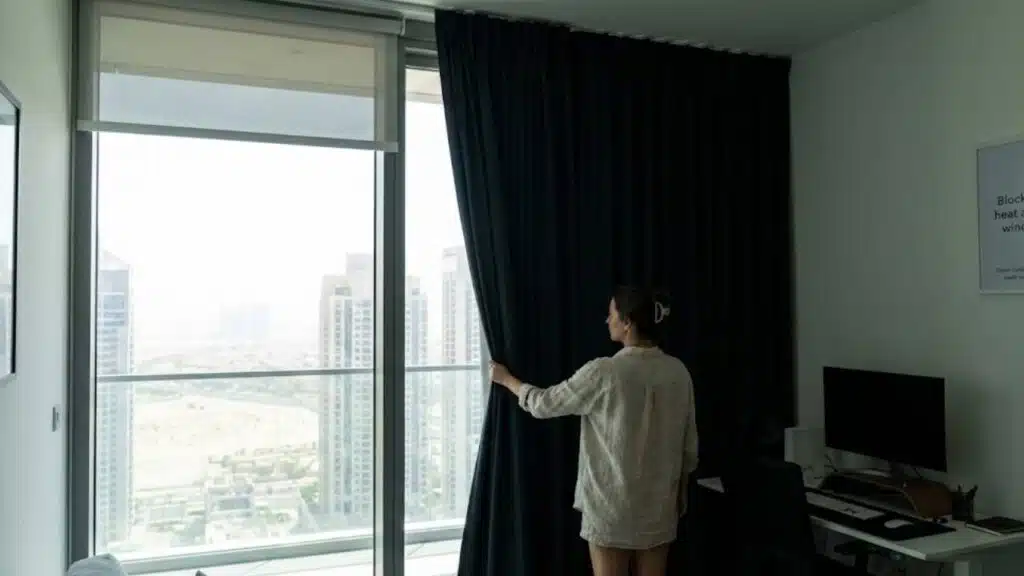
In many Dubai apartments, windows are the biggest heat entry point. Once sunlight pours through glass, it turns into heat indoors, and your AC has to remove it again.
A practical rule: before you “cool harder,” block heat first.
What to do (fast and renter-friendly)
- Close curtains during peak sun hours, especially if the window faces west.
- Use blackout or thermal curtains, or reflective roller blinds.
- If your building allows it, consider removable window film for strong afternoon sun.
This “close curtains in the day” advice appears repeatedly in UAE summer energy tips, including those shared via Empower and Gulf News summaries.
Desk placement matters more than people think
If your desk sits in a sunbeam, you feel hot even if the thermostat is low. Move the desk away from direct sun paths. Even a one-meter shift can change comfort.
| Window strategy | Best for | Why it works |
| Blackout/thermal curtains | Renters | Blocks radiant heat + glare |
| Reflective blinds | Small offices | Reduces solar gain |
| Removable window film | Strong sun rooms | Cuts direct heat and glare |
| Desk relocation | Everyone | Reduces “hot spot” feeling |
3. Seal leaks and stop cooling the whole apartment by accident
Cool air escaping is silent money loss. In Dubai’s summer, even small gaps can matter because the temperature difference is big and the AC runs long hours.
Easy sealing wins
- Add weatherstripping around door and window edges.
- Use a door sweep or draft blocker at the bottom of the office door.
- Keep the door closed if you only cool the office.
DEWA’s own reminders often include sealing doors and windows so cold air doesn’t escape.
One quick test
Close the office door, run the AC for 10–15 minutes, then check:
- Is the hallway still warm while the office is cool? Good.
- Does your room never cool properly? You may be leaking air or battling sun gain.
| Leak point | What it causes | Fix |
| Door gap | Cool air escapes | Door sweep / draft blocker |
| Window frame gaps | Hot air enters | Weatherstripping |
| Balcony door seals | Big cooling losses | Maintenance request |
| Open-plan cooling | Overcooling the home | Zone cool the office |
4. Use fans correctly (they cool people, not rooms)
Fans don’t lower air temperature. They move air across your skin, which helps sweat evaporate and makes you feel cooler.
How to use them in a home office:
- Place a desk fan so it moves air across you, not straight into your eyes.
- If you have a ceiling fan, use it to circulate air evenly.
- Turn fans off when you leave the room (they don’t cool empty spaces).
A useful general guideline: fans can improve comfort effectively in hot conditions, but they mainly help when directed at people, not to “cool the air.”
| Fan tactic | Best for | Result |
| Desk fan aimed at torso | Small offices | 24°C feels cooler |
| Ceiling fan circulation | Larger rooms | Reduces hot spots |
| Fan + steady AC | Long workdays | Less AC strain |
| Turn off when leaving | Everyone | Avoid waste |
5. Keep your AC efficient: filters, coils, and maintenance basics
A struggling AC often costs more because it runs longer to reach the same comfort level.
DEWA specifically reminds customers to clean AC filters periodically to improve efficiency.
What you can do without calling a technician
- Clean or replace filters regularly in summer (frequency depends on dust and usage).
- Keep indoor vents unblocked (don’t push the desk against vents).
- Make sure the thermostat reads correctly and isn’t in direct sun.
When to call for servicing
- It takes much longer to cool than before.
- Airflow is weak even after cleaning filters.
- You notice unusual sounds or odors.
| Maintenance step | What it improves | Simple sign it’s needed |
| Clean AC filter | Airflow + efficiency | Dusty filter, weaker air |
| Unblock vents | Even cooling | Hot/cold zones |
| Thermostat check | Accurate cycling | Room feels off vs setting |
| Professional service | Performance | Longer cooling times |
6. Cut heat from electronics and lighting (your office “internal furnace”)
Even if the sun is blocked, your devices can heat the room. In a compact home office, that heat load is real.
Fast fixes that reduce both heat and power use
- Switch to LED bulbs (UAE policy has pushed away from inefficient incandescent bulbs, and efficiency programs encourage efficient lighting).
- Enable sleep mode on monitors.
- Turn off printers and chargers when not in use.
- Use a smart power strip to cut standby load.
Work setup tips that matter in Dubai
- Laptops run hotter on beds and sofas. Use a stand for airflow.
- If you run heavy tasks (video rendering), schedule them earlier or later when possible.
| Heat source | Why it heats your room | Better option |
| Old bulbs | Waste heat | LED lighting |
| Two always-on monitors | Constant heat + energy | Sleep timers |
| Chargers & adapters | Warm standby draw | Switch off at strip |
| Desktop towers | High heat output | Better ventilation + schedule tasks |
7. Manage humidity and airflow so 24°C feels comfortable
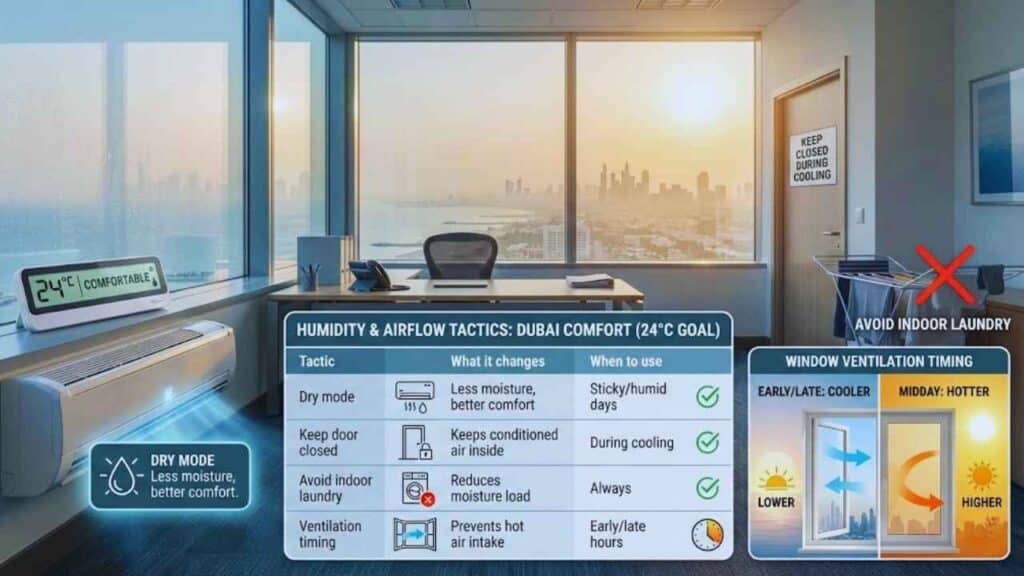
Dubai heat can feel worse when humidity is high, especially near the coast. Average humidity patterns vary by month, but it’s common to see “sticky” days where comfort drops even if temperature stays similar.
What to do in a home office
- Keep the office door closed while cooling.
- Use “Dry mode” when it makes sense (it can improve comfort by removing moisture).
- Avoid drying laundry inside the office.
Window ventilation timing
If outdoor air is hotter than indoor air, opening windows may make the room worse. If you want fresh air:
- Try early morning or late evening when outdoor temperatures are lower.
| Humidity tactic | What it changes | When to use |
| Dry mode | Less moisture, better comfort | Sticky/humid days |
| Keep door closed | Keeps conditioned air inside | During cooling |
| Avoid indoor laundry | Reduces moisture load | Always |
| Ventilation timing | Prevents hot air intake | Early/late hours |
8. Build a “cool schedule” around Dubai peak heat and your workday
Dubai’s summer heat is intense. In recent years, the UAE has seen extreme temperatures, and summer peaks can push cooling demand high. DEWA campaigns also encourage shifting energy-intensive use away from peak load hours (often cited as around 12pm–6pm in DEWA summer messaging).
A simple schedule that fits most home-office routines
- Start of work: pre-cool the room briefly, then hold steady.
- Midday peak: keep curtains closed, reduce indoor heat sources.
- Breaks: avoid turning AC fully off if the room heats quickly; use a timer instead.
- Evening: maintain comfort with fan support.
Zone cooling is your best friend
If your work is in one room, don’t cool the whole home:
- Close other room doors.
- Seal the office better.
- Keep airflow focused in the office.
| Scheduling move | Why it helps | Example |
| Pre-cool briefly | Reduces “catch-up” cooling | 15–20 mins before calls |
| Curtains closed midday | Cuts solar gain | 12pm–6pm focus |
| Use timers | Prevents waste | Timer during lunch |
| Zone cooling | Less total load | Cool office only |
How to reduce DEWA bill in Dubai with smart airflow
Smart airflow is one of the easiest ways to stay comfortable while using less AC. The goal is not to “cool the air” with fans. It’s to make your body feel cooler, so you can keep the thermostat higher (often closer to 24°C) and still work comfortably—something DEWA regularly encourages for energy savings.
When you combine airflow with sensible shading and sealing, you usually reduce how long the AC must run. Over a month, that’s a practical path to reduce DEWA bill in Dubai without sacrificing comfort.
| What airflow improves | Why it helps your DEWA costs | Best paired with |
|---|---|---|
| Perceived coolness | You can tolerate a higher AC setpoint | 24°C setpoint |
| Temperature consistency | Fewer “hot spots” make you lower the thermostat less | Curtains + sealing |
| AC run-time | Less cooling demand over long hours | Zone cooling |
Why airflow helps you spend less on cooling
In Dubai summer, most people pay for two things:
- Removing heat that enters the room (sun, hot air leaks)
- Removing heat generated inside (people and electronics)
Airflow doesn’t remove heat from the room the way an AC does. It makes you feel cooler by increasing evaporation and reducing the “stuffy” feeling. That means you can:
- Set the thermostat higher
- Use AC for shorter periods
- Avoid extreme settings like 19–21°C that increase consumption
Many Dubai/UAE energy-saving guides push the “set AC to 24°C” message because it balances comfort and energy use. Airflow is the tool that helps 24°C feel good during long work hours.
| Comfort problem | What people do (expensive) | Better airflow-based fix |
|---|---|---|
| Room feels warm at 24°C | Drop to 21–22°C | Add fan + adjust direction |
| Hot spot near desk | Lower thermostat | Move desk + circulate air |
| “Stuffy” room | Blast AC longer | Improve circulation + sealing |
Best fan choices for a Dubai home office
You don’t need a fancy setup. Choose the fan that matches your room size and layout.
- Desk fan: best for focused cooling while seated.
- Pedestal fan: better for larger rooms or shared spaces.
- Ceiling fan: great for smoothing temperature differences (if available).
Key point: fans should be aimed at people, not at the ceiling, and they should be off when the room is empty.
| Fan type | Best for | What to watch |
|---|---|---|
| Desk fan | Single-person office | Avoid drying eyes (angle lower) |
| Pedestal fan | Medium room | Noise level for calls |
| Ceiling fan | Whole-room comfort | Correct direction and speed |
Fan placement that actually works (simple layout rules)
Use these placement rules to avoid wasted airflow:
-
Aim across your body, not directly at your face: Direct wind to the face can cause dry eyes and headaches during long screen time. Angle it toward your upper body or legs.
-
Push air through the “hot zone”: If your room has a sunny wall or a warm corner, point the fan so it moves air out of that zone and mixes the room air.
-
Create a gentle circulation loop
The best setup is often:
- Fan on one side of the desk
- AC vent unobstructed
- Door closed to keep cooled air inside
-
Keep vents and returns clear: Don’t place shelves, curtains, or large monitors blocking AC vents. Restricted airflow makes AC work harder.
| Placement rule | Why it matters | Quick check |
|---|---|---|
| Don’t blow into eyes | Better comfort for long work | Eyes not dry after 1 hour |
| Mix hot corners | Stops “one warm side” feeling | Room feels even |
| Clear AC vents | Improves cooling efficiency | Strong airflow at vent |
The “zone cooling” method (most effective for DEWA savings)
If you work in one room, cool that room—not the whole home.
Steps:
- Close the office door during work hours.
- Add a door draft blocker if there’s a gap.
- Keep curtains closed on sun-facing windows.
- Use a desk fan so 24°C feels comfortable.
This matches the logic behind DEWA’s efficiency messaging: reduce wasted cooling and keep reasonable temperature settings like 24°C.
| Zone cooling step | Impact | Cost |
|---|---|---|
| Close the door | Keeps cool air in | Free |
| Draft blocker | Cuts leakage | Low |
| Curtains midday | Reduces sun heat | Low–medium |
| Fan + 24°C | Comfort with less AC | Low–medium |
A simple “24°C + fan” routine for office hours
Use this routine for a typical Dubai workday:
- 10–15 minutes before work: cool to 24°C, curtains closed
- Working: keep 24°C steady + fan on low/medium
- Short breaks (10–20 min): keep settings steady or use a timer
- Leaving the office for longer: raise thermostat slightly or switch off, depending on how fast the room heats
This approach is designed to avoid extreme cooling and long recovery cycles, while aligning with the UAE’s common 24°C efficiency guidance.
| Time block | What to do | Why |
|---|---|---|
| Before work | Close curtains, set 24°C | Prevent heat gain |
| Work hours | Fan + steady setpoint | Comfort without lowering temp |
| Short breaks | Timer, don’t swing temp | Prevent wasted cooling |
| Long breaks | Raise setpoint slightly | Reduce run-time |
Mistakes that cancel out airflow savings
Avoid these common issues:
- Leaving fans on in an empty room (no comfort benefit)
- Putting a fan behind a monitor (airflow blocked)
- Blocking AC vents with furniture
- Opening the office door while cooling (you start cooling the whole home)
- Lowering thermostat because the room “feels stuffy” instead of improving circulation
| Mistake | What happens | Better fix |
|---|---|---|
| Fan runs all day empty | Wasted electricity | Switch off when leaving |
| Vents blocked | Longer AC cycles | Rearrange furniture |
| Door open | Higher cooling load | Zone cool the office |
| Drop thermostat to “feel air” | Higher bill | Improve airflow direction |
Practical “Do This First” plan (renters vs owners)
Not every home office in Dubai needs expensive upgrades to stay cool. The fastest results usually come from fixing the basics that cause heat build-up and wasted cooling. This section helps you focus on what actually works first, based on whether you rent or own your home.
Dubai apartments vary widely in insulation quality, window exposure, and AC efficiency. Because of that, a one-size-fits-all solution rarely works. The key is to prioritize actions that give comfort and cost benefits without locking you into major changes. For renters, flexibility and low-cost fixes matter most. You want improvements that are easy to install, easy to remove, and still effective during peak summer months. For homeowners, the goal shifts toward long-term efficiency. Permanent upgrades may cost more upfront, but they can deliver better comfort, lower cooling demand, and a more stable path to reduce DEWA bill in Dubai over time.
Use the two checklists below as a starting point, then adjust based on your room size, sun exposure, and daily work hours.
If you rent (highest impact, low commitment)
- Set AC to 24°C baseline and use Auto mode
- Close curtains during the day
- Seal door gaps and window leaks
- Add a desk fan for comfort (so you keep 24°C)
- Clean the AC filter
If you own (longer-term value)
- Better window solutions, shading, insulation improvements, and higher-efficiency cooling equipment (look for UAE efficiency labels).
| Persona | Best first upgrades | Why |
| Renter | Curtains + sealing + fan | Fast comfort gains |
| Owner | Window improvements + efficient systems | Long-term savings |
Takeaways
Dubai summers are tough on home offices, but the fix is not “run the AC harder.” Start by blocking sun, sealing leaks, and cutting heat from electronics. Then run your cooling smarter—especially by aiming near 24°C and using airflow to stay comfortable.
If your goal is to reduce DEWA bill in Dubai, focus on the combination that matters most: less heat coming in, less heat generated inside, and fewer wasted cooling hours. Stick to it for a month, track your usage, and you’ll feel the difference in both comfort and cost.






























