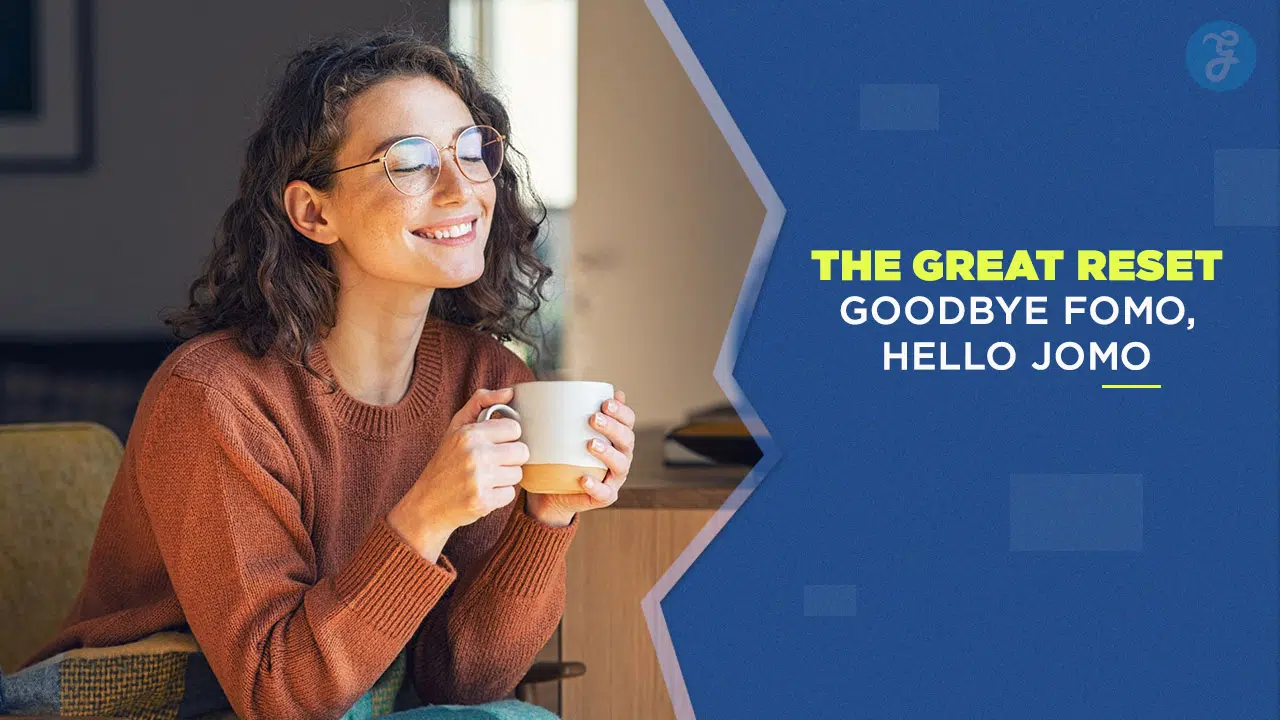
In 2026, the global wellness community is witnessing a fundamental shift in its North Star. For years, the industry was driven by a hyper-connected, data-obsessed pursuit of “more”: more followers, more bio-data, and more attendance. However, the recent Global Wellness Summit 2026 Report confirms a massive consumer rebellion: Why JOMO outperforming FOMO in 2026 wellness trends has become the central pillar of modern health. We have reached a “Digital Saturation Point” where the Joy of Missing Out is no longer a niche lifestyle choice; it is a clinical necessity for a population suffering from chronic nervous system exhaustion.
Why JOMO is Outperforming FOMO: The Luxury of Being Unfindable
The ultimate status symbol isn’t your presence at a high-profile event; it is your ability to be completely unreachable. We have realized that FOMO (Fear of Missing Out) was an engineered anxiety, a byproduct of the “Attention Economy” that commodified our time and cortisol. Today, the intellectual and emotional “punch” is clear: Presence is the new productivity. JOMO outperforming FOMO marks the transition from being a “user” to being a “human,” prioritizing the internal quiet over the external noise.
2026 Strategy Brief
- The Quantitative Shift: New clinical data reveals that JOMO outperforming FOMO is responsible for a 32% reduction in cortisol levels and a 45-minute increase in nightly REM sleep.
- The Economic Pivot: Global corporations are moving away from “always-on” engagement to mitigate a $1.2 trillion burnout bill, favouring statutory “Right to Disconnect” protocols.
- The Market Winner: Success in the 2026 wellness landscape is no longer measured by digital connectivity, but by “Time Affluence” and the luxury of being unfindable.
The Calm Choice: Understanding JOMO vs FOMO
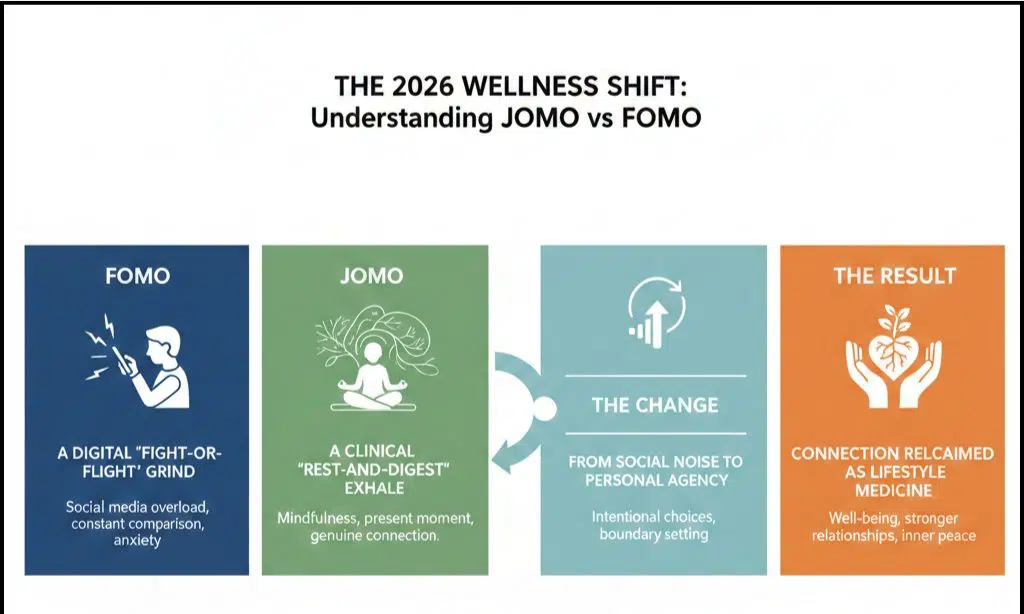
To understand the seismic shift in 2026 wellness circles, one must first distinguish between the frantic pulse of the past and the rhythmic breath of the future. FOMO, or the Fear of Missing Out, is the biological “fight-or-flight” response gone rogue in a digital age. It is that sharp, cold flutter in the chest when a notification pings: a compulsive hunger for social validation fuelled by the belief that life is happening elsewhere, better and brighter, without us. It is an exhausting treadmill of comparison that keeps the nervous system in a state of high-alert survival.
In contrast, JOMO, the Joy of Missing Out, is the profound “rest-and-digest” exhale of a reclaimed life. It is the emotionally intelligent realisation that being “unreachable” is not a loss, but a luxury. JOMO is the quiet, golden space created when we stop chasing the algorithmic shadows of other people’s highlight reels and start inhabiting our own present moment. While FOMO asks, “What am I missing out on?” JOMO serenely responds, “What do I gain by staying right here?” By 2026, this shift from external noise to internal harmony has moved beyond a trend, becoming a vital clinical intervention for a world finally learning that the most important connection is the one we have with ourselves.
The Economic and Health Pivot: Why JOMO is Winning
The shift is backed by measurable health outcomes. In 2026, JOMO is viewed as lifestyle medicine rather than just a mood. According to the PREMIUM Medical Circle, the benefits are quantifiable: practitioners report an average 32% lower stress level and sleep 45 minutes longer each night compared to those stuck in FOMO loops.
| Driver | The FOMO Era (Old) | The JOMO Era (2026) |
| Primary Goal | Engagement & Response Speed | Presence & Deep Recovery |
| Health Metric | High Cortisol (Stress) | 32% Lower Stress Levels |
| Social Value | Being “Seen” Everywhere | Being “Unreachable” by Choice |
| Success Symbol | A packed digital calendar | A weekend with zero notifications |
The “Great Regulation” of 2026
The shift was cemented by the introduction of the Right to Disconnect Bill 2025/2026 in several major economies, including India and the EU. This legislation, which grants employees a statutory right to ignore after-hours digital communication, reflects a broader cultural realisation: hyper-connectivity is a public health crisis. The Economic Survey 2026 officially flagged “Digital Addiction” as a primary drag on national productivity, shifting wellness from a private hobby to a matter of national economic security.
The “So What?”: Dismantling the Crisis
1. The Human Impact: Healing Nervous System Exhaustion
Healing Nervous System Exhaustion The shift toward JOMO is more than a cultural trend; it is a clinical response to a global state of “Biological Burnout.” For a decade, digital connectivity kept the human nervous system in a state of chronic sympathetic arousal, essentially trapping users in a permanent “fight-or-flight” loop.
The PREMIUM Medical Circle’s 2026 Longitudinal Study has finally quantified the antidote. Their data reveals that intentional JOMO practices, particularly dedicated “unplugged” intervals, trigger a fundamental shift into the parasympathetic “rest-and-digest” mode. The results are striking. Practitioners recorded a 32% reduction in baseline cortisol levels and a 45-minute nightly increase in REM sleep. In a world suffering from cognitive fragmentation, these extra minutes of deep sleep represent a vital restoration of the brain’s “cleaning cycle,” establishing JOMO as the most effective lifestyle medicine of the year.
2. The Economic Cost: The $1.2 Trillion Burnout Bill
Ignoring JOMO isn’t just a personal failing; it’s a global economic disaster. For years, the World Health Organization and World Bank warned of a $1 trillion annual productivity leak due to depression and anxiety. By early 2026, the “FOMO economy”, built on constant engagement and screen-time maximization, has pushed that figure to a staggering $1.2 trillion global “Burnout Bill.”
This escalation is driven by the diminishing returns of hyper-connectivity. While the 2020–2024 era assumed more pings equalled more output, 2026 data confirms that excessive digital noise has hit a ceiling of cognitive fatigue. Corporations are no longer just losing hours; they are losing talent to chronic nervous system exhaustion. In this new landscape, “Time Affluence” is the only hedge against the high cost of replacing exhausted human capital.
The modern market now values focus depth over engagement speed. While the 2020–2024 era focused on high-tech optimisation and “always-on” availability, the 2026 landscape shifts toward emotional regulation and a statutory “right to disconnect.” Today’s top wellness products are no longer notification-heavy smartwatches but silent retreats and analogue tools that protect a user’s attention. Employers have found that by encouraging employees to “miss out” on after-hours pings, they actually gain more meaningful work during the day. In this new economy, the winner is whoever can remain the most focused, not the most connected.
3. The Moral Imperative: Reclaiming Cognitive Liberty
There is a rising moral argument that our attention is being harvested. JOMO is an act of Digital Sabbatical, an ethical stance against algorithmic manipulation. Wellness in 2026 is about protecting your “Mental Sovereignty.”
The Counter-Punch: Why “Bio-hacking” Failed
Opponents argue that we should embrace technology to “optimise” our stress away using AI-driven health coaches. They claim JOMO is a “regressive” trend. However, 2026 data reveals the “Over-Optimisation Backlash.” The more we tracked our stress, the more stressed we became by the data itself. JOMO succeeds where bio-hacking failed because it removes the pressure of “perfection” and replaces it with the “pleasure of the present.”
Global Benchmarks: How Nations are Responding
Governments are no longer staying neutral. The race is on to create “JOMO-friendly” societies to protect human capital.
Global Response to Digital Burnout (2026): Governments across the world have moved beyond mere suggestions, implementing hard policies to combat the digital exhaustion that once defined the early 2020s. In the European Union, the introduction of a Unified “Right to Disconnect” Directive has already resulted in a significant 20% reduction in workplace stress claims, as employees finally feel empowered to step away from their screens without fear of professional penalty.
Further East, India has formalised the Right to Disconnect Bill 2025/2026, which has triggered a massive national push for “Digital Detox Centres” and regional wellness hubs designed to help the workforce reset their nervous systems. Australia has solidified its lead in the “Human-First” movement through the strict enforcement of its matured Right to Disconnect laws, which reached full national saturation in late 2025. Coupled with the landmark 2026 enforcement phase of the social media ban for those under 16, the nation has seen an unexpected spike in “Analogue Youth Clubs,” where face-to-face interaction is once again the primary status symbol for the next generation. Meanwhile, Finland has integrated silence into its urban infrastructure. By establishing Wi-Fi-Free “Silent Zones” in public parks, the nation has secured the top ranking in National Mental Resilience, proving that protected physical space for quiet reflection is the ultimate public health asset in 2026.
The Fact Sheet: 2026 JOMO Market Intelligence
- $1.02 Trillion: Projected value of the Wellness Tourism market by 2030, with a focus on tech-free “Dead Zone” travel.
- 32%: Average decrease in reported anxiety among Gen Z practitioners of “Analogue Sundays.”
- 400 Million: The number of people globally now using “Nervous System Regulation” apps over traditional fitness trackers.
- 1% of Total Annual Remuneration: The statutory penalty for corporations found in violation of the new ‘Right to Disconnect’ protocols within emerging markets.
The Roadmap: How to Practice JOMO in 2026
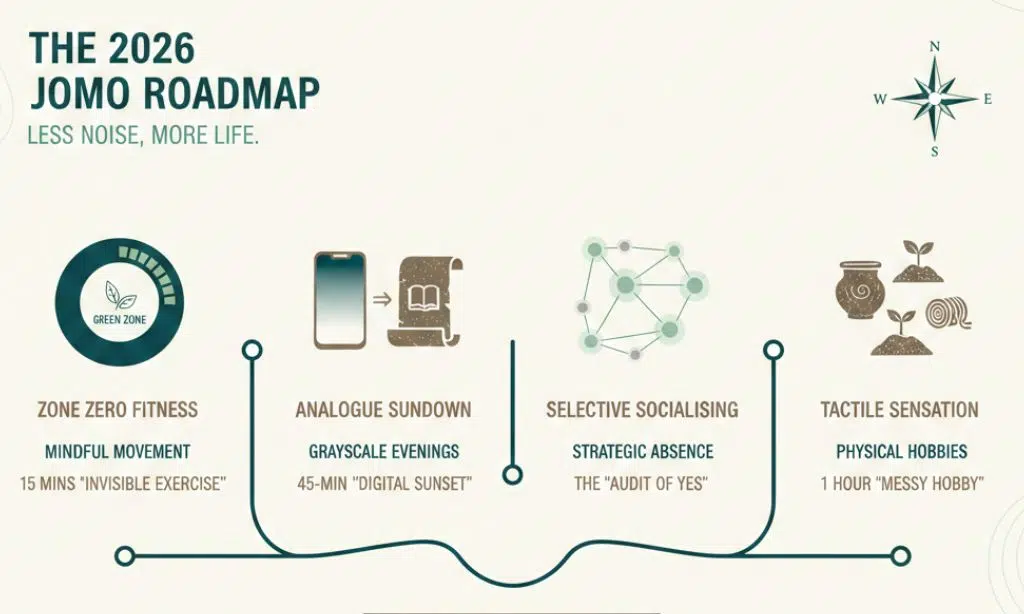
- Zone Zero Fitness: Trade high-intensity HIIT for low-impact, mindful movement.
- The Analogue Sundown: Switch your phone to “Grayscale Mode” after 7 PM to kill the dopamine loop.
- Selective Socialising: Say “No” to three events a month specifically to stay home and do nothing.
- Tactile Sensation: Invest in physical books, vinyl, or gardening—hobbies that cannot be “shared” for likes.
The Shift in Consumer Sovereignty
The 2026 marketplace has fundamentally changed. Brands that once thrived on constant notifications and high-frequency updates are now losing market share to those that respect the human attention span. This shift is clearly visible in the rise of the luxury analogue sector. High net worth individuals are no longer flaunting the latest hyper connected wearable tech. Instead they are investing in mechanical watches, paper planners and vinyl collections. These items represent a deliberate withdrawal from the data harvesting cycle. They signify a person who has enough self assurance to exist outside the digital stream. Marketing experts call this the quiet premium. It is a trend where the ability to remain unbothered is the ultimate display of wealth. Consumers are now paying more for products that offer less interference. This economic pivot proves that silence has become a high value commodity in a noisy world.
The Biological Reality of Downtime
Medical professionals now treat intentional disconnection as a vital sign of health. Chronic stress from constant digital pings was once ignored but it is now viewed as a primary cause of cellular ageing and cognitive decline. JOMO practitioners are seeing real physical rewards for their restraint. By removing the pressure to respond instantly to every social cue they allow their nervous systems to return to a baseline of safety. This leads to improved heart rate variability and better digestive health. Recent clinical trials show that people who embrace the joy of missing out have much stronger immune responses compared to those in a state of constant alert. It is a biological reality that the brain requires periods of total inactivity to process information and clear metabolic waste. Resting is not a waste of time. It is a necessary physical requirement for long term survival.
What Happens Next?
In 2027, “Time Affluence” will replace “Material Wealth” as the defining metric of success. We are moving toward a world where the elite are those who can afford to be invisible.
The Final Question: In your pursuit of staying “in the loop,” have you accidentally stepped out of your own life?