Are you tired of long waits for checkups and test results? You might feel lost in a maze of appointments and digital charting. Many treatments follow a one-size-fits-all plan, and you may feel like just a number.
Precision medicine, also called personalized medicine, offers a way to match treatments to your body. And ultrasound diagnosis can catch problems early.
In May 2024, 150 startups joined BioMed Israel in Tel Aviv. We will tour 20 Israeli HealthTech Companies Revolutionizing Medical Care. You will learn how they use data models, remote monitoring, and digital charting to speed up care and cut costs.
Keep reading.
Key Takeaways
- In May 2024, Tel Aviv hosted BioMed Israel with 150 startups, and 20 HealthTech firms like AISAP (2022) and AIVF (2018) showed AI ultrasound, IVF AI, and cancer therapies.
- Aidoc’s AI scans X-rays and CTs in seconds across hundreds of U.S. hospitals, while In-House Health and Assuta cut errors with AI nurse schedules and vital-sign monitoring.
- Nucleai maps tumors at the molecular level with over 60% of top 20 pharma, and Pangea Biomed’s ENLIGHT (2018) uses ML and bioinformatics to guide cancer treatment via EMR links.
- Datos Health, Motion Informatics’ Stimel-03, and Epilog (2022) offer 24/7 wearables, care apps, and AI chat to track patients, boost telehealth, and catch risks early.
- Innoventric (2016) builds a transcatheter valve solution to avoid open-heart surgery, and Nevia Bio (2020) uses swab tests and ML to spot ovarian cancer and endometriosis early.
Key Trends in Israeli HealthTech
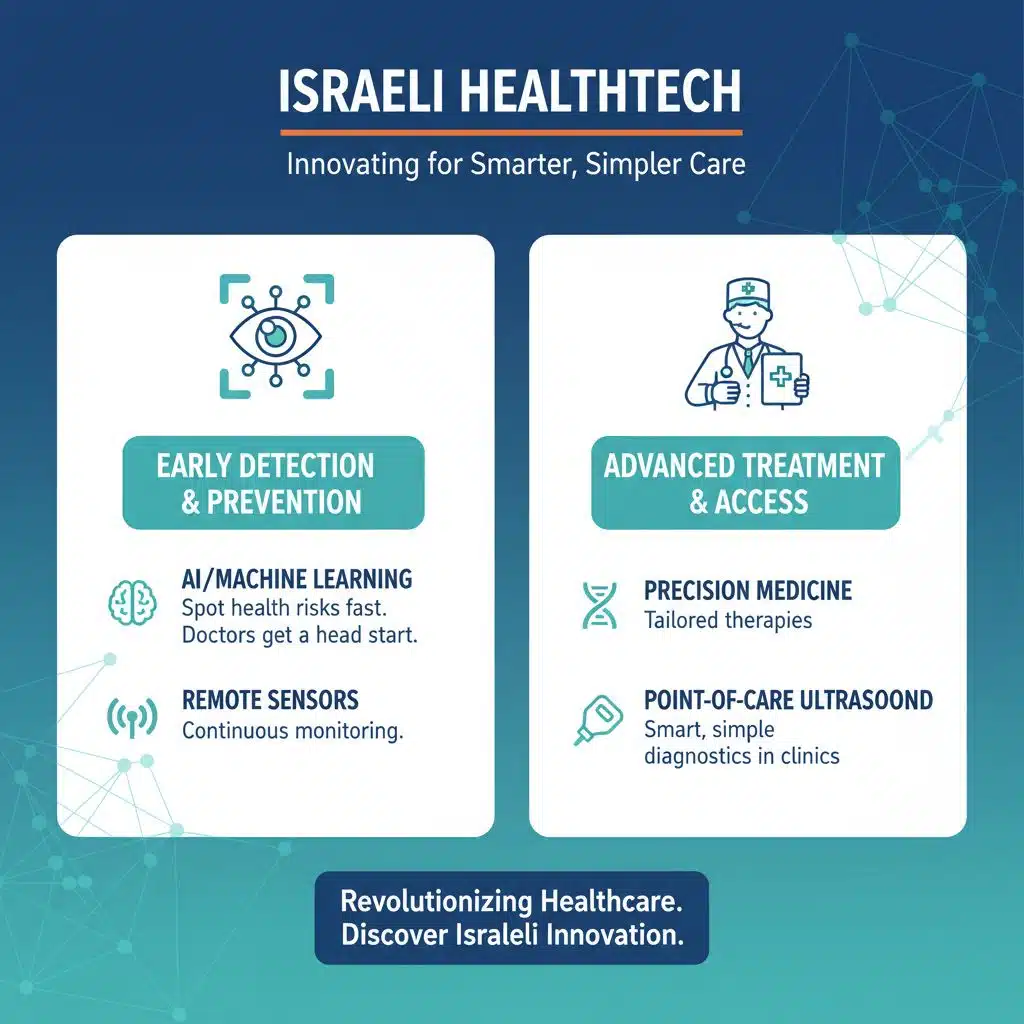
Israeli firms tap machine learning, remote sensors, and generative AI to spot health risks fast, so doctors get a head start on treatment. They also push precision medicine tools and point-of-care ultrasound kits into clinics, making care smart and simple.
How is AI and automation transforming healthcare?
That continuous data analysis platform from Aidoc scans X-rays and CT data in seconds. Hospitals run its tool in hundreds of U.S. healthcare systems. Nurses get automated shift plans with an AI workload prediction engine from In-House Health and Assuta.
Clinical teams see fewer errors in vital sign monitoring and image reviews. A clinical documentation assistant records doctor notes, then writes summaries in real time. This care note automation frees doctors to focus on patients.
AI tools boost decision-making, cut delays, and lower costs across digital health.
An AI driven protein design tool churns out custom antibodies fast for cancer care and precision medicine. Labs use this system in drug discovery and clinical trials. Machines handle big data from monitors, and AI scales research and operational tasks.
A survey of 490 people, including 113 healthcare professionals and 115 investors, found that the sector ramps up artificial intelligence in healthcare. Companies build more medical devices with machine learning modules.
Care teams spot risks sooner, and trial teams speed up drug candidate tests with AI models.
What are the latest advancements in precision medicine?
Israeli startups now power precision medicine with clinical AI tools. Nucleai builds a spatial biology platform that maps tumors at the molecular level. It works with more than 60% of top 20 pharma firms.
Labs use blood tests to spot cancer early. Liquid assays track tiny bits of tumor DNA in plasma. Regulators and payers still slow tests with tight rules on coverage. Clinical AI still fights for reimbursement in U.S. healthcare systems.
Pangea Biomed blends molecular biology, bioinformatics, and machine learning to guide cancer care. Its ENLIGHT platform spots gene mutations and tracks gene activity. Curesponse mixes genomic profiling and live tumor screens to pick drug candidates.
MDclone and LynxMD focus on health data security and analytics to speed up r&d. Other startups build combo screens to find new therapeutic agents. Labs turn to research automation tools to cut costs and fire up drug discovery.
How do remote monitoring solutions improve patient care?
Remote monitoring tools connect patients and doctors through digital health tech. Nurses track vital signs around the clock via wearables and connected devices. Datos Health offers a remote care platform that blends monitoring, care, and patient engagement with Patient CareApps.
Stimel-03 by Motion Informatics drives rehab, muscle training, and pain relief in the U.S. and India. Epilog’s chat program supports folks with serious illnesses, boosting telehealth access.
APIs address past IT clashes and let new modules plug in smoothly. Clinical ai sifts data fast, flagging trouble before patients feel pain. It acts like a 24/7 safety net for frail folks at home.
Systems track health trends, boost patient care, and speed early diagnostics. Hospitals adopt precision medicine models thanks to this digital health boost.
20 Israeli HealthTech Companies Revolutionizing Medical Care
They apply AI, digital microscopy and machine-learning models to advance precision diagnostics, speed drug development and shape personalized medicine. They build medical devices, e-records systems and medical technology that transform point-of-care, remote monitoring and hospital workflows.
What does AISAP specialize in?
Founded in 2022 in Ramat Gan, AISAP builds an AI-powered point-of-care ultrasound diagnosis platform. POCAD runs in real time on a cloud-based system. It taps machine-learning and clinical AI to speed precision diagnostics.
That helps tailor personalized treatments at the bedside. Engineers designed it for multi-organ screening with one device. The team aims to cut costs and boost access to medical devices.
CARDIO software got FDA clearance for heart exams. Clinicians can run multi-disease scans in seconds. The platform drew praise in a 2025 survey of 490 respondents as a top 10 Israeli health tech company.
Respondents noted its ability to deliver actionable insights at the patient’s bedside.
What technologies does AIVF develop?
AIVF set up shop in Tel Aviv in 2018. The team crafts artificial intelligence (AI) models to boost in vitro fertilization (IVF) efficiency and cut costs. Its tools blend computer vision, data analytics, and AI models to spot healthy embryos.
Clinicians tap AI dashboards to rank candidates. Patients see faster cycles and fewer visits.
Machine learning powers its platform. It draws on time-lapse imaging and patient data. The system links with electronic medical records to share insights at the point of care. Lab teams use clinical AI to fine tune treatment.
Global clinics adopt its tech to tackle fertility challenges.
How does AlonBio innovate in HealthTech?
AlonBio began in 2021 in Ness Tziona as a biotechnology startup. The firm develops targeted cancer therapies using precision medicine approaches. These methods cut toxicity and improve treatment outcomes.
Researchers apply advanced molecular and cellular technologies and a laboratory instrument. Their R and D sparks health tech and personalized medicine breakthroughs. AlonBio answers unmet clinical needs in cancer therapies.
What solutions does Avertto offer?
Founded in 2019 in Aderet, Avertto offers a medical device that spots strokes early. It uses artificial intelligence in healthcare and wearable or implanted sensors to monitor neurological signals nonstop, like a guard dog for your brain.
Clinicians integrate it with electronic medical records and remote monitoring solutions for hospital and at-risk home patients.
This clinical AI solution fits precision medicine in neurology and connects to healthcare providers for rapid response, aiming to save lives.
How does Curesponse impact medical care?
In 2017, Curesponse opened offices in Tel Aviv and London. It blends DNA screening and live tumor assays to match patients with targeted cancer drugs. The system links clinical ai and data analytics in daily routine.
This precision medicine tool drives precise diagnoses and personalized treatments.
Functional testing verified in preclinical and clinical settings boosts operational efficiency. Oncologists report sharper treatment accuracy and better patient outcomes. Hospitals tap this platform to speed drug discovery and cut costs.
What is Epilog’s role in HealthTech?
Epilog launched in Tel Aviv in 2022. It runs a chat-based platform for people with serious illnesses. The platform gives emotional and informational support to patients and families.
Epilog aims to improve the patient journey through digital innovation. It links users with healthcare professionals and support resources, filling gaps in care coordination.
Teams at Epilog use a chatbot built with AI to boost patient engagement and quality of life. The solution taps clinical AI and personalized treatments to fill holes in medical care.
Patients can ask questions, find support groups, or chat with nurses. This setup guides families through tests, treatment steps, and follow-ups.
What innovations come from Innoventric?
Innoventric rolled out a transcatheter solution to swap a tricuspid valve via a small tube. The startup, born in 2016 in Ness Tziona, cuts the need for open-heart surgery. High risk patients with tricuspid valve disease gain a safer path.
The system taps catheter lab instruments and ultrasound imaging to guide each device. Medical teams record faster recovery times and fewer hospital days.
Advanced biomedical engineering drives this healthcare innovation. Innoventric molds new medical devices for structural heart therapies. Teams test each part in test rigs and labs.
The design links precision, safety, and ease of use. Patients win with less pain and quicker return to life.
How does MetaSight contribute to healthcare?

MetaSight started in 2020 in Rehovot. The team builds medical devices that use smart sensing and data analysis. Clinicians tap the clinical AI to sharpen diagnostic precision and cut errors.
The analytics model flags small patterns in images and lab results.
Integrations link hospital EMRs, diagnostic imaging devices, and AI tools. This digital health solution trims procedure costs and simplifies workflows. Researchers apply it in precision medicine trials and across global healthcare networks.
What breakthroughs is Nevia Bio making?
Nevia Bio uses machine learning to analyze vaginal secretions for early detection of ovarian cancer and endometriosis. Founded in 2020 in Haifa, the startup blends precision medicine and digital health to spot disease at stage one.
Their non-invasive sampling works like a simple swab, then artificial intelligence algorithms read the results, matching them to proprietary biomarkers. The platform offers a new tool in women’s health, filling a key gap in diagnostics.
Investors and the Israel Innovation Authority back this r&d push, as the company aims for global healthcare impact.
How does Pangea Biomed revolutionize medicine?
Pangea Biomed opened in Tel Aviv in 2018 and blends molecular biology, bioinformatics and machine learning to change cancer care. Its ENLIGHT platform reads genetic changes and gene activity and guides therapy selection.
Oncologists get data-driven treatment plans that match each tumor profile. The tool fits into existing electronic medical records and clinic routines.
Information from laboratories and clinical trials flows into its clinical AI. Doctors apply personalized medicine and precision medicine strategies fast. Patients benefit from smarter drug discovery and targeted therapies.
This helps oncologists improve patient outcomes.
Takeaways
These startups fuel hope with AI and new scanning tools. Each team brings fresh ideas in personalized medicine and robotics. Talks at BioMed Israel showed new paths for digital biomarkers and ultrasound diagnostic gear.
Readers get a clear view of rapid shifts in clinical AI and drug discovery. Israeli innovators prove bold ideas can reshape health care.
FAQs on Israeli HealthTech Companies Revolutionizing Medical Care
1. What medical devices do Israeli HealthTech innovators make?
They build tools like surgical navigation systems, ultrasound diagnostic gear, robotics arms, and microscope modules. Teams also craft functional electrical stimulation and neuromuscular electrical stimulation units for rehab.
2. How do startups use artificial intelligence and genai in healthcare?
They train clinical ai models to scan electronic medical records, spot patient patterns, and speed up drug discovery. Some teams automate supply chain management and medical billing with digital health tools.
3. What role do strategic partnerships play in health tech?
Startups team up with the Israel Innovation Authority, pharmaceutical companies, and healthcare systems in the U.S. These alliances boost r&d, compliance, and global healthcare reach.
4. How do they push precision medicine and personalized treatments?
They tap into biotech and precision medicine, using data to tailor therapies for women’s health, cancers, and chronic conditions. This work in personalized medicine leads to targeted, effective care.
5. How do they tackle pain management and rehab?
They mix biofeedback, electrical stimulation modalities, and behavioral health support in one package. This combo aids faster recovery, less hospitalization, and better usability in real life.
6. How did the covid-19 pandemic speed up health tech innovation?
The crisis spurred digital health advances, from automating patient triage to remote monitoring. Biotech startups raced to improve drug discovery, while r&d in telehealth and emrs took off.