The green divide is widening as we enter 2026. While eco-consciousness is a global responsibility, the financial barrier to entry has created a “sustainability class.” This analysis explores whether the path to a net-zero future is a universal road or a gated community for the affluent.
The dream of a “green revolution” was built on the premise of collective action. From the 1970s Earth Day marches to the 2015 Paris Agreement, the narrative was simple: every individual choice matters. However, by 2026, that narrative has hit a structural wall. As climate-conscious living moves from a niche movement to a lifestyle standard, a significant portion of the global population is finding themselves priced out of the “responsibility” they are told to uphold.
This phenomenon, often termed “eco-gentrification,” has transformed organic food, carbon-neutral housing, and zero-emission transport into status symbols. Sustainable living, once framed as a shared civic duty, is increasingly shaped by purchasing power rather than participation. The “green premium”… the additional cost of choosing a sustainable product over a conventional one, remains a stubborn barrier. While technology is driving costs down in some sectors, the speed of the transition is creating a two-tier society: those who can afford to buy their way into a sustainable future, and those left to navigate the rising costs of a legacy, carbon-heavy world.
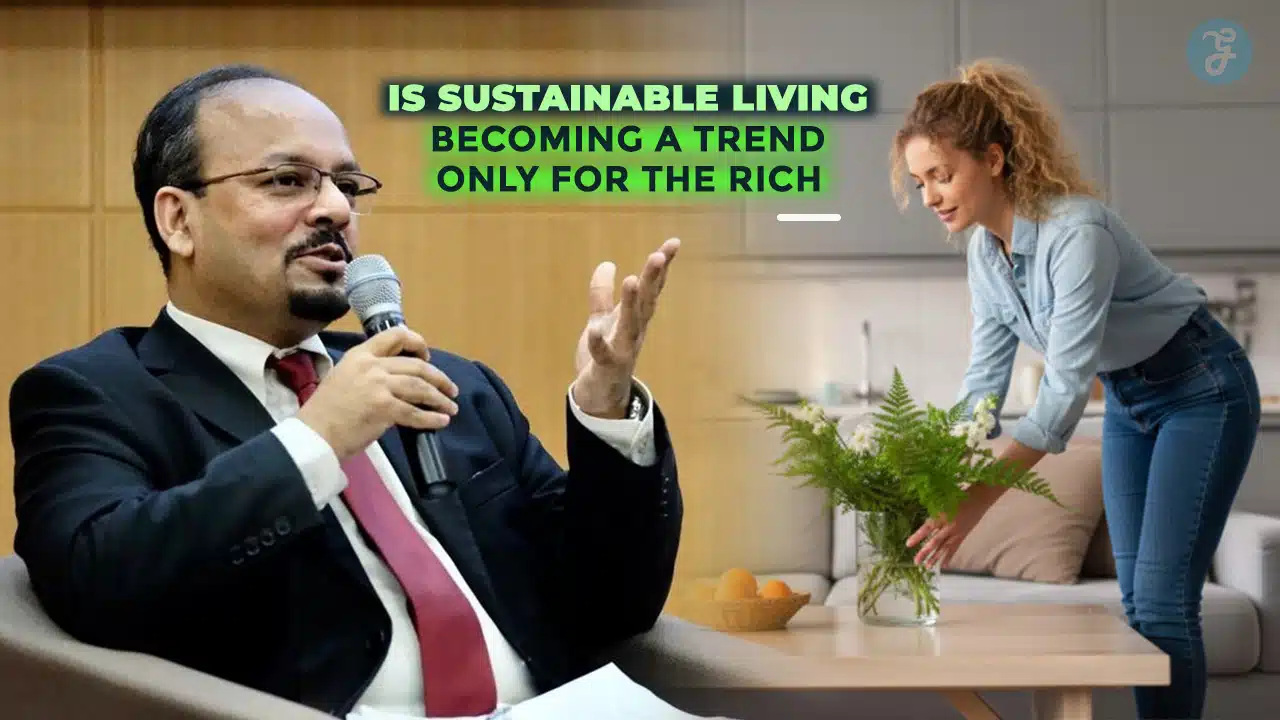
Dr Aurobindo Ghosh, Assistant Professor of Finance and Director SMU I2XL Program at the Lee Kong Chian School of Business, Singapore Management University, notes that while sustainability has long been embedded in everyday lives and livelihoods, both in India and globally, the modern idea of sustainable living is increasingly a privilege rather than a right. “With the rising cost of living, ordinary households are often forced to choose between meeting daily necessities and caring for the planet’s long-term health. In most cases, survival takes precedence,” he says.
Says a government school teacher, Shikha Sharma, based in Delhi-NCR, “I teach my students about climate responsibility, but I still travel by a petrol scooter because an EV is out of reach. There’s a gap between what we teach and what we can afford to practice.”
The “Green Premium” and the Death of the Middle-Class Budget
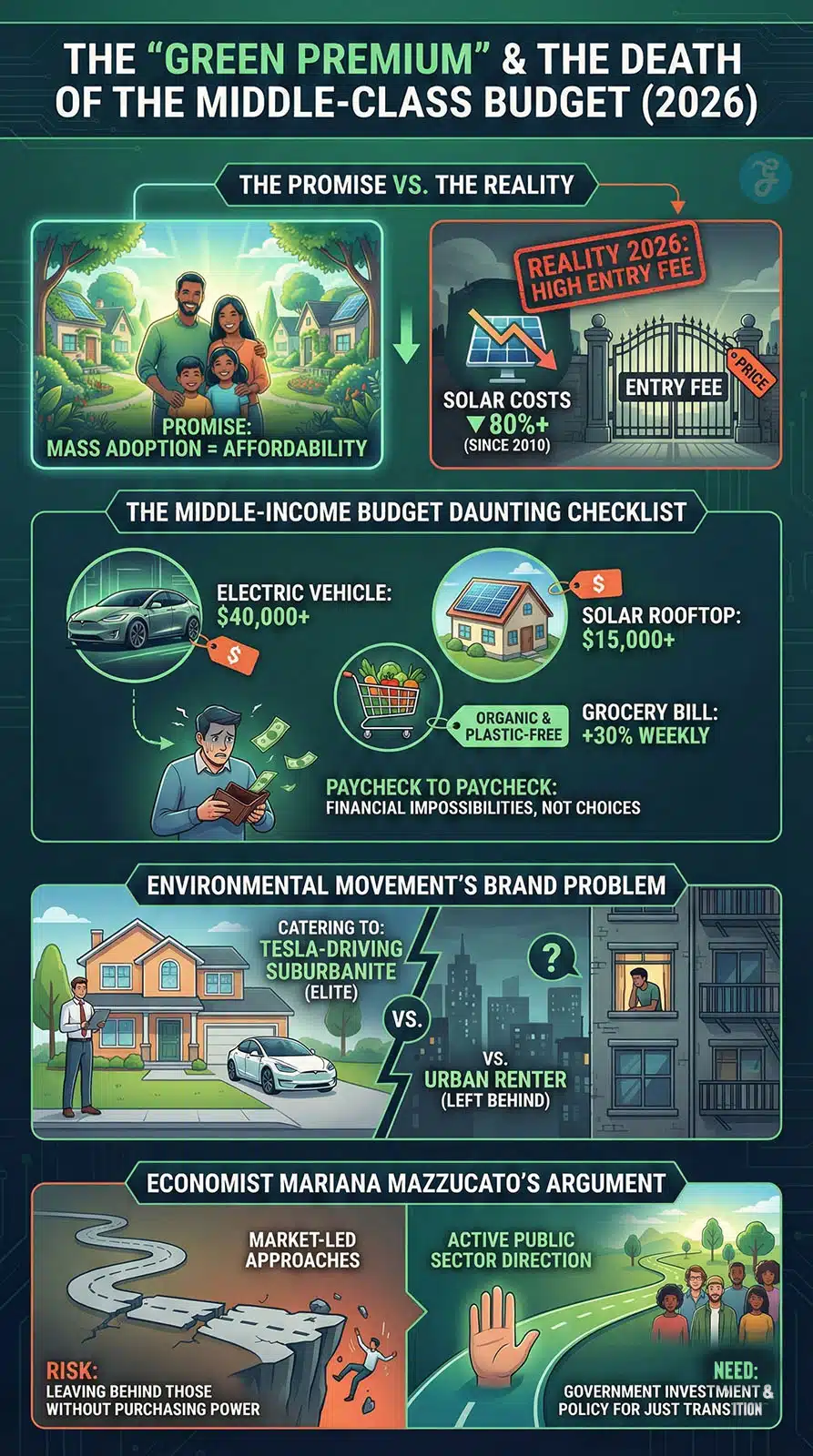
For decades, the promise was that mass adoption would make green living affordable. In 2026, the reality is more nuanced. While the cost of renewable technology like solar panels has plummeted (down over 80% since 2010), the “entry fee” for a sustainable life remains high.
An average middle-income household today faces a daunting checklist: an electric vehicle ($40,000+), solar rooftop installation ($15,000+), and a 30% higher weekly grocery bill for organic, plastic-free goods. For a family living paycheck to paycheck, these aren’t “choices”, they are financial impossibilities. This has led to a perception that the environmental movement has a “brand problem,” catering more to the Tesla-driving suburbanite than the urban renter.
Economist Mariana Mazzucato has argued that relying solely on market-led approaches for the green transition can risk leaving behind those without purchasing power, underscoring the need for active public sector direction.
Comparing the Cost of Entry: Conventional vs. Sustainable (2026 Estimates)
| Category | Conventional Option | Sustainable Option | The “Green Premium” |
| Transport | Mid-size ICE Vehicle: $31,000 | Mid-size EV: $38,500 | +$7,500 (Upfront) |
| Home Energy | Grid Electricity: $150/mo | Solar + Battery: $25,000 | ~10-12 Year Payback |
| Grocery Basket | Standard Produce: $120 | Organic/Local: $185 | +54% |
| Housing | Standard Build | LEED/Net-Zero Home | +10% to 15% Build Cost |
The EV Paradox: Why Price Parity Isn’t Enough
We were told 2026 would be the year of the $25,000 electric car. While manufacturers have finally released budget-friendly models, the “hidden” costs of ownership still favor the wealthy. Affluent homeowners with private garages can utilize “night-time” charging rates, effectively paying pennies for fuel.
In contrast, lower-income renters in urban centers often rely on public charging networks. In 2026, public charging can cost up to 300% more than home charging due to demand pricing and infrastructure taxes. Consequently, the person who can afford the most expensive car actually pays the least to run it. This creates a cycle where the financial benefits of sustainability are reserved for those who already have the capital to invest.
Organic Food: Health as a High-End Commodity
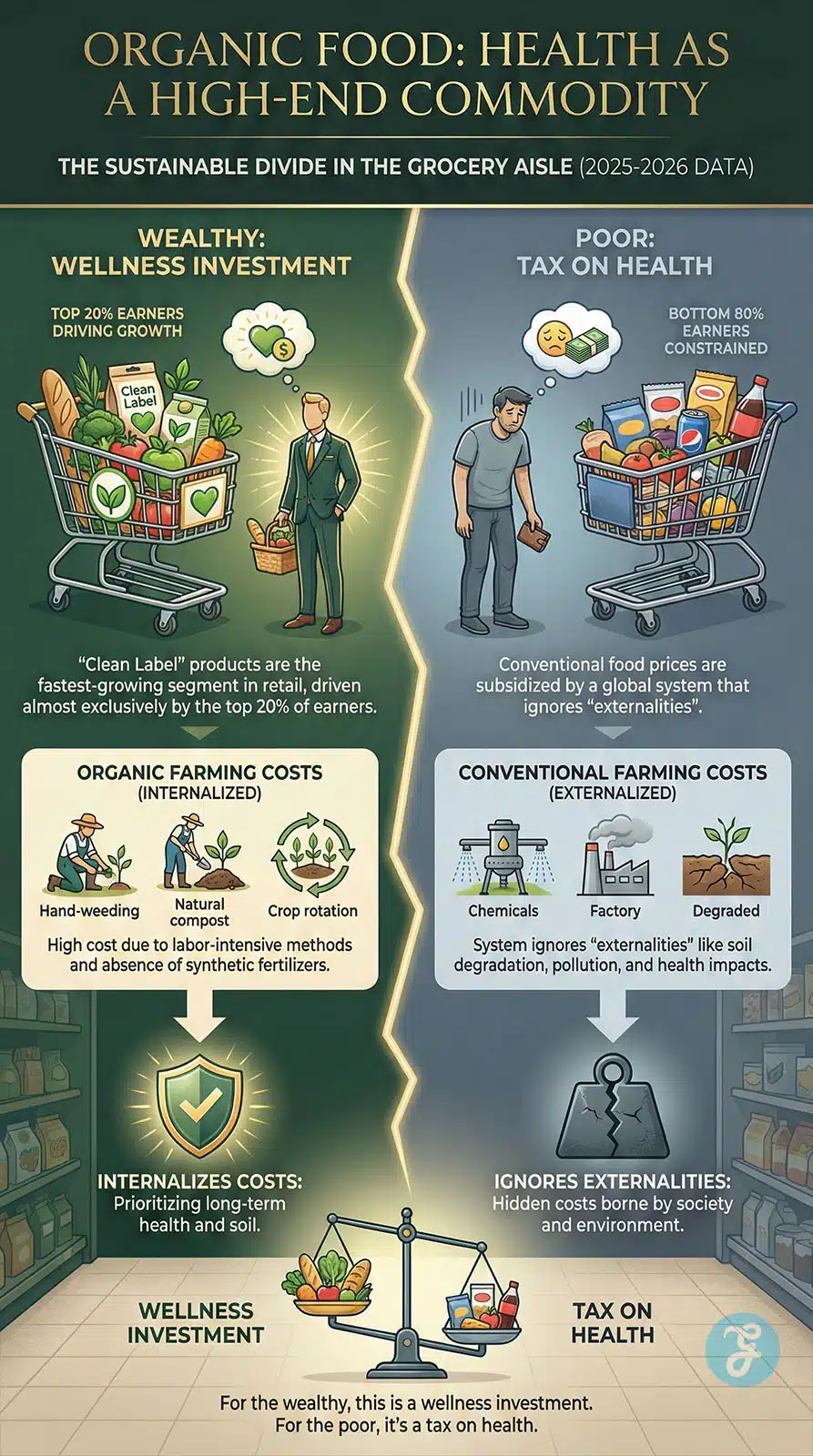
Nowhere is the sustainable divide more visible than in the grocery aisle. Data from 2025-2026 shows that while “Clean Label” products are the fastest-growing segment in retail, they are almost exclusively driven by the top 20% of earners.
The cost of organic farming remains high due to labor-intensive methods and the absence of synthetic fertilizers. While conventional food prices are subsidized by a global system that ignores “externalities” (like soil degradation), organic food “internalizes” these costs. For the wealthy, this is a wellness investment. For the poor, it’s a tax on health.
Winners vs. Losers in the 2026 Green Economy
| Segment | The “Winners” (Affluent/Owners) | The “Losers” (Renters/Low-Income) |
| Energy | Selling excess solar power to the grid. | Paying higher “carbon-adjusted” utility bills. |
| Mobility | Access to subsidies and home charging. | Dependent on aging public transit or expensive public chargers. |
| Real Estate | High resale value for “Eco-Certified” homes. | Rising rents in “Green-gentrified” neighborhoods. |
| Investment | High yields from ESG-focused portfolios. | Exposure to “stranded assets” in legacy industries. |
From Responsibility to “Eco-Luxury”
In the luxury real estate and hospitality sectors, sustainability has become the ultimate “flex.” High-net-worth individuals in 2026 are no longer asking for gold faucets; they want “Biophilic Design,” AI-powered climate control, and air filtration systems that exceed hospital standards.
This shift has changed the psychology of sustainability. It is no longer seen as a “sacrifice” but as an “upgrade.” While this has accelerated innovation, it has also alienated the grassroots base of the environmental movement. When solar panels become a status symbol similar to a designer watch, the moral urgency of the climate crisis risks being diluted by the aesthetics of wealth.
Expert Perspectives: Is the Gap Closing?
There is no consensus that sustainability is permanently out of reach for ordinary people. Many analysts argue that society is still in the early adopter phase of a large structural transition, where costs are high initially but decline as technologies mature, scale up, and enter secondary markets.
-
The Optimistic View:
Historically, most technologies, from smartphones to automobiles, entered society as expensive products before becoming widely accessible. Early buyers absorbed much of the development cost, allowing prices to fall over time. In the case of electric vehicles, a growing supply of used models is expected as first-generation EVs return from leases and ownership cycles. By the latter half of the decade, the second-hand EV market is likely to become a key entry point for middle-income households, particularly in regions with supportive charging infrastructure and policy incentives.
-
The Critical View:
Others caution that the transition is not evenly distributed. Policies such as carbon taxes and higher energy costs, while designed to reduce emissions, can place a disproportionate burden on lower-income groups who lack the financial capacity to switch to cleaner alternatives. Without parallel investments in affordability, public transport, and targeted subsidies, climate policy risks deepening inequality, penalising those least responsible for emissions while benefits remain concentrated among those who can afford to adapt.
Who Pays the Transition Cost? The Hidden Politics of Green Economics
One of the least discussed aspects of sustainable living is not whether societies should transition, but who bears the cost of that transition, and when. Climate policy is often framed as morally neutral or scientifically inevitable, but in practice it redistributes costs and benefits across social classes. In 2026, this redistribution is becoming impossible to ignore.
Carbon pricing, stricter building codes, fuel levies, and plastic bans all aim to correct environmental damage. Yet these measures frequently raise everyday costs… electricity, heating, transport, food, before affordable green alternatives are universally available. For households with savings, property ownership, or access to credit, these higher costs are temporary inconveniences. For lower-income families, they are structural penalties.
This imbalance has fuelled growing scepticism around climate policy, not necessarily climate science itself, but the economic design of the transition.
The Renter’s Dilemma: Sustainability Without Control
Homeownership has quietly become one of the strongest predictors of sustainable access. Owners can install solar panels, upgrade insulation, buy EVs with home chargers, and recover costs over time. Renters, by contrast, are often locked into inefficient housing stock with no authority to make green upgrades, and no protection from rising utility bills.
In many cities, landlords pass carbon compliance costs directly to tenants through higher rents or service charges. “Green renovations” frequently lead to eco-gentrification, where neighbourhoods become environmentally improved but socially exclusionary. Energy-efficient buildings raise property values, pushing out long-term residents who cannot afford the associated rent increases.
Thus, sustainability, intended to be collective, becomes spatially selective, reinforcing inequality through housing markets rather than correcting it.
Time Poverty and the Sustainability Burden
Another overlooked dimension of the green divide is time. Sustainable living often demands behavioural changes that assume surplus time: cooking from scratch, repairing instead of replacing, sorting waste correctly, researching ethical brands, or commuting via slower public transport.
For professionals with flexible schedules or remote work options, these adjustments are manageable. For shift workers, caregivers, or people juggling multiple jobs, sustainability becomes an additional cognitive and logistical burden.
In this sense, sustainable living is not only income-dependent but time-dependent, an invisible privilege rarely acknowledged in climate discourse.
Corporate Sustainability vs Household Responsibility
While individuals are encouraged to make greener choices, corporations often receive subsidies, tax credits, and regulatory flexibility to transition gradually. Large emitters can absorb costs, pass them down supply chains, or offset emissions through market mechanisms.
Households, however, face immediate price increases without similar buffers. This mismatch creates public resentment: individuals are asked to sacrifice first, while systemic polluters adapt slowly and strategically.
The result is a perception gap, where sustainability feels less like shared responsibility and more like moral outsourcing, with accountability shifting downward.
Global Inequality: The North–South Sustainability Gap
The sustainability class divide is not confined within countries; it also plays out globally. Wealthier nations increasingly externalise the environmental and social costs of their green transitions. Critical minerals for batteries, solar panels, and wind turbines are extracted largely from the Global South, often under conditions that raise serious ethical and ecological concerns.
Meanwhile, climate-vulnerable countries are pressured to adopt green standards without comparable access to finance, technology, or transition timelines. The message is contradictory: industrialise sustainably, but without the historical carbon space that wealthy nations already consumed.
This global asymmetry raises a crucial question: can sustainability be equitable if its supply chains are not?
The Cultural Shift: When Sustainability Becomes Performance
As sustainability merges with lifestyle branding, its meaning subtly changes. Eco-friendly products are marketed not just as responsible choices, but as markers of taste, intelligence, and social awareness. Reusable bottles, minimalist wardrobes, plant-based diets, and electric cars signal belonging to a morally elevated consumer class.
This performative dimension risks alienating those who cannot afford the symbols, even if their carbon footprints are already low by necessity rather than choice. In many cases, lower-income households consume less, travel less, and waste less, yet remain excluded from the narrative of “green living.”
Sustainability, paradoxically, becomes something you must prove through consumption.
The Risk of Backlash
History suggests that transitions perceived as unfair do not fail quietly, they provoke resistance. Rising energy costs have already triggered protests in multiple countries over the past decade. If green policies continue to raise living expenses without visible improvements in affordability or access, political backlash becomes inevitable.
This backlash does not always reject climate action outright. Instead, it questions whose version of sustainability is being imposed, and who benefits first.
Without careful policy design, the green transition risks being framed not as a shared future, but as elite engineering, undermining long-term public support.
Redefining Sustainability Beyond Consumption
If sustainability is to escape the trap of elitism, it must be reframed beyond individual purchasing power. Access to reliable public transport, affordable energy, durable goods, and well-designed urban infrastructure often reduces emissions more effectively than premium consumer choices.
True sustainability lies less in what people buy and more in what systems allow them to avoid buying. Walkable cities, rent-controlled energy-efficient housing, universal public charging, and strong social safety nets democratize climate benefits without demanding lifestyle upgrades.
Until these systemic shifts accelerate, sustainable living will remain unevenly distributed, not by values, but by means.
Future Outlook: What Happens Next?
The next 24 months will be a turning point. We are seeing the rise of “Community Solar” and “Public Charging Mandates” designed to break the monopoly of the wealthy on green benefits.
- Democratization of Tech: In late 2026, expect a flood of solid-state battery news, which promises to slash EV prices further.
- Social Safety Nets: The EU’s Social Climate Fund (starting operation in 2026) will provide €86.7 billion to help vulnerable households insulate homes and afford green transport.
- The Resale Boom: As the first wave of high-tech eco-homes and EVs hits the secondary market, we will see if “sustainable” can truly mean “affordable.”
Sustainability cannot remain a luxury if it is to be a solution. The challenge for 2026 and beyond is not just to invent better technology, but to build a better bridge, one that ensures the “green” life is a right, not a privilege.