As of March 31, 2025, the Union Government of India’s total debt liability — including both internal liabilities and obligations from the public account — stood at a level where, if divided equally, every citizen would carry a debt share of about ₹1,32,059.66. This figure is provisional and has been calculated based on the latest budget and fiscal documents.
This means that statistically, each Indian, regardless of income or age, has a share in the country’s overall borrowing burden. The number has been steadily rising year after year as the government continues to borrow to finance its expenditure, reflecting both the scale of India’s economic ambitions and the challenges of managing revenue shortfalls.
Interest Payments: A Major Expenditure Head
The cost of servicing this debt is climbing quickly. In the financial year 2024–25, interest payments alone amounted to around ₹11,16,343 crore. This figure forms a large part of the government’s revenue expenditure, which also includes subsidies, pensions, and administrative expenses.
Analyses from PRS Legislative Research show that interest payments have now reached nearly 24% of total expenditure in 2024–25. Even more striking, interest consumes almost 37% of the government’s revenue receipts when borrowing is excluded. This indicates that more than a third of the government’s actual income is going simply toward paying interest, leaving less room for development spending.
The trend is clear: year by year, a growing portion of India’s budget is being locked into repaying past borrowing. This reduces fiscal flexibility and raises questions about long-term debt sustainability.
A significant part of India’s obligations comes from external debt. According to data published in The Times of India, India’s external debt stood at US$736.3 billion at the end of March 2025. This represents a 10% increase compared to the previous year, showing India’s continued reliance on international borrowing.
The external debt-to-GDP ratio also climbed slightly, from about 18.5% in FY 2023–24 to 19.1% in FY 2024–25. While this ratio remains lower than that of many advanced economies, the upward trend underscores the growing importance of managing India’s exposure to global lenders, exchange rate risks, and international interest rate fluctuations.
Debt-to-GDP Ratio and Government Targets
Overall government debt, measured as a percentage of GDP, is estimated at around 57% of nominal GDP in recent quarters, according to CEIC and RBI data. Some economic projections, including those from Trading Economics, warn that if borrowing continues at current levels, this ratio could rise further, potentially approaching 80% in the next few years if corrective measures are not taken.
To address this, the government has announced key fiscal targets:
-
Fiscal Deficit Reduction: For FY 2025–26, the fiscal deficit is targeted at 4.4% of GDP, a reduction from about 4.8% in the previous year. This indicates the government’s intent to reduce its reliance on borrowing.
-
Long-Term Debt-to-GDP Goal: By 2030–31, the government aims to bring total debt down to 50% of GDP. Meeting this target will require sustained fiscal discipline, strong growth, and careful management of borrowing costs.
How Debt Pressures Impact Government Spending
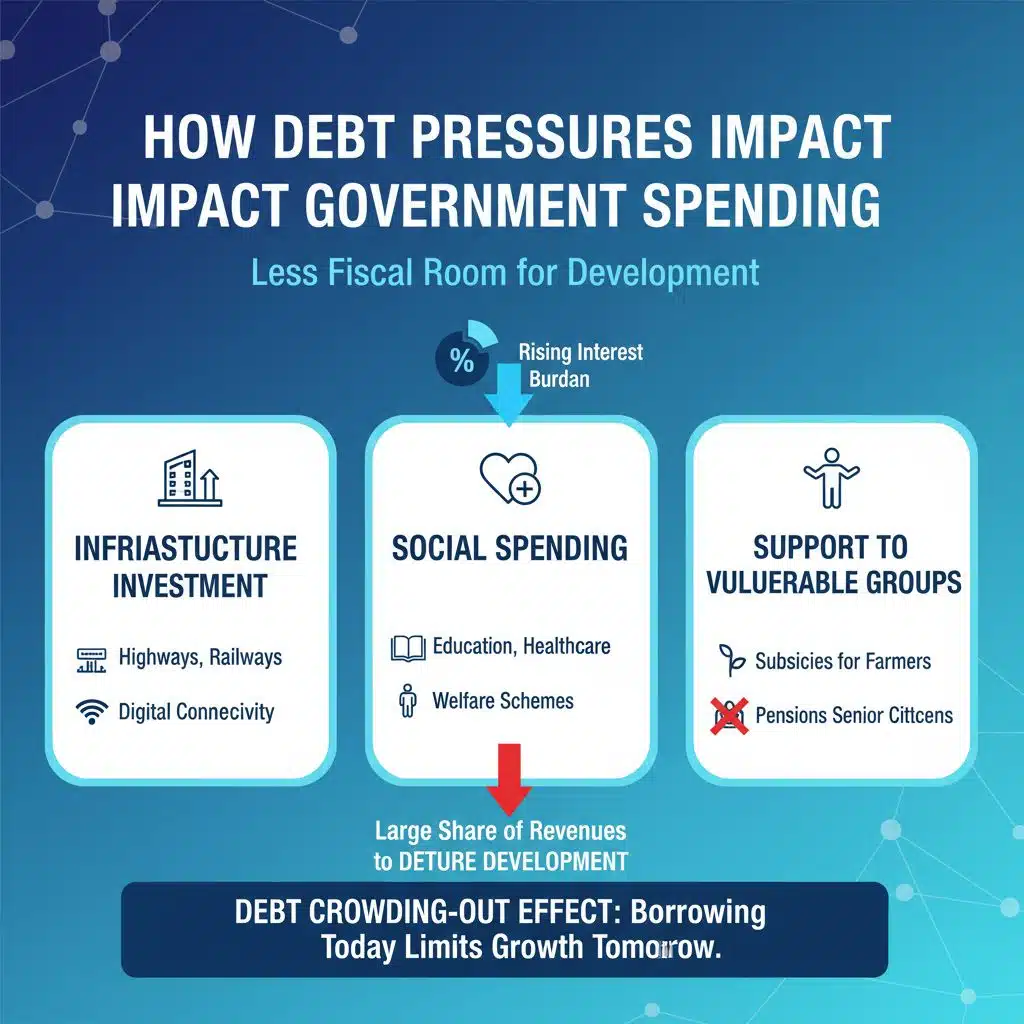
The rising interest burden has direct implications for how India allocates money in its budget. With a large share of revenues going to debt servicing, the government is left with less fiscal room for:
-
Infrastructure investment such as highways, railways, and digital connectivity.
-
Social spending on education, healthcare, and welfare schemes.
-
Support to vulnerable groups, including subsidies for farmers and pensions for senior citizens.
This crowding-out effect means that while borrowing allows the government to meet immediate expenditure needs, it also limits future development expenditure because so much money must be diverted to service past loans.
What Needs to Happen to Meet the 2031 Debt Goal
Meeting the ambitious target of reducing debt-to-GDP to 50% by March 2031 will not be easy. Several conditions need to align:
-
Sustained GDP Growth: India’s economy must continue to grow strongly, ideally above 6–7% annually. A growing GDP increases the denominator in the debt-to-GDP calculation, making the debt burden relatively smaller.
-
Higher Tax Revenue: Expanding the tax base, improving GST compliance, and enhancing direct tax collections are essential so that the government can fund more of its spending from revenue rather than borrowing.
-
Deficit Control: Reducing the fiscal deficit steadily over the years is critical. This requires rationalizing subsidies, curbing wasteful spending, and prioritizing investments that generate growth.
-
Managing Interest Costs: Interest costs can be controlled by refinancing older debt at lower rates, negotiating longer repayment terms, and avoiding high-cost borrowing, especially in volatile international markets.
-
Productive Use of Borrowed Funds: Debt is less of a burden when borrowed money is invested in projects that yield long-term growth. Infrastructure, health, education, and renewable energy are examples of sectors where investment can generate returns. In contrast, borrowing to finance consumption or short-term subsidies can increase fiscal stress.
-
External Debt Management: Careful management of foreign borrowing is crucial to avoid risks from currency depreciation or global interest rate hikes. This means diversifying borrowing sources and keeping foreign debt within sustainable limits.
Risks That Could Derail Progress
Despite clear plans, several risks could hinder debt reduction:
-
Rising Interest Rates: If domestic or global interest rates climb, India will face higher debt servicing costs, making targets harder to meet.
-
Slower Growth: Global economic shocks, inflation, or geopolitical tensions could slow India’s GDP growth, making the debt ratio harder to reduce.
-
Weak Tax Revenues: If revenues do not grow as projected, borrowing will remain high, undermining fiscal consolidation.
-
Currency Depreciation: A weaker rupee increases the cost of servicing external debt in local terms.
-
Unexpected Crises: Events like pandemics, wars, or natural disasters can force governments to spend more, pushing up borrowing unexpectedly.
India’s debt burden has reached levels where every citizen, statistically, carries over ₹1.32 lakh of government liabilities. Interest payments are consuming a growing portion of the budget, already accounting for nearly one-quarter of all expenditure and over one-third of actual revenue receipts. External debt has crossed US$736 billion, making up almost a fifth of GDP.
The government is targeting a fiscal deficit of 4.4% of GDP in FY 2025–26 and aims to reduce the overall debt-to-GDP ratio to 50% by 2030–31. Achieving these goals will depend on strong growth, disciplined fiscal management, improved revenue collection, and prudent debt handling.
The path ahead is challenging, but careful planning and consistent execution can ensure that India maintains fiscal stability while continuing to invest in development and growth.