
Government contracting faces unique workforce challenges that differentiate it from other industries. Contract transitions often trigger staffing changes, presenting challenges that can disrupt project delivery and client relationships. Within this demanding environment, HX5 has developed an approach that defies conventional expectations, maintaining a stable workforce while expanding operations across 34 states and 90 government locations.
Margarita Howard, sole owner and CEO of HX5, attributes the company’s retention success to deliberate hiring practices established from its founding in 2004. “We were very selective of people that we chose for our management team,” Howard explains. “And really, I could not be more proud of the team that we have.”
The results demonstrate the effectiveness of this approach. “Many of them have been with us 10 years or so, and we just have a highly dedicated and experienced workforce,” Howard notes. This longevity proves particularly significant in government contracting, where industry norms often see personnel movement coinciding with contract awards and transitions.
Strategic Foundation Building Over Quick Expansion
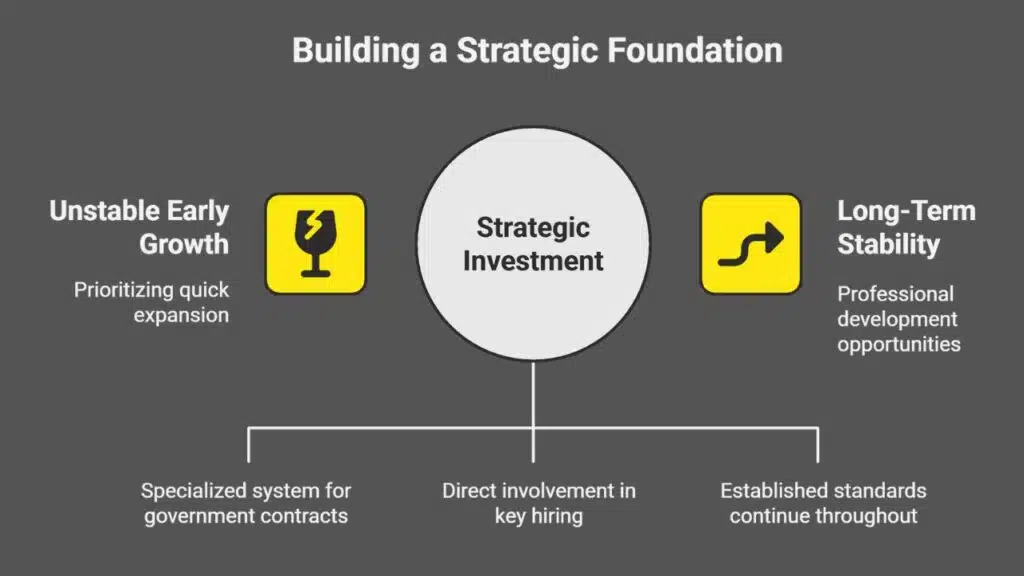
HX5’s retention strategy originated with fundamental infrastructure decisions made during the company’s early growth phase. Rather than prioritizing conventional business amenities, Howard focused on systems that would create long-term stability and professional development opportunities.
“Right from the beginning, we invested heavily upfront in purchasing and implementing a specialized accounting system developed for government service contracting firms,” Howard explains. This system provided government billing audit capabilities and approval for contract performance, establishing credibility with both agencies and potential business partners.
The investment philosophy extended beyond financial systems. Howard maintained direct involvement in key personnel decisions even as the company expanded beyond 1,000 employees. “With our corporate staff, especially for management positions, to this day, company leadership remains involved in the hiring process,” she says.
This hands-on approach created a cascading effect throughout the organization. When growth eventually required delegating hiring responsibilities to program managers, the established standards continued. “Once we were ready to turn it over to our management staff to do the hiring, they looked for the same kind of people,” Howard observes.
Compliance Excellence as Retention Driver
Government contracting demands meticulous attention to regulatory requirements, creating additional pressure on workforce management. HX5’s comprehensive approach to compliance creates an environment where experienced professionals can focus on substantive work rather than navigating constantly changing requirements.
“From working in the industry, we knew the importance of impeccable record keeping,” Howard explains. “Therefore, we’ve always ensured our finances, and all our records of everything we say we do must always be supported with the appropriate documentation and recorded accurately because, as a government contractor, all of our records are open to the government’s inspection and audits at any time.”
The company maintains specialized advisory relationships to manage complex regulatory matters across contracting, accounting, and audit issues. This infrastructure provides employees with clear guidance and support systems, reducing the stress typically associated with government contract work.
Building Relationships Through Performance Excellence
HX5’s approach to client relationships reinforces its internal team stability. The company’s focus on delivering consistent performance creates positive working environments for employees while generating repeat business opportunities.
“Building strong relationships with government agencies is an invaluable asset for successful government contractors as it can serve to provide the contractor with positive performance appraisals and sometimes even lead to new or additional business,” Howard notes.
These strong client relationships provide project continuity that benefits both the company and its employees, creating stable work environments that support long-term career development.
Howard’s retention strategies demonstrate that sustained success in government contracting requires more than technical competence. Creating stable, professional environments where experienced teams can thrive becomes a competitive advantage that benefits clients, employees, and business growth simultaneously. The approach challenges conventional assumptions about workforce management in an industry often characterized by transient relationships and project-based employment.