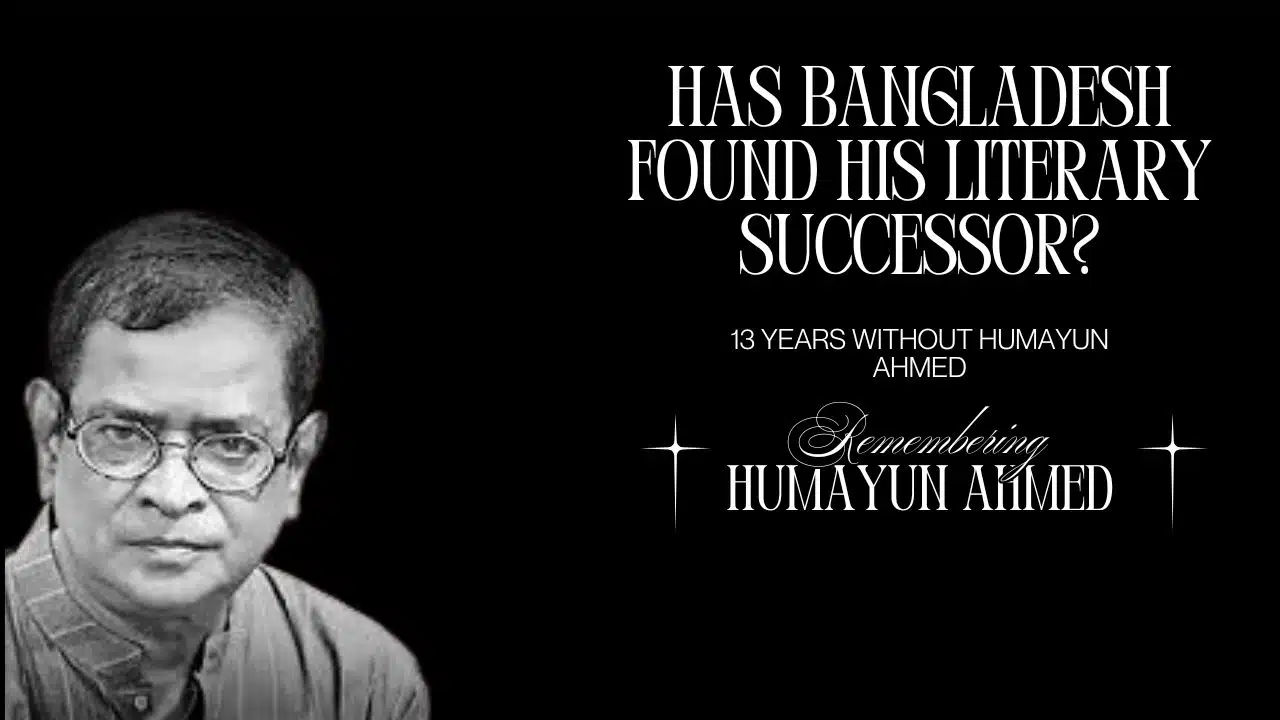
On July 19, 2012, Bangladesh lost more than a literary icon—it lost the man who redefined storytelling for an entire nation. Now, as we mark the Humayun Ahmed 13th Death Anniversary, a familiar wave of emotion sweeps through readers of all ages. Bookshops once again highlight his titles, television channels replay his timeless dramas, and social media floods with quotes from Himu, Misir Ali, and Shuvro. Thirteen years have passed, yet his presence feels as tangible as ever.
Humayun Ahmed was not merely a novelist—he was a cultural architect. He gave voice to middle-class struggles, painted everyday emotions with poetic simplicity, and brought Bangladeshi storytelling to the mainstream. For many, he was the first author whose books didn’t intimidate but embraced them. His dialogues became idioms, his characters family, and his stories mirrors of a changing society.
But time moves on, and so does literature. In the 13 years since his passing, countless new voices have emerged—some bold, some brilliant, and many experimental. The digital age has brought with it new genres, globalized narratives, and storytelling on screens as much as on pages.
So, the question arises: Has Bangladesh found a literary successor to Humayun Ahmed? Has any writer managed to captivate the masses, bridge generations, and shape culture the way he once did? Or was his kind truly one of a kind?
In this editorial, we explore the contours of that question—measuring legacy, comparing talent, and understanding what it really means to “succeed” a legend like Humayun Ahmed.
The Humayun Phenomenon: Why He Was More Than Just a Writer
To understand why the question of Humayun Ahmed’s successor carries such emotional weight, we must first understand the magnitude of the man himself. On this Humayun Ahmed 13th Death Anniversary, it is evident that he was not just a bestselling author or an award-winning screenwriter—he was a cultural phenomenon who redefined what literature could mean for an entire nation.
Redefining Bengali Storytelling
Before Humayun Ahmed, literature in Bangladesh largely catered to the intellectual elite. Writers like Syed Waliullah, Akhtaruzzaman Elias, and Selina Hossain offered dense, layered prose often rooted in historical trauma or ideological critique. Humayun, however, took a radically different path. He embraced simplicity—his language was accessible, his characters familiar, and his stories emotionally immediate. He democratized literature, making the novel a household item and not just a classroom relic.
His genius lay in turning the mundane into the magical. A walk through a Dhaka alleyway, a family dinner, or a shy university romance became windows into deeper existential questions. He made readers feel seen—no academic degrees or literary training required.
Multidisciplinary Genius
Few writers in the region have managed to conquer as many mediums as Humayun Ahmed. In television, he brought a cinematic flair to serialized storytelling. Dramas like Kothao Keu Nei and Bohubrihi weren’t just popular—they were cultural events. The death of Baker Bhai, for instance, led to public protests and newspaper editorials, blurring the line between fiction and reality.
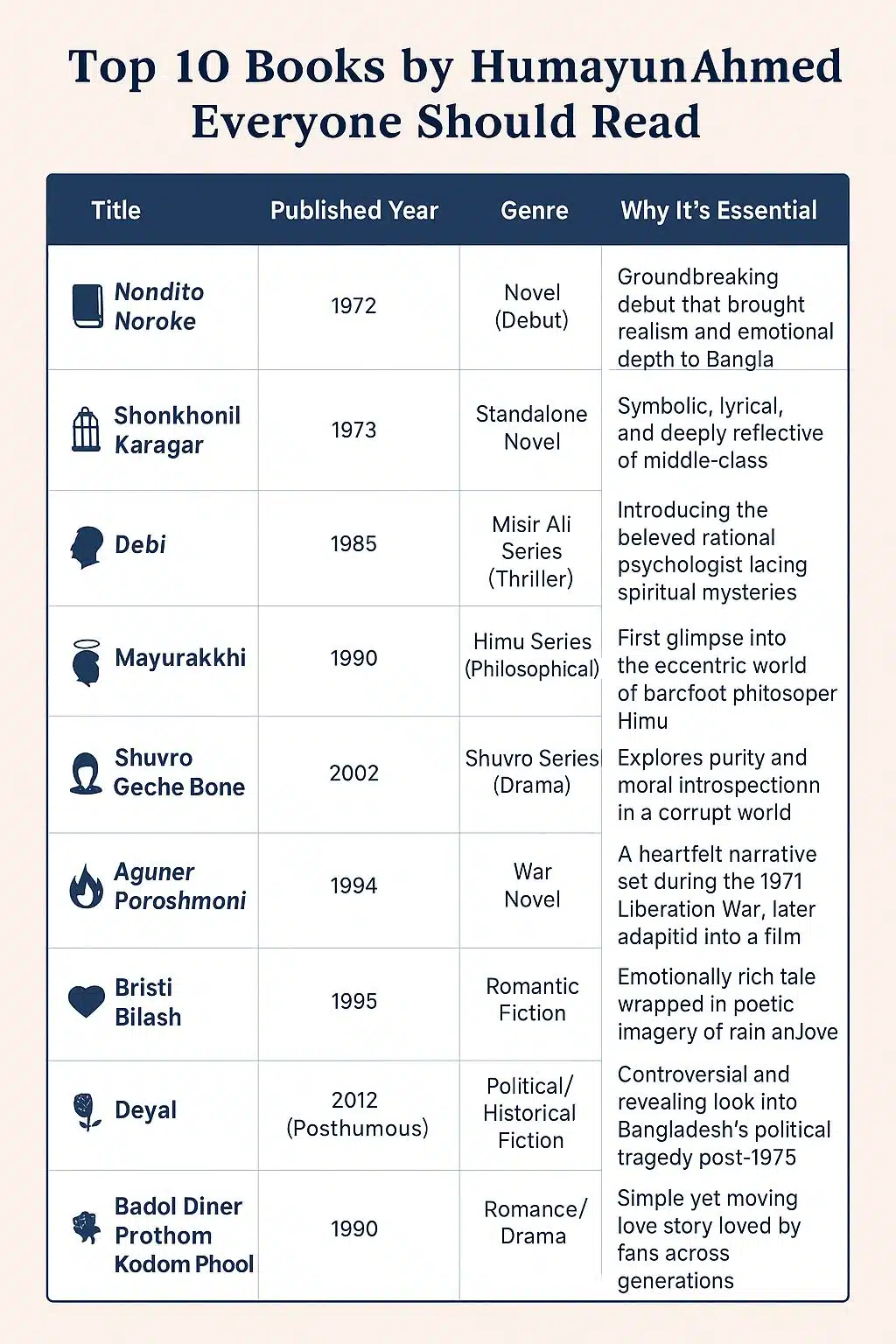
In film, he directed national award-winning titles such as Aguner Poroshmoni, Shyamol Chhaya, and Ghetuputra Komola—films that dealt with themes of war, loss, and memory with delicate nuance. His cinematic language echoed his literary one: simple yet striking, emotional yet never manipulative.
On this Humayun Ahmed 13th Death Anniversary, we’re reminded that his legacy is not confined to the printed page. It lives in TV reruns, film festivals, and stage plays. His multidisciplinary mastery elevated him far beyond the role of a traditional novelist.
Relationship with the Public
More than any of his accolades, what defined Humayun Ahmed was his relationship with his readers. He didn’t write for them—he wrote to them. His readers weren’t just an audience; they were a community. During book fairs, people queued for hours just to get a signed copy or a glimpse of him. Many read his books multiple times not for the plot, but for comfort.
His death was mourned like the passing of a close relative. In the years since, annual tributes, reading sessions, and fan gatherings have kept his memory alive. Even today, the mere mention of Himu sparks conversations, nostalgia, and sometimes even tears.
On this Humayun Ahmed 13th Death Anniversary, his continued popularity underscores an uncomfortable truth—no other writer has commanded this kind of love, loyalty, and lasting cultural relevance.
What Makes a Literary Successor in Bangladesh?
As we mark the Humayun Ahmed 13th Death Anniversary, the question arises: what qualifies someone to be his literary successor? It’s not simply about writing bestsellers or earning literary awards. Humayun Ahmed’s legacy was multi-dimensional, built on emotional resonance, mass appeal, creative innovation, and a deep cultural footprint. To meaningfully compare others to him, we must first define the criteria of a “successor.”
Literary Output and Originality
Humayun Ahmed was astonishingly prolific. Publishing over 200 books across genres—romance, mystery, science fiction, and memoir—he never confined himself to one literary lane. A successor must not only be productive but offer originality. Mere imitation, no matter how skilled, cannot match the creative soul that birthed Himu or Misir Ali.
Cultural Impact and Mainstream Relevance
Few writers have shaped popular culture the way Humayun did. His characters transcended pages to become cultural memes, fashion statements, and ideological symbols. A true successor would not only write but also shape collective identity—echoing through music, memes, dialogues, and day-to-day conversation.
Critical Acclaim vs. Popular Love
Some writers are adored by critics, others by the masses. Humayun Ahmed had both. While some literary purists dismissed his simplicity, his emotional intelligence and intuitive grasp of human nature earned deep respect over time. A successor must bridge this divide—respected by peers, loved by the people.
Cross-Media Versatility
Humayun Ahmed didn’t limit himself to literature. He wrote, directed, produced, and sometimes even acted. His characters leapt from books into television and cinema seamlessly. A potential successor must be able to engage audiences across platforms—books, OTT series, film scripts, or even podcasts.
Longevity and Generational Appeal
Humayun Ahmed wasn’t a phase—he was a phenomenon that lasted decades. People who discovered Shuvro as teenagers still revisit him as adults. His stories spoke to both the 18-year-old student and the 60-year-old retiree. A successor must offer that same timeless value—speaking to multiple generations with equal fluency.
On this Humayun Ahmed 13th Death Anniversary, the benchmark is clear: to succeed him is not merely to be successful, but to become essential—to literature, to culture, to people.
The Post-Humayun Literary Landscape in Bangladesh
Thirteen years after his passing, the literary ecosystem of Bangladesh has evolved significantly. The post-Humayun era has brought new voices, new mediums, and new narratives—but also fragmentation and shifting reader loyalties. As we reflect on the Humayun Ahmed 13th Death Anniversary, it’s important to assess what this new landscape looks like and whether it’s fertile ground for a successor to emerge.
Thematic Shifts in Storytelling
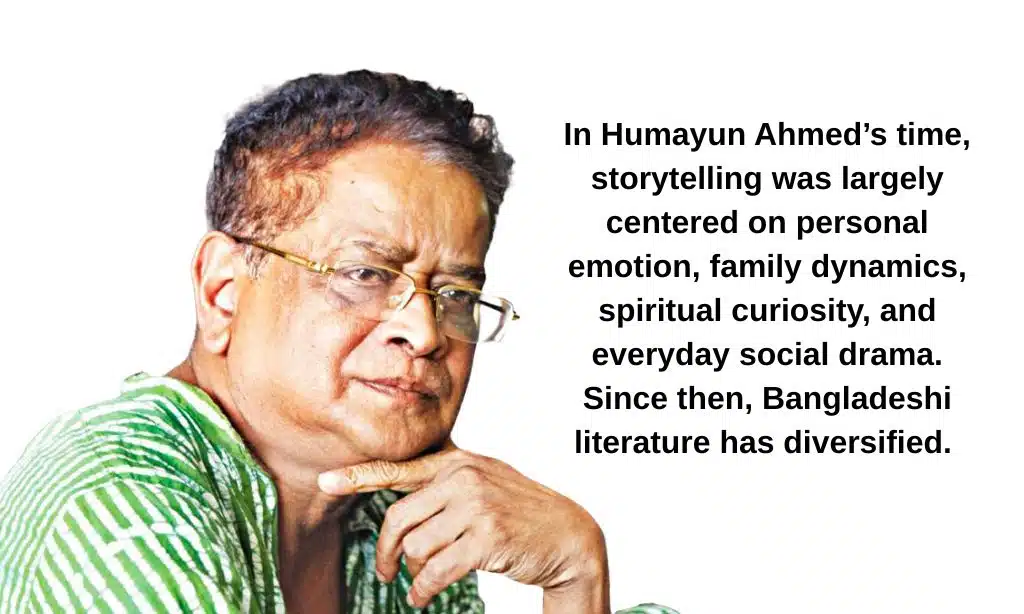
In Humayun Ahmed’s time, storytelling was largely centered on personal emotion, family dynamics, spiritual curiosity, and everyday social drama. Since then, Bangladeshi literature has diversified. Writers now tackle themes such as:
-
Urban alienation and mental health
-
Feminist identity and social justice
-
Migrant and diasporic experiences
-
Historical revisionism and political critique
While these themes are essential and intellectually rich, they often cater to niche audiences or require more academic literacy—unlike Humayun’s effortlessly readable prose that transcended class and education levels.
Digital Platforms and the Rise of New Storytellers
The democratization of the internet has birthed a generation of writers who share stories via blogs, Facebook pages, YouTube monologues, and even TikTok. These digital writers often speak the language of their generation—raw, immediate, and hyper-emotional. Some gain cult followings, yet few achieve the cultural maturity or cross-generational appeal that defined Humayun Ahmed.
Additionally, while digital platforms offer new visibility, they rarely provide the editorial guidance and structure that traditional publishing afforded Humayun Ahmed. Many promising talents risk burning out quickly or remaining confined to short-form content.
Genre Expansion but Audience Fragmentation
The post-Humayun era has seen an explosion of genres—fantasy, horror, thriller, and even LGBTQ+ narratives. However, unlike Humayun’s emotionally inclusive storytelling that unified diverse audiences, most new writers appeal to specific communities. The idea of a “national storyteller” has grown more elusive in a landscape where audiences are segmented by platform, ideology, or reading habit.
The Absence of Literary Ritual
Humayun Ahmed created cultural rituals—book fair releases, TV drama releases, and film premieres became national events. In today’s scattered digital age, few writers command such shared anticipation. The loss is not only of a writer but of literary ceremony itself.
On this Humayun Ahmed 13th Death Anniversary, one thing is evident: Bangladesh has no shortage of voices, but it has yet to find a single voice that echoes through all corners of society as his once did.
Who Are the Contenders for Humayun Ahmed’s Literary Successor?
In the years since Humayun Ahmed’s passing, many writers have risen to prominence—some critically acclaimed, others widely read. Yet, on this Humayun Ahmed 13th Death Anniversary, the question lingers: Has anyone truly carried his torch? Let’s explore a few potential successors, analyzing both their promise and their limitations.
Muhammed Zafar Iqbal: The People’s Professor
The most obvious contender is Humayun Ahmed’s younger brother, Muhammed Zafar Iqbal. A celebrated author in his own right, Zafar Iqbal has carved a niche in science fiction and children’s literature. His books like Dipu Number Two, Amar Bondhu Rashed, and the Robon series are staples in school libraries and youth reading lists.
Yet, while Zafar Iqbal is beloved by young readers, his thematic focus is narrower. He does not venture into the layered emotional territories of adult relationships, existential longing, or spiritual ambiguity the way Humayun did. His stories are sharper, sometimes more ideological, but less poetic.
Verdict: A generational favorite for children and teens—but not a complete successor in emotional range or mass adult appeal.
Anisul Hoque: The Emotional Craftsman
Journalist and novelist Anisul Hoque achieved fame through works like Maa and Alo Andhokare Jai, offering strong emotional storytelling rooted in history, war, and personal struggle. His style—accessible yet poignant—has been compared to Humayun Ahmed’s, especially for its impact on middle-class readers.
However, Anisul Hoque hasn’t developed any recurring literary characters with the same cultural presence as Himu or Misir Ali. His public persona is more reserved, and his multi-platform presence is limited.
Verdict: A powerful literary voice with emotional resonance—but lacks the mass character creation and media crossover that defined Humayun.
Imdadul Haq Milan: The Romantic Popularist
Known for love stories that swept the 80s and 90s, Imdadul Haq Milan was once a strong contender for the title of “most-read writer.” His books like Bhalobasha Kare Koy and Nodi Upakhyan were emotionally intense and extremely popular.
Still, Milan’s focus was narrow, mostly romantic. He never achieved Humayun’s range across genres, nor did he evolve his storytelling style with the times.
Verdict: Once a household name—but his influence faded, and he lacked the versatility and longevity of Humayun Ahmed.
Selina Hossain & Contemporary Female Authors
Award-winning author Selina Hossain represents the critically acclaimed stream of Bangladeshi literature. Her works, rooted in social realism and political resistance, have won awards and academic admiration.
Similarly, a new wave of female writers—Shazia Omar, Shaheen Akhtar, Nasreen Jahan—are telling bold, necessary stories about gender, trauma, and resistance.
Yet, these writers often operate within niche literary circles. Their works are essential but do not (yet) command the mass cultural presence Humayun had.
Verdict: Rich in substance and style, but lacking widespread cross-demographic readership.
Diaspora Writers: Global Voices, Local Disconnect?
Writers like Tahmima Anam (The Good Muslim) and Kaiser Haq have earned international recognition. Their themes—migration, memory, global identity—offer sophistication and relevance.
However, their work often caters more to global audiences and academic readers than to the average Bangladeshi reader. Language (mostly English) and distribution barriers also limit their cultural penetration back home.
Verdict: International acclaim, but limited grassroots impact within Bangladesh.
Digital-Era Writers: The New Frontier
A new generation of writers—Rifat Munim, Arif Anwar, and countless online storytellers—are pushing boundaries. Web fiction, social media storytelling, and video essays are emerging as popular formats. Some are even reimagining characters like Himu in modern settings.
Still, most are early in their careers and face the challenge of building consistent, long-term relevance. And very few have developed iconic characters or transmedia storytelling legacies.
Verdict: Promising, innovative, but not yet culturally dominant.
On this Humayun Ahmed 13th Death Anniversary, it becomes clear: many have risen, some have soared—but none have touched the same cultural nerve. Humayun Ahmed was not just a great writer—he was a phenomenon that transcended genres, generations, and media.
Why No One Has Truly Replaced Humayun Ahmed
As we reflect on the Humayun Ahmed 13th Death Anniversary, it becomes increasingly evident that despite the emergence of talented writers, no one has truly stepped into his shoes. The question is not whether we have great writers today—we do—but whether any of them have replicated the depth, reach, and emotional intimacy that defined Humayun’s legacy.
The Void of Emotionally Accessible Storytelling
Humayun Ahmed mastered the art of simplicity. His genius lay in crafting emotionally rich stories with everyday words. Today’s literary scene often leans toward either academic abstraction or digital virality—neither of which captures the emotional accessibility that Humayun perfected. Many contemporary writers prioritize intellectual complexity or stylistic experimentation, unintentionally alienating readers who crave the warmth and relatability Humayun once offered.
The Collapse of the “Event Book” Culture
When Humayun Ahmed released a new book, it wasn’t just a publication—it was an event. Readers lined up at book fairs; TV and newspapers covered the releases like national news. His characters—Himu, Misir Ali, Baker Bhai—were so popular they inspired fan clubs and cosplay-like devotion.
In contrast, today’s book launches are quieter affairs. The digital age has fragmented attention spans, and no single book dominates public discourse in the way Humayun’s releases once did. On this Humayun Ahmed 13th Death Anniversary, we’re reminded that his books didn’t just fill shelves—they filled hearts and became social moments.
The Disconnect Between Writers and Mass Media
Another key difference is media integration. Humayun Ahmed was not just a novelist—he was a playwright, screenwriter, and film director. His TV dramas reached millions. His films were national events. In contrast, many of today’s writers remain isolated from mainstream platforms. They publish in literary journals or niche publishers, reaching select audiences.
The few who do venture into screenwriting often work within commercial constraints, lacking the creative control Humayun enjoyed. As a result, their stories don’t carry the same multi-platform resonance.
Fragmented Audiences in a Noisy Era
In the age of social media, content is abundant but attention is scarce. Readers are scattered across platforms—Facebook groups, YouTube channels, Wattpad, Kindle Direct Publishing—making it harder for any single voice to unite them. Humayun Ahmed came from a time when fewer channels meant greater collective focus.
On this Humayun Ahmed 13th Death Anniversary, we realize that part of what made his influence possible was timing. The cultural ecosystem then allowed for a unifying figure. Today, the landscape is more democratic—but also more divided.
Could AI, Web Novels, or Screenwriters Be the Next “Successors”?
On this Humayun Ahmed 13th Death Anniversary, as we look to the future of storytelling in Bangladesh, it’s worth asking: could the next literary successor to Humayun Ahmed emerge from an unexpected place—not from traditional publishing, but from tech, web fiction, or even artificial intelligence?
Rise of Digital Fiction Platforms
Today’s readers—especially younger ones—are shifting away from printed novels toward web-based storytelling. Platforms like Facebook Stories, Wattpad, or local Bangla apps have become popular arenas for serialized fiction. These platforms are buzzing with romantic thrillers, slice-of-life tales, and family sagas—genres Humayun once ruled.
However, while this democratization of literature has empowered many, the lack of editorial guidance, narrative discipline, and long-form consistency poses a challenge. Few web novelists have yet achieved the literary craftsmanship or philosophical subtlety that defined Humayun’s work. Their stories often thrive on trends, not timelessness.
OTT Scriptwriters as the New Storytellers
Bangladesh’s OTT boom—spearheaded by platforms like Chorki and Binge—has introduced a new class of scriptwriters. Shows like Unoloukik, Karagar, and Taqdeer are being celebrated for their layered storytelling and cinematic quality.
Some of these writers do have the potential to shape cultural narratives the way Humayun did. But most remain behind the scenes, anonymous to the public. Unlike Humayun, whose personal brand was as strong as his stories, today’s screenwriters rarely build literary followings.
Can Artificial Intelligence Fill the Gap?
In an era where AI tools can generate fiction in seconds, one may wonder—could machines someday write stories like Humayun Ahmed?
The answer, for now, is no.
Humayun’s work was rooted in empathy, cultural context, human contradiction, and spiritual nuance. AI lacks this depth. It can mimic language, not lived experience. While it may assist future writers in drafting or editing, it cannot replicate the soul of a storyteller like Humayun Ahmed.
Humayun Ahmed’s Legacy as a Benchmark, Not a Template
On this Humayun Ahmed 13th Death Anniversary, one thing has become increasingly clear: trying to replicate Humayun Ahmed is a misguided pursuit. His genius cannot be cloned, nor should it be. What today’s writers—and readers—should strive for is not duplication, but inspiration.
Imitation vs. Innovation
Since his passing, many have attempted to write “like” Humayun Ahmed—copying his sentence structure, his character archetypes, even using spiritual vagueness as a narrative tool. Yet few of these imitators have succeeded. Why?
Because Humayun’s storytelling wasn’t built on formulas. His emotional resonance stemmed from authenticity, not structure. He wrote from his own deep understanding of society, human nature, and inner conflict. Those who attempt to copy his form without embracing that substance often produce hollow echoes.
A literary successor cannot simply be a “second Humayun.” They must bring something new, just as he did.
Lessons Writers Can Learn from Him
While no one should walk in his shadow, there is much to learn from his approach:
-
Empathy first: Humayun Ahmed made his readers feel seen.
-
Simplicity over showmanship: He didn’t need grand vocabulary to convey profound truths.
-
Emotional truth: Even in fantasy or psychological thrillers, his characters felt real.
-
Cross-platform storytelling: He didn’t limit himself to books—he understood where his audience lived.
New writers can internalize these values—not to recreate him, but to carve their own lasting imprint.
Why We Should Stop Searching for the “Next Humayun Ahmed”
Every era has its own voice. Just as Tagore and Nazrul shaped the early 20th century, Humayun Ahmed shaped the late 20th and early 21st. The next great Bangladeshi storyteller may not look like him, write like him, or even be a novelist at all. They might come from video games, interactive media, or AI-human collaborations.
But their work, like Humayun’s, will endure if it connects—deeply, emotionally, and honestly—with people.
On this Humayun Ahmed 13th Death Anniversary, perhaps the best way to honor his legacy is not to search for a replica, but to cultivate a literary culture that values the human truth he so eloquently delivered.
Takeaways: The Legend, the Legacy, and the Future
As Bangladesh observes the Humayun Ahmed 13th Death Anniversary, the void he left behind remains as deep as ever. His books are still read by teenagers discovering love for the first time. His dramas are still rewatched by adults seeking comfort in familiarity. His characters—Himu, Misir Ali, Shuvro—are still referenced in everyday conversations. He is, quite simply, irreplaceable.
And yet, the literary world does not stop. New voices have emerged. Talented writers continue to tell important stories. Platforms have evolved. Audiences have changed. But no one has yet woven themselves into the cultural and emotional fabric of the nation the way Humayun Ahmed did.
Perhaps that is because he wasn’t just a writer—he was a mirror. He reflected who we were, who we feared becoming, and who we quietly hoped to be. He made the strange familiar and the familiar profound. He didn’t write down to his readers—he wrote with them, standing shoulder to shoulder.
So, has Bangladesh found his literary successor? Not yet. And perhaps, it doesn’t need to.