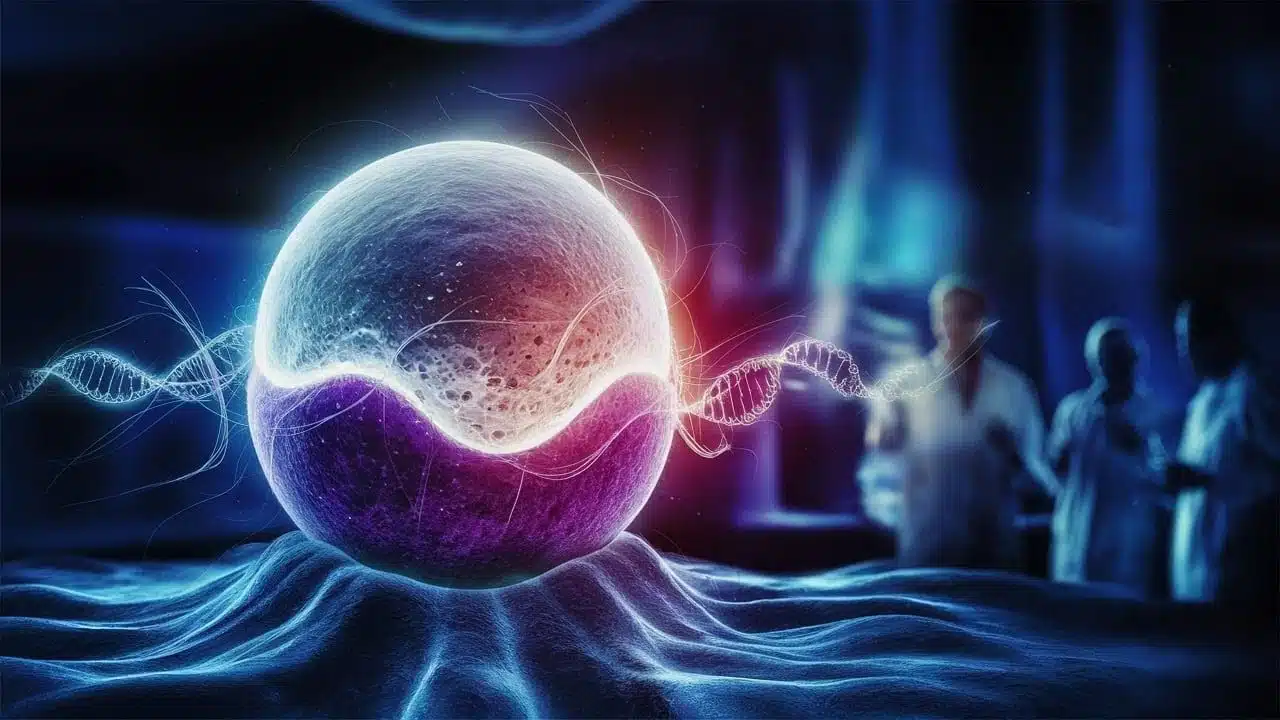
In a landmark achievement that redefines the boundaries of reproductive science, researchers at Oregon Health & Science University (OHSU) have successfully created functional human eggs from skin cells and used them to produce early-stage human embryos.
This revolutionary “proof of concept,” published in the esteemed journal Nature Communications on September 30, 2025, offers a potential new direction for treating infertility and could one day allow same-sex couples to have children genetically related to both partners.
The scientific team, led by the renowned biologist Professor Shoukhrat Mitalipov, developed a novel technique that transforms an ordinary skin cell’s nucleus into a fertilizable egg. While the resulting embryos were not viable for pregnancy and the technology is at least a decade away from clinical trials, the breakthrough represents a monumental step forward in the field of in-vitro gametogenesis (IVG), the process of creating sperm and eggs in the laboratory.
A New Path Called ‘Mitomeiosis’
The central challenge in creating eggs from body cells (somatic cells) is chromosomal mathematics. A skin cell contains a full set of 46 chromosomes (a diploid set), whereas a healthy egg or sperm cell contains only half that number, 23 chromosomes (a haploid set). When sperm and egg combine during fertilization, they create an embryo with the correct 46 chromosomes.
Previous IVG research has largely focused on reprogramming skin cells back into “induced pluripotent stem cells” (iPS cells) and then guiding their development into eggs or sperm. Professor Mitalipov’s team took a more direct and radical approach, adapting the somatic cell nuclear transfer (SCNT) technique famously used to clone Dolly the sheep.
Here is a simplified breakdown of the process:
- Nucleus Transfer: The team took a healthy donor egg and surgically removed its nucleus, which contains its genetic material.
- Skin Cell Insertion: They then extracted the nucleus from an adult human skin cell (containing 46 chromosomes) and inserted it into the enucleated donor egg.
- Inducing ‘Mitomeiosis’: This reconstructed egg now had a full set of 46 chromosomes. The researchers developed a novel chemical and electrical stimulation process to trigger a new form of cell division they named “mitomeiosis.” This process forces the egg to expel half of its chromosomes, leaving it with the crucial 23 needed for fertilization.
“We achieved something that was thought to be impossible,” Professor Mitalipov stated in an OHSU press release. “Nature gave us two methods of cell division, mitosis and meiosis, and we just developed a third.”
Latest Data & Statistics
The results of the OHSU study, while groundbreaking, underscore the long road ahead. The data, published in Nature Communications, provides a clear picture of both the successes and the current limitations.
- Total Eggs Created: The researchers successfully generated 82 functional, egg-like cells (oocytes) using the mitomeiosis technique.
- Embryo Development Rate: Following fertilization with donor sperm, approximately 9% of the oocytes successfully developed to the blastocyst stage. This is a crucial milestone, as it’s the stage where an embryo would typically be implanted into a uterus during an IVF cycle.
- Genetic Viability: Critically, genetic analysis revealed that the process of chromosome segregation during mitomeiosis was random and imprecise. All the resulting embryos were aneuploid, meaning they had an incorrect number of chromosomes and would not have been able to develop into a healthy baby. The experiment was concluded after 6 days, and no embryos were transferred.
Official Responses & Expert Analysis
The scientific community has reacted with a mixture of excitement for the scientific advance and profound caution regarding its application.
Dr. Paula Amato, a co-author of the study and professor of obstetrics and gynecology at OHSU, highlighted the potential benefits. “In addition to offering hope for millions of people with infertility due to lack of eggs or sperm, this method would allow for the possibility of same-sex couples to have a child genetically related to both partners,” she explained.
However, independent experts stressed that the technology is in its infancy. Professor Ying Cheong, a fertility specialist at the University of Southampton in the UK, who was not involved in the study, commented, “While this is still very early laboratory work, in the future it could transform how we understand infertility and miscarriage… but there will be very important safety concerns.”
The chromosomal abnormalities remain the single biggest obstacle. Stanford University bioethicist Hank Greely noted the significance of this flaw, stating, “Even when they succeeded, it didn’t really succeed. It’s interesting, but not useful yet.”
A Glimmer of Hope
For millions globally facing infertility, this research, however distant, represents a powerful glimmer of hope. Infertility affects an estimated 1 in 6 people worldwide, according to the World Health Organization. For women who have lost ovarian function due to premature ovarian failure, cancer treatments like chemotherapy, or advanced maternal age, the prospect of creating eggs from their own skin cells is revolutionary.
The technology could also fundamentally alter family-building for same-sex couples. Theoretically, a skin cell from one male partner could be used to create an egg, which could then be fertilized by the sperm of the other partner, resulting in a child with genetic material from both fathers.
The Ethical and Scientific Road Ahead
The path forward is laden with scientific and ethical challenges. Scientifically, the immediate goal is to refine the mitomeiosis process to ensure the correct number and pairing of chromosomes. Professor Mitalipov and his team are already working on methods to improve this critical step.
Ethically, the research opens a Pandora’s box of complex issues that society must debate:
- Embryo Research: The work involves the creation and destruction of human embryos for scientific study, a practice with significant moral and legal restrictions in many countries.
- “Designer Babies”: Widespread availability of lab-grown eggs could theoretically lead to large-scale genetic screening of embryos, raising fears of a new era of eugenics.
- Genetic Theft: Bioethicists warn of scenarios where a person’s genetic material could be stolen from a stray hair or skin cell and used to create a child without their consent.
As the science progresses, regulatory bodies and the public will need to engage in a robust conversation to establish clear ethical guidelines long before this technology reaches a fertility clinic.
The creation of human eggs from skin cells is a stark reminder of the relentless pace of scientific innovation. The OHSU study has cracked open a door that was once firmly sealed, presenting a future where the biological limits of reproduction may be profoundly different. While the dream of eliminating certain forms of infertility remains on a distant horizon, this research has laid a critical and undeniable foundation. The journey is just beginning, and it will force us to confront not only what is scientifically possible, but also what is ethically wise.