
Let’s be real: AI is everywhere. From crafting emails to drafting blog posts, it’s proving to be a game-changer for content creators. But here’s the big question that keeps many up at night: can you really tap into AI’s power for content creation without accidentally turning your unique voice into something bland, generic, or just plain robotic? It’s a valid concern. Nobody wants their hard-earned personal brand to sound like it was spit out by a machine.
The good news? Absolutely, you can. The trick isn’t about letting AI take the wheel entirely; it’s about making AI your co-pilot, a super-smart assistant that helps you fly faster and further, but always under your command.
This guide is all about showing you how to use AI for content creation without losing your voice, blending cutting-edge technology with your irreplaceable human touch. We’ll dive into practical strategies, real-world examples, and actionable steps to ensure your content always sounds like you, even when AI lends a hand.
Understanding Your Unique Voice: The Foundation Before AI
Before you even think about firing up an AI tool, you’ve got to know what makes yourvoice, well, yours. Your voice isn’t just about the words you choose; it’s the rhythm, the personality, the specific way you connect with your audience. It’s the secret sauce that makes your content recognizable and relatable. If you don’t nail this down first, you’re essentially handing AI a blank canvas and hoping it paints a masterpiece in your style. That’s a recipe for generic content.
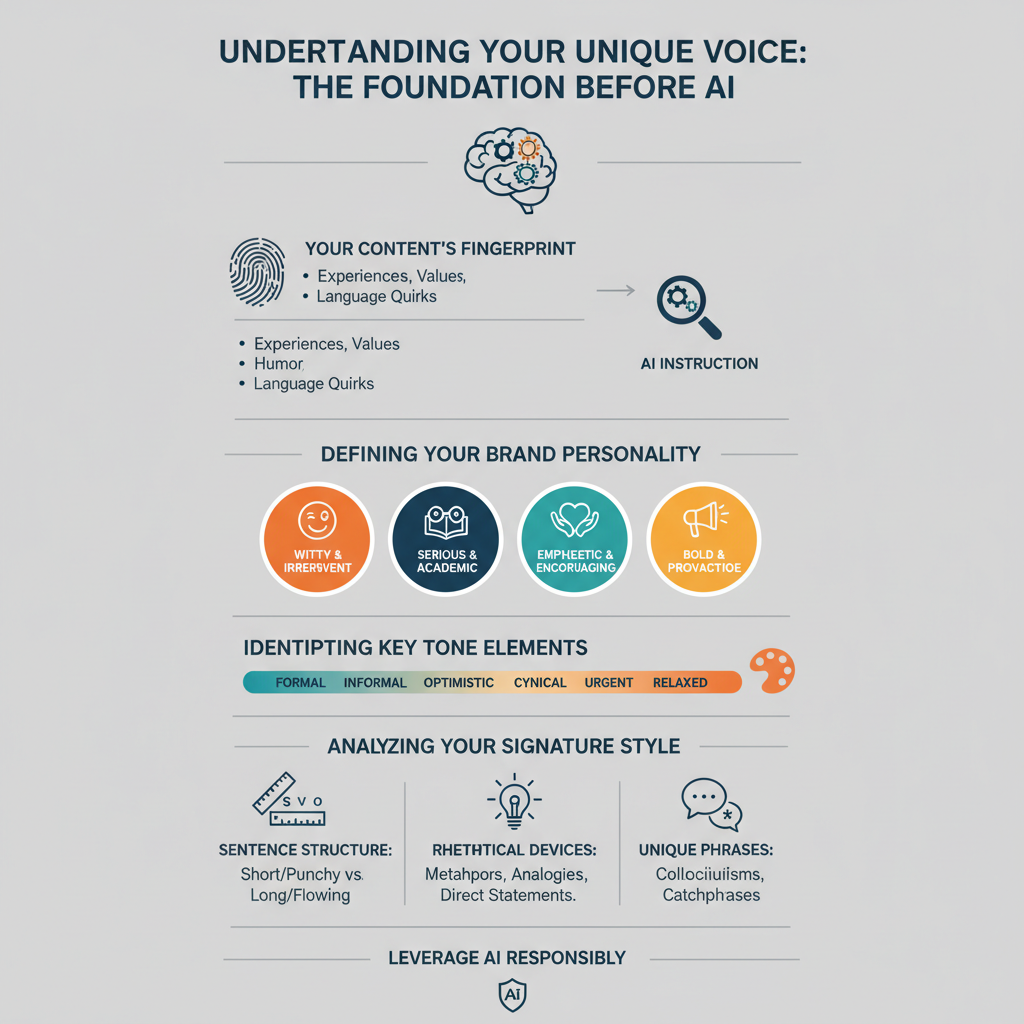
Think of your unique voice as your content’s fingerprint. It’s built from your experiences, your values, your sense of humor, and even the quirks in your language. It’s what differentiates you from everyone else talking about similar topics. When you’re clear on this, you can then instruct AI to mimic or enhance these elements, rather than overwrite them. This foundational step is often overlooked, but it’s absolutely crucial for anyone looking to leverage AI responsibly in their creative process.
Defining Your Brand Personality
What kind of personality does your content project? Are you witty and irreverent, or serious and academic? Maybe you’re empathetic and encouraging, or perhaps bold and provocative. Pinpointing these traits helps you set the right parameters for AI.
Identifying Key Tone Elements
Tone is the emotional coloring of your writing. It can be formal, informal, optimistic, cynical, urgent, or relaxed. List out the adjectives that best describe your typical tone. This gives AI a clear target to aim for.
Analyzing Your Signature Style
Look at your past successful content. Do you use short, punchy sentences? Long, flowing paragraphs? Do you favor metaphors, analogies, or direct statements? Are there specific phrases or colloquialisms you often use? These stylistic choices are part of your unique fingerprint.
| Aspect of Your Voice | Description & How It Impacts AI Use |
|---|---|
| Brand Personality | The “who” behind your content (e.g., expert, friend, innovator). Guides AI in choosing appropriate language and approach. |
| Tone | The emotional feeling of your writing (e.g., humorous, authoritative, empathetic). Essential for AI to match sentiment. |
| Vocabulary | Specific words, jargon, or simplicity you prefer. Helps AI select words that resonate with your audience and style. |
| Sentence Structure | Your typical flow (e.g., short, complex, varied). Influences AI’s output readability and rhythm. |
| Unique Quirks | Specific phrases, rhetorical devices, or conversational habits. Crucial for AI to replicate “you.” |
AI as Your Idea Generator, Not Your Ghostwriter
One of the best ways to use AI without losing your voice is to position it as a brainstorming partner. Think of it as a limitless well of ideas, outlines, and angles, rather than a tool to churn out finished drafts. When you treat AI this way, you’re always in control, guiding its output to serve your vision. This approach ensures that the core concepts and unique perspective in your content originate from you, while AI simply helps to expand and organize them. It’s about leveraging AI’s computational power for exploration, freeing up your mental energy for deeper creative work.
This strategy is particularly effective for overcoming writer’s block or when you need a fresh perspective on a familiar topic. Instead of staring at a blank page, you can prompt AI to generate a multitude of ideas, and then you cherry-pick the ones that truly resonate with your authentic voice and message.
Brainstorming Blog Post Topics and Angles
Stuck for what to write next? Feed AI your niche and a few keywords. It can spit out dozens of topic ideas, potential headlines, and unique angles you might not have considered. You then choose what feels most “you.”
Developing Comprehensive Outlines
Once you have a topic, AI can help structure your thoughts. Ask it to create a detailed outline, suggesting headings, subheadings, and even potential points to cover within each section. This gives you a robust framework to build upon.
Generating Keywords and Semantic Terms
AI is fantastic for SEO research. It can identify relevant keywords, long-tail phrases, and semantic terms that Google’s algorithms love, helping your content reach a wider audience without compromising your voice.
Crafting Engaging Opening Hooks
Sometimes the hardest part is starting. AI can generate several compelling introduction paragraphs or opening lines. You can then adapt, combine, or rewrite them to perfectly capture your authentic tone and draw readers in.
| AI Brainstorming Use Case | Benefit for Maintaining Your Voice |
|---|---|
| Topic Generation | Provides diverse ideas; you select those aligning with your brand’s mission. |
| Outline Creation | Structures content efficiently, allowing you to fill in with your unique insights. |
| Keyword Research | Enhances visibility without dictating content; you integrate keywords naturally. |
| Hook Development | Offers starting points and overcomes writer’s block, which you then personalize. |
| Perspective Shifting | Presents alternative viewpoints, enriching your content while you choose the final angle. |
The Art of Prompt Engineering for Personalization
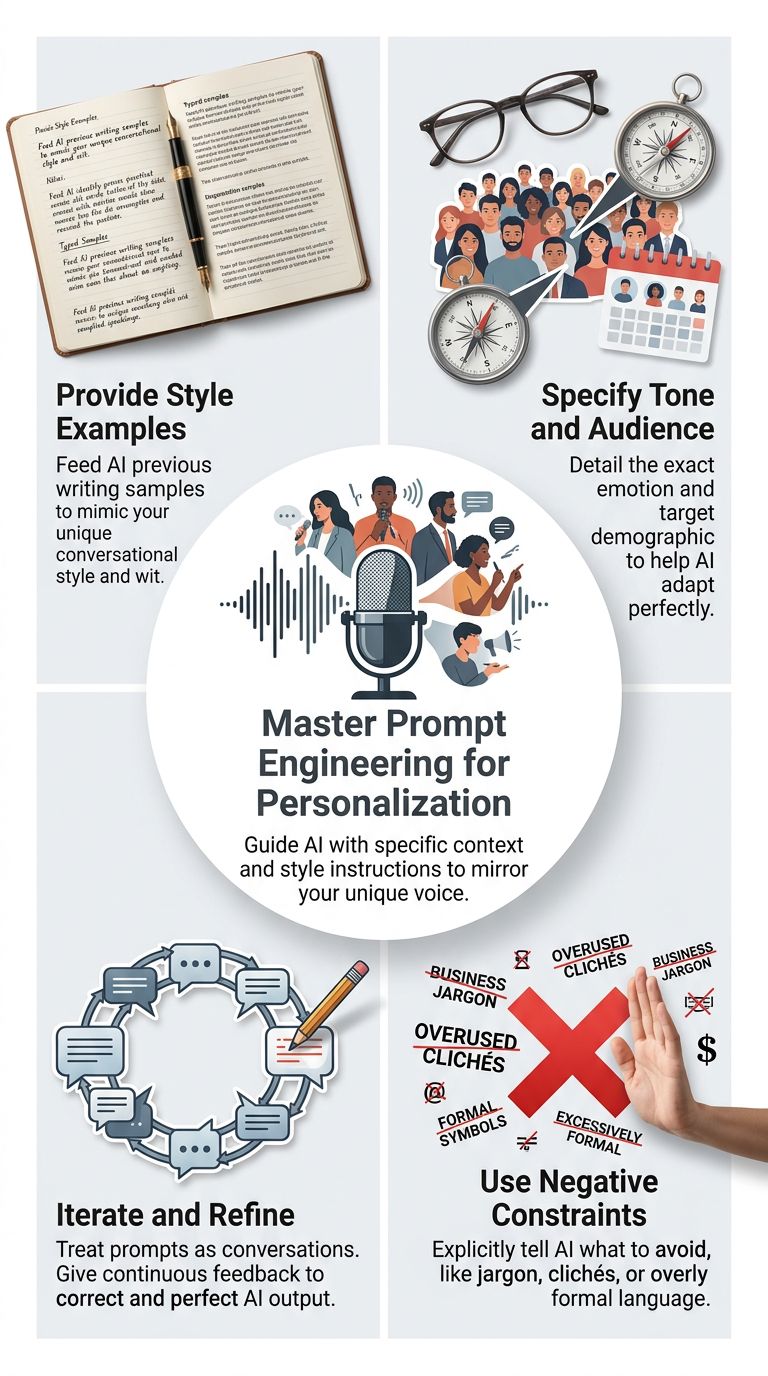
Here’s where the magic really happens: how you talk to AI dictates what it gives you back. “Prompt engineering” might sound fancy, but it just means learning to ask AI the right questions in the right way. If you want AI to sound like you, you have to tell it how to sound like you. This isn’t just about giving it a topic; it’s about providing context, tone, style examples, and specific instructions that guide its output to mirror your unique voice. This is perhaps the most critical skill to develop when integrating AI into your content workflow.
Think of your prompts as detailed briefs for a highly intelligent, but ultimately literal, assistant. The more specific and nuanced your instructions, the closer the AI’s output will come to your desired voice. Without thoughtful prompting, you’ll get generic responses every time. It’s about giving AI a clear model of your style to emulate.
Providing Style Guides and Examples
Don’t just say “write in a friendly tone.” Instead, give AI examples of your previous writing. “Here are three paragraphs I wrote. Mimic this style: conversational, a bit witty, and uses personal anecdotes.”
Specifying Tone and Audience
Be explicit. “Write this section with an encouraging and empathetic tone, for small business owners who feel overwhelmed.” The more detail, the better the AI can adapt.
Using Constraints and Exclusions
Tell AI what not to do. “Avoid jargon,” “don’t use clichés,” or “refrain from overly formal language.” These negative constraints are just as powerful as positive ones.
Iterative Prompting and Feedback
It’s rarely perfect on the first try. If the AI output isn’t quite right, tell it why. “This is too formal; make it more casual,” or “Add more humor here.” Treat it as a conversation, refining with each turn.
| Prompt Engineering Technique | How It Preserves Your Voice |
|---|---|
| Style Guides/Examples | Directly trains AI on your existing writing patterns and preferences. |
| Tone/Audience Specificity | Ensures emotional resonance and target reader alignment. |
| Constraints/Exclusions | Prevents generic phrasing and avoids common AI pitfalls. |
| Iterative Feedback | Allows for continuous refinement, nudging AI closer to your ideal voice. |
| Role-Playing Prompts | Encourages AI to adopt a persona, which you define as “you.” |
Editing and Humanizing AI-Generated Drafts
Okay, so you’ve used AI to generate some content. Now what? This is where your human touch becomes non-negotiable. Think of AI’s output as a first draft, a raw material that needs your expert craftsmanship. You wouldn’t publish a rough sketch; you’d refine it, add details, and infuse it with your unique artistry. The same goes for AI-generated text. It needs your keen eye, your personal insights, and your voice to truly shine. This isn’t just about correcting grammar; it’s about injecting soul.
This editing phase is where you transform generic AI text into something authentically yours. It’s the difference between a mass-produced item and a handcrafted piece. Skipping this step is the fastest way to lose your voice and make your content indistinguishable from countless other AI-assisted pieces online. Embrace this as your primary role: the editor, the voice-infuser, the storyteller.
Infusing Personal Anecdotes and Experiences
AI can’t tell your story. Add personal examples, anecdotes, and unique observations that only you could provide. These are powerful voice markers.
Refining Word Choice and Sentence Structure
AI often uses predictable vocabulary or sentence patterns. Swap out generic words for more evocative ones, vary sentence length, and rearrange phrases to match your natural flow.
Adding Nuance and Emotion
AI struggles with genuine emotion and subtle nuance. Read through the text and ask: “Does this sound like I’m truly passionate/frustrated/excited about this?” Adjust to convey the right feelings.
Checking for Authenticity and Relatability
Does the content feel genuine? Would your audience connect with this? Sometimes AI can be technically correct but emotionally flat. Punch it up, make it more conversational, or add a touch of humor if that’s your style.
Fact-Checking and Updating Data
While AI can pull data, it sometimes hallucinates or provides outdated information. Always verify facts, statistics, and examples to maintain credibility and accuracy.
| Editing/Humanizing Technique | Impact on Your Voice |
|---|---|
| Personal Stories | Adds unique perspective and emotional depth, impossible for AI to replicate. |
| Vocabulary Refinement | Elevates language from generic to distinctive, matching your specific lexicon. |
| Sentence Restructuring | Breaks AI’s predictable patterns, creating a natural, engaging rhythm. |
| Injecting Emotion/Nuance | Transforms factual text into relatable, heartfelt, or passionate prose. |
| Adding Unique Insights | Provides original thoughts and conclusions that reflect your expertise. |
| Fact-Checking | Ensures credibility and reinforces your authority. |
Developing a Hybrid Content Workflow
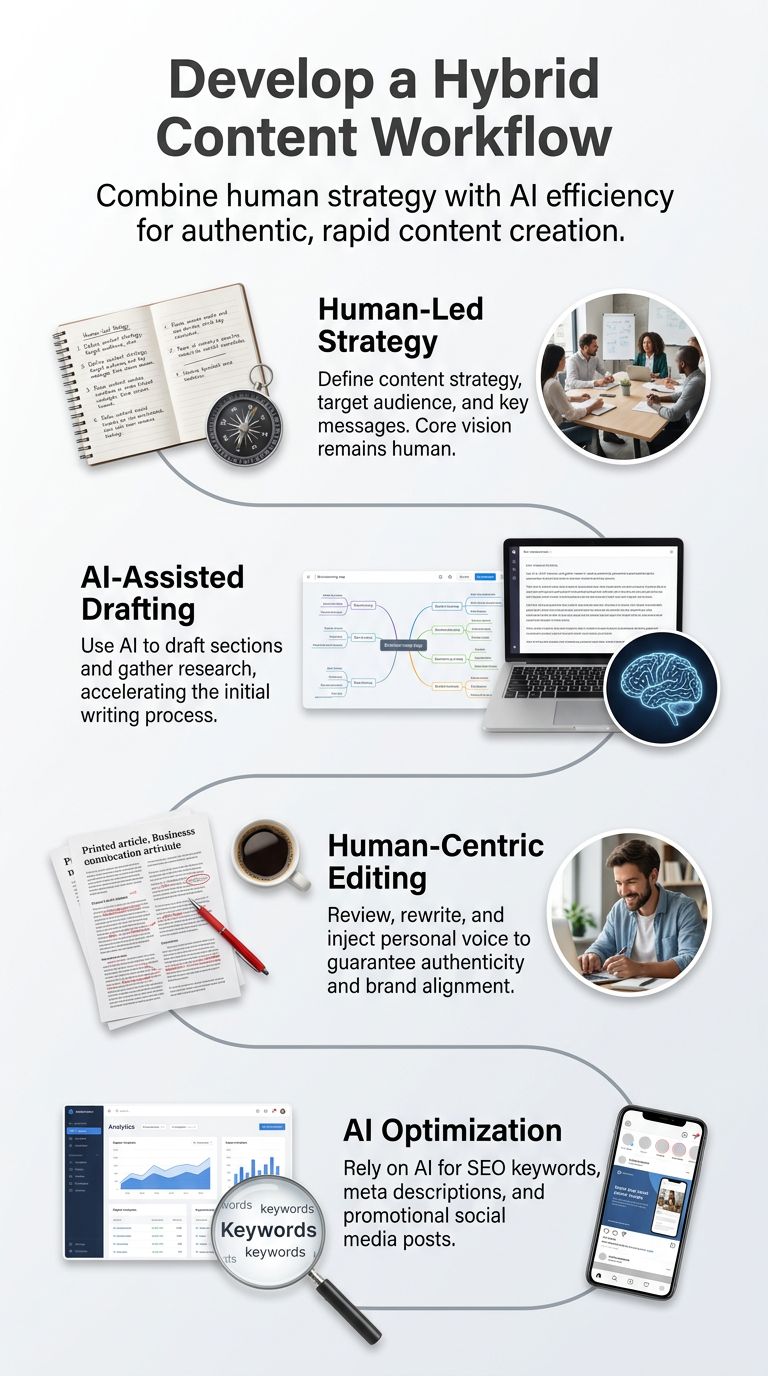
The most effective way to use AI isn’t to replace your existing workflow, but to integrate it seamlessly. Think of it as creating a hybrid process where AI handles the heavy lifting of initial drafting or research, and you, the human, provide the strategic direction, creative spark, and final polish. This approach maximizes efficiency without sacrificing authenticity. It’s about being smart with your time and leveraging tools where they excel, while preserving your irreplaceable role as the voice and vision behind your content.
A hybrid workflow isn’t a one-size-fits-all solution; it evolves as you become more familiar with AI tools and how they best serve your specific needs. The key is to consciously assign tasks to AI that are repetitive, time-consuming, or require extensive data processing, allowing you to focus on the truly creative and voice-driven aspects of content creation.
Phase 1: Human-Led Strategy and Ideation
You define the overarching content strategy, target audience, and key messages. You generate initial ideas, and then AI assists in expanding on those ideas or suggesting variations. This ensures the core vision remains yours.
Phase 2: AI-Assisted Drafting and Research
Once the outline and core ideas are set, AI can help draft sections, gather supporting information, or provide different ways to explain complex concepts. This speeds up the initial writing process significantly.
Phase 3: Human-Centric Editing and Personalization
This is your crucial stage. You review, rewrite, inject your voice, add personal stories, refine the tone, and ensure every word aligns with your brand. This phase is non-negotiable for authenticity.
Phase 4: AI for Optimization and Distribution
After your human touch has perfected the content, AI can assist with SEO optimization (keyword suggestions, meta descriptions), social media post generation, or even email subject lines for promotion.
| Hybrid Workflow Phase | Human Role | AI Role | Voice Preservation Impact |
|---|---|---|---|
| Strategy & Ideation | Sets vision, core message, initial concepts. | Expands ideas, suggests variations, brainstorms. | Ensures foundational content aligns with your unique perspective. |
| Drafting & Research | Guides AI with detailed prompts, provides direction. | Generates initial drafts, collects information. | Speeds up creation of raw material, freeing your time for voice. |
| Editing & Personalization | Infuses voice, adds nuance, fact-checks, refines. | Provides a starting point for human refinement. | Crucial phase for embedding your authentic voice and style. |
| Optimization & Distribution | Approves final copy, oversees overall strategy. | Assists with SEO, social copy, scheduling. | Enhances reach without altering your core message or tone. |
Ethical Considerations and Transparency
As we embrace AI in content creation, it’s not just about efficiency; it’s also about ethics. Being transparent with your audience, understanding the limitations of AI, and using it responsibly are paramount. Your reputation and the trust your audience places in you are invaluable. If your readers feel deceived or that your content lacks genuine human input, it can severely damage your brand. This isn’t just good practice; it’s essential for long-term credibility and building a loyal community around your work.
The rapid evolution of AI means we’re constantly learning about its capabilities and drawbacks. Staying informed about these aspects allows you to make conscious decisions about when and how to deploy AI, always keeping your audience’s best interests and your brand’s integrity at the forefront.
Disclosing AI Use (When Appropriate)
While you don’t need to declare every time you use AI for a brainstorm, if a significant portion of your content was AI-generated and then heavily edited, consider a disclaimer. This builds trust.
Avoiding Misinformation and Bias
AI models can sometimes generate biased or inaccurate information based on their training data. Always fact-check rigorously and ensure your content is fair, balanced, and truthful. Your voice is tied to your credibility.
Prioritizing Human Creativity
Remember that AI is a tool, not a replacement for human ingenuity. Use it to enhance your creative process, not to diminish your unique contribution. Your original thoughts and emotions are what truly resonate.
Understanding AI’s Limitations
AI lacks genuine understanding, empathy, and lived experience. It can’t truly “feel” or “know.” Be aware of these limitations and rely on your human judgment for sensitive topics or deeply personal narratives.
| Ethical Consideration | Why It Matters for Your Voice & Brand |
|---|---|
| Transparency | Builds trust and credibility with your audience. |
| Avoiding Bias/Misinfo | Protects your reputation and ensures accuracy. |
| Prioritizing Creativity | Keeps your unique perspective at the forefront of your content. |
| Understanding Limitations | Prevents missteps on sensitive topics, maintains authenticity. |
| Data Privacy | Protects your and your audience’s information. |
Final Thoughts
So, there you have it. Using AI for content creation doesn’t mean sacrificing your unique voice; it means strategically leveraging a powerful tool to amplify it. It’s about being the conductor of your creative orchestra, with AI as a super-talented, obedient instrument. Your authenticity, your personality, your unique way of seeing the world – these are the things that make your content truly special, and no AI can replicate that.
By understanding your voice, using AI as an idea generator, mastering prompt engineering, diligently editing, and adopting a smart hybrid workflow, you can harness the incredible power of artificial intelligence to create more, create faster, and reach a wider audience, all while sounding undeniably you. The future of content creation isn’t human versus AI; it’s human plus AI, working together to tell stories that resonate and connect. Go forth, create, and let your amazing voice shine, with a little help from your new AI friend.