The era of the “smart” phone is ending; the era of the “intelligent” companion has arrived. If you are wondering how AI is changing smartphones in 2026, the answer lies in a fundamental shift from command-based interaction to intent-based anticipation. We are no longer just tapping apps; we are interacting with neural engines that understand context, predict needs, and execute complex workflows autonomously.
As we move deeper into 2026, the convergence of Agentic AI, hyper-efficient NPUs (Neural Processing Units), and on-device processing is redefining the mobile experience. Below is a comprehensive dive into this technological metamorphosis, optimized to give you a clear view of the future in your pocket.
Key Takeaways
-
From Apps to Agents: The fundamental shift from clicking static icons to using AI agents that proactively manage workflows and anticipate needs.
-
Multimodal “Vision”: Cameras have evolved into search engines; “Visual Intelligence” now understands real-time context, objects, and text without taking a photo.
-
Universal Communication: Real-time translation with voice cloning has effectively dissolved language barriers during calls and face-to-face interactions.
-
The NPU Advantage: Dedicated Neural Processing Units now handle 80% of tasks on-device, ensuring data privacy and extending battery life significantly.
-
Democratized Creativity: Generative AI tools (Genmoji, Magic Editor) allow every user to create professional-grade images and text instantly.
-
Proactive Health & Security: AI acts as a bodyguard and coach, identifying scam patterns in real-time and connecting health data points for actionable advice.
The Core Shift: From App Grids to Fluid Intelligence
To truly appreciate these changes, we must first understand that the fundamental architecture of the smartphone interface is dissolving. For the last fifteen years, our digital lives have been compartmentalized into grids of static icons—the “App Store” model. If you wanted to travel, you opened a travel app. If you wanted to calculate costs, you switched to a calculator. In 2026, those walls are crumbling.
The “Intelligent Phone” operates on a layer above the apps. Powered by advanced Large Action Models (LAMs) and dedicated Neural Processing Units (NPUs), your device now functions less like a file cabinet and more like a digital executive assistant. It pulls data from your email, cross-references it with your calendar, and applies it to your maps without you ever needing to copy-paste a single link.
This isn’t just about faster chips; it is about intent-based computing. Your phone now understands the goal (e.g., “Plan a dinner date”), not just the command (“Open Yelp”). As we explore the twelve key areas below, remember that these aren’t just isolated features; they are the visible results of a device that has finally learned to think.
The 12 Pillars of the AI Smartphone Era
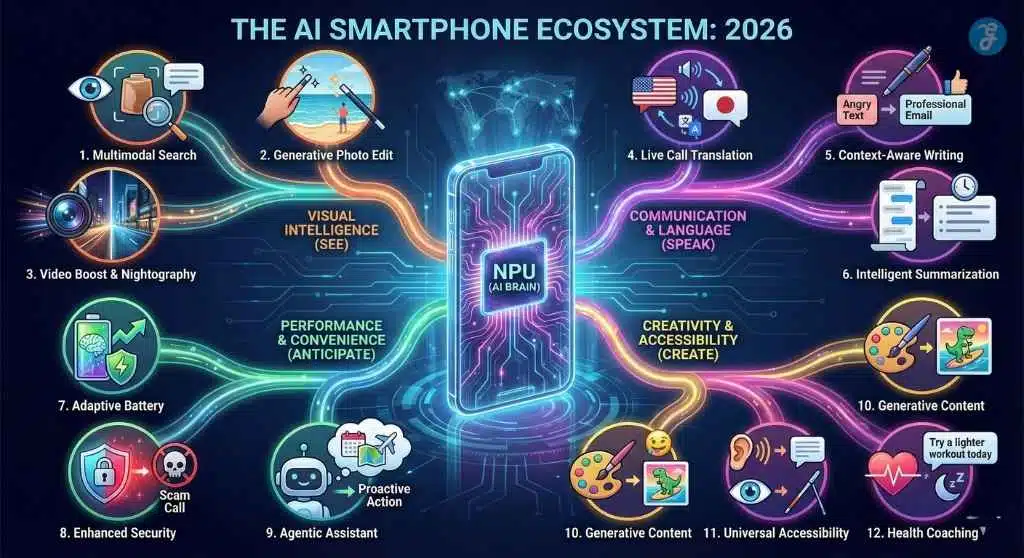
How AI Is Changing Smartphones? From the way we capture memories to how we protect our digital identity, artificial intelligence is rewriting the rules of mobile engagement. These twelve defining capabilities transform your device from a passive tool into a proactive, intelligent partner that anticipates your needs before you even speak.
Visual Intelligence & Photography (The “See” Era)
The camera is evolving from a tool that captures images to a sensor that queries reality.
1. Search What You See (Circle to Search/Visual Intelligence)
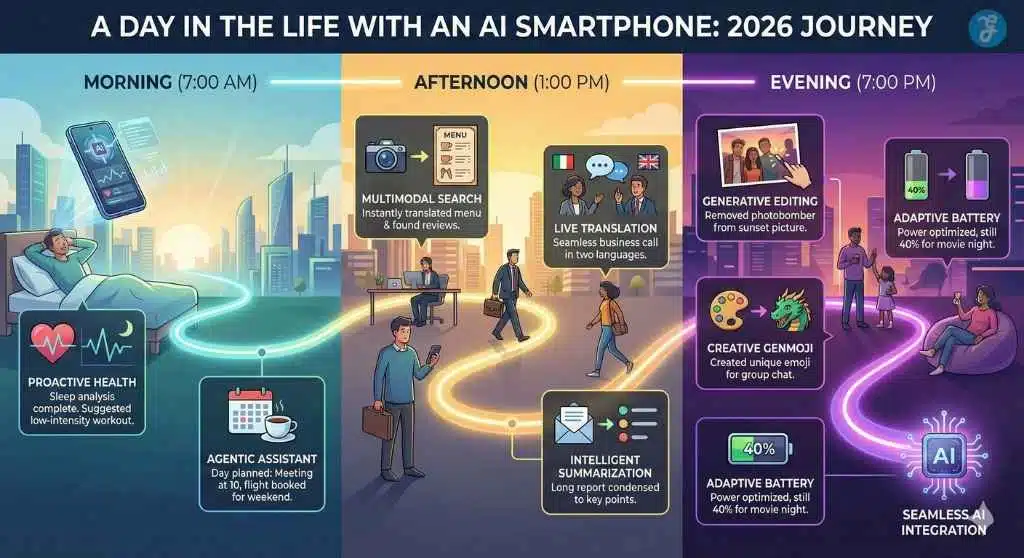
The days of typing queries are ending. With visual intelligence, your camera acts as a cursor for the real world. In 2026, features like “Circle to Search” have evolved into fully multimodal search engines. You can now point your camera at a strange vegetable in the grocery store, and the phone won’t just identify it—it will pull up recipes, nutritional info, and local pricing without you ever taking a photo or switching apps. Computer vision now understands context, not just objects.
2. Generative Photo Editing
We have moved beyond simple filters to “reality reconstruction.” Generative fill and Magic Editor tools allow you to completely reimagine a scene after it has been shot.
-
Object Removal: Erase a tourist from your beach photo, and the AI hallucinates the missing ocean waves perfectly.
-
Subject Repositioning: Move your friend closer to the center of the frame, and the AI fills in the gap where they used to stand.
3. Video Boost & Nightography
While photo editing is established, 2026 is the year of computational videography. New NPU (Neural Processing Unit) capabilities allow phones to process video frame-by-frame in real-time.
-
Nightography Video: AI analyzes low-light footage instantly, reducing grain and boosting color fidelity as you record.
-
Video Boost: Cloud-based processing for video is moving on-device, allowing for cinema-quality stabilization and lighting correction without the wait.
Communication & Language (The “Speak” Era)
Language is the primary interface of humanity, and AI is removing its friction.
4. Real-Time Language Translation
The “Tower of Babel” problem is dissolving. Live Translate features now offer near-zero latency (under 300ms) during phone calls. When you speak English to a Spanish speaker, they hear Spanish in your voice tone (via AI voice cloning), not a robotic narrator. This face-to-face interpretation capability turns your phone into a universal translator for travel and business.
| Feature | 2024 Capability | 2026 Standard |
| Latency | 2-3 seconds delay | <300ms (Conversational) |
| Voice | Robotic TTS | Voice Cloning (Maintains Emotion) |
| Context | Literal Translation | Idiom & Slang Aware |
5. Context-Aware Writing Assistants
Keyboards are now creative partners. Magic Compose and similar writing tools don’t just spellcheck; they adjust your “voice.”
-
Tone Adjustment: Convert a hastily written, angry text into a professional, polite email with one tap.
-
Grammar & Flow: Complex sentence restructuring happens on the fly, making you sound like a native speaker in any language you type.
6. Intelligent Summarization
Information overload is a relic of the past. AI now acts as your personal secretary.
-
Voice Notes: Record a one-hour lecture, and the AI will transcribe it, identify different speakers, and generate a concise bullet-point summary.
-
Group Chats: Instead of scrolling through 500 missed messages, the AI provides a “Catch Me Up” summary of the key decisions and dates mentioned.
Performance & Daily Convenience (The “Anticipate” Era)
The best AI is the kind you don’t see—it just works in the background to keep your device running perfectly.
7. Proactive Battery Management
Battery anxiety is being cured by Adaptive Battery intelligence. The AI learns your specific usage patterns—knowing you check social media at 8 AM but leave the phone idle during meetings. It aggressively kills background processes during your “down times” and pre-loads apps right before you usually open them. This extends battery life by 20-30% without needing a physically larger battery.
8. Enhanced Security & Spam Protection
Your phone is now your digital bodyguard.
-
Fraud Detection: During a call, on-device AI listens for specific patterns associated with financial scams (e.g., “urgent wire transfer,” “gift card payment”). If detected, it flashes a red warning on your screen in real-time.
-
Spam Filtering: It visually screens calls, providing a live transcript of the caller so you can decide if it’s worth answering.
9. Personalized Digital Assistants
We are transitioning from “Command-Based” assistants (Siri, Google Assistant) to Conversational LLMs (Gemini, Apple Intelligence). These agents have screen awareness. You can say, “Add this to my calendar,” while looking at a concert poster on Instagram, and the assistant understands “this” refers to the date and time on the image, executing the action without further prompts.
Creativity & Accessibility (The “Create” Era)
Smartphones in 2026 are democratizing creativity and access to information.
10. Generative Content Creation (Genmoji/Image Playground)
You no longer need to search for the perfect image; you can create it.
-
Genmoji: Create custom emojis on the fly by typing a prompt like “A T-Rex surfing wearing sunglasses.”
-
Image Playground: Generate unique illustrations for presentations or social media directly on your device, ensuring your content is always original.
11. Accessibility for All
AI is bridging the gap for users with disabilities.
-
Live Caption: The phone can generate accurate captions for any audio playing on the device—podcasts, videos, or even phone calls—even if the volume is muted.
-
Visual Descriptions: For the visually impaired, the camera can narrate the world, describing the layout of a room or reading a restaurant menu aloud.
12. Health & Wellness Coaching
Health apps have moved from “Data Display” to “Data Coaching.” Instead of just showing you slept 6 hours, the AI connects the dots: “Your heart rate variability is low because of poor sleep yesterday; consider skipping high-intensity cardio today.” It turns raw statistics into actionable, personalized wellness advice.
The Privacy Paradox: Convenience vs. Control
As we hand over more agency to our phones, we face the Privacy Paradox. In 2026, we are trusting AI agents to book flights and manage bank transfers—tasks that require deep access to our most sensitive data.
-
The “Black Box” Problem: While on-device processing is safer, 2026 has introduced “App Agent” permissions. When you grant an AI permission to “act on your behalf,” you are effectively giving it the keys to your digital life.
-
The Solution – “Permission Scopes”: Look for the new “AI Intervention” settings in Android 16 and iOS 19. These allow you to set strict limits—for example, * “The AI can read my emails to draft a summary, but it must ask for FaceID confirmation before sending a reply.”*
-
Digital Wellbeing: There is also a push for “AI Detox” modes. Because these phones are so good at anticipating our needs, they can become addictive. New wellbeing tools track not just “Screen Time,” but “AI Reliance,” encouraging you to perform tasks manually to keep your cognitive skills sharp.
Gaming 3.0: Living Worlds in Your Pocket
Mobile gaming is undergoing its biggest shift since the introduction of the touchscreen. The era of the “Non-Player Character” (NPC) that repeats the same three lines of dialogue is over.
-
Memory-First AI: In 2026, RPGs, NPCs utilize Small Language Models (SLMs) running locally. If you help a villager in Level 1, they will remember your kindness in Level 50. They don’t read a script; they react to your past actions dynamically.
-
Agentic Level Design: You are no longer just a player; you are a director. In sandbox games, you can now type (or speak) commands like, “Generate a racing track with a loop-de-loop and neon aesthetics,” and the NPU builds a playable 3D level in seconds.
-
Dynamic Difficulty: Instead of choosing “Easy” or “Hard,” the AI director analyzes your reaction time and frustration levels (via screen taps) to adjust the game speed in real-time, keeping you in the perfect “flow state.”
The Economic Reality: The “AI Tax” of 2026
While AI features are exciting, they come with a new price tag. In 2026, we are seeing a phenomenon analysts call the “AI Component Squeeze.”
Because AI data centers are buying up massive amounts of high-speed memory (DRAM) and advanced silicon to run models like GPT-6 and Gemini Ultra, there is a global shortage of these components for consumer devices.
-
The Impact: Flagship smartphones in 2026 are, on average, 15-20% more expensive than their 2024 counterparts.
-
The Trade-off: To keep prices stable, some “Flagship Killer” brands are actually downgrading other specs (like using plastic backs instead of glass) to afford the expensive NPU chips required for on-device AI.
-
Buying Tip: In 2026, the “smart” buy is often a refurbished 2025 flagship rather than a mid-range 2026 phone, as older flagships often receive the same software AI updates but have better build quality.
The Technology Behind the Magic (Technical SEO Section)
To understand how this works, we must look at the silicon. The magic happens in the NPU (Neural Processing Unit).
On-Device AI vs. Cloud AI
In 2026, the priority is On-Device AI. This means the processing happens locally on your phone’s chip, not on a remote server.
Why It Matters:
-
Privacy: Your photos and chats never leave your device.
-
Speed: No latency from waiting for a server response.
-
Offline Capability: Translation and summarization work even when you are in “Airplane Mode.”
| Feature | On-Device AI (NPU) | Cloud AI |
| Privacy | High (Data stays local) | Variable (Data sent to server) |
| Speed | Instant | Depends on 5G/Wi-Fi |
| Complexity | Small/Medium Tasks | Heavy Tasks (4K Video Gen) |
Frequently Asked Questions (FAQ)
1. Does AI drain my smartphone battery?
Actually, no. Modern NPU optimization allows AI to manage power consumption more efficiently than standard processors. By learning your habits and killing zombie apps, AI features in 2026 often result in a net gain in battery life.
2. Is my data safe with AI features?
Safety is a priority. Most 2026 features utilize On-Device Processing, meaning your personal data (photos, messages) is processed locally on your phone’s silicon and is never sent to the cloud.
3. Do I need a new phone to get AI features?
For the most advanced “On-Device” capabilities (like instant video boost or heavy gaming AI), yes, you need a phone with a modern NPU (2024-2026 models). However, many cloud-based AI features, like simple photo editing, are rolling out to older models via software updates.
4. Can I turn off these AI features if I don’t want them?
Yes. Manufacturers are including dedicated “Intelligence” settings menus where you can toggle off specific features like generative text or screen awareness if you prefer a classic experience.
5. How does AI help with spam calls?
AI goes beyond simple blocklists. It uses “Call Screen” technology to answer unknown numbers for you, ask the caller their business, and provide you with a live transcript, effectively filtering out robocalls before your phone even rings.
Final Thoughts: The “Intelligent” Future
As we settle into 2026, the definition of a mobile device has fundamentally changed. We have graduated from the era of the “Smartphone”, a passive tool waiting for commands, to the “Intelligent Companion,” an active agent that anticipates our needs before we even voice them.
This shift reduces the friction between thought and action. Whether it is breaking language barriers in real-time or managing our digital well-being through proactive battery governance, the technology is finally fading into the background to let us take center stage.
The future isn’t about staring at screens more; it is about the device handling the busy work so we can look up at the world. We are no longer just users; we are directors of our digital lives. The best feature of 2026 isn’t a faster chip; it is the gift of time.