September 4th marks a day of significant historical events and notable birthdays that have shaped various aspects of our world. From geographical discoveries to political movements, and from musical innovations to scientific breakthroughs, this date has witnessed a diverse array of impactful occurrences.
This article explores five key historical events and the lives of five influential individuals born on this day, highlighting their contributions to society and their lasting legacies.
Historical Events on September 4
1. Hudson Discovers Manhattan (1609)
On September 4, 1609 (though some sources cite September 11), English navigator Henry Hudson, while in the service of the Dutch East India Company, became the first European to discover the island of Manhattan. Hudson was searching for a northwest passage to Asia when he sailed into what is now New York Harbor.
Hudson’s discovery was pivotal for European exploration and colonization of North America. The Dutch were quick to establish a trading post on the island, which they named New Amsterdam. This settlement would later become New York City after the English took control in 1664.
The discovery of Manhattan by Hudson led to the establishment of New Netherland, a Dutch colony that encompassed parts of present-day New York, New Jersey, Connecticut, and Delaware. This early European presence laid the foundation for what would become one of the world’s most influential cities and a major center of global finance, culture, and commerce.
Hudson’s exploration of the region also included sailing up the river that now bears his name, the Hudson River. His detailed accounts of the area’s geography, flora, fauna, and native inhabitants provided valuable information for subsequent European settlers and traders.
2. Siege of Namur (1695)
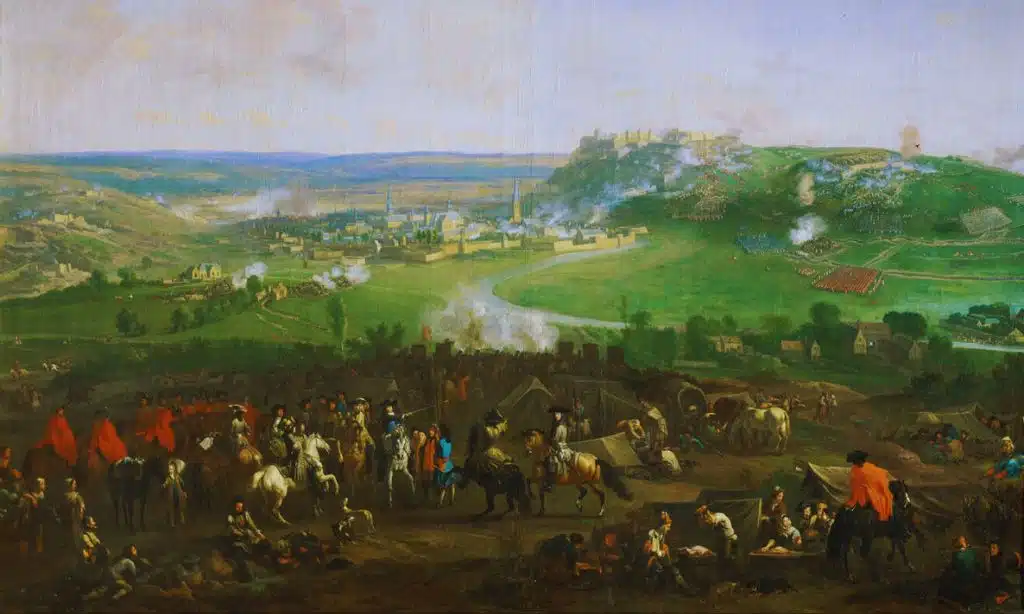
On September 4, 1695, the French garrison of Namur Castle surrendered to the army of the Grand Alliance, commanded by King William III of England. This event was a significant turning point in the Nine Years’ War (1688-1697), also known as the War of the Grand Alliance.
The Siege of Namur began on July 2, 1695, when Allied forces surrounded the city and its formidable citadel. The French, under Marshal Boufflers, had heavily fortified Namur, making it one of the strongest fortresses in Europe. However, after a grueling two-month siege, the city fell on August 4, and the citadel finally surrendered a month later.
This victory was crucial for the Allied forces, as it demonstrated their ability to overcome even the most formidable French defenses. It also marked a shift in the balance of power in the war, boosting Allied morale and weakening French dominance in the region.
King William III’s leadership during this siege enhanced his reputation as a military commander and strengthened his position both in England and on the continent. The fall of Namur was a significant blow to Louis XIV’s ambitions and contributed to the eventual peace negotiations that led to the Treaty of Ryswick in 1697.
3. Standardization of Electrical Units (1861)
On September 4, 1861, at its 31st annual meeting in Manchester, England, the British Association for the Advancement of Science proposed standard units of electrical measurement. This landmark decision led to the adoption of the volt, named after Italian physicist Alessandro Volta, and the ohm, named after German physicist Georg Ohm.
This standardization was crucial for the rapidly developing field of electrical engineering. Prior to this, there was no unified system of measurement for electrical phenomena, which hampered scientific communication and technological progress. The introduction of these standard units allowed for more precise and consistent measurements, facilitating advancements in electrical theory and applications.
The volt, a unit of electromotive force, and the ohm, a unit of electrical resistance, became fundamental to understanding and working with electricity. These units, along with others proposed later, formed the basis of the International System of Units (SI) for electrical measurements.
This standardization effort paved the way for the expansion of electrical technology in the late 19th and early 20th centuries. It enabled more accurate design and production of electrical equipment, fostered international collaboration in electrical engineering, and ultimately contributed to the electrification of modern society.
4. Sivas Congress (1919)
On September 4, 1919, Mustafa Kemal Atatürk, the founder of the Republic of Turkey, convened the Sivas Congress to make crucial decisions about the future of Anatolia and Thrace. This congress was a pivotal moment in the Turkish War of Independence and the formation of modern Turkey.
The Sivas Congress brought together delegates from various regions of Anatolia and Thrace to discuss resistance against foreign occupation following World War I. The Ottoman Empire had been defeated, and Allied powers were planning to partition its territories.
During the congress, several key resolutions were adopted:
1. The territorial integrity of the Ottoman lands within the armistice lines should be preserved.
2. Foreign mandates and protectorates were to be rejected.
3. A provisional government would be formed if the Istanbul government failed to protect the nation’s independence.
4. A Representative Committee was elected to represent the national movement.
These decisions laid the groundwork for the Turkish national movement and the eventual establishment of the Republic of Turkey. The Sivas Congress marked a turning point in Atatürk’s leadership, consolidating his position as the leader of the Turkish independence movement.
The principles agreed upon at Sivas formed the basis of the Turkish National Pact, which defined the core aims of the Turkish War of Independence. The congress’s resolutions ultimately led to the creation of a new Turkish state, with Atatürk as its first president in 1923.
5. Japanese Peace Treaty Conference (1951)
On September 4, 1951, U.S. President Harry Truman addressed the opening of the Japanese Peace Treaty Conference in San Francisco. This conference marked a significant step in normalizing relations between Japan and the Allied Powers following World War II.
The primary purpose of the conference was to officially end the state of war and to re-establish Japan as a sovereign nation. Truman’s address emphasized the importance of building a lasting peace and reintegrating Japan into the international community.
Key points of the treaty included:
1. Recognition of Japan’s sovereignty
2. Withdrawal of Allied occupation forces
3. Provisions for war reparations
4. Territorial adjustments
The treaty, signed by 48 nations on September 8, 1951, came into effect on April 28, 1952. It marked the end of the Allied occupation of Japan and restored full sovereignty to the Japanese government.
This event was crucial in shaping post-war international relations in Asia and the Pacific. It allowed Japan to rebuild its economy and eventually become a major economic power. The treaty also solidified the U.S.-Japan alliance, which has remained a cornerstone of security in the Asia-Pacific region.
Famous Birthdays on September 4
1. Anton Bruckner (1824-1896)
| Aspect | Details |
|---|---|
| Full Name | Josef Anton Bruckner |
| Born | September 4, 1824, in Ansfelden, Austria |
| Died | October 11, 1896, in Vienna, Austria |
| Occupation | Composer, organist, music theorist |
| Notable Works | Nine symphonies, Te Deum, Mass in F minor |
| Musical Style | Late Romantic, influenced by Wagner |
| Legacy | Influential in the development of the symphony |
Anton Bruckner was an Austrian composer known for his symphonies, masses, and motets. Born to a schoolmaster father, Bruckner showed early musical talent and received his first musical training as a chorister at St. Florian monastery.
Bruckner’s mature style was characterized by expansive length, elaborate development, and a rich, complex harmonic language. He was heavily influenced by Richard Wagner, which often put him at odds with the supporters of Johannes Brahms in the musical debates of the time.
Despite being derided by some critics as a “monumental bore,” Bruckner’s work has had a lasting impact on classical music. His innovative approach to symphonic form and his deep, spiritual style of composition have influenced many later composers. Today, Bruckner is recognized as one of the most important late-Romantic composers, particularly for his contributions to the symphonic repertoire.
2. Darius Milhaud (1892-1974)
| Aspect | Details |
|---|---|
| Full Name | Darius Milhaud |
| Born | September 4, 1892, in Marseille, France |
| Died | June 22, 1974, in Geneva, Switzerland |
| Occupation | Composer, teacher |
| Notable Works | “Le bœuf sur le toit,” “La création du monde” |
| Musical Style | Polytonality, jazz influences, Brazilian music |
| Legacy | Member of “Les Six,” influential teacher |
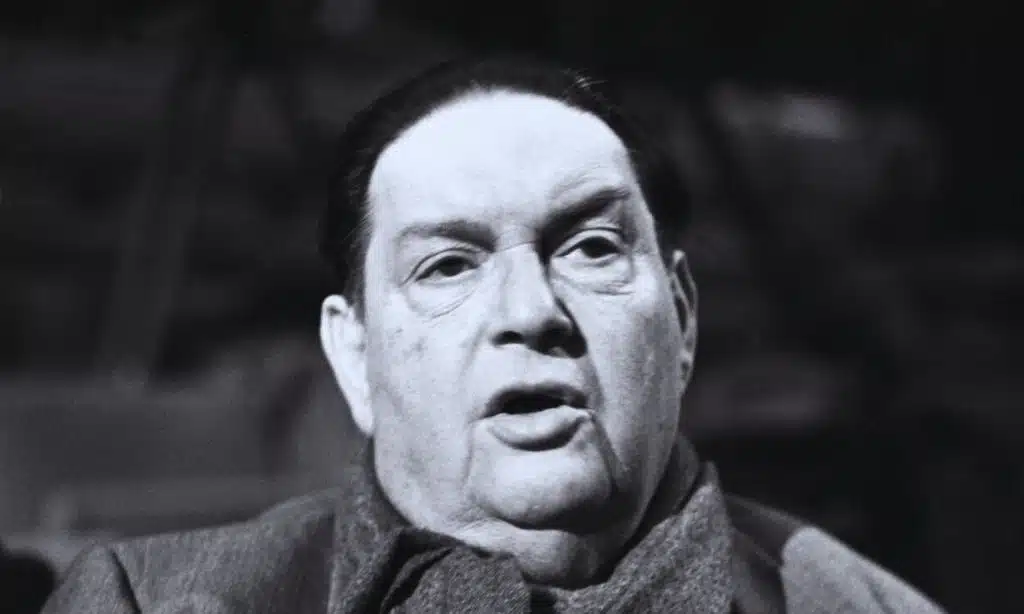
Darius Milhaud was a prolific French composer and teacher, known for his innovative use of polytonality and incorporation of jazz elements into classical music. Born into a Jewish family in Marseille, Milhaud studied at the Paris Conservatoire before embarking on a diverse and influential musical career.
Milhaud was a member of “Les Six,” a group of French composers who reacted against the excesses of Romanticism and Impressionism. His style was characterized by its rhythmic vitality, often inspired by Brazilian music, and its exploration of polytonality – the simultaneous use of multiple keys.
Throughout his career, Milhaud composed in a wide range of genres, including operas, ballets, symphonies, and chamber music. His work “Le bœuf sur le toit” (The Ox on the Roof) became particularly famous, embodying his Brazilian influences and playful style.
As a teacher, Milhaud influenced many important 20th-century composers and musicians, including Philip Glass and Burt Bacharach. His legacy continues through his innovative compositions and his impact on music education.
3. Paul Harvey (1918-2009)
| Aspect | Details |
|---|---|
| Full Name | Paul Harvey Aurandt |
| Born | September 4, 1918, in Tulsa, Oklahoma, USA |
| Died | February 28, 2009, in Phoenix, Arizona, USA |
| Occupation | Radio broadcaster, commentator |
| Notable Works | “The Rest of the Story,” “Paul Harvey News” |
| Style | Distinctive voice, dramatic pauses, human interest stories |
| Legacy | One of the most listened-to radio personalities in history |
Paul Harvey was an American radio broadcaster known for his distinctive delivery and popular programs “Paul Harvey News” and “The Rest of the Story.” His career in radio spanned nearly seven decades, during which he became one of the most recognizable voices in American broadcasting.
Harvey began his radio career in 1933 at KVOO in Tulsa, Oklahoma. He quickly gained popularity for his unique style, which included dramatic pauses and a deep, resonant voice. His trademark sign-on, “Hello Americans, this is Paul Harvey. Stand by for news!” became instantly recognizable to millions of listeners.
“The Rest of the Story,” perhaps his most famous program, featured little-known or forgotten facts on various subjects, often with a surprise ending. This format captivated audiences and ran from 1976 until Harvey’s death in 2009.
Harvey’s influence extended beyond just entertainment. His conservative commentary on current events shaped public opinion, and his product endorsements could significantly boost sales. At the peak of his career, Harvey’s various programs reached an estimated 24 million listeners daily.
Paul Harvey’s long-running career and distinctive style left an indelible mark on American radio broadcasting. His ability to connect with listeners through storytelling and his unique delivery continues to influence broadcasters today.
4. John McCarthy (1927-2011)
| Aspect | Details |
|---|---|
| Full Name | John McCarthy |
| Born | September 4, 1927, in Boston, Massachusetts, USA |
| Died | October 24, 2011, in Stanford, California, USA |
| Occupation | Computer scientist, cognitive scientist |
| Notable Contributions | Coined term “artificial intelligence,” created Lisp programming language |
| Awards | Turing Award (1971), National Medal of Science (1990) |
| Legacy | Founding father of artificial intelligence |
John McCarthy was an American computer scientist and cognitive scientist who played a pivotal role in the development of artificial intelligence (AI). Born in Boston, McCarthy showed early aptitude in mathematics, completing his Ph.D. in mathematics from Princeton University in 1951.
McCarthy’s most significant contribution to computer science was coining the term “artificial intelligence” in 1955. He organized the Dartmouth Conference in 1956, which is widely considered the founding event of AI as a field of study.
In 1958, McCarthy created the Lisp programming language, which became the preferred language for AI programming for many years. Lisp introduced several central concepts in computer programming, including tree data structures, automatic storage management, dynamic typing, and the self-hosting compiler.
Throughout his career, McCarthy made numerous contributions to AI and computer science, including the development of time-sharing systems and the concept of garbage collection in programming languages. He was a strong advocate for the use of mathematical logic to describe knowledge, including common sense knowledge.
McCarthy’s work laid the foundation for many aspects of modern computing and AI. His ideas continue to influence the field, and his vision of machines that can reason like humans remains a central goal of AI research.
5. Dawn Fraser (b. 1937)
| Aspect | Details |
|---|---|
| Full Name | Dawn Lorraine Fraser |
| Born | September 4, 1937, in Balmain, Sydney, Australia |
| Occupation | Swimmer, politician |
| Olympic Medals | 4 Gold (100m freestyle 1956, 1960, 1964; 4x100m freestyle relay 1956) |
| World Records | 39 world records (27 individual, 12 team) |
| Awards | Australian of the Year (1964), International Swimming Hall of Fame |
| Legacy | One of the greatest female swimmers in history |
Dawn Fraser is an Australian swimming legend, widely regarded as one of the greatest female swimmers of all time. Born in Sydney, Fraser overcame childhood polio to become a dominant force in world swimming during the 1950s and 1960s.
Fraser’s most remarkable achievement was winning the 100-meter freestyle gold medal in three consecutive Olympic Games (1956 Melbourne, 1960 Rome, 1964 Tokyo). This feat was not replicated in swimming until 1992 when Krisztina Egerszegi of Hungary achieved it in a different event.
Throughout her career, Fraser set 39 world records. She was the first woman to swim the 100-meter freestyle in under a minute, achieving this milestone in 1962. Her world record in the 100-meter freestyle stood for 15 years after she retired.
Fraser’s career was not without controversy. She was known for her rebellious nature, often clashing with swimming authorities. After the 1964 Olympics, she was banned for 10 years by the Australian Swimming Union for various misdemeanors, effectively ending her swimming career.
After retiring from swimming, Fraser entered politics, serving as an independent member of the New South Wales Legislative Assembly from 1988 to 1991. She remains an iconic figure in Australian sports history, admired for her exceptional athletic achievements and her pioneering role for women in sports.
Takeaways
September 4th stands out as a day of remarkable diversity in historical events and notable births. From Henry Hudson’s discovery of Manhattan, which laid the groundwork for one of the world’s most influential cities, to the Sivas Congress that shaped the future of modern Turkey, this date has witnessed pivotal moments in global history. The standardization of electrical units and the Japanese Peace Treaty Conference further underscore the day’s significance in scientific and diplomatic realms.
The individuals born on this day have left equally impressive marks on their respective fields. Anton Bruckner and Darius Milhaud contributed significantly to the evolution of classical music. Paul Harvey’s distinctive voice shaped American broadcasting for decades. John McCarthy’s groundbreaking work in artificial intelligence continues to influence modern computing. Dawn Fraser’s swimming achievements inspired generations of athletes.
These events and individuals, each in their unique way, have shaped our world and continue to influence various aspects of our society, from urban development and international relations to music, technology, and sports. The diverse legacy of September 4th serves as a testament to the multifaceted nature of human achievement and historical progress.
References:
- Judd, D. (2010). Empire: The British Imperial Experience From 1765 to the Present. I.B. Tauris.
- Childs, J. (1991). The Nine Years’ War and the British Army, 1688-1697: The Operations in the Low Countries. Manchester University Press.
- Hunt, B.J. (1994). The Ohm Is Where the Art Is: British Telegraph Engineers and the Development of Electrical Standards. Osiris, 9, 48-63.
- Mango, A. (1999). Atatürk: The Biography of the Founder of Modern Turkey. Overlook Press.
- Schaller, M. (1985). The American Occupation of Japan: The Origins of the Cold War in Asia. Oxford University Press.
- Floros, C. (2011). Anton Bruckner: The Man and the Work. Peter Lang.
- Drake, J. (2003). Darius Milhaud: A Bio-Bibliography. Greenwood Press.
- Harmon, J. (2010). Paul Harvey’s America: The Life, Art, and Faith of a Man Who Transformed Radio and Inspired a Nation. Regnery Publishing.
- Lester, P. (2011). John McCarthy: Computer scientist known as the father of AI. The Guardian.
- Lomas, G. (2004). Heroine of Sport: The Story of Dawn Fraser. University of Queensland Press.