You might think your capital loan cost is just the interest rate. You follow your amortization schedule and pay on time. Still, extra charges can sneak in. Lenders add origination fees of about one percent.
That charge can cost you hundreds of dollars.
We list ten sneaky fees, from underwriting fees and guarantee fees to closing costs and transaction fees. We break down each cost and show you ways to cut the total. We keep it clear so you can act fast.
Ready to save?
Key Takeaways
- Origination and closing fees run 2% to 5% of your loan or home price. They may include application fees, points, and PMI. Bank of America and JPMorgan Chase list these charges in every loan contract.
- Underwriting fees cost about $400 to $600 on a $100,000 loan. You pay for a credit report, an appraisal, and deposit verification. Lenders must show these costs in your closing disclosure.
- Late‐payment fees run $25 to $35 per missed payment. Overdraft fees can add $3 per ATM slip, plus up to $6 per cash withdrawal. The SBA and credit unions must list these fees in your loan terms.
- Prepayment penalties and early‐closure fees can apply. For example, Chase may charge $25 if you close an account in under 90 days. Servicing and annual maintenance fees also apply, but Aspire’s business account waives them.
- Third-party costs add up fast: appraisals run $300–$500, escrow and title fees about $1,000, paper statements $5 per month, and foreign transaction fees 3%–3.25%.
What are origination fees and how do they affect your loan?
Lenders charge origination fees to cover processing and approval work. These fees usually total 2% to 5% of the home purchase price. Zillow shows closing costs often include application fees, points, and insurance premiums.
Borrowers pay these charges at closing instead of over the loan term.
Bank of America and JPMorgan Chase list origination fees in their loan contract. Underwriters use these funds to offset staff work. Loan documents break the cost into either a flat fee or a percentage.
Small business financing and personal loans follow this model.
Why do lenders charge underwriting fees?
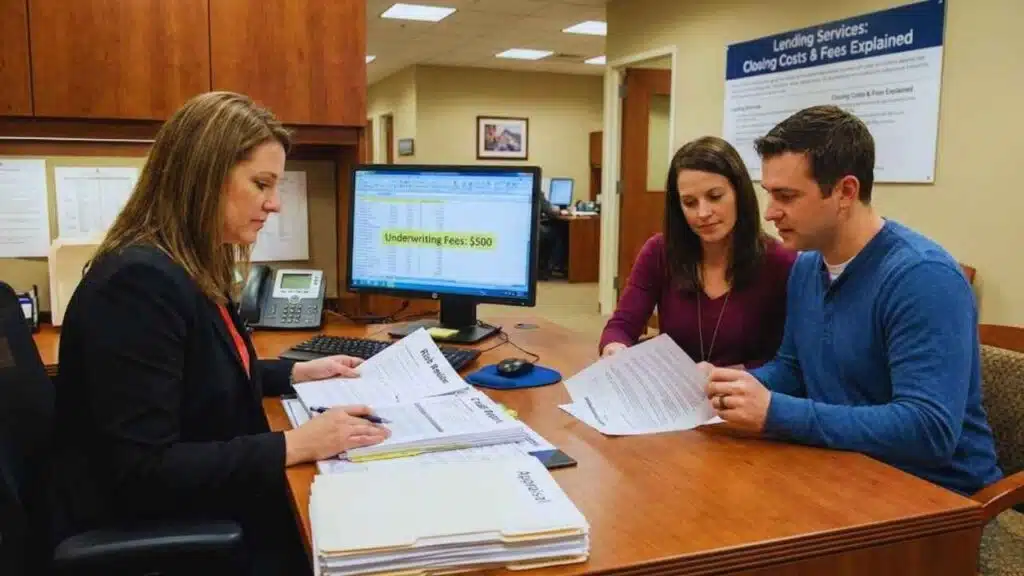
Underwriting fees pay for the work of risk review. A loan officer orders a credit report and a real estate appraisal. They check bank statements and payment history on a business loan.
They run automated clearing house files and verify deposits. The team tallies data to set your annual percentage rate and other hidden fees. These fees help banks offset their cost when they pay interest on deposits.
This review helps banks guard against bad checks and nonsufficient funds.
You spot them in closing costs for a home or business loan. Banks and credit unions must list them in your loan agreement. You find them alongside appraisal fees, cashier’s checks and credit card fees.
The list lives in your account or loan documents. A $100,000 loan can carry $400 to $600 in underwriting fees.
What are closing costs and how can you prepare for them?
Zillow data shows closing costs run 2% to 5% of a home price. Lenders add application fees, points and insurance premiums in those costs. Mortgage insurance or PMI can pop up if down payment falls under 20%.
Homeowners insurance tops the list too. Big banks like Bank of America demand it before they fund a loan. Property taxes slip into each mortgage payment and bump up your closing fees.
Use a free mortgage calculator from credit unions or JPMorgan Chase. Save cash in a savings account or a checking account with overdraft protection. Stash enough to cover a wire transfer or a cashier’s check.
Ask your lender for a closing disclosure at least three days before checkout. Shop fee sheets for hidden charges, compare interest rates and cut unexpected costs. A Chase account shows a $25 closing fee if you shut it in 90 days.
That proves banks love hidden fees.
How much can late payment fees add to your loan cost?
Missing a loan payment adds a late fee, usually $25 to $35. That extra charge adds to your balance. Rolling fees can raise your cost by hundreds.
Opting out of overdraft protection cuts ATM fee risk. Overdraft fees hit $3 per incident at ATMs. Lenders, including the U.S. Small Business Administration, must list late fees in your contract.
Good borrowers can ask credit unions for fee refunds.
What are prepayment penalties and when do they apply?
Lenders list prepayment penalties in your capital loan or closing cost disclosures as hidden fees. You pay the penalty when you clear a business loan too fast. They offset lost interest, and they discourage early payoff.
Contracts must list these fees at signing, so read your loan documents carefully. Some credit unions also sneak in these charges.
Certain deals charge you if you refinance or sell the asset in the first 3–6 months. Chase hits business accounts with a $25 early closure fee under 90 days. That fee works like a prepayment penalty, hitting your bottom line.
What are servicing fees on a capital loan?
Servicing fees charge you for loan management over its life. They appear as monthly or annual line items in your contract. You might sign that agreement with an e-sign tool. A simple spreadsheet tracks each cost.
They keep bank cash flow moving so it can pay staff, update systems, and fund lending. Hidden fees can surprise you if you miss these charges.
Aspire offers a business account with no monthly, fall-below, or minimum balance fees. Other banks raise servicing fees if you exceed six savings account transfers per statement period.
Inactivity also triggers extra charges after months of no movement. Accounting software shows every debit on your checking accounts. A clear view shields you from overdrafts and NSF fees.
What are guarantee fees and why are they charged?
Lenders add guarantee fees to cover the chance you fail to pay. This loan guarantee fee pays a federal agency or third party to take on that risk. You find it in capital loans, often with business loans backed by federal programs.
Banks list it at account opening, either in closing costs or as a separate line item. You may pay a flat fee or a percent of your loan amount.
The IRS makes banks keep closed account records for years, driving up admin costs. Guarantee fees help cover those bank charges and risk management costs. They let depository institutions issue more credit, even if clients miss payments or use overdraft protection.
These hidden fees feel small next to a rate spike if lenders took on all risk.
What document preparation fees should you expect?
Document prep fees cover drafting, review, storage of loan papers. They often fall under application fees or closing costs. Closing costs can add 2% to 5% of the purchase price. Transaction fees for checks, cashier’s checks, deposits, or ATM withdrawals may join that line.
A returned deposit fee shows up if a deposited check bounces.
Banks must disclose these junk fees in advance. Complexity of the loan can push charges higher. Customers with solid account history can ask for a refund on some fees. Bank of America and JPMorgan Chase list these charges in their agreements.
Hidden fees on electronic payments or direct debits may still raise your bank account costs.
What are annual maintenance fees in capital loans?

Lenders charge annual maintenance fees to keep a capital loan or account active. Some banks debit these fees monthly or yearly from your bank accounts. You can dodge them if you hold a required minimum balance or hit set criteria.
Aspire business account shines here, with zero monthly, fall-below, or minimum balance fees. Inactivity pockets a hidden fee if you skip transactions for a set period. Your loan contract must list these costs under account terms.
Minimum balance checks often use an average snapshot over 30 days or a quarter. Banks use these charges to bolster cash flow for lending and payment processing. Business or specialized accounts may carry higher annual fees to cover extra perks and tools.
Such hidden fees can sneak up like an ATM fee on a debit card or a foreign transaction fee. Scanning your documents keeps you aware of any unseen charges.
What third-party costs might you encounter with loans?
Third-party costs sneak into closing. Appraisers often bill $300 to $500 for home value checks. Escrow fees and title insurance can add about $1,000. Legal fees for document review vary by state.
Insurance premiums and title transfer fees join the tally on closing day.
Borrowers might face paper statement fees near $5 a month for physical mail. Credit cards charge foreign transaction fees, 3% by Bank of America or 3.25% on average in Singapore. ATM fees can hit $6 on a $60 cash withdrawal, with $3 from each bank.
Homeowners juggle pest control, lawn care, and snow removal as part of loan covenants. Aspire says to haggle with banks and choose regulated payment providers for fewer hidden fees.
Takeaways
This post showed ten hidden fees that can hike your loan charges. Loan calculators can help you spot fees early. Review interest rates and service charges before you sign the papers. Ask your credit union or bank for a clear fee sheet. Stay sharp and keep an eye on each line item.
FAQs
Hidden fees are surprise costs when you borrow money. They hide in your loan like a wolf in sheep’s clothing. You might pay closing costs, excise taxes, even paper work fees. They can drain your wallet fast.
2. How do atm fees and insufficient funds charges pile up?
Some loans link to your debit cards at credit unions. You can pull cash at an ATM, but you pay atm fees. If your balance dips too low, you hit insufficient funds or overdraft protection charges. That hurts.
3. What are foreign transaction fees and cross-border charges in a loan?
If your loan pays out in foreign currency, watch for foreign transaction fees. Each payment outside the U.S. can add cross-border fees to your bill. They can sneak in each month. Check your loan terms.
4. Why might travel perks cost me extra fees?
Some loans cover trips as perks, but they tack on airline fees or resort fees. You may even pay bag checks for your luggage. It feels like a free trip, but you still pay hidden fees.
5. How do closing costs and excise taxes bump up my loan bill?
Whenever you close a loan, you face closing costs and special taxes. They pay for admin work and property charges. Excise taxes can add a big slice to your bill. That extra cost can sting.
6. Can late fees hurt my credit score and credit reports?
If you miss a payment or use a cash advance, you get a late fee. Late fees stick to you like gum on your shoe, and they show up on your credit reports. That can harm your credit score, making borrowing more pricey.