

The promise of 5G has been the anthem of the tech world for the last half-decade. We were promised a revolution of speed, a utopia of connectivity, and a latency-free existence where buffering is a relic of the past. By 2025, over 80% of enterprises had dipped their toes into 5G adoption, driven by the fear of missing out on this digital transformation.
However, for many businesses and tech-savvy consumers, the monthly bill tells a different, more painful story. While the performance is often undeniable, the hidden costs of switching to 5G are beginning to surface, revealing a financial iceberg that lies beneath the waterline of the standard subscription fee.
This guide isn’t here to discourage you from the inevitable upgrade; 5G is, without a doubt, the future of global connectivity. Instead, this article serves as a financial radar. We will expose the eight specific areas where costs unexpectedly balloon, from the physics of radio waves penetrating your office walls to the energy bills of running edge servers. More importantly, we will provide you with the actionable, updated strategies you need for 2026 to navigate this transition without wrecking your budget.
Key Takeaways: The Financial Reality Check
-
The Indoor Signal Void: High-band 5G struggles to penetrate modern buildings, often necessitating expensive Distributed Antenna Systems (DAS).
-
The “Speed Tax”: Faster connections lead to higher data consumption habits, triggering throttling or overage fees much faster than on 4G.
-
Legacy Hardware Failures: The “sunsetting” of 2G and 3G networks to make room for 5G can render critical operational tech (like alarm systems and GPS trackers) instantly obsolete.
-
Energy Spikes: Private 5G networks and Edge computing nodes are power-hungry, potentially doubling energy costs for server rooms.
-
Security Premiums: A massive increase in connected IoT devices expands your “attack surface,” requiring new investments in Zero Trust security architectures.
The “Iceberg Effect”: Why 5G Costs Are Deceptive
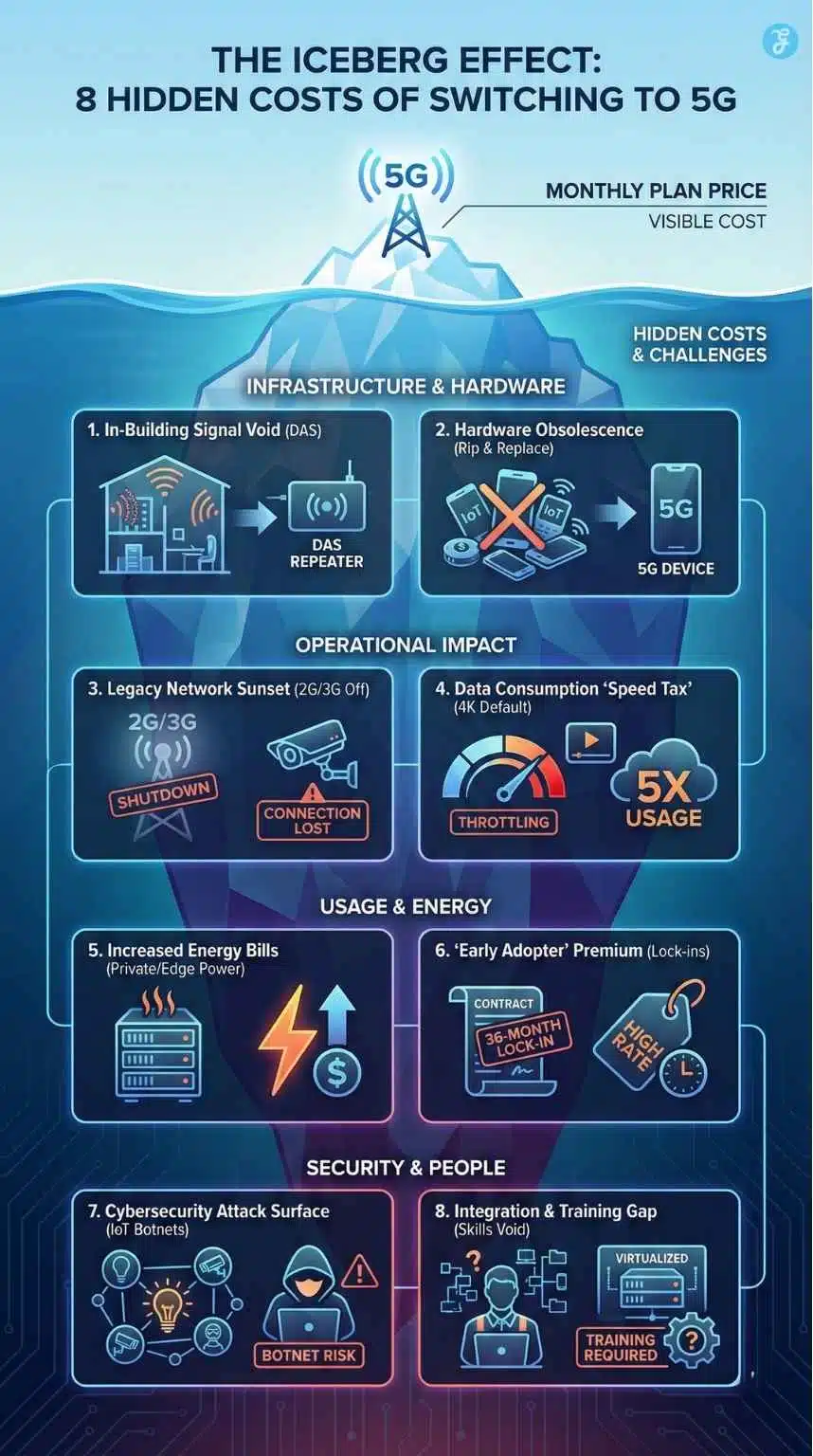
To understand why these financial pitfalls catch so many seasoned IT leaders and business owners off guard, we must look beyond the carrier marketing brochures. When the world upgraded from 3G to 4G, it was largely a linear evolution: better chips and faster downloads, but the fundamental infrastructure behaviors remained similar. You bought a new phone, inserted a SIM, and it worked. 5G is different. It is not merely a speed boost; it is a complete architectural overhaul of how data is transmitted, processed, and secured.
This technology relies on entirely new radio physics, specifically, high-frequency millimeter waves (mmWave), that behave differently than any cellular network we have managed before. These waves are fragile, line-of-sight dependent, and energy-intensive. Consequently, the “sticker price” of your monthly subscription is just the visible tip of the iceberg. The massive, submerged mass of the cost comes from adapting your physical environment, your legacy hardware, and your security protocols to accommodate this demanding new standard.
As we move deeper into 2026, the businesses that view 5G as a simple utility upgrade are the ones seeing their budgets bleed. Those who treat it as a complex infrastructure project, however, are the ones who will successfully navigate the following eight hidden costs.
The Infrastructure & Hardware Costs
The most immediate shock for new 5G adopters—especially in the enterprise sector—is discovering that the “wireless” revolution requires a surprising amount of wires, hardware, and physical retrofitting.
1. The “In-Building” Penetration Void
The most touted feature of 5G is its blistering speed, often delivered via high-frequency bands known as mmWave (millimeter wave). While these waves can carry massive amounts of data, they have a significant physical weakness: they are terrible at going through obstacles. Unlike the lower-frequency 4G waves that could easily pass through walls, mmWave struggles to penetrate concrete, steel, and even energy-efficient “low-E” glass windows.
The Hidden Cost:
You sign a premium 5G contract for your headquarters, only to find that the signal drops the moment you walk away from the window. The “hidden cost” here is the sudden need for in-building densification. You cannot rely on the carrier’s outdoor tower; you effectively have to build a mini-network inside your own building.
This usually requires investing in a Distributed Antenna System (DAS) or a fleet of signal boosters and small cells. For a medium-sized office building (approx. 50,000 sq. ft), a carrier-grade DAS installation can range from $25,000 to over $100,000. This is a capital expenditure (CAPEX) that rarely appears in the marketing brochures.
How to Avoid It:
-
Conduct a Pre-Contract Site Survey: Never assume coverage maps equal indoor reality. Hire a third-party engineer to measure signal strength (specifically, high-band penetration) inside your critical workspaces before signing.
-
Prioritize Sub-6GHz 5G: When selecting devices and plans, ensure your hardware prioritizes Sub-6GHz frequencies (specifically the “C-Band”). This “mid-band” 5G offers a much better balance of speed and wall-penetrating capability than mmWave, reducing the need for expensive indoor boosters.
2. Forced Hardware Obsolescence (The “Rip and Replace”)
5G is not just a software update; it is a fundamental shift in radio technology. This leads to a cascade of incompatibility. Your existing fleet of smartphones is likely just the tip of the iceberg. The real cost lies in the “invisible” hardware: industrial modems, IoT sensors, telematics dongles in company vehicles, and even older routers.
The Hidden Cost:
The cost isn’t just buying new iPhones for the sales team. It’s the administrative downtime and disposal fees.
-
Modem Incompatibility: Many industrial IoT devices use LTE Cat-M1 or NB-IoT standards. While 5G is technically designed to coexist with these, older antennas often cannot communicate effectively with new Standalone (SA) 5G cores without firmware upgrades that may not exist.
-
E-Waste Disposal: Properly disposing of hundreds of lithium-ion battery-powered devices in compliance with environmental regulations is an added operational cost.
| Hardware Category | The Obsolescence Risk | Estimated Replacement Cost (Per Unit) |
| Smartphones | Lack of 5G bands (C-Band/mmWave) | $600 – $1,200 |
| Industrial Routers | Incompatible with 5G SIMs/Speed | $300 – $800 |
| IoT Sensors | 2G/3G dependency (see below) | $50 – $150 (plus installation labor) |
| Fleet GPS Trackers | Antenna incompatibility | $100 – $200 |
How to Avoid It:
-
Phased Rollout Strategy: Avoid the “Big Bang” approach. Audit your users to identify the 20% of “Power Users” who actually generate ROI from 5G speeds (e.g., video editors, field engineers). Upgrade them first. Leave the administrative staff on 4G LTE, which will remain robust for years.
-
Demand Backward Compatibility: When purchasing new IoT hardware, ensure it is rated for 5G RedCap (Reduced Capability) or specifically guarantees backward compatibility with 4G LTE Cat-M1 to future-proof your investment.
3. The Sunset of Legacy Networks
This is the silent killer of operational budgets. To free up the radio spectrum for 5G, carriers are aggressively shutting down (or “sunsetting”) older 2G and 3G networks. By 2026, most major carriers will have completely darkened these frequencies.
The Hidden Cost:
Many businesses have critical infrastructure running on “forgotten” connections. That elevator emergency phone? It might be 3G. The alarm system in the warehouse? Likely 2G. The GPS trackers on your shipping containers? Often older tech.
When these networks shut down, these devices don’t just get slower; they stop working entirely. The cost here is emergency retrofitting—paying double or triple for rush delivery of new hardware and emergency technician call-outs to get your security systems back online.
How to Avoid It:
-
The “Zombie Device” Audit: immediately catalog every SIM card you are paying for. If you have SIMs that use very little data (KB ranges), they are likely legacy M2M (Machine-to-Machine) devices.
-
Replace Early: Don’t wait for the shutdown letter. Replace these critical safety devices with 4G LTE/5G compatible units now. The cost of a planned replacement is 50% lower than an emergency fix.
The Operational & Usage Costs
Once the hardware is installed, the daily operational costs of 5G can bleed a budget dry if not actively managed. The very nature of the technology changes user behavior and energy consumption.
4. The Data Consumption “Speed Tax”
There is a psychological phenomenon in bandwidth usage: the faster the pipe, the more you fill it. 5G networks are so fast that latency is imperceptible, leading to a dramatic spike in data consumption that users often don’t notice until the bill arrives.
The Hidden Cost:
-
The 4K Default: On a 4G connection, YouTube or Netflix might default to 720p or 1080p to prevent buffering. On 5G, these apps detect the high bandwidth and automatically switch to 4K UHD. This burns through data roughly 4x to 5x faster.
-
Cloud Syncing: With 5G, users stop relying on Wi-Fi for large file backups. A phone might silently back up 5GB of photos and videos to the cloud over cellular data in minutes.
-
The Throttling Cliff: “Unlimited” plans are rarely truly unlimited. They often have a “premium data” cap (e.g., 50GB or 100GB). Once you hit this—which happens much faster on 5G—you are throttled to unusable 2G/3G speeds, killing productivity for the rest of the month.
How to Avoid It:
-
Mobile Device Management (MDM): Use MDM software to enforce policies on company devices. You can restrict high-bandwidth apps (like Netflix or 4K YouTube) to “Wi-Fi Only” while allowing business apps (Zoom, Slack) on cellular.
-
Negotiate “True” Unlimited: For enterprise contracts, negotiate specifically for QCI (Quality of Service Class Identifier) priority. Ensure your critical business lines are not deprioritized during network congestion.
5. Increased Energy Bills (Private 5G/Edge)
For organizations building Private 5G networks or utilizing Edge Computing (processing data closer to the source rather than in the cloud), electricity becomes a major line item.
The Hidden Cost:
While 5G is more energy-efficient per bit of data transmitted, the absolute energy consumption of 5G equipment is higher.
-
Active Antenna Units (AAUs): 5G base stations require massive MIMO (Multiple Input Multiple Output) antennas that consume significantly more power than passive 4G antennas.
-
Thermal Management: The processing power required to handle 5G speeds generates immense heat. If you are hosting 5G edge servers on-premise, your cooling costs (HVAC) will spike. Some reports indicate a 5G base station can consume 2x to 3x the energy of a 4G equivalent.
How to Avoid It:
-
AI-Driven Sleep Modes: Modern 5G equipment often comes with AI software that can analyze traffic patterns. Configure your network to put radio units into a “deep sleep” mode during nights and weekends when traffic is near zero. This can reduce energy consumption by up to 30%.
-
Liquid Cooling: If you are building a server room for Edge computing, skip traditional air conditioning. Liquid cooling solutions are more expensive upfront but offer a massive ROI on ongoing electricity bills.
6. The “Early Adopter” Premium
Economics dictates that early technology is expensive. Carriers have spent billions on spectrum auctions and infrastructure, and they are eager to recoup those costs from early adopters.
The Hidden Cost:
-
Premium Tier Lock-ins: Carriers often gate their fastest “Ultra Wideband” or “5G+” speeds behind their most expensive plan tiers. You might be paying an extra $10-$20 per line for speeds that your employees only use 1% of the time.
-
Contract Rigidity: Signing a long-term (36-month) contract in 2025/2026 is risky. As 5G commoditizes and 6G talk begins (likely around 2028-2030), 5G prices will drop. Being locked into 2025 rates in 2027 will be a financial burden.
How to Avoid It:
-
Shorter Lease Cycles: Opt for 12 or 24-month contracts, even if the monthly rate is slightly higher. The flexibility to renegotiate as market rates drop will save you more in the long run.
-
Wait for Standalone (SA): Ensure you are paying for 5G Standalone (SA). Many early networks are Non-Standalone (NSA), which is essentially 5G radio running on a 4G core. NSA offers speed but lacks the low latency and slicing capabilities that justify the premium price. Don’t pay a premium for “fake” 5G.
The Security & People Costs
The final category of hidden costs is the most dangerous: the risks to your data and the strain on your workforce.
7. The Cybersecurity “Attack Surface” Expansion
5G enables Massive Machine-Type Communications (mMTC)—the ability to connect thousands of devices per square kilometer. This sounds great until you realize every single one of those devices is a potential door for a hacker.
The Hidden Cost:
-
The IoT Botnet Risk: Cheap IoT sensors often have weak security (default passwords, no encryption). With 5G, hackers can hijack these devices to create massive botnets for DDoS attacks.
-
Network Slicing Vulnerabilities: 5G allows for “slicing” the network into virtual segments. If not configured correctly, a breach in a low-security slice (like guest Wi-Fi) could theoretically allow lateral movement into a high-security slice (like patient records).
-
The Cost of Remediation: You will need to invest in Zero Trust security software and perhaps a SOC (Security Operations Center) service to monitor this expanded network 24/7.
How to Avoid It:
-
Implement Zero Trust Architecture: Adopt a security model where no device is trusted by default, even if it is inside the building. Every access request must be verified.
-
Network Segmentation: rigorously separate your IoT traffic from your critical business data. If a smart lightbulb gets hacked, it shouldn’t have a path to your payroll server.
8. The Integration & Training Gap
5G networks are software-defined. They behave more like cloud computing than traditional telecoms. This creates a massive skills gap.
The Hidden Cost:
Your current IT team likely knows how to manage Wi-Fi and standard LANs. They probably do not know how to manage Network Function Virtualization (NFV) or Multi-Access Edge Computing (MEC).
-
Consultant Fees: You may find yourself forced to hire expensive external consultants ($200+/hour) to troubleshoot connection issues that your internal team can’t understand.
-
Training Downtime: Sending your staff to get 5G certified takes time and money, pulling them away from their daily tasks.
How to Avoid It:
-
Managed Services Provider (MSP): For the first 1-2 years, it is often cheaper to outsource the management of your 5G/SD-WAN network to a specialized MSP. Let them handle the complexity while your team learns the ropes through osmosis.
-
Vendor-Included Training: When negotiating your 5G hardware contracts (e.g., with Nokia, Ericsson, or Cisco), insist that “training credits” or “onboarding workshops” be included in the purchase price.
Strategic Checklist: How to Shield Your Budget
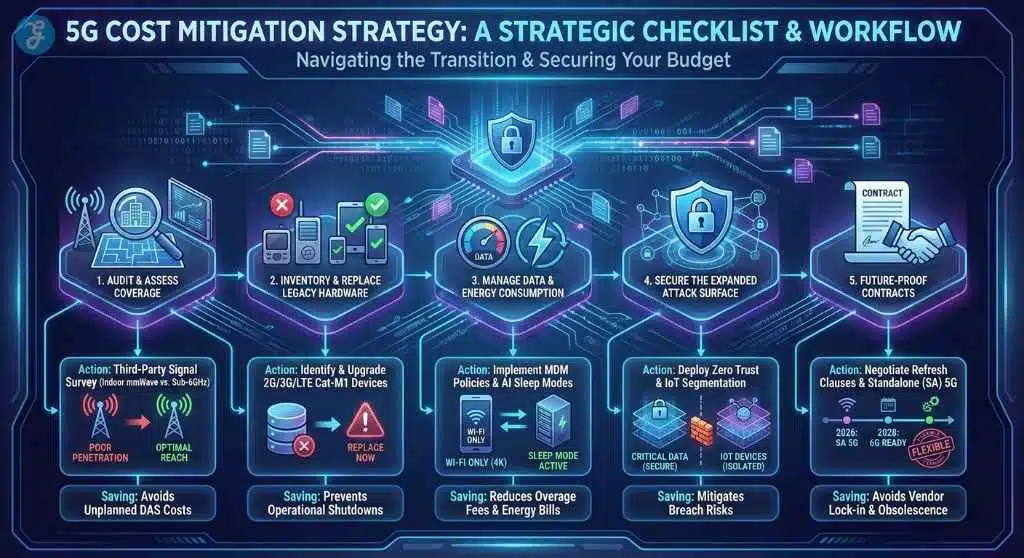
Use this checklist to audit your readiness before signing on the dotted line.
| Cost Category | Pre-Switch Action Item | Potential Saving |
| Coverage | Third-party Signal Audit: Test indoor mmWave vs. Sub-6GHz reception. | Avoids $50k+ in unexpected DAS hardware. |
| Hardware | IoT Inventory: Identify 2G/3G/LTE Cat-M1 devices. | Prevents operational shutdowns & rush fees. |
| Data Plans | MDM Policy: Restrict 4K streaming & auto-backups to Wi-Fi. | Saves 30-50% on data overage/tier costs. |
| Energy | Smart Scheduling: Configure AI sleep modes for Private 5G radios. | Reduces energy overhead by ~25%. |
| Security | Zero Trust Segmentation: Isolate IoT devices on separate VLANs/Slices. | Mitigates million-dollar ransomware risks. |
| Contract | Review “Refresh” Clauses: Ensure upgrade path to 6G/Standalone 5G. | Prevents locking into obsolete tech/prices. |
Frequently Asked Questions (FAQ)
Is 5G really more expensive than 4G for a small business?
On paper, the monthly plan might look similar or only $5-$10 higher. However, the Total Cost of Ownership (TCO) is higher. You will likely need to buy new phones, perhaps a signal booster, and pay for more data as your usage naturally spikes. Budget for a 20-30% increase in your overall connectivity spend in Year 1.
What happens if I just ignore 5G and stick with 4G LTE?
For now, that is a viable strategy! 4G LTE will be around until at least 2030. However, as carriers refarm spectrum for 5G, 4G speeds may slowly degrade in congested areas. Sticking with 4G is fine for email and basic web use, but don’t expect it to support cutting-edge apps like AR or real-time remote monitoring.
Can I use a regular Wi-Fi router instead of investing in 5G indoor systems?
Absolutely. For most static office environments, Wi-Fi 6 or Wi-Fi 7 is actually a better, more cost-effective solution than indoor 5G. Wi-Fi offers similar speeds without the data caps. Save 5G for mobile employees and outdoor logistics, and keep the office on robust Wi-Fi.
Yes. The “hidden cost” is usually deprioritization. In a crowded area (like a conference or city center), carriers prioritize “Premium” business data over standard “Unlimited” users. Your 5G icon might still show, but your speed could drop to a crawl, costing you productivity. Read the fine print about “Premium Data” allowances.
Will 5G increase my company’s carbon footprint?
Initially, yes. Manufacturing new devices and running power-hungry 5G networks increases carbon output. However, 5G enables “Smart Building” technologies—like smart sensors that turn off HVAC and lights in empty rooms—which can eventually lower your total carbon footprint by more than the network consumes. It’s a short-term pain for a long-term green gain.
Final Thought: The Price of Progress
Switching to 5G is akin to buying a high-performance sports car. The sticker price is just the entry fee; the tires, the premium fuel, and the specialized mechanic are where the real money is spent.
However, this doesn’t mean you should stay in the slow lane. The efficiency, speed, and capability of 5G are transformative for businesses that use them correctly. The secret to ROI isn’t avoiding 5G—it’s respecting the complexity of the upgrade. By auditing your environment, securing your endpoints, and managing your data policies before you switch, you can harness the power of the next generation without getting run over by the hidden costs.
Are you ready to audit your infrastructure? Start with the “Zombie Device” check today—it’s the single easiest way to prevent a disaster.




























