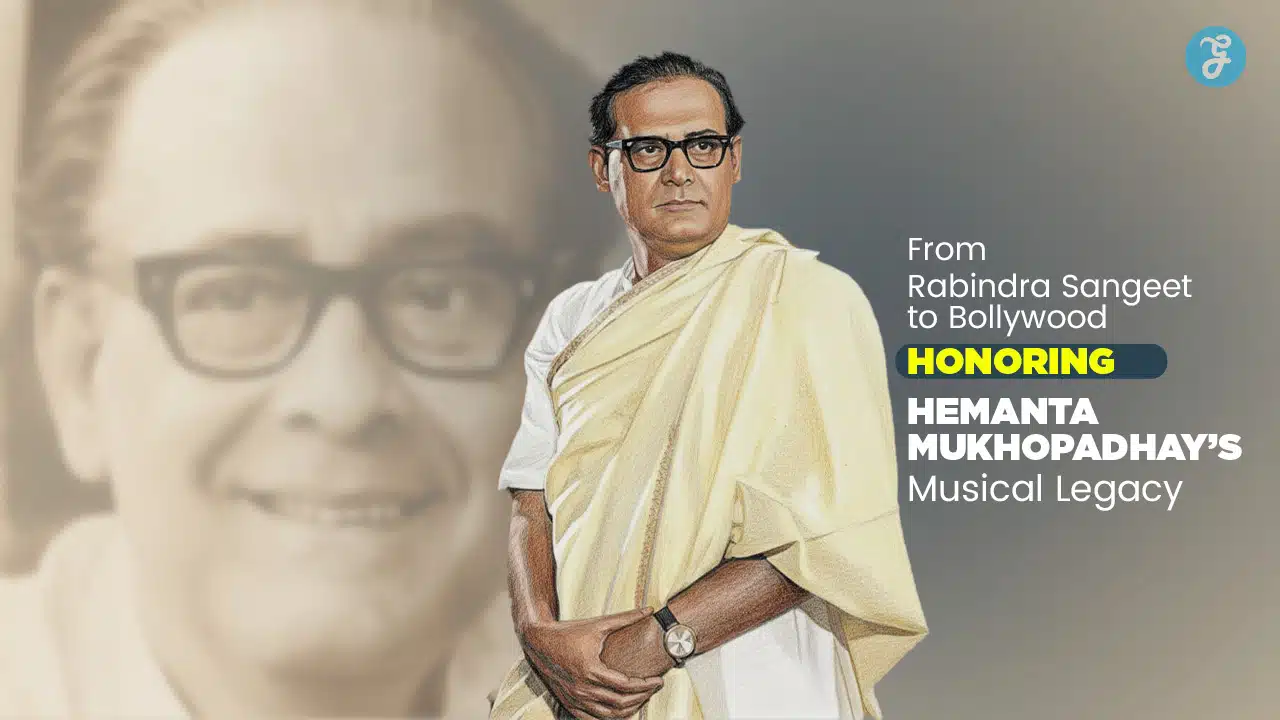
Hemanta Mukhopadhay—credited as Hemant Kumar in Hindi cinema—sang like a close friend speaking softly. He began in Bengal with Rabindra Sangeet, then shaped Indian film music as a playback singer, music director, and producer. His baritone was calm; his arrangements left room for words; his melodies favored memory over flash. This final, publication-ready guide brings together his Bengali work (film and non-film), Hindi highlights, and the craft choices that made his music last. Dates, awards, and song credits are verified from reliable sources so you can trust what you publish.
Who Was Hemanta Mukhopadhay?
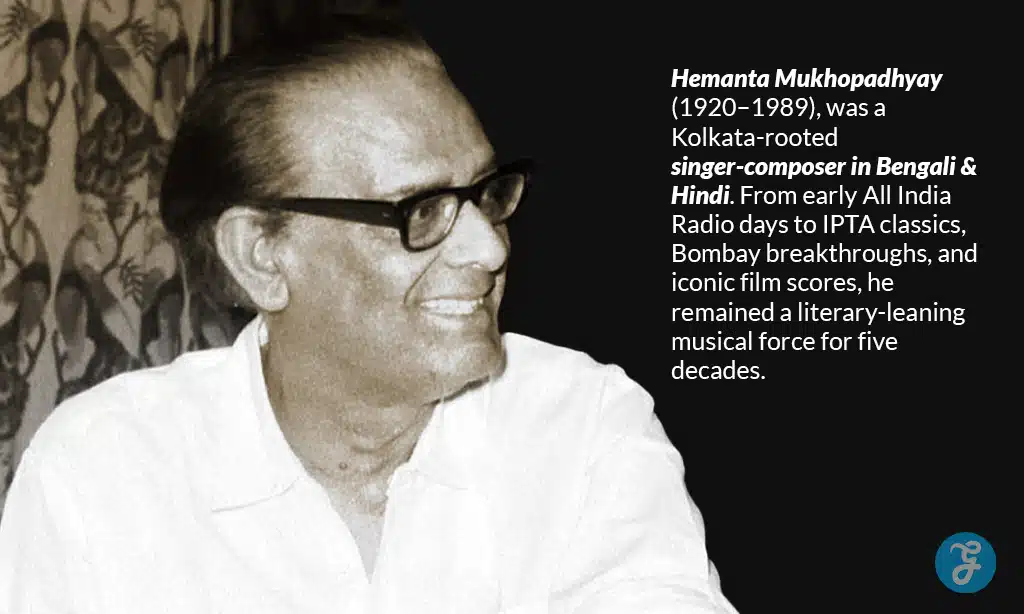
Use this section as a map. It shows how a Kolkata-rooted singer became a national figure without losing his literary lean. You’ll see early radio years, the IPTA connection, the Bombay break, and a late career that still drew full houses.
Core facts. Hemanta Mukhopadhay (16 June 1920 – 26 Sept 1989)—also credited as Hemanta Mukherjee/Hemant Kumar—was born in Benares (Varanasi) and worked mainly in Bengali and Hindi, with recordings in several other Indian languages. He remained active from the mid-1930s till 1989.
Snapshot timeline
| Year | Milestone | Why it matters |
| 1930s | Early records & All India Radio | Builds mic technique and RS repertoire. |
| 1947–49 | Non-film breakthrough with “Kon ek Ganyer/Gnayer Bodhu” (Salil Chowdhury) | IPTA-era modern Bengali classic; changed the tone of non-film songs. |
| 1952 | Anand Math (Hindi) as music director | The Bombay entry point for large-scale scoring. |
| 1954 | Nagin soundtrack | Wins Filmfare Best Music Director at the 1956 ceremony; from 1956 the award covered the entire soundtrack. |
| 1955–61 | Bengali film peak: Shap Mochan, Harano Sur, Deep Jwele Jaai, Saptapadi | Defines the Uttam–Suchitra era mood. |
| 1959 | Produces Neel Akasher Neechey (Hemant-Bela/Geetanjali) | Early social film; widely documented as his production; praised by leaders and critics. |
| 1962–64 | Bees Saal Baad, Kohraa (producer-composer) | Songs and scores become evergreen staples. |
| 1989 | Passes away in Kolkata | Closes a five-decade span; catalog lives on via reissues and playlists. |
Bengali Song Contribution (Film, Non-Film, and Rabindra Sangeet)
For Bengali audiences, Hemanta is the voice of adhunik (modern non-film songs), the sound of Uttam–Suchitra romance, and a trusted guide to Tagore. This section separates those threads so readers can explore deliberately: singles and EPs that lived on radio, film songs that framed a generation’s emotions, and Rabindra Sangeet that still anchors family playlists.
1) Non-film “Adhunik” songs
These records carried social poetry and everyday feeling to living rooms. The IPTA-linked “Kon ek Ganyer/Gnayer Bodhu” (often translated as “A Village Bride”) became a cult song; Salil Chowdhury himself recalled how deeply it landed. Hemanta also shaped arrangements for “Runner,” with Salil crediting him for the orchestration lift.
| Title (selected) | Period | Composer/Lyric | Notes |
| Kon ek Ganyer/Gnayer Bodhu | 1947–49 | Salil Chowdhury | Landmark modern Bengali non-film hit; IPTA milieu. |
| Runner | early 1950s | Salil Chowdhury (poem by Sukanta Bhattacharya) | Salil notes Hemanta “arranged the orchestration” beyond a few hints. |
| Curated reissues | 1990s–2020s | Labels/streamers | The “Runner” single and Ganyer Bodhu appear on official services. |
2) Bengali film songs (Uttam–Suchitra era and beyond)
From mid-1950s to early 1960s, Hemanta’s music set the emotional temperature of Bengali cinema.
| Film | Year | Hemanta’s role | Representative song(s) | Why it matters |
| Shap Mochan | 1955 | MD; playback for Uttam Kumar | Multiple hits | Early anchor of the Uttam–Hemanta pairing. |
| Harano Sur | 1957 | MD & playback | “Aaj Dujanar Duti Path” (lyrics Gauriprasanna) | Culturally defining romance; widely reissued. |
| Deep Jwele Jaai | 1959 | MD & playback | “Ei Raat Tomar Amar” | Late-night intimacy; later remade in Hindi (Khamoshi). |
| Saptapadi | 1961 | MD & playback | “Ei Path Jodi Na Shesh Hoy” (duet with Sandhya Mukherjee) | Iconic bike sequence; highest grosser in 1961. |
3) Rabindra Sangeet (Tagore songs)
Hemanta’s RS has become “default Tagore” for many families because of its unhurried tempo, clean diction, and low-key baritone. Official label playlists make it easy to sample 10–100 songs in one sitting.
| Focus | Example (Hemanta) | What to notice | Where to start |
| Nostalgia | “Purano Sei Diner Kotha” | Gentle lift on refrains; steady laya | Label uploads & playlists (Saregama). |
| Devotional hush | “Tumi Rabe Nirabe” | Whisper-soft phrasing; breath control | Kuheli/anthology versions on official channels. |
Rabindra Sangeet Roots—A Voice Shaped by Tagore
Tagore’s music rewards restraint. Hemanta placed meaning first: fewer ornaments, room for words, and a calm baritone that carried emotion without push. This RS discipline later governed his film writing: melody first, voice centered, orchestra as cushion.
Why his RS works
| Trait | What you hear | Result |
| Baritone ease | Low, warm register, no strain | A reflective, prayer-like atmosphere |
| Clean phrasing | Crisp consonants; minimal murki | Lyrics stay intelligible |
| Steady tempo | Even gait | New listeners can follow every line |
Starter RS picks
| Song | What to listen for | Verified source |
| Purano Sei Diner Kotha | Nostalgic arc; gentle refrain | Official Saregama uploads/playlists. |
| Tumi Rabe Nirabe | Devotional hush; breath control | Film Kuheli/RS compilations (official). |
Crossing Over—From Kolkata to Bombay (Bollywood Breakthrough)
Why this matters: It shows how a Bengali singer-composer became a national figure.
Hemanta’s move to Bombay grew from the IPTA circle and his deep bond with Salil Chowdhury. The 1947 disc “Ganyer Badhu” put him on the map beyond Bengal. In the early 1950s he started composing and singing for Hindi films. By the late 1950s he was a go-to voice for leading men and a respected music director.
Early Hindi successes (sample)
| Film (Year) | Song | Credit | Why it clicked |
| Solva Saal (1958) | “Hai Apna Dil To Awara” | Singer (S. D. Burman) | Breezy, radio-friendly charm. (Standard film/song pages corroborate.) |
| Baat Ek Raat Ki (1962) | “Na Tum Hamen Jano” | Singer (S. D. Burman) | Hushed noir romance with Dev Anand vibe. |
| Anand Math (1952) | “Vande Mataram” (choral) | Music director | Early proof of choral & orchestral command. |
Key collaboration highlights
| Collaborator | Representative track(s) | Why it worked |
| S. D. Burman | “Hai Apna Dil To Awara”, “Na Tum Hamen Jano” | Light, singable lines matched Hemanta’s grain. |
| Lata Mangeshkar | “Kahin Deep Jale Kahin Dil” (Bees Saal Baad) | Hemanta’s restrained arrangement left air for the vocal; the song won Filmfare for Best Lyricist & Best Female Playback. |
| Salil Chowdhury | “Ganyer Bodhu”, “Runner” (non-film) | IPTA roots; documented note on Hemanta’s orchestration for “Runner.” |
The Composer-Producer—Scores That Shaped an Era
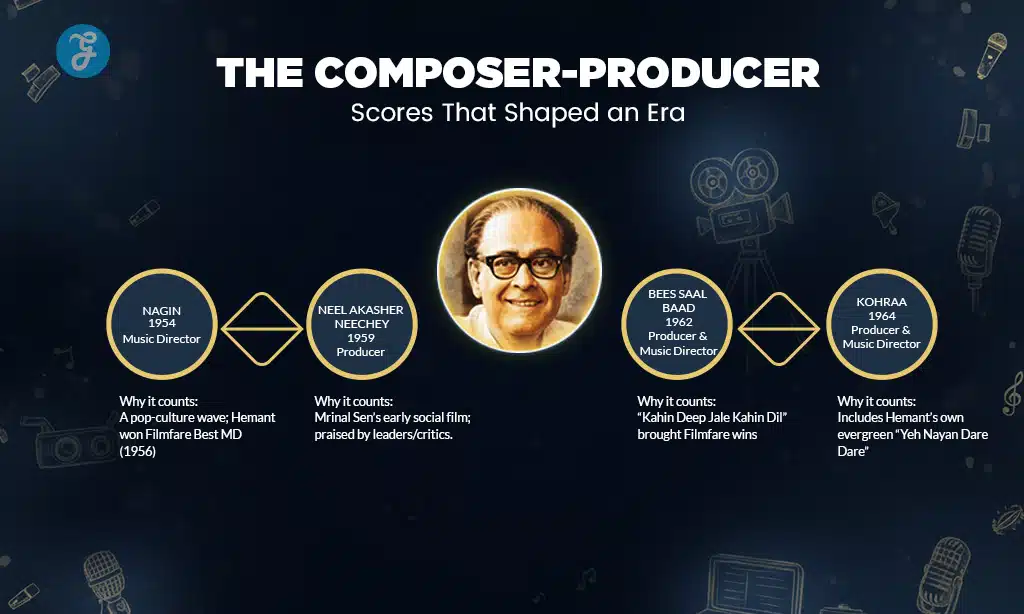
Composing is craft; producing is commitment. Hemanta did both—writing melody-first scores and backing films with cultural weight. He preferred intimacy over bombast and believed a motif could brand a film more strongly than volume could.
Composer & producer highlights (evidence-backed)
| Film | Year | Capacity | Why it counts |
| Nagin | 1954 | Music Director | A pop-culture wave; Hemant won Filmfare Best MD at the 1956 ceremony (from that year, award recognized full soundtrack). |
| Neel Akasher Neechey | 1959 | Producer (Hemant-Bela) | Mrinal Sen’s early social film; widely documented as produced by Hemanta; praised by leaders/critics. |
| Bees Saal Baad | 1962 | Producer & MD | “Kahin Deep Jale Kahin Dil” brought Filmfare wins (lyricist & female playback). |
| Kohraa | 1964 | Producer & MD | Includes Hemant’s own evergreen “Yeh Nayan Dare Dare” (lyrics Kaifi Azmi). |
Essential Listening—A Starter Playlist (Balanced Across Bengali & Hindi)
New to Hemanta? This is a 10-track “fast tour.” You’ll get RS warmth, Bengali film intimacy, and Hindi elegance. Every pick here is well-documented and easy to find.
| Track | Language | Film/Source | Hemanta’s role | Why start here | Source |
| Purano Sei Diner Kotha | Bengali (RS) | RS anthologies | Singer | Benchmark nostalgia & diction | (YouTube) |
| Tumi Rabe Nirabe | Bengali (RS) | Kuheli / anthologies | Singer | Devotional hush; breath control | (YouTube) |
| Ei Raat Tomar Amar | Bengali | Deep Jwele Jaai (1959) | Singer/MD | Midnight tenderness | |
| Ei Path Jodi Na Shesh Hoy | Bengali (duet) | Saptapadi (1961) | Singer/MD | Iconic bike duet (Uttam–Suchitra) | |
| Hai Apna Dil To Awara | Hindi | Solva Saal (1958) | Singer | Feather-light classic | |
| Na Tum Hamen Jano | Hindi | Baat Ek Raat Ki (1962) | Singer | Hushed noir romance | |
| Bekarar Karke Hume | Hindi | Bees Saal Baad (1962) | Singer/MD | Romance inside a thriller | |
| Kahin Deep Jale Kahin Dil (Lata) | Hindi | Bees Saal Baad (1962) | Composer | Filmfare wins tied to this song | |
| Yeh Nayan Dare Dare | Hindi | Kohraa (1964) | Singer/MD | Hemant’s silken solo; Kaifi Azmi lyric | |
| Vande Mataram (arr.) | Hindi | Anand Math (1952) | MD | Early choral sweep |
Collaborations & Duets That Endure
Great voices bloom beside great partners. Hemanta’s phrasing flexed—giving Lata headroom, merging conversationally with Sandhya Mukherjee, and floating over S. D. Burman’s airy frameworks.
| Partner | Representative example | What to notice |
| Lata Mangeshkar | “Kahin Deep Jale Kahin Dil” (Bees Saal Baad) | Strings never crowd the vocal; Filmfare wins for lyricist & female playback. |
| Sandhya Mukherjee | “Ei Path Jodi Na Shesh Hoy” (Saptapadi) | Conversational duet; iconic bike scene with Uttam–Suchitra. |
| S. D. Burman | “Hai Apna Dil…”, “Na Tum Hamen Jano” | Burman’s light melodies + Hemant’s velvet grain = evergreen charm. |
| Salil Chowdhury | “Ganyer Bodhu”, “Runner” | IPTA roots; Hemanta’s orchestration on “Runner” is noted by Salil. |
Impact & Legacy—Why Hemanta Still Matters
Why this matters: Legacy explains why the songs stay alive.
Hemanta bridged Bengali literary song and Hindi mainstream cinema. He made melody and meaning work together. As a producer, he backed films with social awareness—Neel Akasher Neechey won the President’s Gold Medal. As a composer, he wrote melody-first songs with warm strings and woodwinds that never crowded the voice. As a singer, he set a standard for diction, breath, and emotional control. His influence shows in how later singers treat language and pace. He performed into the 1980s and passed away on 26 September 1989 in Kolkata.
Legacy quick facts
| Item | Detail |
| Producer with purpose | Neel Akasher Neechey (Hemant-Bela/Geetanjali) is widely cited as his production; Mrinal Sen’s film enjoyed high-level appreciation. |
| Film award milestone | Filmfare Best Music Director for Nagin at the 1956 ceremony (from that year, award covered full soundtrack). |
| Bengali film pillars | Harano Sur, Deep Jwele Jaai, Saptapadi remain cultural touchstones. |
| RS continuity | Large, official RS playlists keep his Tagore voice discoverable. |
Bengali Cinema Classics (1955–61)
These albums aren’t just soundtracks; they are mood-maps for a generation. Hemanta scored tenderness with simple strings and gave Uttam–Suchitra romances their unhurried glow.
| Film | Year | Hemanta’s role | Flagship song(s) | Notable facts |
| Shap Mochan | 1955 | MD; playback | Multiple hits | Solidifies the Uttam–Hemanta singer–actor bond. |
| Harano Sur | 1957 | MD & playback | “Aaj Dujanar Duti Path” | Hemanta’s MD credit and Gauriprasanna’s lyric are well-documented; official reissues abound. |
| Deep Jwele Jaai | 1959 | MD & playback | “Ei Raat Tomar Amar” | Seminal late-night love song; film later remade as Khamoshi. |
| Saptapadi | 1961 | MD & playback | “Ei Path Jodi Na Shesh Hoy” | “All-time evergreen,” with the famous bike scene; top grosser of 1961 in Bengal. |
Hindi “Golden Era” Highlights
Three case studies show Hemanta’s Bombay strengths: one mass-market wave, two producer-composer showcases.
Nagin (1954)
A soundtrack phenomenon with a signature “been” color and sturdy melodies. Hemant won Filmfare Best Music Director at the 1956 awards—also the year Filmfare shifted to recognizing entire soundtracks in this category.
| Aspect | Detail |
| Release | 1954; award presented 1956 |
| Signature | Motifs threaded across songs and background cues |
| Why it matters | Put Hemant in the top rank of Hindi MDs |
Bees Saal Baad (1962)
Producer-composer project with a haunting palette. “Kahin Deep Jale Kahin Dil” (sung by Lata Mangeshkar, lyrics Shakeel Badayuni) won Filmfare for Best Female Playback and Best Lyricist; Hemant also sang popular numbers like “Bekarar Karke Hume.”
| Aspect | Detail |
| Capacity | Producer & Music Director |
| Awards | Filmfare (Lyricist + Female Playback) for “Kahin Deep Jale Kahin Dil” |
| Why it matters | Balances thriller mood with romantic melody |
Kohraa (1964)
Rebecca-inspired mystery crowned by Hemant’s own “Yeh Nayan Dare Dare” with lyrics by Kaifi Azmi—a masterclass in intimate singing and restrained orchestration.
| Aspect | Detail |
| Capacity | Producer & Music Director |
| Signature | “Yeh Nayan Dare Dare” (Hemant; lyrics Kaifi Azmi) |
| Why it matters | Shows his Hindi writing at its tender best |
Style Notes: What Defines the Hemanta Sound?
If you’re a musician or critic, this is the blueprint: mid-tempo comfort, string cushions, woodwind replies, and phrasing that treats lyrics like conversation.
| Element | Description | Result |
| Melody-first writing | Tunes arrive uncluttered; easy to hum | High recall value |
| Voice-centered mixes | Orchestra as cushion (not wall) | Room for words; warmth |
| Baritone delivery | Calm grain, close-miked | Intimacy even at medium volume |
| Tagore influence | Respect for meter/cadence | Literary feel inside popular forms |
Awards & Distinctions (Curated Facts)
Awards are mile markers, not the road—but they help readers and archivists anchor the story.
| Award/Honor | Work/Reason | Year/Context |
| Filmfare Best Music Director | Nagin | 1956 ceremony (category recognized full soundtrack from 1956) |
| Widely cited production credit; high-level praise | Neel Akasher Neechey (producer, Hemant-Bela) | 1959 (documentation, retrospectives, Mrinal Sen centenary coverage) |
The Voice That Still Breathes
Hemanta Mukhopadhay built bridges: Bengal ↔ Bombay, poetry ↔ popular, intimacy ↔ cinema-scale. His RS taught listeners to trust stillness; his film songs taught composers to make space for words. Start with the playlist above, then wander. The more you listen, the more you hear—tiny pauses, soft rises, and a melody that never hurries. That is why the Hemanta Mukhopadhay legacy continues to feel new