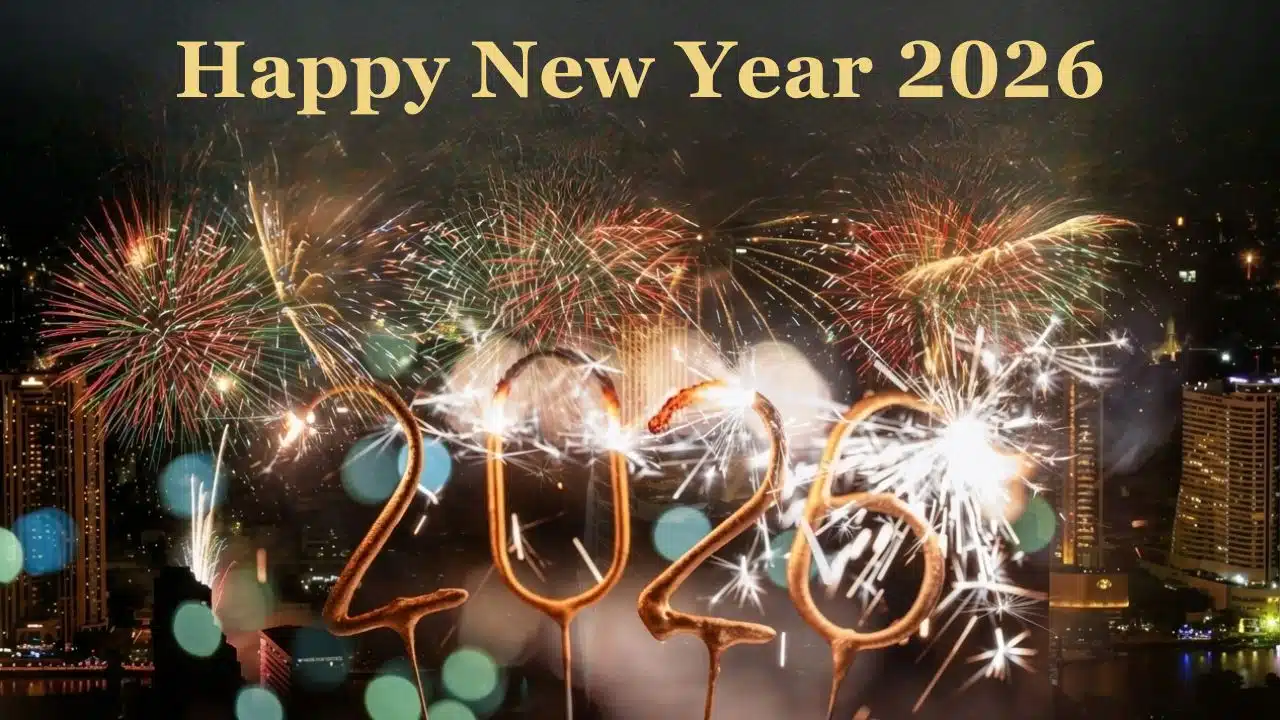
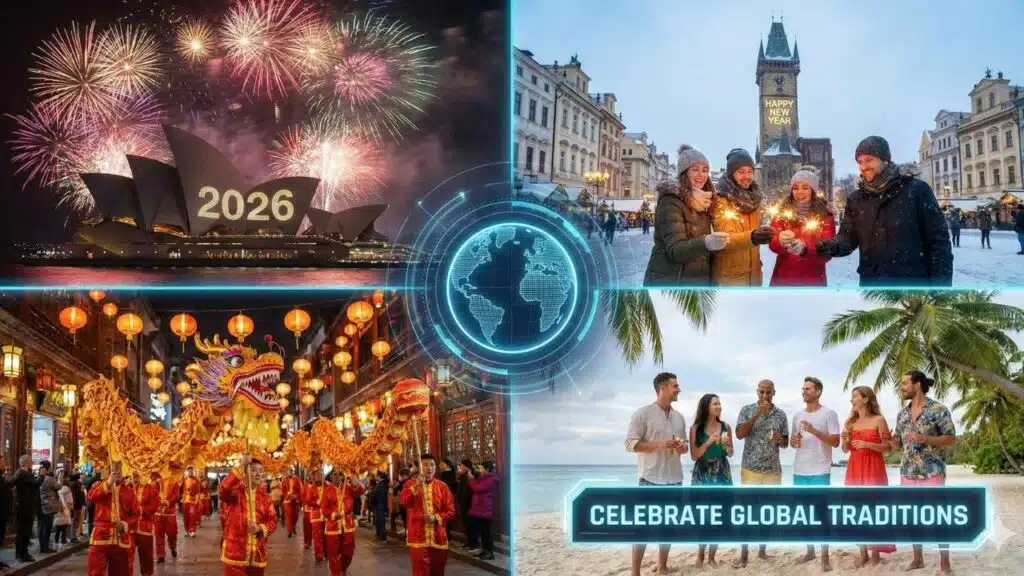
Happy New Year 2026 arrived first in Kiribati (UTC+14) and then swept west across every time zone, with countries marking January 1 through fireworks, bell-ringing, lucky foods, and family rituals.
How The World’s New Year Works: A Rolling Midnight
New Year’s is a shared calendar moment, but it happens in sequence, not simultaneously. The earliest populated celebrations begin in Kiritimati (Christmas Island), Kiribati, which sits in UTC+14, one of the first places on Earth to reach January 1.
At the other end of the clock, the last places to reach January 1 fall under UTC−12 (“Anywhere on Earth”), including Baker Island and Howland Island (U.S. Minor Outlying Islands).
New Year 2026 Time-Zone Milestones
| The Wave | Example Location | Typical Time Reference | Why It Matters |
| First populated New Year | Kiritimati, Kiribati | UTC+14 | Earliest January 1 midnight |
| Early major-country midnight | New Zealand (Auckland) | NZDT (DST varies) | Among the first major population centers |
| Australia prime-time events | Sydney | AEDT (DST varies) | One of the world’s most-watched fireworks hubs |
| East Asia midnight | Japan / South Korea | UTC+9 | Temple/bell traditions and city countdowns |
| Southeast Asia midnight | Singapore | UTC+8 | Marina Bay Countdown and islandwide events |
| Last New Year on Earth | Baker & Howland Islands | UTC−12 | Final places to reach January 1 |
History: Why January 1 Became New Year’s Day
New Year celebrations are ancient, but January 1 was not always the global “new year” marker. Some of the earliest recorded New Year festivals trace back thousands of years and were linked to agriculture, seasons, and lunar cycles rather than a fixed winter date.
In ancient Rome, the calendar originally began in March, but reforms and political needs gradually pushed official timekeeping toward winter. By the late Roman Republic, Julius Caesar introduced the Julian calendar (implemented in the mid-40s BCE), establishing a more regular solar calendar system that helped formalize civic timekeeping.
Over centuries, parts of Europe shifted the “start of the year” to other religious dates. Eventually, the Gregorian calendar reform of 1582, issued under Pope Gregory XIII, corrected drift in the Julian system and became the foundation for the civil calendar used widely today. As adoption spread across countries over time, January 1 became the dominant civil New Year date in many places—though numerous cultures still observe additional New Year festivals on other calendars (for example, Lunar New Year and regional new years).
Significance: Why New Year Still Matters In 2026
New Year’s Day is more than a party. In many countries, it functions as:
- A civic reset: Governments, businesses, and institutions frame January 1 as a clean boundary for budgets, policies, records, and planning cycles
- A social ritual: Families gather, communities count down together, and public spaces become shared “time markers,” reinforcing belonging during a global moment
- A cultural mirror: Food, sound, and symbolism differ by country, but many customs reflect the same themes—renewal, gratitude, and hopes for prosperity
- A major logistics and safety event: Big public celebrations require transit planning, crowd management, and coordinated event rules—often published on official city and agency sites
South Korea: Seoul’s Bosingak Bell Ceremony
In Seoul, one of the best-known New Year’s Eve rituals is the Bosingak Pavilion bell-ringing ceremony, where the bell is struck 33 times at midnight to welcome the new year.
City guidance describes the ceremony as a major public event with deep historical roots tied to Joseon-era timekeeping and gate signals, and it remains a defining tradition of New Year in South Korea’s capital.
Japan: 108 Bell Rings And The First Shrine Visit
Across Japan, many Buddhist temples observe Joya no Kane, a New Year’s Eve bell-ringing tradition in which the bell is struck 108 times. The ceremony is widely understood as a symbolic way to leave the old year behind and enter the new one with a clearer mind.
After midnight, many people take part in Hatsumōde, the first shrine or temple visit of the year, typically occurring on January 1–3.
Singapore: Marina Bay Countdown And Islandwide Celebrations
Singapore’s official countdown centerpiece is the Marina Bay Singapore Countdown, presented by the Urban Redevelopment Authority (URA) with support from the Singapore Tourism Board (STB).
Government and public-agency notices around the event also highlight that the celebration involves coordinated operations and waterway controls tied to fireworks setup and safety.
Singapore follows UTC+8, which places it ahead of Europe and the Americas in the global New Year sequence.
Australia: Sydney’s Harbor Show And Nationwide Festivities
In Australia, New Year’s Eve is typically marked by city-run events, concerts, and fireworks. Sydney remains the country’s flagship global broadcast celebration, supported by an official city guide that publishes vantage points, transport updates, and safety rules.
Because Australia spans multiple time zones and some states observe daylight saving while others do not, the exact “midnight moment” varies by location—yet January 1 is celebrated nationwide.
New Zealand: Early Midnight In The Global Sequence
New Zealand is among the earliest nations to welcome January 1 due to its position in the time-zone map, with Auckland operating under daylight-saving rules during summer months (when applicable).
Public guidance from Auckland’s city channels has historically framed New Year’s Eve as a coordinated city-center event anchored by the downtown countdown experience.
A World Tour Of New Year Traditions By Region
It is not practical to list every country’s exact schedule and local customs in a single story, but New Year on January 1 is celebrated in virtually every region—often blending public fireworks with home-based rituals around luck, food, and family.
Global Traditions Snapshot (Countries & Examples)
| Region | Countries (Examples) | Widely Seen Traditions | What It Symbolizes |
| Oceania | New Zealand, Australia, Fiji, Tonga, Samoa, PNG | Fireworks, waterfront events, concerts | Community celebration; “fresh start” |
| East Asia | Japan, South Korea, Taiwan, Hong Kong | Bell ceremonies, temple/shrine visits, family time | Renewal, reflection, good fortune |
| Southeast Asia | Singapore, Malaysia, Thailand, Philippines, Indonesia, Vietnam | City countdowns, malls/parks shows, family dinners | Togetherness, optimism |
| South Asia | India, Bangladesh, Pakistan, Sri Lanka, Nepal | Public events + home prayers/feasts (varies widely) | Gratitude, family, new goals |
| Middle East | UAE, Qatar, Bahrain, Jordan, Lebanon | Landmark fireworks/light shows in many cities | Public spectacle + family gatherings |
| Africa | South Africa, Nigeria, Kenya, Ghana, Egypt, Morocco | Church/night services in many places, fireworks in major cities | Faith, resilience, hope |
| Europe | UK, France, Germany, Spain, Italy, Netherlands, Sweden | Fireworks, countdowns, “luck” foods and rituals | Prosperity, unity, letting go |
| Americas | USA, Canada, Mexico, Brazil, Argentina, Chile, Colombia | Big public countdowns + home traditions and “lucky” actions | New beginnings, prosperity, travel hopes |
Signature Traditions That Cross Borders
Some New Year customs have traveled widely—shared through migration, media, and social platforms—while still keeping their original cultural meaning.
Spain: The 12 Grapes At Midnight
A famous Spanish tradition is eating 12 grapes—one with each clock chime at midnight on December 31—often linked to luck across the coming 12 months. The practice has also been adopted in parts of Latin America, the Caribbean, and beyond.
Scotland: Hogmanay, Auld Lang Syne, And “First-Footing”
Scotland’s Hogmanay celebrations are closely associated with singing “Auld Lang Syne” and the tradition of first-footing, where the first person to enter a home after midnight is treated as a sign of luck for the year.
Brazil: Wearing White For Peace And Renewal
In Brazil, wearing white on New Year’s Eve is widely recognized as a symbolic choice linked to peace and positive intentions for the coming year, shaped by cultural and religious influences over time.
The U.S. And The Global TV Moment: Times Square
In the United States, a central media symbol of New Year’s Eve is the Times Square ball drop in New York City. Official history traces the ball’s first descent to 1907, after Times Square had already become a gathering place for New Year celebrations.
What’s Next After The Celebrations
As January 1 arrives across the last time zones, attention typically shifts from fireworks to reality: travel returns, schools and offices reopen on local schedules, and public agencies finalize event logistics. Yet the bigger takeaway is cultural: the world marks the same date with different languages, foods, songs, and rituals—turning a single midnight into millions of local stories.
Final Thoughts
Happy New Year 2026 is a rolling global moment—from Kiribati first to Baker and Howland Islands last—but the message is remarkably consistent: celebrate community, reset intentions, and step into the new year with hope.