Many of us see more trash in our streets. We feel the heat rise from old power grids. We ask, how can we save energy and clean the air? We will explore Green Tech Projects In Macao Driving Sustainability.
In 2025, the Macao International Environmental Co-operation Forum and Exhibition will show nearly 20 firms with new green technology. This list spans smart city sensors, carbon neutrality zones, circular economy pilots, EV charging hubs and more.
You will find clear ideas to cut waste, spark clean energy use, and lift our community. Keep reading.
Key Takeaways
- The Macao SAR Government signed an MoU with WWF-Hong Kong and UNU Macau on July 2, 2025. They will use AI and IoT to monitor wetlands and oceans.
- Over 400 firms at the 2025 Macao International Environmental Co-operation Forum & Exhibition showcased smart city sensors, microgrids, EV chargers, and circular-economy pilots.
- Macao hosts a 5 MW solar park at Coloane, a Taipa hybrid microgrid (1 MW wind, 500 kW hydro), a 2 MW floating solar farm, a hydrogen fuel cell station, and an AI energy hub issuing green electricity certificates.
- The Debut Economy Projects Zone pilots include a waste-to-energy plant, biodegradable packaging hubs, AI bin sensors, digestor labs, repair cafes, and clothing swap events to cut landfill waste.
- The 2025 MIECF runs March 27–29 at Cotai Expo, The Venetian Macao. It will feature nearly 20 firms, a Debut@Macao start-up matching session, a green finance portal (launched 2024), ESG Awards, and new carbon neutrality demo zones under 2025 guidelines.
Collaborative Initiatives and Strategic Partnerships in Macao
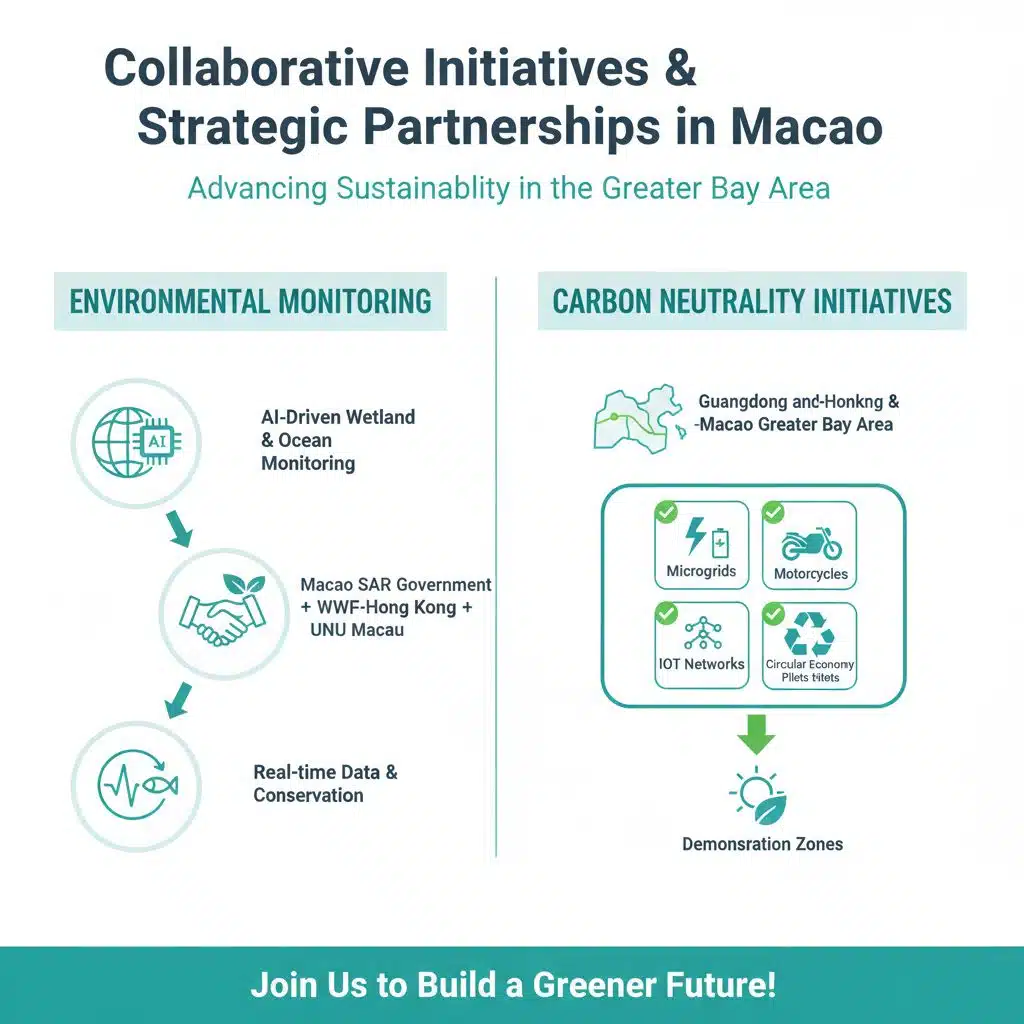
Macao SAR Government teams up with WWF-Hong Kong and UNU Macau to run AI-driven wetland and ocean monitoring projects, and they’re hitting the ground running. The Guangdong-Hong Kong-Macao Greater Bay Area partnership tests microgrids, electric motorcycles, IoT networks, and circular economy pilots in new carbon neutrality demonstration zones.
What partnerships support green technology development in Macao?
Green tech thrives on teamwork across borders. Macao hosts partnerships that speed its green transition.
- WWF-Hong Kong and UNU Macau inked an MoU on July 2, 2025. The pact channels artificial intelligence into wetland monitoring, ocean monitoring, biodiversity conservation, and visitor management. They launch research, seminars, workshops, and conferences. They strengthen ecosystem monitoring with big data and internet of things tools for the green transformation.
- A panel at the Macao International Environmental Co-operation Forum & Exhibition gathered experts from the Bank for International Settlements Innovation Hub, KPMG, and ATOS. They examine policy innovation, AI for nature, and cross-sector collaboration. They scout solutions in fuel cell research, circular economy pilot projects, and microgrid design. They feed insights into the Guangdong-Hong Kong-Macao Greater Bay Area green development plan.
- The Macao SAR Government joins hands with Portuguese speaking countries at the Cotai Expo and The Venetian Macao. They promote green finance, electric vehicles, shared electric bikes, and liquid cooled ultra fast charging systems. They showcase green electricity certificates and green future industry zones. They support sustainable development, one health, and clean energy sources across the debut economy projects zone.
How does international cooperation advance Macao’s sustainability goals?
International ties spark green wins. Massive turnouts at MIECF fuel shared goals.
- Data sharing and tech transfer: Over 400 firms from Asia-Pacific, Europe and other regions showcased projects at the 2025 Macao International Environmental Cooperation Forum & Exhibition. They spread renewable energy solutions and carbon neutrality demos across the city.
- Pan-Pearl River Delta collaboration: Macao teams with Guangdong-Hong Kong-Macao Greater Bay Area partners. They deploy circular economy models and smart city tools to curb waste and boost resource reuse.
- NGO and institute partnerships: WWF-Hong Kong and UNU Macau run ocean and wetland monitoring projects. They harness artificial intelligence and IoT sensors to track wildlife and pollution, aiding biodiversity conservation.
- Policy innovation platforms: The Green Forum at the 2025 MIECF drew more than 60 overseas firms. It drove Sustainable Development Goals via dialogue, tech demos and policy labs.
- Green finance networks: The local authority issues green power certificates and hosts ESG awards for excellence. Global investors back hydrogen fuel-cell stack pilots and microgrid trials, funding new energy growth.
- Research exchange programs: Local universities link with overseas labs to test proton exchange membranes and biofuel cells. They leverage big data, biotechnology and clean energy studies to cut emissions and speed green transformation.
- Joint demo zones: Authorities and foreign firms built carbon neutrality hubs in the Debut Economy Projects Zone. They feature liquid-cooled ultra-fast charging systems for electric motorcycles and shared bikes, showcasing green transportation.
Why are collaborations important for environmental impact?
NGOs, local firms, and the government join forces through partnerships. The WWF-Hong Kong and UNU Macau alliance set a strong example for circular economy pilots. Teams deploy innovative financing, policy frameworks, and shared data.
This work speeds climate change mitigation. It powers carbon neutrality roadmaps across the Guangdong-Hong Kong-Macao Greater Bay Area.
Researchers use artificial intelligence for wetland monitoring and ocean monitoring. They track species and guide biodiversity conservation efforts. Public engagement swells as citizens log data via mobile apps.
Events at MIECF spark fresh alliances. These bonds fuel green electricity certificate schemes and microgrids in the green future industry zone.
Innovative Green Technology Projects in Macao
Macao tests mini power grids that pair solar panels, fuel cells, and smart meters to cut coal use. IoT sensors and AI scans track wetland health and air quality in real time.
What smart energy management systems are implemented in Macao?
City officials rolled out green power trading and green electricity certificate programs at the 2025 MIECF event. These market schemes push renewable energy sources into power grids, fuel carbon neutrality goals, and boost green transition across the Greater Bay Area.
Utility companies use IoT platforms and smart meters to monitor real-time power flow and cut energy waste.
Event organizers also showcased a liquid-cooled ultra-fast charging system for electric vehicles. It uses smart sensors, edge computing, and demand response to balance loads on microgrids.
They built charging stations with 90% recyclable materials to limit waste and upgrade sustainable urban infrastructure. Drivers grab a coffee and a quick chat while their EV tops up.
How is AI used for environmental monitoring in Macao?
Robot Dog B2 patrols shorelines, scanning mangroves and tidal flats with infrared sensors. The mechanical dog barks up the right tree in wetland monitoring. It uses a sensor network and neural network analysis to spot shifts in water quality and wildlife activity.
Data streams feed city dashboards for smart urban management. Teams tap this live feed to guide ocean monitoring, biodiversity conservation, and resource exploration.
Macao International Environmental Co-operation Forum & Exhibition 2025 highlighted artificial intelligence-driven green management. Organizers shared a real case from Hong Kong’s Mai Po Nature Reserve, where cameras track bird flights and flag wildlife crime with image analysis.
Drones map coral reefs and catch illegal fishing. Park staff use data models for visitor management and one health approaches in coastal zones. Citizens enjoy cleaner water and greener streets through smart city tech.
What clean energy installations and microgrids exist in Macao?
Macao hosts several solar energy installations and mini grids. They drive a green transformation and cut fossil fuel use.
- Solar energy installations at Coloane Solar Park feed 5 MW into Macao’s grid. This photovoltaic farm cuts coal demand and issues green electricity certificates.
- A hybrid microgrid in Taipa links a 1 MW wind turbine, a 500 kW hydroturbine, and battery storage. It uses IoT sensors and a microgrid controller for smart energy balancing.
- The Venetian Macao hosts the world’s first solar-powered, wireless charger for shared e-motorbikes. Rooftop photovoltaic modules pair with magnetic induction tech to top up each ride.
- A hydrogen fuel cell station in the debut economy projects zone uses proton exchange membrane cells. It supports a low-carbon bus fleet and showcases green transition.
- An AI-driven energy hub debuted at the 2025 MIECF, showcased at Cotai Expo. It uses machine learning to forecast power demand, optimize battery storage, and blend solar and wind inputs.
- A floating array of photovoltaic panels on Macau Reservoir produces 2 MW of clean power. It cuts water loss and boosts hydropower output for a circular economy.
- A regional tie-line links micro-hydro hubs in the Guangdong-Hong Kong-Macao Greater Bay Area to Macao’s grid. Smart inverters and a secure SCADA system share renewable output seamlessly.
How are circular economy pilot projects shaping sustainability?
Pilot projects shape a circular economy, cutting waste and spurring reuse. They help protect resources and aid green transition.
- 2025 Macao International Environmental Co-operation Forum & Exhibition demo built a waste-to-energy plant that feeds a microgrid and slashes landfill waste.
- Refill hubs trial new biodegradable packaging for environmental protection, letting SMEs swap plastic for plant film that breaks down in soils.
- Sensor networks link bin scales with AI for nature to map waste streams and flag recycling gaps in real time.
- Digestor labs use bio-reactors to turn food scraps into farm feed across the Guangdong-Hong Kong-Macao Greater Bay Area, cutting methane leaks.
- Retail take-back lanes shred old gadgets, then upcycle metals and plastics into new kits at the green future industry zone.
- Repair cafes at Cotai Expo join small shops with tech pros to revive devices, cut e-waste, and back carbon neutrality goals.
- Clothing swaps reclaim textiles, spin fibers into insulation mats, and ship mats to builders in the debut economy projects zone.
- Policy pilots nudge shoppers toward zero-waste shops and link them to smart bins that log waste management data.
What are carbon neutrality demonstration zones in Macao?
Macao set up carbon neutrality demonstration zones to test low carbon strategies at its convention sites. Each zone follows new specialized guidelines for convention and exhibition activities released in 2025 by the Macao SAR government and local environmental organizations.
Organizers plan event layouts and energy flows with clear metrics. This project aims to show green transformation in real time.
A debut economy projects zone launched carbon capture technology that absorbs indoor carbon dioxide at trade halls. The unit cuts emissions and offers a living lab for show planners.
Environmental organizations led the guidelines release meeting at the Macao international environmental co-operation forum & exhibition. Visitors watch sensors track CO2, energy use and waste in each hall.
How is green transportation and EV infrastructure developing?
Green transport moves into center stage, fueled by electric innovation. Cities now host ultra-fast chargers on every block.
- Debut two-wheeler EV with remote-controlled automatic parking drew crowds at a green transformation showcase.
- Liquid-cooled ultra-fast charging system gives electric vehicles ten-minute top-ups at major stations.
- Solar-powered wireless docks for shared electric bicycles cut grid load on busy routes.
- Electric coaches and light rail shuttles link key hubs to ease congestion and meet carbon neutrality goals.
- Trial area at Cotai Expo and Macao International Environmental Co-operation Forum & Exhibition tests EV car-share schemes.
- Internet of Things modules and artificial intelligence regulate load across charging points throughout the Guangdong-Hong Kong-Macao Greater Bay Area.
What digital solutions manage waste and water effectively?
Digital platforms power real time control of waste and water flows. That demo came at a showcase for sustainable urban infrastructure.
- SUEZ and Macao Water showcased an Internet of Things (IoT) sensor network at the Cotai Expo. It tracks bin fill levels and pipe pressures in real time. It joins Macao’s smart cities plan to boost sustainable development.
- An AI analytics platform cleans raw signals and spots leaks before they grow. It uses machine learning to sort noise and send alerts to utility crews.
- A public mobile app lets users log overflow via QR scans. It maps circular economy sites across the Pan-Pearl River Delta, guiding trucks to reuse hubs and compost centers.
- Cloud pump control adapts water flows based on demand. It cuts energy use, helping Macao move toward carbon neutrality.
- A digital twin mirrors the city’s pipe grid in 3D. Operators run tests offline, cut costs and speed up repairs.
- A unified dashboard pulls live data on waste, water and green electricity certificates. Macao SAR Government staff use it to guide environmental protection and sustainable development goals.
How is urban environmental infrastructure being upgraded?
City crews in Macao plant forest patches, green corridors on rooftops and roadsides to boost biodiversity, improve air quality. They add wetlands, small parks, breathing rooms for birds, bees and kids.
Builders mix bamboo panels, recycled steel and solar glass in new green buildings, slashing power bills by half. They fit liquid-cooled ultra-fast charging systems for electric motorcycles and shared electric bikes, cutting smog.
Sensors clad street lamps and waste bins with IoT chips, telling crews when bins fill or pipes leak. These upgrades nudge Macao toward smart cities and circular economy goals.
What green finance and investment platforms are available?
Macao SAR Government opened a green finance portal in 2024. Banks list green bonds and sell green electricity certificates there. The portal covers loans for proton exchange membrane fuel cell projects.
It links with the 2025 MIECF event. That show held over 450 meetings and signed more than 50 project deals.
Hong Kong, Mainland China and Macao will send over 30 listed firms to the ESG Awards for Excellence. They compete in sustainable business and environmental protection. The Debut Economy Projects Zone drives the green transition.
It showcases biodegradable material, shared electric bikes and circular economy pilots. Investors find fresh clean energy and waste management projects there.
How do biodiversity data platforms support conservation?
Biodiversity data platforms collect wildlife reports from sensors and satellites. Machine learning checks bird counts at Mai Po Nature Reserve. The WWF-Hong Kong and UNU Macau partnership runs AI-driven tools to forecast zoonotic disease outbreaks.
Staff exchange knowledge with field biologists and build skills in data management. They feed information into cloud dashboards with geospatial maps.
Workshops in Macao spread those skills farther. The program boosts policy innovation and one health approaches. Government and NGOs use the insights to protect wetlands. They also plan green transportation routes around nature reserves.
This work strengthens environmental sustainability and biodiversity conservation.
What sustainable building initiatives are underway?
Builders at the 2025 MIECF event reached a 90% recyclability rate for construction materials. They applied energy-efficient designs and used recycled steel, glass, and bamboo. New green buildings at Cotai Expo feature solar panels, smart lighting, and IoT sensors.
Each powered kilowatt earned a green electricity certificate.
The Venetian Macao installed proton exchange membrane fuel cells for backup power. Planners set up a liquid-cooled ultra-fast charging system in the underground garages. That setup supports shared electric bikes and electric motorcycles.
Macao SAR Government and UNU Macau launched the green future industry zone on the expo grounds. WWF-Hong Kong awarded ESG excellence for rainwater harvest systems and green roofs, pushing Macao toward sustainable cities.
How do academic green tech research incubators contribute?
Research hubs spark new eco ideas on campus. They hold seminars, workshops, and conferences on clean energy research. Macao SAR government funds many projects. UNU Macau and WWF-Hong Kong lend expertise on carbon neutrality and circular economy pilots.
Students test prototype solar meters, run small-scale grid models, and measure green electricity certificate impacts.
Incubators link students to city firms and multinationals in the Guangdong-Hong Kong-Macao Greater Bay Area. They run pilot runs of biodegradable material, electric motorcycle trials, and shared electric bikes.
Research hubs apply data analytics and IoT devices for wetland monitoring and ocean monitoring tasks. Faculty shape policy innovation, green transition roadmaps, and resource recycling guides.
They adapt ideas based on ongoing assessment and funding trends.
The Role of Research and Academia in Green Innovation

Campus labs use quadcopters, DNA sequencers, and neural-net displays to watch wetlands, test plant-based plastics, and plan net-zero goals—keep reading.
How do local universities contribute to green technology?
Local campuses drive green tech change. They test new tools for smart cities and clean energy.
- The United Nations University Institute in Macau signed a MoU on July 2, 2025 with WWF-Hong Kong; it funds research, capacity-building and policy innovation.
- University of Macau researchers apply artificial intelligence to wetland and ocean monitoring in the Guangdong-Hong Kong-Macao Greater Bay Area.
- Macau Polytechnic Institute runs labs on electrochemical cells and liquid-cooled ultra-fast charging systems for electric motorcycles.
- Faculty teams use internet of things sensors to track water and waste flows in urban sites to support circular economy pilots.
- Researchers host policy innovation workshops at the Macao International Environmental Co-operation Forum & Exhibition to shape carbon neutrality roadmaps.
- Science centers incubate startups that use big data to improve visitor management in green buildings at The Venetian Macao.
- Engineering groups work on shared electric bikes and EV stations to speed the green transition across city districts.
What big data, biotechnology, and clean energy research is ongoing?
Macao teams drive new green studies. They tackle data, biotech, and solar science.
- Big data analytics run 1,000 sensors in Cotai, buzzing like a hive, fuel wetland monitoring at Nam Van and guide visitor management at Macao Science Center.
- Lab crews at UNU Macau pair biotech tools like CRISPR with biodegradable material trials for electric motorcycle seats, cut polymer waste by 40% and boost circular economy targets.
- University of Macau scientists fuse AI models with satellite imagery to spot ocean pollution across the Pan-Pearl River Delta, bolstering biodiversity conservation in line with WWF-Hong Kong blue economy insights.
- Digital platforms track wildlife health, forecast zoonotic spikes with real-time feeds, support one health approaches under Macao SAR government policy innovation.
- Clean energy pilots at The Venetian Macao and debut economy projects zone install solar microgrids, issue green electricity certificates, and test a liquid-cooled ultra-fast charging system for shared electric bikes.
- Researchers model wind and solar yields with internet of things data streams, design smart cities grids in the Guangdong-Hong Kong-Macao Greater Bay Area for carbon neutrality.
What are examples of academic sustainability projects impacting communities?
Local scholars sketch hands-on projects that spark community change. They mix tech, policy, and fun to drive green transformation.
- Tranquility Path at Mai Po Nature Reserve trains 1,000 visitors each month in nature therapy, blending biodiversity conservation with public mental well-being measures.
- UNU Macao outfits 30 villages with Internet of things sensors for wetland monitoring, sharing water quality data across the Guangdong-Hong Kong-Macao Greater Bay Area.
- Students at City University pilot a circular economy scheme using biodegradable material in campus canteens, cutting plastic waste by 25 percent in six months.
- Researchers at University of Macau build a biodiversity data platform that logs over 5,000 species reports, improving wildlife crime tracking through AI for nature tools.
- A team from Macau Polytechnic installs a liquid-cooled ultra-fast charging system for electric motorcycle fleets, boosting shared electric bikes use by 40 percent since 2023.
- Faculty at Macau Institute of Management host green business workshops at the Macao International Environmental Co-operation Forum & Exhibition, training 200 entrepreneurs in green finance and ESG Awards for Excellence standards.
The Future of Sustainability in Macao
The next Macao International Environmental Co-operation Forum & Exhibition will show off pilot mini grids in the Guangdong-Hong Kong-Macao Greater Bay Area. IoT sensors will log water quality in mangrove swamps, and AI for nature will spot rare birds.
What upcoming green initiatives will be showcased at MIECF?
Macao SAR Government announced MIECF will run March 27 to 29 at Cotai Expo, The Venetian Macao. Nearly 20 firms will showcase carbon neutrality plans. The Debut Economy Projects Zone highlights circular economy solutions and green consumer goods.
Developers will introduce a liquid-cooled ultra-fast charging system, electric motorbikes, shared electric bikes, and biodegradable material for smart cities.
A special session, Debut@Macao Project Launch x Innovation Matching Session, will connect startups and investors. Guests can explore environmental protection tools like AI for nature, IoT sensors for wetland monitoring, ocean tracking platforms, and green electricity certificates.
WWF-Hong Kong and UNU Macau will host Pearl River Delta region conservation talks. Attendees will discuss policy innovation, biodiversity conservation, and green buildings under the theme Innovation and Green Development: Solutions to Build Beautiful Cities.
What challenges and opportunities exist for expanding green tech?
Green tech must scale fast. Stakeholders need to tackle challenges head on.
- High upfront costs hamper microgrid installs and circular economy pilots. Macao SAR government granted MOP 50 million in 2023 to cover part of those costs.
- Skills gaps slow AI for nature and IoT deployments. UNU Macau and WWF-Hong Kong train staff on wetland monitoring and wildlife crime checks.
- Poor EV network holds back electric motorcycle and shared electric bikes rides. Venetian Macao hosts a liquid-cooled ultra-fast charging system demo to showcase new tech.
- Data gaps hurt biodiversity conservation and smart city planning. Big data tools close gaps in visitor management and pollution tracking.
- Policy misalignment stalls green electricity certificate rolls. Pan-Pearl River Delta talks and policy innovation at MIECF push for unified rules.
- Public awareness lags on environmental sustainability and one health approaches. Green innovation conference at Cotai Expo fires up citizen action.
- Funding gaps freeze green future industry zone and debut economy projects zone. ESG awards for excellence and green finance platforms lure private capital.
- Land limits test green buildings and wetland restoration plans. Engineers use vertical gardens and rooftop solar to save space and boost sustainable development.
- Heritage issues can clash with modern tech in Portuguese-speaking countries. Dialogue with local leaders blends cultural preservation with green transition.
- Ongoing assessment demands fresh data and quick tweaks. Macao SAR government reviews green transformation twice a year to keep projects on track.
How will green technology affect Macao’s economy and environment?
New solar arrays and microgrids help cut greenhouse gas emissions under Macao SAR government goals. Smart connectivity nodes track energy use and air quality citywide. AI for wildlife and wetland monitoring guards coastal biodiversity.
Green transformation drives job creation in renewable energy and tech. Residents breathe cleaner air and enjoy better public health.
Circular economy pilots reuse waste for building materials in Cotai district. Carbon neutrality demonstration zones showcase electric motorcycles and shared electric bikes. Investment from green finance platforms boosts local startups and fuels sustainable development.
The Guangdong-Hong Kong-Macao Greater Bay Area partnership brings tech transfer and policy innovation. These efforts support a government target to cut emissions by a set year.
How can businesses, policymakers, and citizens support sustainability?
Green transition in Macao needs all hands on deck. Firms, officials, and citizens can take clear steps today.
- Companies register for the Green Innovation Conference and ESG Awards for Excellence before the June 2024 Macao International Environmental Co-operation Forum & Exhibition and join project matching sessions to link with investors and tech partners.
- Firms buy green electricity certificates to back solar or wind farms in the Green Future Industry Zone and launch circular economy pilots that cut waste and boost reuse.
- Governments set up carbon neutrality demonstration zones at the Cotai Expo site under the Guangdong-Hong Kong-Macao Greater Bay Area plan and adjust rules to speed green transformation and lure startups.
- Officials team up with WWF, United Nations University, and use one health approaches to roll out wetland monitoring platforms, biodiversity conservation tools, and wildlife crime tracking systems.
- Residents swap gas bikes for electric motorcycles or shared electric bikes that tap liquid-cooled ultra-fast charging systems at new stations.
- Civic groups host public fairs to teach waste sorting, water management, and energy conservation with Internet of Things sensors and AI for nature, focusing on education, well-being, and environmental goals for a just transition.