In a rare show of unity, the foreign ministers of 31 Arab and Islamic countries, along with the heads of three major regional blocs—the Arab League, the Organisation of Islamic Cooperation (OIC), and the Gulf Cooperation Council (GCC)—issued a strongly worded condemnation of Israeli Prime Minister Benjamin Netanyahu’s recent comments promoting the idea of a “Greater Israel.”
Their joint statement described Netanyahu’s remarks as not only provocative but also a serious violation of international law. The leaders said the comments “represent a grave disregard for the rules of international law and the foundations of stable international relations.”
They warned that such language and policy direction pose “a direct threat to Arab national security, to the sovereignty of states, and to both regional and global peace and security.”
This was one of the strongest collective responses in recent years, reflecting growing alarm across Arab and Islamic capitals about Israel’s long-term intentions.
Why Netanyahu’s Remarks Sparked Outrage
Netanyahu’s “Greater Israel” vision—though not formally defined—has been linked to settlement expansion, territorial annexation, and permanent Israeli control over Palestinian lands. Critics argue that it directly undermines the long-promised two-state solution backed by the United Nations, the European Union, and much of the international community.
Arab and Islamic leaders highlighted that these statements cannot be viewed in isolation. They come at a time when:
- Settlement activity in the West Bank continues at record pace.
- Israeli ministers like Bezalel Smotrich openly reject the possibility of a Palestinian state.
- The humanitarian crisis in Gaza is worsening by the day.
The timing of Netanyahu’s remarks, amid ongoing violence in Gaza and the West Bank, deepened suspicions that Israel’s leadership seeks to normalize permanent occupation rather than pursue peace.
Qatar Joins Condemnation
Qatar, which often acts as a mediator in conflicts involving Gaza, echoed the condemnation. Its Ministry of Foreign Affairs released a statement on X (formerly Twitter), denouncing Netanyahu’s words as a “gross disregard and blatant violation of international law.”
Qatar also stressed that such remarks could fuel further instability, undercut diplomatic mediation, and derail international humanitarian efforts.
UN Rights Office Raises Alarm Over Civilian Deaths
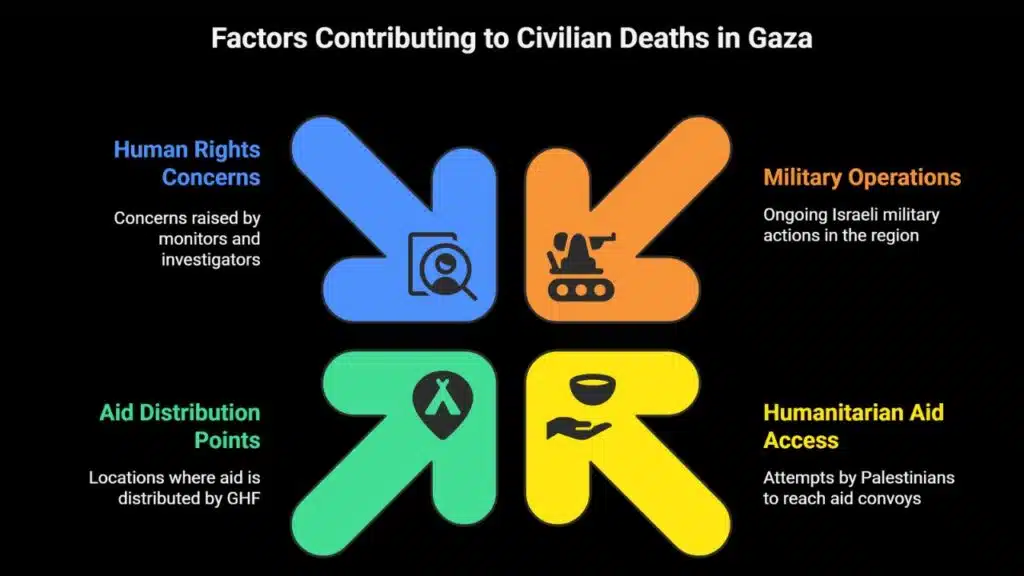
Alongside political outrage, fresh reports highlighted the humanitarian cost of ongoing Israeli military operations.
The UN Human Rights Office in the Occupied Palestinian Territory (OHCHR) said that since the beginning of August, it has documented 11 incidents where Palestinians were killed while guarding or attempting to access humanitarian aid convoys. These incidents alone left at least 46 people dead.
The OHCHR further reported that between May 27 and August 13, at least 1,760 Palestinians were killed while trying to obtain aid. Disturbingly, 994 of those deaths occurred near food and aid distribution points run by the controversial Gaza Humanitarian Foundation (GHF).
Human rights monitors and international investigators have raised concerns that these sites have repeatedly become “death zones”, where civilians desperate for food and medicine have come under live fire.
Recent Strikes Kill Children in Gaza
According to Al Jazeera, citing Al-Awda Hospital in Nuseirat, at least ten Palestinians were killed on Friday morning, including four children, after Israeli airstrikes hit parts of central Gaza.
Hospitals across Gaza continue to report an influx of victims from both direct strikes and incidents near aid distribution centers. Medical staff, already stretched thin by shortages of supplies, described the scenes as “catastrophic” with families arriving carrying multiple casualties.
Wider International Context
The Arab League, OIC, and GCC—representing more than a billion people combined—framed Netanyahu’s remarks as part of a broader pattern:
- Violation of UN resolutions: Particularly UN Security Council Resolution 2334 (2016), which reaffirmed that Israeli settlements in occupied Palestinian territory are illegal under international law.
- Rejection of international rulings: Including the International Court of Justice (ICJ) advisory opinion condemning the construction of Israeli settlements and barriers.
- Destabilization of the region: By undermining existing state borders and fueling conflict in already fragile states.
Calls for Ceasefire and Humanitarian Protection
The joint statement went beyond condemnation. Leaders demanded:
- An immediate ceasefire in Gaza.
- Full, unrestricted access for humanitarian aid.
- An end to forced displacement of Palestinians.
- Commitment to a sovereign Palestinian state with East Jerusalem as its capital, based on pre-1967 borders.
They also called for stronger international intervention to protect civilians, hold violators accountable, and pressure Israel to respect international law.
Human Rights Groups and Investigations
Investigations by international media and human rights groups—such as The Guardian and Human Rights Watch—have documented patterns of violence around GHF distribution sites, where evidence suggests Palestinians were deliberately fired upon while seeking aid.
Forensic analysis of bullets and wounds, combined with eyewitness testimony, has indicated that IDF weapons and tactics were used in multiple fatal incidents.
Human Rights Watch described the GHF sites as “death traps”, urging international bodies to oversee aid distribution in Gaza directly.
Meanwhile, the United States sent envoy Steve Witkoff to assess the situation and explore alternatives to ensure safer food and medical supply routes, amid mounting criticism of GHF’s involvement.
The convergence of political outrage and humanitarian crisis paints a deeply troubling picture:
- Netanyahu’s “Greater Israel” rhetoric is seen by Arab and Islamic states as an existential threat to regional stability and Palestinian sovereignty.
- The humanitarian crisis in Gaza is worsening, with civilians—including children—being killed not only in strikes but also while waiting in line for food and aid.
- International law, UN resolutions, and humanitarian protections continue to be violated, fueling global demands for accountability and urgent intervention.
This unified stance by Arab and Islamic countries underscores a broader message: the situation in Palestine is not just a local or regional issue—it is a global test of justice, peace, and the credibility of international law.
The Information is Collected from Arab News and MSN.