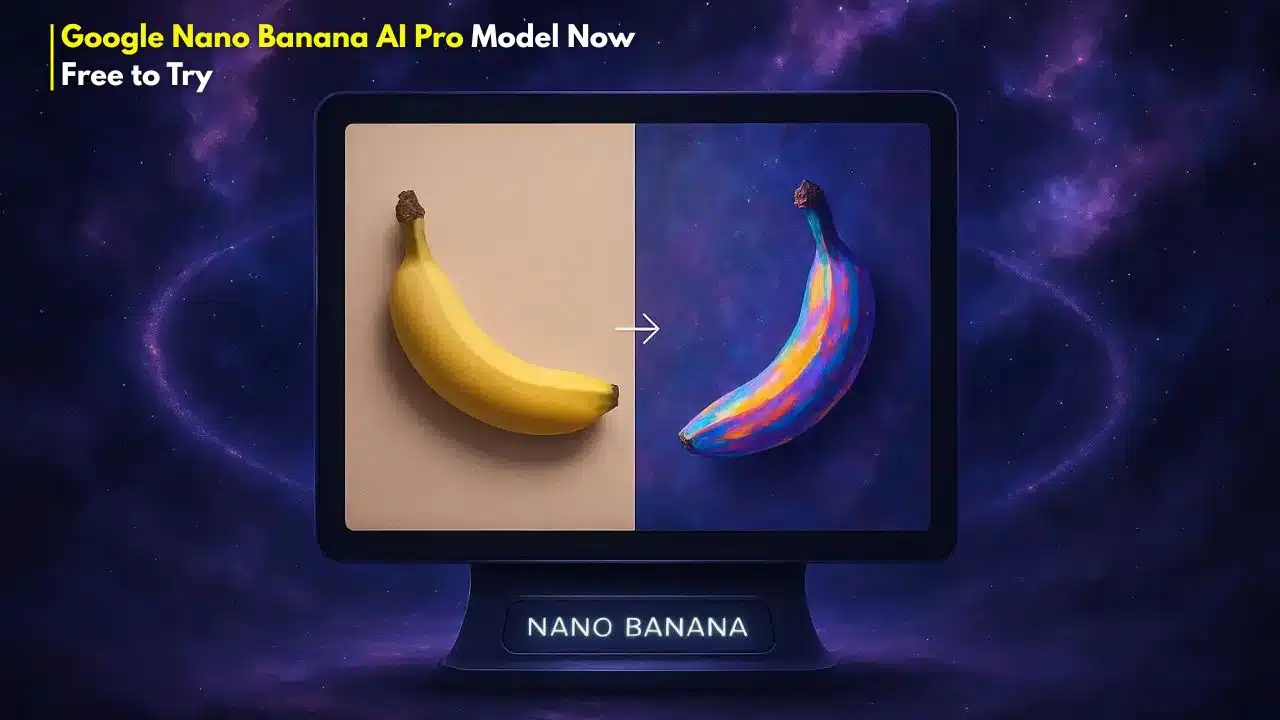
The era of “prompt-and-pray”—where users typed vague commands into AI generators and hoped for a coherent result—ended yesterday. In a defining moment for the generative AI sector, Google officially dismantled the barrier between experimental toy and professional tool. The tech giant has unveiled Nano Banana Pro (built on the groundbreaking Gemini 3 architecture), a visual intelligence engine designed for high-end enterprise use, while simultaneously democratizing the technology by pushing the standard Google’s Nano Banana AI Image Model to over two billion users via Google Photos and the Gemini app.
This dual release, which dominated the news cycle from Silicon Valley to Singapore over the last 24 hours, represents a fundamental restructuring of Google’s AI strategy. It is no longer just about generating pixels; it is about understanding the physical and semantic logic of the world those pixels represent.
Executive Summary: The Key Developments
- The “Pro” Launch: Nano Banana Pro (Gemini 3 Pro Image) went live yesterday (Nov 20) for developers via Vertex AI. It boasts 4K native resolution and “reasoning” capabilities.
- Free Mass Rollout: The standard Nano Banana model is now the default rendering engine for Google Photos, powering the new “Help me edit” suite on Android 16 and iOS 19.
- The “Thinking” Engine: Unlike diffusion models of 2024, Nano Banana Pro utilizes a “Chain of Thought” process to plan image layout, lighting physics, and text spelling before rendering.
- Enterprise Control: The Pro model introduces “14-Shot Style Transfer,” allowing brands to upload up to 14 reference images to lock in character consistency and brand aesthetics.
- Memory vs. Reality: New editing features allow users to “Open Eyes” in photos or reconstruct cropped limbs, sparking renewed ethical debates on the authenticity of digital memories.
- Security: Every asset is stamped with SynthID v2, a robust, invisible watermark that survives compression, screenshots, and color grading.
The Strategy Pivot: Why “Banana”?
The naming convention has raised eyebrows in financial circles accustomed to stoic names like “Titan” or “Apex.” Why “Nano Banana“?
According to internal memos cited by The Verge earlier this week, the branding is a calculated psychological play. Google aims to position this AI not as a cold, intimidating “Skynet” entity, but as an accessible, organic, and everyday utility—like a piece of fruit.
However, the playful name belies the aggressive technical dominance Google is asserting. By integrating the standard model directly into Google Photos—an app used by nearly everyone with a smartphone—Google has effectively cornered the consumer market overnight, leaving competitors like Apps and standalone editors fighting for the niche “Pro” user base.
Technical Deep Dive: The “Thinking” Image Model
The most significant revelation from the Google DeepMind whitepaper released yesterday is the integration of Gemini 3’s “Thinking” protocols into visual generation.
How It Differs from Diffusion
Traditional image generators (like the older Imagen 2 or early Midjourney) worked on “probabilistic diffusion”—essentially hallucinating patterns out of static noise until they resembled the prompt. They didn’t “know” what a cat was; they just knew what pixels usually went together when the word “cat” was used.
Nano Banana Pro works differently.
- Prompt Analysis: When a user asks for “A diagram of a 4-stroke engine cycle,” the model first accesses Google’s Knowledge Graph.
- Logical Planning: It “thinks” through the steps: Intake, Compression, Combustion, Exhaust. It determines where the valves must be for each stage.
- Semantic Layout: It draws a low-resolution “skeleton” ensuring the text labels are correctly placed next to the corresponding parts.
- Final Rendering: Only then does it paint the high-resolution pixels.
The Result: Diagrams are accurate. Text is spelled correctly (supporting 40+ languages). Hands have five fingers because the model “knows” the anatomy of a hand, rather than just guessing the shape.
“We have solved the ‘spaghetti text’ problem. If you ask Nano Banana Pro for a ‘Stop’ sign in Paris, it reads ‘Arrêt’. If you ask for it in Tokyo, it reads ‘止まれ’. It understands context, not just shape.”
— Eli Collins, VP of Product at Google DeepMind (Vertex AI Launch Event)
The Enterprise Killer App: 14-Shot Consistency
For marketing agencies and design studios, the “Pro” model’s killer feature is consistency.
Previously, maintaining a consistent character (e.g., a brand mascot) across different AI images was nearly impossible. Nano Banana Pro introduces a “Style & Character Reference” slot that accepts up to 14 images.
Use Case Scenario: The “Global Campaign”
Imagine a sportswear brand launching a new sneaker.
- Input: The creative director uploads 4 photos of the sneaker, 2 photos of the logo, and 8 photos of a specific model (human).
- Prompt: “Generate a wide shot of our model wearing the sneaker, sprinting on a rainy Tokyo street at night, neon lighting, cinematic blur.”
- Output: The AI generates the scene. Crucially, the sneaker laces are correct, the logo is not warped, and the model’s face is identical to the reference photos.
This capability, previously only possible with complex, technical “LoRA” training on local servers, is now available via a simple web interface in Google Workspace.
The Consumer Revolution: Google Photos Integration
While the Pro model targets the Fortune 500, the standard Nano Banana model is changing the lives of parents, travelers, and social media users.
The “Help Me Edit” Suite
Rolling out this week, the old “Magic Editor” button in Google Photos is being replaced by a sparkle icon labeled “Help me edit.” This interface relies entirely on natural language.
- The “Open Eyes” Feature: Utilizing the user’s own photo library, the AI can analyze a subject’s face. If you took a perfect group shot but one person blinked, you can tap their face and select “Fix Eyes.” The AI finds a photo of that person with open eyes from the same event (or past events) and seamlessly transplants the gaze
- Weather & Lighting Control: Users can type “Make it golden hour” or “Change the background to a snowy day.” The Nano Banana model relights the subject to match the new environment, adjusting shadows and skin tones so the edit doesn’t look pasted on.
- Decluttering: The command “Clean up the table” will automatically identify and remove trash, crumpled napkins, and messy wires from a dinner photo, filling in the gaps with realistic wood grain or tablecloth textures.
Market Impact: The Numbers Game
The release of Nano Banana Pro places immense pressure on the incumbent leaders of the creative software space.
Comparative Feature Analysis (November 2025)
| Feature | Google Nano Banana Pro | Midjourney v7 | Adobe Firefly Image 4 | OpenAI DALL-E 4 |
| Core Architecture | Gemini 3 (Reasoning) | Diffusion + Transformer | Diffusion + Vector | Transformer |
| Max Resolution | 4096 x 4096 | 2048 x 2048 | 4096 x 4096 | 1792 x 1024 |
| Text Accuracy | 95% (Multilingual) | 80% (English dominant) | 90% (Stylized) | 85% |
| Reference Images | 14 inputs | 2-4 inputs | Style Kits | 1 input |
| Ecosystem | Workspace / Google Cloud | Discord / Web | Creative Cloud | ChatGPT / Copilot |
| Commercial Cost | $0.02 / image (Pro) | $30 / month | Included in CC | $20 / month |
Financial Implication: Analysts predict that by bundling the standard model for free and offering the Pro model on a “pay-per-token” basis via Google Cloud, Google is undercutting the subscription models of Midjourney and Adobe. Small businesses may drop their $30/month subscriptions if they can pay $0.02 per image only when they need it.
Ethics, Safety, and the “Reality Blur”
With the fidelity of Nano Banana Pro, the line between reality and fabrication is thinner than ever. Google has implemented three layers of safety to address this.
- SynthID v2 (The Invisible Shield): Every image generated by Nano Banana contains a watermarking signal embedded in the pixel frequency. It is imperceptible to the human eye but survives cropping, filtering, and screenshots. Google has open-sourced the detector API, allowing social media platforms (X, Meta, TikTok) to automatically label these images as “AI Generated.”
- The “Public Figure” Firewall:Try to generate a photorealistic image of the US President or a Bollywood star doing something controversial, and the model will refuse. Google maintains a “hard block” list of protected VIPs to prevent political disinformation.
- The Metadata Chain:Google Photos preserves the “Edit History” in the file metadata. Even if a user exports the photo, a C2PA (Coalition for Content Provenance and Authenticity) credential travels with it, stating: “Original captured by Pixel 10, Modified by Nano Banana AI.”
Expert Voices
Dr. Aruna Ravichandran, Chief AI Analyst at Gartner, provided this comment to English News:
“Google has effectively woken the sleeping giant. For two years, they watched startups define the generative image space. With Nano Banana Pro, they aren’t just catching up; they are changing the physics of the market. The ‘reasoning’ capability for diagrams and layouts is the feature that moves this from ‘art station’ to ‘workstation’. This is a tool for engineers and educators, not just concept artists.”
Marcus Brown, a freelance photographer based in London, offered a more cautious view:
“The ‘Open Eyes’ feature in Google Photos scares me. If I take a photo of my child crying and use AI to make them smile, am I preserving a memory, or am I lying to my future self? We are entering an age where our photo albums are curated fictions.”
What to Watch Next
- The Video Frontier: Industry rumors suggest “Video Banana” (built on the Veo 2 architecture) will launch in Q1 2026, bringing this same level of “reasoning” to video clips.
- Legal Challenges: As artists see their styles replicated with the “14-shot” feature, expect a new wave of copyright lawsuits, despite Google’s indemnity promises for enterprise users.
- Hardware Requirements: While the cloud does the heavy lifting for the Pro model, the standard Nano Banana requires the new Tensor G6 chip (found in Pixel 10) for on-device processing. Older phones will rely on slower cloud connections.
Conclusion
Google’s Nano Banana AI Image Model is more than a quirky name; it is a statement of intent. By creating a “Pro” tier that understands the logic of the world and a “Free” tier that lives in the pockets of billions, Google has seamlessly integrated generative AI into the fabric of daily digital life.
For the professional, the frustration of “hallucinated” text and inconsistent characters is largely solved. For the everyday user, the ability to fix a ruined photo is now a tap away. The technology is impressive, the utility is undeniable, but the onus is now on society to decide how much “editing” our reality can withstand before it ceases to be real.