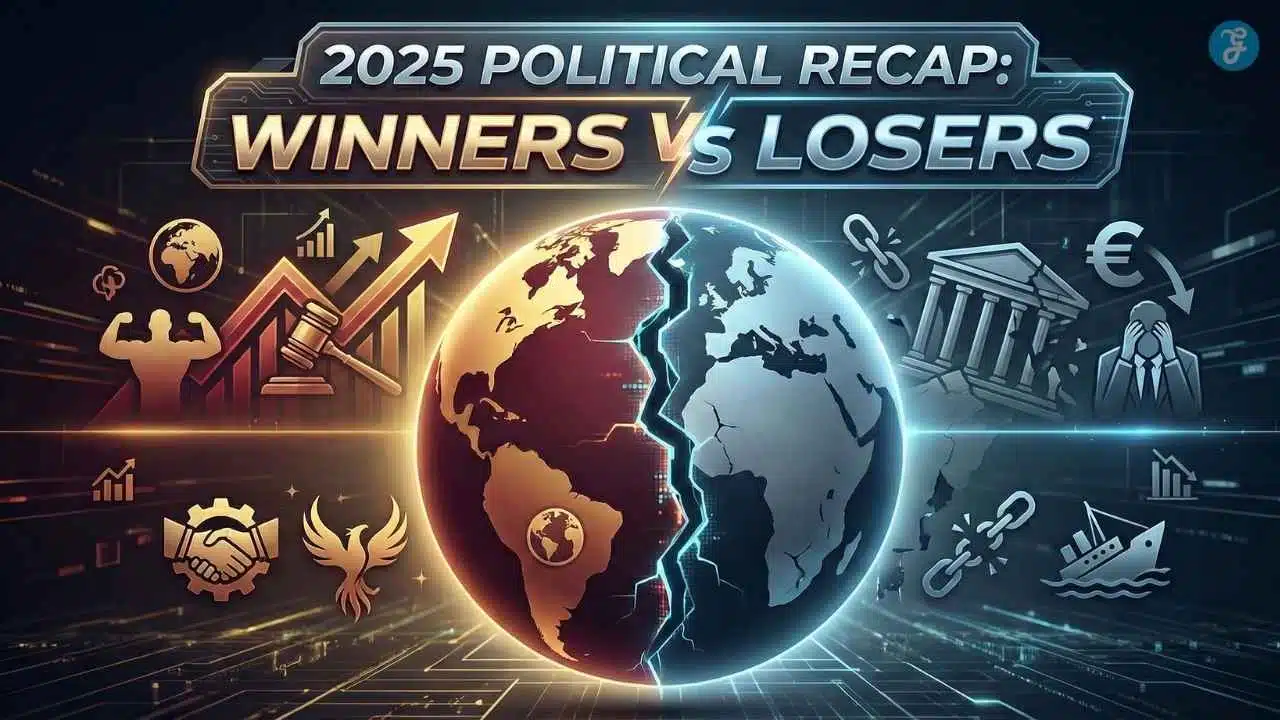
If 2024 was the year of anxiety, 2025 was the year the dam finally broke. As we close the books on this tumultuous year, our Global Politics 2025 Recap reveals a landscape that would have been unrecognizable just a decade ago. The comfortable, predictable rhythms of the liberal international order—where summits were polite, and treaties were sacred- have been swept away. In their place stands a raw, unfiltered era of “Realpolitik Reborn.”
The defining mood of 2025 wasn’t hope or fear; it was calculation. From Washington to Tokyo, leaders stopped asking “What is the right thing to do for the world?” and started asking “What is the profitable thing to do for my country?” The inauguration of Donald Trump for a second term in January set the tempo, but he was merely the loudest voice in a global chorus. Across continents, voters rejected the status quo of the center-left establishment, opting instead for disruptors who promised to tear down the old system and build “Fortresses” of national interest.
We are no longer living in the “Post-Cold War” world. That chapter is closed. We have entered the Multiplex Era, a messy, complex reality where economic partners can be security rivals, and where the only permanent rule is that there are no permanent rules.
Key Takeaways: The Year of the Deal
-
Realpolitik Returns: Ideology was replaced by transactional diplomacy. Alliances are now flexible, not fixed.
-
The Populist Wave: Donald Trump (USA) and Javier Milei (Argentina) cemented the “Strongman” era, while Sanae Takaichi (Japan) shattered glass ceilings with a hawkish fist.
-
Establishment Collapse: Centrist leaders like Justin Trudeau and the German Coalition fell due to economic stagnation and voter fatigue.
-
The Global South Rises: Non-aligned nations like India and Indonesia became the ultimate power brokers, playing both sides of the US-China rivalry.
-
A “Multiplex” World: The Unipolar moment is dead. We now live in a fragmented world of regional fortresses and ad-hoc security pacts.
The Global Zeitgeist: Why the Pendulum Swung
Before we examine the individual winners and losers, it is crucial to understand the atmosphere that created them. 2025 was not defined by a single ideology, but by a shared global mood: exasperation.
Across the world, from the American Midwest to the suburbs of Berlin, the “Incumbency Advantage” vanished. In previous decades, sitting governments could rely on stability to stay in power. In 2025, stability was a liability. Voters viewed established leaders not as safe hands, but as tired guardians of a broken system.
Three specific drivers fueled this global “Vibe Shift” that cleared the path for the disruptors:
-
The Inflation Hangover: While headline inflation numbers cooled in many regions, prices remained permanently higher. The average voter’s purchasing power did not recover, creating a deep-seated resentment toward “technocratic” economic management.
-
Security Over Liberty: With conflicts raging in Eastern Europe and the Middle East, and migration pressures mounting, populations overwhelmingly prioritized order over openness. The abstract promise of “democracy” lost ground to the concrete promise of “safety.”
-
The Rejection of Globalism: The idea of a “global village” was formally rejected at the ballot box. Voters rewarded leaders who promised to prioritize their citizens, their jobs, and their borders first, regardless of the international diplomatic cost.
It was in this unforgiving climate—where patience for process had run out—that a specific breed of leader thrived.
The Winners: The Disruptors and The Strategists
History is written by the victors, and in 2025, the victors were those who wielded power with blunt force or ruthless pragmaticism. The “Winners” column this year is dominated by the archetype of the Strongman (and Strongwoman) and the Transactional Neutral.
1. The Return of the Strongman: Trump & Milei
The biggest story of the year was, undeniably, the return of Donald Trump to the White House. His “America First 2.0” agenda was far more organized and efficient than his first term. By swiftly implementing universal tariffs and decoupling from traditional multilateral commitments, he forced allies and adversaries alike to renegotiate their standing with Washington on a case-by-case basis.
Meanwhile, in South America, Argentina’s Javier Milei proved that his “chainsaw” libertarianism wasn’t just a campaign gimmick. His decisive victory in the October legislative elections validated his harsh austerity measures. Inflation in Argentina has stabilized to single digits for the first time in decades, making him a poster child for the global right.
The Populist Playbook 2025:
| Leader | Country | Key 2025 Achievement | Policy Focus |
| Donald Trump | USA | Implementation of 15% Universal Baseline Tariff | Protectionism, Deregulation, Border Control |
| Javier Milei | Argentina | The majority wins in the Midterm Legislative Elections | aggressive Fiscal Austerity, Dollarization steps |
| Nayib Bukele | El Salvador | Regional Security Pact Leadership | Zero-tolerance Crime Policy, Tech Investment |
2. The New Iron Lady: Sanae Takaichi
In October, Japan made history. The Liberal Democratic Party (LDP), sensing the shifting geopolitical winds, elected Sanae Takaichi as Prime Minister, making her the first woman to hold the post. But Takaichi is no liberal icon. A staunch conservative and protégé of the late Shinzo Abe, she spent her first months in office shredding the remnants of Japan’s pacifist constitution.
Under Takaichi, Japan has accelerated its defense spending to 3% of GDP and signaled a willingness to host American intermediate-range missiles. She is a winner because she correctly read the room: in a dangerous Asia, Japan decided it needed a hawk, not a dove.
3. The “Swing State” Strategists
While great powers bickered, the “Middle Powers” cashed in. Countries like India, Indonesia, and Saudi Arabia mastered the art of playing both sides. They didn’t join the US containment of China, nor did they join China’s anti-Western bloc. Instead, they accepted infrastructure deals from Beijing and defense technology from Washington.
India, in particular, solidified its role as the “Factory of the Future,” absorbing manufacturing exiting China. Prime Minister Modi’s diplomatic calendar in 2025 was a masterclass in multi-alignment, hosting summits that included Russian energy tycoons one week and Silicon Valley CEOs the next.
The Losers: The Squeezed Establishment
If you were a centrist incumbent in 2025, it was a terrible year. The “Losers” of 2025 were defined by paralysis. These were leaders and institutions that tried to play by the old rules of consensus and globalization, only to find that the game had changed underneath them.
1. The Fall of the Liberal Center
The most shocking political demise of the year occurred in Canada. After a decade in power, Justin Trudeau stepped down in March 2025. Facing catastrophic polling numbers and a revolt within his own caucus, he handed the reins to Mark Carney. However, the Liberal brand remained toxic, weighed down by the housing affordability crisis and a sense of drift.
In Germany, the collapse of the “Traffic Light” coalition (SPD, Greens, FDP) in early 2025 led to snap elections that produced a fractured, gridlocked Bundestag. The German economic engine, deprived of cheap Russian energy and hit by American tariffs, sputtered badly. The political center in Europe has hollowed out, with the far-right AfD and far-left BSW gaining significant ground.
2. “Fortress Europe” Under Siege
The European Union spent 2025 in an existential crisis. The bloc found itself in a vice grip:
-
From the West: The US administration demanded Europe pay more for its own defense while slapping tariffs on European luxury goods and steel.
-
From the East: China flooded the European market with heavily subsidized electric vehicles (EVs) and green tech, undercutting European manufacturers.
Brussels attempted to retaliate with its own tariffs, but the unity of the 27 member states fractured. Hungary and Slovakia vetoed unified responses, seeking their own side deals with Beijing. The dream of a “Geopolitical Europe” faded as the continent looked more like a collection of squabbling states than a superpower.
Major Political Exits in 2025:
| Leader | Country | Reason for Exit/Decline | Successor/Outcome |
| Justin Trudeau | Canada | Resignation due to polling collapse | Mark Carney (Interim/New Leader) |
| Olaf Scholz | Germany | Coalition collapse & Snap Election loss | Fractured Parliament |
| Rishi Sunak | UK | 2024/25 General Election Defeat | Labour Government (Struggling with debt) |
3. The International Institutions (UN & WTO)
The biggest loser of 2025 was the concept of “Global Governance.” The 80th session of the UN General Assembly was widely criticized as a “talk shop” with zero deliverables. The Security Council remained paralyzed by vetoes.
The World Trade Organization (WTO) officially became a zombie institution in 2025. With the US blocking judge appointments and ignoring rulings, and China exploiting “developing nation” status, the world moved to a system of bilateral trade wars. If you have a trade dispute in 2025, you don’t go to Geneva; you impose a tariff and wait for the phone to ring.
The New World Order: The “Multiplex” Era
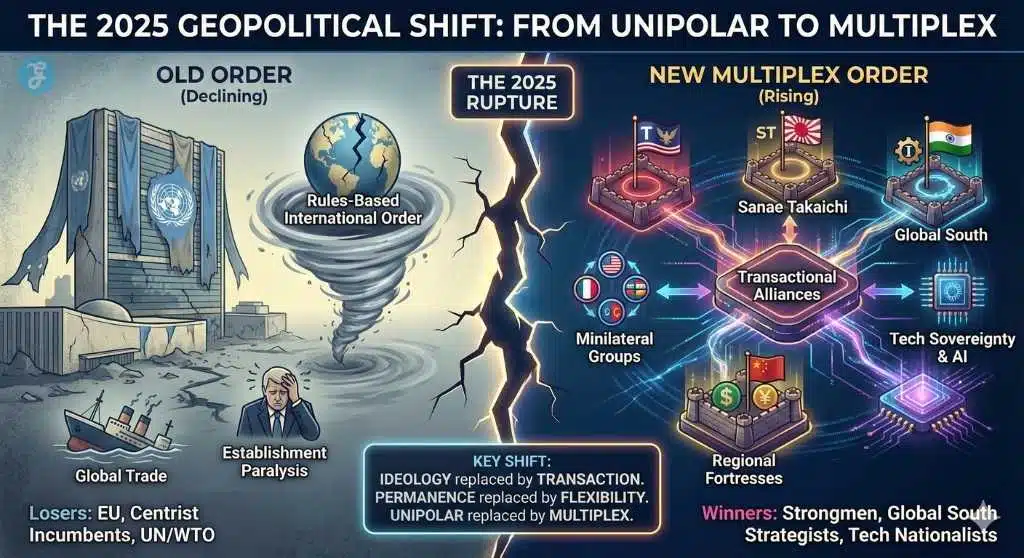
So, if the old order is dead, what has replaced it? Academics and geopolitical strategists are coalescing around the term “Multiplex Order.”
Unlike the Cold War (Bipolar) or the 1990s (Unipolar), a Multiplex world resembles a modern cinema: there are many movies playing at once, and you can choose which theater to walk into.
1. Transaction Over Treaty
The NATO alliance still exists, but its soul has changed. In 2025, alliances became transactional. Nations no longer marry for life; they date for specific benefits.
-
Example: Turkey remained in NATO to enjoy the security umbrella but deepened energy and financial ties with the BRICS+ bloc to stabilize its Lira.
-
The Shift: Diplomacy is no longer about “shared values” (democracy vs. autocracy). It is about “shared interests” (energy security, supply chains, counter-terrorism).
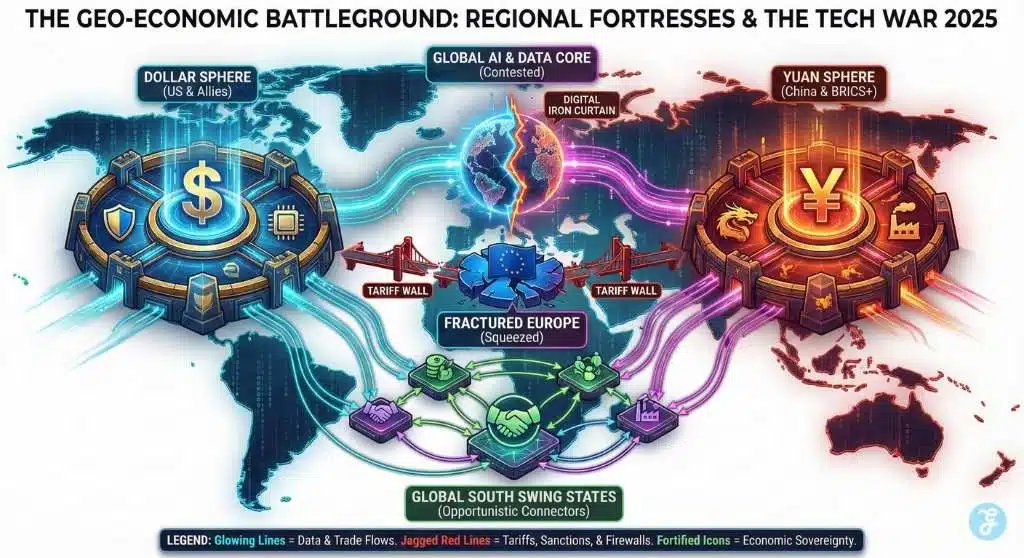
2. The Fragmentation of Trade (Regional Fortresses)
Globalization didn’t die, but it fragmented. We now see the emergence of three distinct economic spheres:
-
The Dollar Sphere: The Americas and parts of Western Europe, centered on US tech and finance.
-
The Red Sphere: China, Russia, and Central Asia, centered on the Yuan and state-controlled infrastructure.
-
The Non-Aligned Sphere: The “Global South” trading freely with both, acting as the interface.
Supply chains in 2025 are shorter, more expensive, and politically vetted. “Just-in-Time” efficiency has been replaced by “Just-in-Case” security.
3. The Rise of Minilateralism
Because the UN is broken, countries have formed small, exclusive clubs to get things done.
-
The Quad (US, Japan, India, Australia): Solidified into a naval enforcement group in the Indo-Pacific.
-
The “Lithium Triangle”: South American nations forming a cartel to control battery prices.
-
The Nordic Defense Pact: Scandinavian nations integrating air forces independent of broader NATO command structures.
Old Order vs. New Order [2025]:
| Feature | The Old Liberal Order (1991-2020) | The Multiplex Order (2025-Present) |
| Dominant Power | US Hegemony (Unipolar) | US/China/Global South (Multipolar) |
| Key Institution | United Nations / WTO | Ad-hoc Coalitions / Bilateral Deals |
| Trade Goal | Maximum Efficiency (Global) | Maximum Security (Regional) |
| Alliance Style | Permanent & Treaty-based | Temporary & Issue-based |
| Currency | US Dollar Dominance | Dollar vs. Yuan vs. Crypto/Gold |
The New Battlegrounds: AI Sovereignty & Green Protectionism
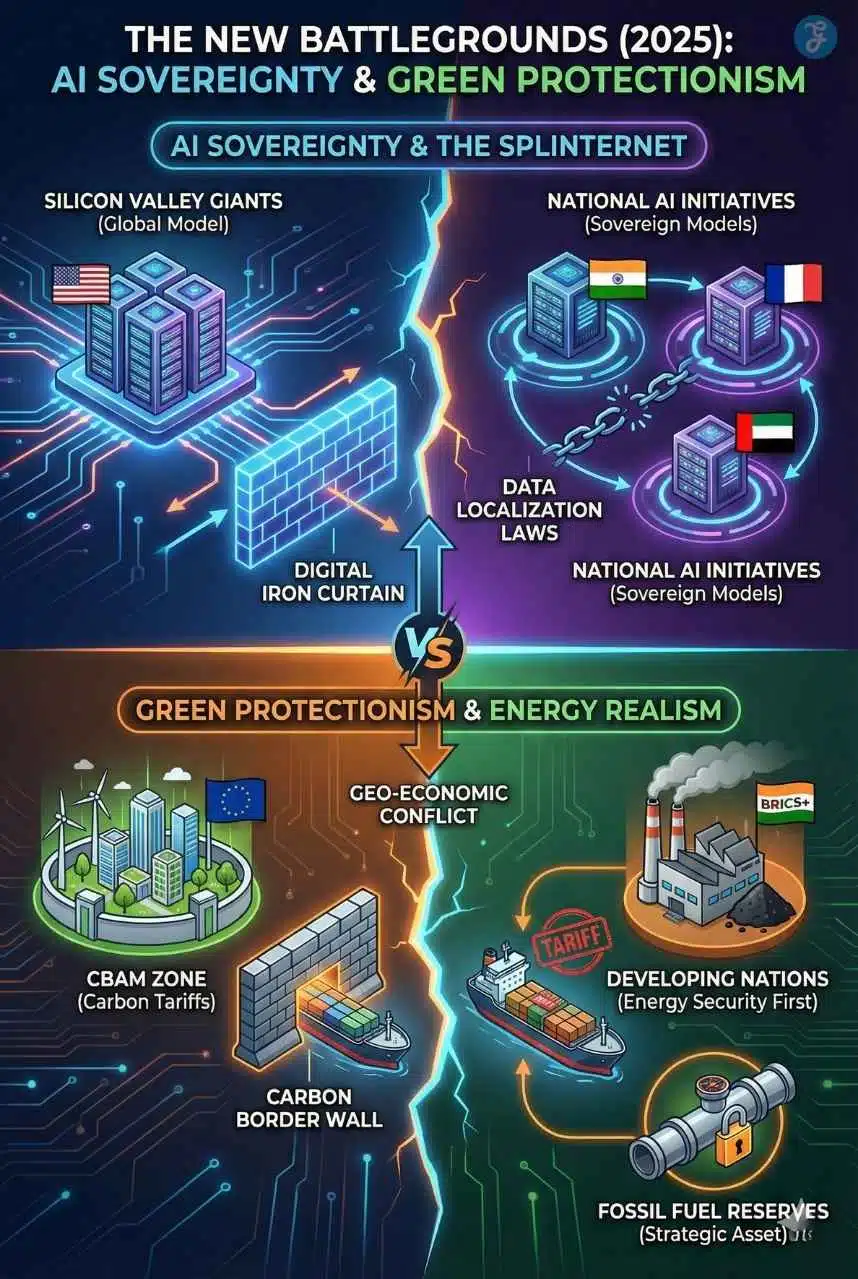
While land borders were being reinforced, 2025 saw the erection of a “Digital Iron Curtain.” The era of a single, global internet is effectively over.
The Race for “Sovereign AI”
In 2025, Artificial Intelligence ceased to be just a commercial product; it became a matter of national security. Nations realized that relying on Silicon Valley (USA) or Shenzhen (China) for their AI infrastructure was a vulnerability.
-
The Trend: Countries like France, India, and the UAE launched massive state-backed initiatives to build “Sovereign AI” models—systems trained on their own languages, data, and cultural values, independent of US tech giants.
-
The Result: A fragmented digital world. We now see the emergence of the “Splinternet,” where data laws in the EU, firewall restrictions in Asia, and US export bans on chips have created distinct, incompatible digital ecosystems.
The “Greenlash” and Climate Realism
The idealism of previous climate summits vanished in 2025. In its place came “Green Protectionism.”
-
The Shift: Climate policy is no longer about saving the planet; it is about saving domestic industry. The EU’s full implementation of the Carbon Border Adjustment Mechanism (CBAM) effectively acted as a tariff wall against developing nations, sparking trade retaliations from India and Brazil.
-
The Reality: 2025 marked the year “Energy Security” officially trumped “Energy Transition.” With geopolitical tensions high, nations (including the US and China) doubled down on whatever energy source was cheapest and most secure—often meaning a quiet return to coal and natural gas reserves, even while paying lip service to green goals.
3 Global Flashpoints to Watch in 2026
As the dust settles on the upheavals of 2025, intelligence agencies and risk analysts are already turning their eyes to the next potential crises. Here is where the tectonic plates of the new order are likely to grind together in 2026.
-
The Taiwan Strait “Quarantine” Scenario: With the US focused on domestic renewal and Europe fractured, analysts fear Beijing may test the waters not with an invasion, but with a “customs quarantine”—a grey-zone blockade of Taiwan to test the resolve of the new US administration.
-
The Arctic Trade Route Race: As ice caps recede, the competition for the Northern Sea Route is heating up. Russia and China cemented a joint Arctic navigation pact in late 2025. Expect 2026 to be the year NATO allies scramble to counter this “Polar Silk Road.”
-
The “Post-Dollar” Payment System: The BRICS+ bloc teased a blockchain-based payment system in 2025 to bypass SWIFT. In 2026, the pilot program is expected to launch. If successful, it could be the first real chip in the armor of US financial sanctions power.
Frequently Asked Questions: Understanding the 2025 Shift
1. Is the US still the world’s superpower in 2025?
Yes, but the definition has changed. The US remains the dominant military and economic power, but it no longer has the ability (or desire) to police the world. Under the “America First 2.0” doctrine, the US acts more like a super-sized nation-state looking out for its own interests rather than a global guardian.
2. What happened to the Ukraine and Gaza conflicts in 2025?
Fatigue set in. In Ukraine, the frontline largely froze as Western aid slowed, forcing Kyiv into de facto ceasefire negotiations without a formal peace treaty. In Gaza, the conflict transitioned into a low-intensity insurgency, with Israel facing significant diplomatic isolation but maintaining security control. Both conflicts highlighted the limits of military power to achieve total political victories.
3. Why is “Soft Power” shifting to Asia?
The 2025 Soft Power Index showed a decline in Western influence due to perceived hypocrisy and internal instability. Conversely, nations like China, South Korea, and Japan gained ground by exporting stability, technology, and culture (gaming, anime, EVs) without demanding political conformity from their partners.
4. What does “Minilateralism” mean for smaller countries?
It means they have to hustle. Smaller countries can no longer rely on big organizations like the UN to protect them. They must actively join small, specific groups (like a regional trade pact or a local security group) to ensure their voices are heard.
5. How has the global economy changed for the average person?
Things are more expensive. The shift from “efficient” global trade to “secure” regional trade means higher prices for consumer goods (electronics, clothes). However, it has also led to a reshoring of jobs in manufacturing sectors in North America and parts of Europe.
Final Thought: The Era of Self-Reliance
As we look toward 2026, the lesson of the Global Politics 2025 Recap is clear: No one is coming to save you.
For decades, nations relied on the “International Community” to solve problems. 2025 proved that the “International Community” is a myth. We are back to a world of distinct nations, each fighting for its slice of the pie. It is a more dangerous world, certainly. But it is also a more honest one. The pretense is gone.
In this new Multiplex Order, the winners will be those who are agile, self-reliant, and unburdened by the dogmas of the past. The losers will be those waiting for the old rules to return. They never will.