The digital landscape has not just shifted; it has been completely terraformed. For two decades, we played a game called “Ten Blue Links,” optimizing our content to catch the user’s eye on a results page. That game is over. In its place, a new ecosystem has emerged, one where users often get their answers without ever clicking a website.
As we navigate this new terrain, your Generative Engine Optimization GEO Strategy 2026 must be built on a fundamental truth: the goal is no longer just to rank first, but to be the source that the AI cites when it answers the user for you. We are living in the “Post-ChatGPT” reality. The panic that initially swept the marketing world in late 2024 has settled into a pragmatic realization. Search engines have evolved into “Answer Engines.”
Google’s AI Overviews (formerly SGE), SearchGPT, and Perplexity have changed user behavior fundamentally. The user journey is no longer a hunt; it is a conversation. This guide is your blueprint for survival and dominance in this era, moving beyond traditional keywords into the realm of entities, context, and trust.
Before diving into technicalities, we must confront the Zero-Click Tsunami. The internet’s old social contract, Google scrapes content in exchange for traffic, has been fundamentally renegotiated. By late 2025, data confirmed that over 60% of informational searches now end without a single click. Users have been trained to expect “Synthetic Answers”: instant, AI-generated summaries, rather than a list of links to wade through.
This isn’t the death of opportunity, but its relocation. While casual “top-of-funnel” traffic has evaporated, the users who do click through an AI snapshot are now your most valuable audience. They have read the summary and are clicking because they crave the nuance, depth, or human connection that AI cannot simulate.
Surviving this shift requires adapting your strategy to speak to two distinct audiences simultaneously: the Human User seeking connection and the AI Model seeking structure. We must stop optimizing for “Finding” and start optimizing for “Answering.”
Phase 1: The Paradigm Shift – From “Finder” to “Answer”
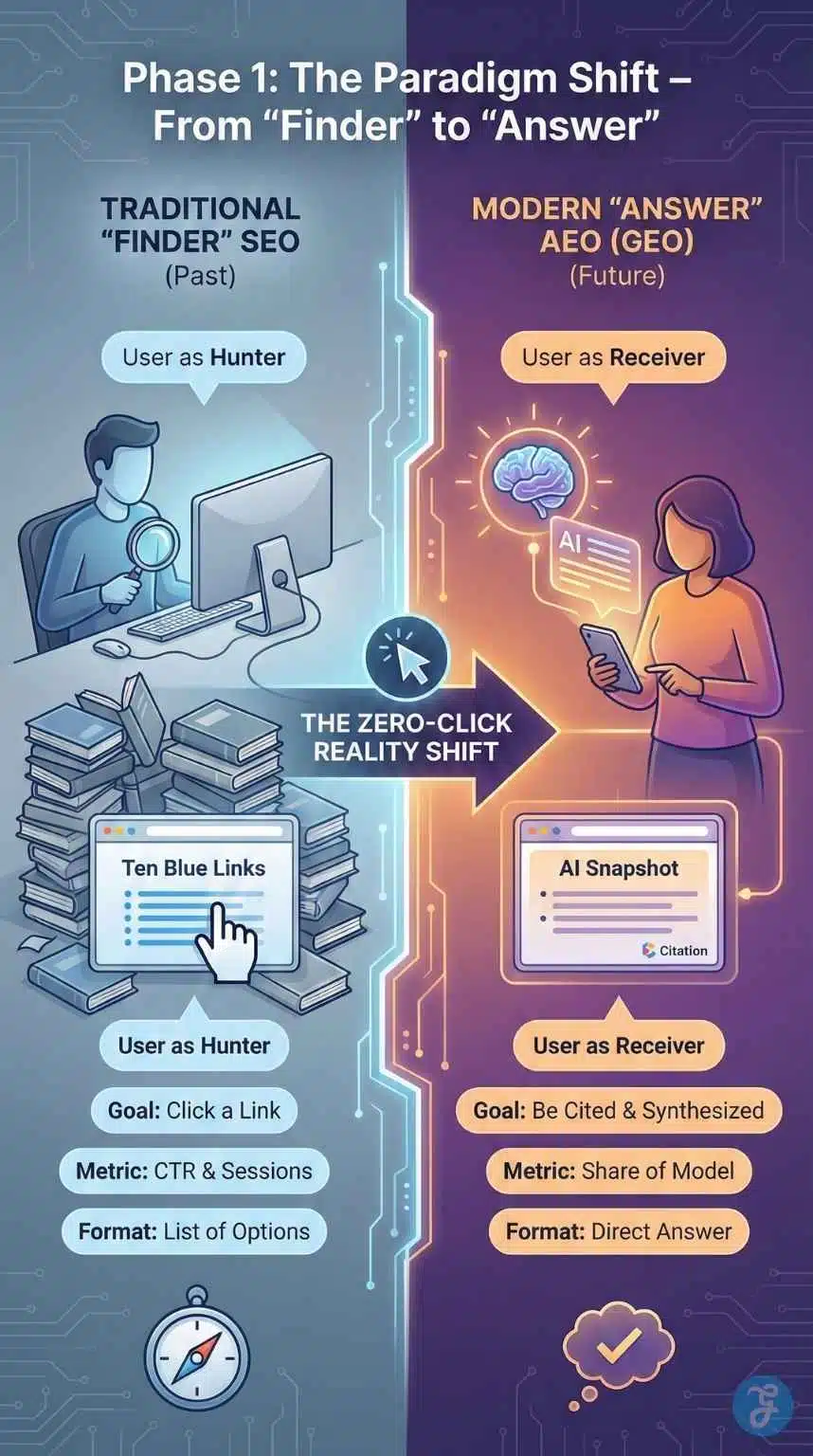
To understand how to win in 2026, we first have to accept that the mechanism of search has changed. Traditional SEO was about “finding.” A user typed “best running shoes,” and Google acted as a librarian, pointing to a shelf of books. You wanted to be the book with the brightest cover on the eye-level shelf.
Today, the search engine is not a librarian; it is a research assistant. When a user asks that same question, the AI reads the books for them, synthesizes the information, and presents a direct summary. This is the Zero-Click Reality.
The Rise of Answer Engine Optimization (AEO)
This shift necessitates a move from SEO (Search Engine Optimization) to AEO (Answer Engine Optimization). In the AEO model, your content is not competing for a click in the traditional sense; it is competing for inclusion. You are fighting to be one of the three or four trusted sources that the Large Language Model (LLM) synthesizes to generate its answer.
If your content is “fluff”, if it takes 500 words to get to the point, the AI will ignore it. It seeks density, structure, and factual accuracy. The websites that are losing 40-60% of their traffic in 2026 are those that relied on generic, informational content. The websites that are winning are those that provide Information Gain, unique data that the AI cannot generate on its own.
The Duel: SEO vs. GEO
It is helpful to visualize the difference between the strategies we used to employ and the ones required now.
| Feature | Traditional SEO (Pre-2024) | Generative Engine Optimization (2026) |
| Primary Goal | Rank #1 in organic listings. | Be cited in the AI Snapshot/Overview. |
| Success Metric | Click-Through Rate (CTR) & Sessions. | Share of Voice & Brand Mentions. |
| Keyword Strategy | Exact match & high search volume. | Conversational queries & topical authority. |
| Content Structure | Long intros, “skyscraping” length. | “Answer-First” formatting (BLUF). |
| Target Audience | The Human User. | The LLM (as the gatekeeper) & the Human. |
| Tech Focus | Meta tags, H-tags, Backlinks. | Schema markup, Entity recognition, Vector space. |
Phase 2: Anatomy of the New Search – How AI “Thinks”
To optimize for an AI, you must understand how it retrieves information. It does not read like a human, and it does not index like a 2010 spider. It uses Vector Search and Semantic Analysis.
Understanding Vector Search
In the past, if you wanted to rank for “cheap holidays,” you needed that exact phrase on your page. Today, Google uses Vector Search to map the meaning of concepts. Imagine a massive 3D map where words are points in space. The concept “cheap holidays” is located close to “budget travel,” “low-cost flights,” and “affordable vacations.”
The AI calculates the “distance” between the user’s query and your content. If your article talks about “frugal getaways” but provides deep value, the AI connects it to “cheap holidays” even if the keywords don’t match perfectly. This means you must optimize for Concepts, not just strings of text.
The 3-Step Retrieval Process of 2026
When a user types a complex query like, “How does the new tax law affect freelance designers in California?”, the AI goes through three rapid stages:
- Retrieval (The Old Guard): The search engine still runs a traditional keyword search to find a broad set of relevant pages. This is why traditional SEO (keywords, speed, mobile-friendliness) is still the foundation. You cannot be cited if you aren’t found.
- Synthesis (The Reading): The LLM “reads” the top results. It looks for consensus. If three sites say the tax rate is 5% and your site says 10%, it might discard your data as an outlier unless you have high authority.
- Generation (The Writing): The AI writes the answer, citing the sources that provided the most structured, direct, and authoritative data.
The “Liquid Content” Concept
Think of your content as “liquid.” In the AI era, your article is often melted down. The AI extracts the facts, the stats, the quotes, the steps, and pours them into its own container (the AI Overview).
Your job is to ensure that even when your content is melted down, your Brand Entity remains solid. You do this by associating your brand strongly with specific topics in the Knowledge Graph. When the AI thinks of “Advanced SEO Strategies,” it should probabilistically associate that concept with your domain name.
Phase 3: The New Ranking Factors – Trust is the Algorithm
With the internet flooded by AI-generated sludge, trust has become the single most expensive currency. Google’s algorithms are now aggressively tuned to filter out generic content. They are looking for humanity.
1. Information Gain: The Antidote to Generic AI
This is arguably the most critical factor for 2026. Information Gain refers to the amount of new information your content provides compared to what already exists in the search results.
If you write an article about “How to boil an egg,” and you repeat the same steps as the top 10 results, your Information Gain is zero. An LLM can generate that answer without you. To rank, you must add something new.
How to Inject Information Gain:
- Original Data: Run a survey and publish the numbers.
- Contrarian Viewpoints: Challenge the consensus with evidence.
- Personal Experience: “I tried this method for 30 days, and here is what happened.”
- Expert Quotes: Interview a subject matter expert.
2. E-E-A-T: Experience is the New “E”
Google expanded E-A-T (Expertise, Authoritativeness, Trustworthiness) to E-E-A-T by adding Experience. This was a direct countermeasure to AI content. ChatGPT can hallucinate facts, but it cannot hallucinate experience. It cannot taste food, it cannot test software, and it cannot visit a travel destination.
To rank in 2026, your content must bleed “Experience.”
| Element | Low E-E-A-T (AI Susceptible) | High E-E-A-T (AI Resistant) |
| Author | “Admin” or generic names. | Verified expert with a linked LinkedIn/Bio. |
| Perspective | Third-person, objective description. | First-person (“I,” “We”), subjective nuance. |
| Evidence | Stock photos. | Original photos of the product/place being tested. |
| Depth | Surface-level summary. | Nuanced discussion of pros, cons, and edge cases. |
3. Entity Authority and N-Grams
Search engines view your brand as an Entity. They analyze the N-grams (sequences of words) that frequently appear near your brand name. If “Editorial Ge” is frequently mentioned alongside “News Analysis,” “Global Politics,” and “SEO,” the Knowledge Graph solidifies that connection.
Strategy: You must stay in your lane. If you are a finance site and you suddenly write about “Best Pizza Recipes,” your Entity Authority for food is weak, and the AI will not cite you. Build topical clusters that reinforce your primary expertise.
4. The “Reddit” Factor: Community Signals as Authority
In late 2024 and throughout 2025, Google and other Answer Engines made a decisive pivot: they began prioritizing User-Generated Content (UGC). Why? While AI can generate polished articles, it cannot fake a messy, heated, and honest debate between real humans on a forum.
If your brand exists only on your website, the AI views it with skepticism. If your brand is discussed, recommended, and even critiqued on platforms like Reddit, Quora, and specialized forums, the AI views it as a “Living Entity.”
5. The Strategy: “Barnacle SEO” 2.0
You cannot just rely on your own domain. You must attach your brand to the “big ships” that the AI already trusts. This is called Barnacle SEO.
| Action | Old Strategy (Forum Spam) | New Strategy (Community Engineering) |
| Goal | Drop a link to your site. | Add value to the conversation (Zero-Link). |
| Platform | Any open comment section. | Highly specific subreddits (e.g., r/SEO, r/Tech). |
| Content | “Check out my guide here!” | “I tested X vs Y. Here is the data table. (Source: My breakdown).” |
| Result | Link is ignored/deleted. | AI scrapes the comment as a citation source. |
Tactical Execution:
- Find the Discussions: Use search operators like site:reddit.com “your keyword” to find where the conversation is happening.
- The “Hidden” Citation: When you post helpful, long-form answers in these threads without aggressively linking, LLMs ingest this text. If you consistently sign off or mention your brand name in high-value comments, the AI begins to associate your Brand Name with the Solution.
- Forum Schema: If you run your own community or forum, ensure you are using the DiscussionForumPosting schema. This explicitly tells the AI, “This is a human conversation,” which is currently ranking gold.
Phase 4: Optimization Blueprint – Writing for Machines and Humans
This is where the rubber meets the road. How do you actually write the article? The structure of content in 2026 looks very different from the “recipe blog” style of 2020.
Step 1: The Inverted Pyramid (BLUF)
You must use the BLUF (Bottom Line Up Front) method. In the age of AI, burying the answer is suicide.
If the user asks, “What is the best SEO strategy for 2026?”, your H2 should be the question, and the very first sentence under it should be the direct answer.
- Bad: “To understand the best strategy, we must first look at the history of Google…”
- Good: “The best SEO strategy for 2026 is Generative Engine Optimization (GEO), which focuses on structuring data for AI Overviews and maximizing Information Gain.”
This snippet is “scan-ready” for the AI. Once you have provided the direct answer, you can then elaborate, provide context, and add nuance for the human reader who decides to click through.
Step 2: Structuring for Scannability
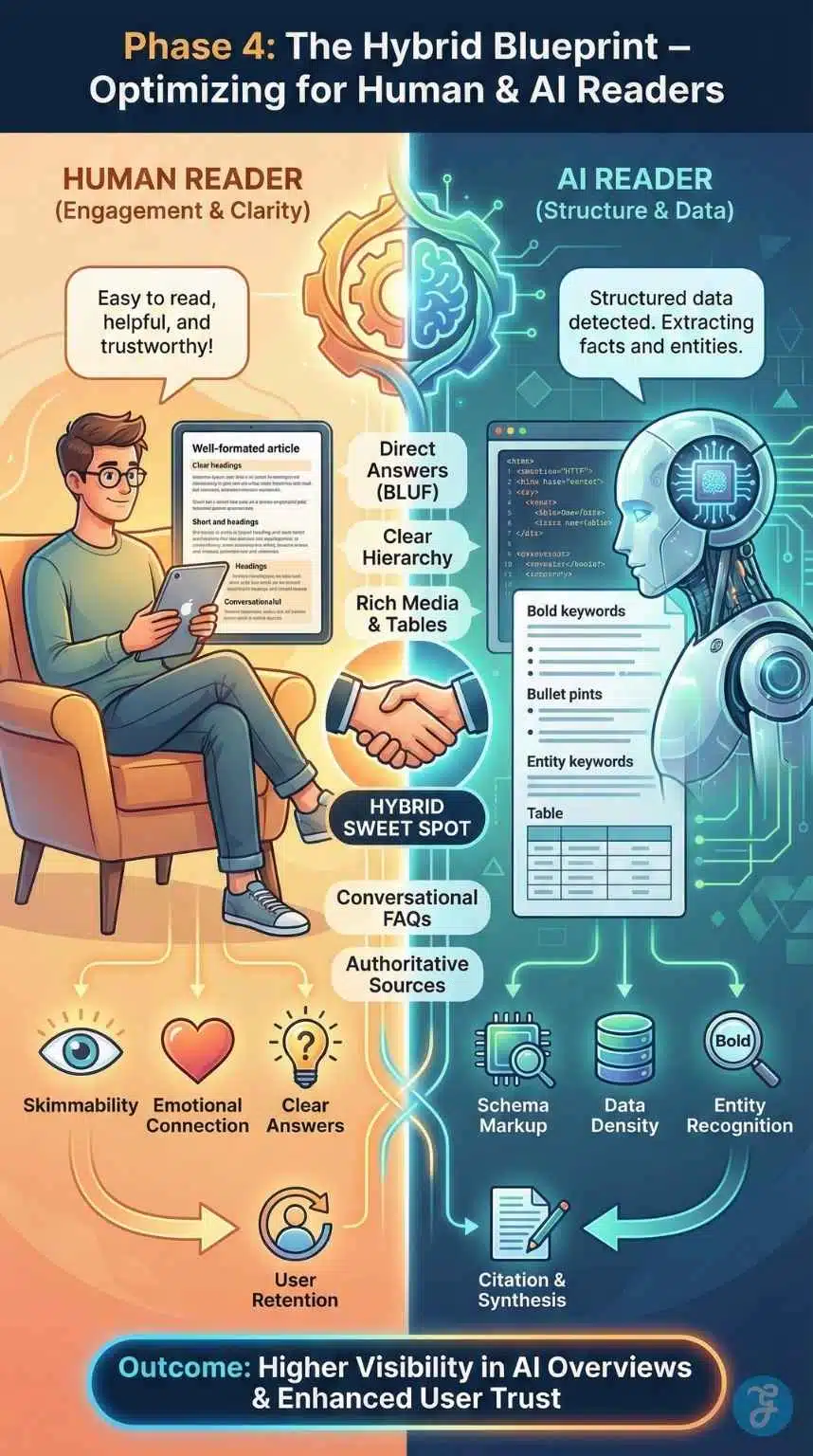
AI models are excellent at parsing structured data. They struggle more with dense, unstructured walls of text. To increase your chances of being cited, you must break your content down.
The Formatting Checklist:
- H-Tags Hierarchy: Ensure a logical H1 -> H2 -> H3 flow.
- Lists: Use bullet points for features, steps, or benefits.
- Tables: AI loves tables. They are structured datasets that are easy to extract and display in a snapshot.
- Bold text: Bold key phrases (not keywords, but facts). This helps the NLP model identify the most important entities in a paragraph.
Step 3: Owning “Query Fan-Out”
In 2026, users don’t just ask one question; they engage in a “Query Fan-Out.” This means one initial question leads to five specific follow-ups.
- Initial: “How to install solar panels?”
- Fan-out 1: “Cost of solar panels in 2026.”
- Fan-out 2: “Do solar panels work in winter?”
- Fan-out 3: “Solar tax credits 2026.”
Strategy: Your content must anticipate these fan-outs. Don’t just answer the main topic. Use tools like People Also Ask (which is now powered by AI prediction) to find these sub-questions and answer them as H3s in your article. This makes your content a “comprehensive entity” that satisfies the entire conversation, not just the opener.
Step 4: Technical Fluency (Schema Markup)
You cannot ignore the code. Schema Markup (JSON-LD) is the language you use to speak directly to the robot. It removes ambiguity.
| Schema Type | Purpose in GEO |
| Article / NewsArticle | Tells the AI the headline, author, and publish date explicitly. |
| FAQPage | Feeds the Q&A format directly into the AI’s logic for Q&A queries. |
| Person | Connects the author to their social profiles and credentials (E-E-A-T). |
| Organization | Establishes the publisher’s brand authority and logo. |
| HowTo | Breaks down processes into steps, increasing chances of list citations. |
Phase 5: Visual SEO & Multimodal Search
We have entered the era of Multimodal Search. This means users can search with images, voice, and text simultaneously. Furthermore, models like Gemini and GPT-5 can “see” the content of your images.
Stop Using Stock Photos
In 2026, stock photos are dead weight. An AI analyzing a generic stock photo of “business people shaking hands” learns nothing about your content. It might even flag the content as low-effort.
Instead, you need Semantic Visuals:
- Infographics: If you have data, turn it into a chart. The AI can OCR (Optical Character Recognition) the text in the chart and use that data to generate an answer.
- Screenshots: If you are writing a tutorial, use annotated screenshots.
- Diagrams: Visualizing concepts (like the “Vector Search” concept mentioned earlier) helps the AI “understand” that your article covers technical depth.
Alt Text 2.0
Alt text is no longer just for accessibility (though that remains crucial). It is now a Context Prompt for the AI.
- Old Alt Text: “Man holding phone.”
- New Alt Text: “User demonstrating the Google Lens feature on a smartphone to perform a multimodal search for GEO Strategy 2026.”
This new style of Alt Text ties the image directly to the topic’s entities, reinforcing the relevance of the page.
Video Indexing: Optimizing for the “Key Moment”
Video is no longer a “black box” to search engines. Models like Gemini can now “watch” and “listen” to video content frame-by-frame. They are not just looking for a title; they are looking for specific answers inside the video to serve as “Key Moments” in search results.
If you have a 10-minute video, and the user asks, “How to change the battery?”, the AI wants to link directly to the 04:32 mark.
How to Optimize Video for GEO:
- The Transcript is King: You must upload a high-accuracy SRT (SubRip Subtitle) file. Do not rely on auto-captions. The transcript is the text document that the AI reads to understand the video’s depth.
- Clip Markup: Use Clip Schema or manually set chapters in YouTube. Give each chapter a descriptive, keyword-rich name (e.g., “Step 3: Removing the connector” instead of just “Step 3”).
- Spoken Keywords: The AI listens to the audio track. Ensure your presenter actually speaks the primary questions and keywords clearly. If the user searches “Best budget laptop,” and your video says “Cheapest notebook,” the connection is weaker. Say the specific phrase you want to rank for.
The New Metrics – Beyond the Click
The hardest pill to swallow in 2026 is that Traffic is no longer the only metric for revenue. If 40% of users get their answer from the AI Overview and never visit your site, your Google Analytics will show a decline. Does that mean you failed? Not if you optimize for Share of Model (SOM).
SOM measures how frequently your brand is mentioned or cited in AI-generated responses for your target category. You are moving from “Share of Search” (how many people search for you) to “Share of Model” (how often the AI recommends you).
The “Invisible Funnel” Metrics:
Since you cannot track a zero-click interaction in GA4, you must look at downstream signals:
- Direct Traffic Spikes: If a user reads about your tool in an AI snapshot, they might not click the citation link. Instead, they might open a new tab and type your URL directly. A rise in “Direct” traffic often correlates with high visibility in AI Overviews.
- Brand Search Volume: Are more people searching for “YourBrand + Keyword”? This indicates that the AI introduced them to you, and they are now seeking you out specifically.
- On-Site Engagement (Qualitative): Users who do click through from an AI Overview are usually highly qualified. They have already read the summary; they are on your site for the deep dive. Expect lower bounce rates and higher conversion rates from this segment, even if the absolute volume is lower.
| Old Metric | New Metric (2026) |
| Organic Sessions | Total Brand Interactions (Sessions + AI Impressions). |
| Keyword Ranking | Citation Frequency (How often you appear in snapshots). |
| Bounce Rate | Engagement Rate (Did the qualified user convert?). |
The Mental Shift:
Stop panicking over a 20% drop in “How-To” traffic. That traffic was low-intent anyway. Focus on the fact that your “Money Page” conversions are stable because the AI is filtering out the tire-kickers and sending you the buyers.
Phase 6: Future-Proofing Your Content Strategy
As we look toward the latter half of the decade, the line between “search engine” and “content creator” will continue to blur. The “Ten Blue Links” may eventually disappear entirely for informational queries, replaced by a fully conversational interface.
However, do not let this dishearten you. The AI needs you. Large Language Models are not knowledge creators; they are knowledge processors. They cannot do original research. They cannot break news. They cannot form a unique human opinion.
The “Human Moat”
Your “Moat”, your defense against irrelevance, is your humanity.
- Build Community: Move your traffic from “rented land” (Google) to “owned land” (Email lists, Communities, Apps).
- Lean into Personality: Let your brand voice be distinct. If your writing sounds neutral and corporate, it sounds like AI. If it sounds opinionated, witty, or empathetic, it sounds human.
- Focus on “Hidden” Knowledge: Write about things that aren’t in the training data yet. Breaking news, emerging trends, and proprietary data are the gold mines of 2026.
The Architect of Answers: SEO Reborn
This is not the end of SEO; it is its maturation. By adopting the principles of GEO, Information Gain, E-E-A-T, and Structured Data, you ensure that your voice is not just heard but echoed by the very AI that powers the web. Welcome to the future of search.
Final Thoughts: The Algorithm is a Mirror
Ultimately, GEO Strategy 2026 is not about tricking a robot. It is about organizing high-quality human knowledge in a way that is easy for a machine to process. The algorithm is simply trying to mirror the best possible human answer. If you focus on being the best possible answer, comprehensive, experienced, and structured, the algorithm will follow.
The era of lazy SEO is dead. The era of high-value, expert-led Content Strategy has just begun.