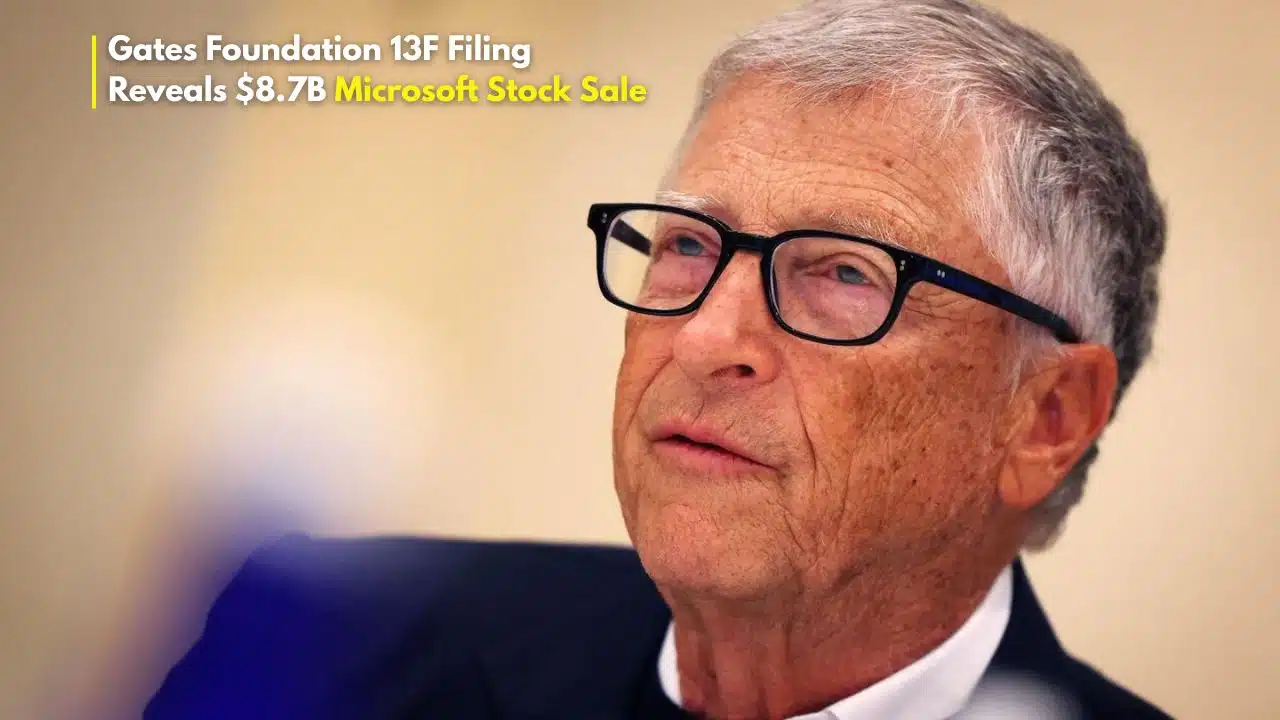
The Gates Foundation Microsoft stake has been dramatically reduced in one of the largest portfolio shifts in the philanthropy’s history. The foundation’s investment trust sold approximately 17 million shares of Microsoft (MSFT) during the third quarter of 2025, a 65% reduction in its holding, valued at an estimated $8.7 billion.
The massive liquidation was revealed in a 13F filing with the U.S. Securities and Exchange Commission (SEC) on November 14, 2025, which details the trust’s holdings as of September 30, 2025.
The move demotes Microsoft from its long-held position as the trust’s largest single asset. Analysts are framing the sale not as a loss of faith in the tech giant, but as a strategic rebalancing to lock in monumental gains from the AI-driven stock rally and provide liquidity for the foundation’s expanding global mission.
Key Facts: The Q3 Portfolio Overhaul
-
Massive Reduction: The trust sold 17,000,000 shares of Microsoft, a 64.91% decrease in its position.
-
Estimated Value: The sale is valued at approximately $8.7 billion, based on Microsoft’s average trading price of around $510 per share during Q3 2025.
-
New Holding: The trust’s remaining Microsoft stake now stands at 9.19 million shares, valued at approximately $4.76 billion.
-
Portfolio Demotion: Microsoft has fallen from the #1 spot (at over 27% of the portfolio) to the #4 holding, now comprising just 13.01% of the trust’s assets.
-
New #1 Holding: Warren Buffett’s Berkshire Hathaway (BRK.B) is now the trust’s largest position, accounting for 29.9% of the portfolio.
-
Other Exits: The foundation also sold its entire stake in United Parcel Service (UPS) and Crown Castle (CCI) during the quarter.
A Monumental Shift Years in the Making
The quarterly 13F filing, a mandatory disclosure for large investment managers, provides a rare window into the strategy of the Gates Foundation Trust, the entity that manages the endowment (valued at over $36.5 billion per the filing) which funds the foundation’s vast philanthropic work.
The scale of the Microsoft sale is staggering. At the end of the second quarter (June 30, 2025), the trust held approximately 26.2 million shares of Microsoft 2025. The Q3 filing confirms the disposition of 17 million of those shares, leaving a new total of 9.19 million.
This move represents a major acceleration of a trimming strategy that began in prior quarters, but at a much smaller scale. The decision appears to be the culmination of three primary factors: prudent risk management, staggering market gains, and an insatiable need for cash to fund the foundation’s mission.
Expert Analysis: Why Sell Billions Now?
While the sale of a founder’s stock often raises alarms, market analysis suggests this is a decision rooted in financial prudence and philanthropic necessity rather than a bearish signal on Microsoft’s future.
1. Locking in the AI Boom
Microsoft’s stock has been on a remarkable run, driven by its leadership in the generative artificial intelligence (AI) race through its partnership with OpenAI. As of November 2025, Microsoft stock (MSFT) is up more than 21% year-to-date, building on massive gains from 2023 and 2024 .
For the foundation’s trust, this success created a “high-class problem”: the Microsoft holding had become so large that it represented an outsized portion of the portfolio, creating significant concentration risk.
“The massive Microsoft reduction… may reflect rebalancing, liquidity planning, or mission-driven asset rotation, rather than a negative view on Microsoft fundamentals,” noted a market analysis from The Economic Times. The consensus among analysts is that this is a “practical rebalance, not market fear.”
Indeed, Wall Street remains broadly bullish on Microsoft. In the weeks leading up to the filing, major banks like Citigroup and Morgan Stanley reiterated “Buy” ratings with price targets in the $650-$700 range, well above its Q3 trading average.
2. Fuelling the Philanthropic Engine
The Gates Foundation is not a typical investment fund; its sole purpose is to give its money away. Bill Gates has repeatedly stated his intention to donate nearly all of his wealth to the foundation, with the goal of increasing its annual spending to $9 billion by 2026 (a significant jump from its pre-pandemic levels) and eventually winding down the foundation entirely.
To meet these ambitious spending goals, the trust must convert its paper gains into liquid cash for grant-making. Selling $8.7 billion worth of highly appreciated stock is the most direct way to fund years of operations in global health, poverty reduction, and education. This sale effectively turns Microsoft’s AI-driven stock surge directly into capital for vaccines, climate adaptation, and agricultural development.
3. The Gospel of Diversification
Even after the sale, the Gates Foundation Trust remains highly concentrated. The new 13F filing shows that its top three holdings—Berkshire Hathaway, Waste Management, and Canadian National Railway—still account for nearly 61% of the portfolio’s value.
However, selling such a large chunk of Microsoft dramatically reduces its single-stock risk. The move diversifies the endowment’s assets, making its ability to fund grants less vulnerable to the volatility of a single tech stock.
The New Look: A Shift to Value and Infrastructure
The Q3 filing reveals a clear strategic pivot. With Microsoft’s dominance reduced, the portfolio’s character has changed, leaning more heavily on industrial, “value” stocks known for stable cash flow—a logical move for an endowment that needs to write billions of dollars in checks every year.
This table, constructed from the November 14, 2025, 13F filing data, illustrates the new portfolio hierarch
Gates Foundation Trust: Top 5 Holdings (as of Sep 30, 2025)
| Rank | Company | Ticker | Portfolio Weight (%) |
| 1 | Berkshire Hathaway Inc. | BRK.B | 29.91% |
| 2 | Waste Management, Inc. | WM | 17.47% |
| 3 | Canadian National Railway Co. | CNI | 13.36% |
| 4 | Microsoft Corp. | MSFT | 13.01% |
| 5 | Caterpillar Inc. | CAT | 8.29% |
The trust’s largest holding is now Berkshire Hathaway, the conglomerate run by Gates’s close friend, Warren Buffett. This position was also trimmed in Q3, but by a much smaller 9.78%. The prominence of Waste Management (WM) and Canadian National Railway (CNI) highlights a preference for companies with deep, predictable, and infrastructure-related business models.
What to Watch Next
This $8.7 billion sale answers a long-standing question about how the foundation would handle its massive, concentrated Microsoft position, which was supercharged by a large donation from Bill Gates himself in 2022.
The key question for market watchers and the philanthropic world is what happens to the remaining 9.19 million shares. This Q3 sale demonstrates that the trust’s managers are not afraid to liquidate shares in massive blocks to achieve their strategic goals.
While the sale was absorbed by the market over the third quarter without causing a major stock price collapse, it signals that the Gates Foundation is no longer a passive holder of its namesake stock. It is an active manager, transforming its historic link to the world’s largest tech company into a diversified, cash-generating engine for 21st-century philanthropy.