

New Zealand has long been recognized as a global leader in agriculture, with its fertile lands and innovative farming practices driving economic growth. However, as the industry faces challenges such as climate change, resource scarcity, and labor shortages, the future of agritech in New Zealand is becoming increasingly vital.
By leveraging cutting-edge technology, the sector is set to revolutionize the way food is grown, processed, and distributed.
This article explores the future of agritech in New Zealand, examining key trends shaping the industry, the role of emerging technologies, and practical solutions for overcoming challenges to ensure sustainable agricultural growth.
We will also look at real-world applications, government support, and actionable insights for farmers and agribusiness stakeholders.
Why Agritech Matters for New Zealand’s Economy
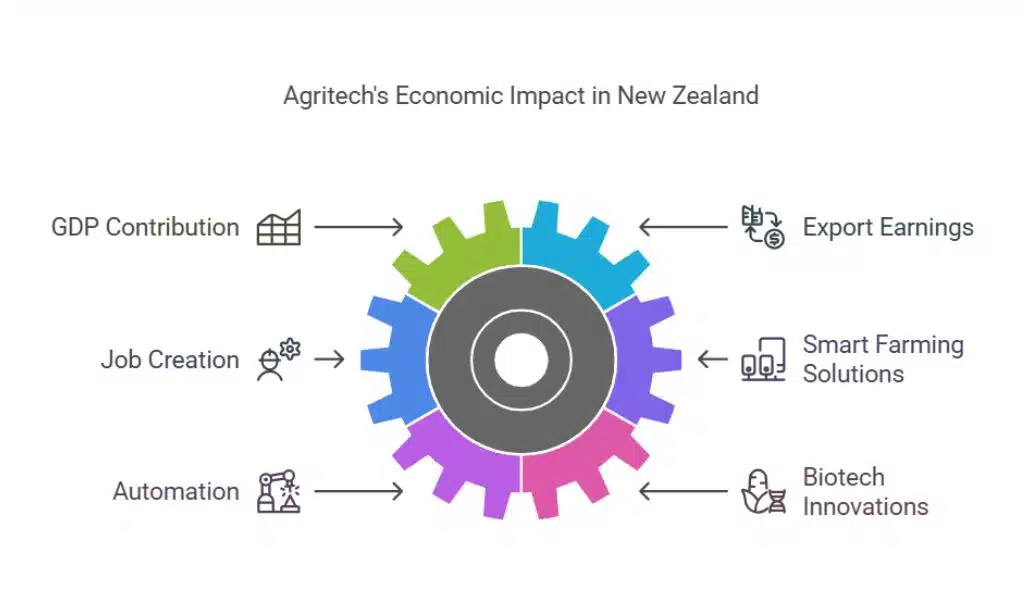
Agritech contributes significantly to New Zealand’s GDP, playing a crucial role in export earnings and job creation.
The adoption of smart farming solutions, automation, and biotech innovations is expected to further boost agricultural productivity and economic sustainability.
Government Support and Industry Growth
- The New Zealand government actively promotes agritech innovation through policies and funding initiatives.
- Programs such as the Agritech Industry Transformation Plan aim to drive the adoption of advanced farming technologies.
- Collaborative efforts between research institutions and agribusinesses foster an ecosystem conducive to technological growth.
- Investment Surge: The government has increased funding by 30% over the last five years to support agritech startups and research.
- Export Initiatives: New Zealand is targeting international agritech markets, particularly in Asia and Europe, to increase competitiveness.
| Key Agritech Initiatives | Impact on the Economy |
| Agritech Industry Transformation Plan | Boosts innovation and exports |
| Research Collaborations | Enhances agricultural efficiency |
| Agritech Startup Grants | Encourages entrepreneurship |
| Export Growth Programs | Strengthens global competitiveness |
| Digital Infrastructure Expansion | Improves agritech adoption in rural areas |
Challenges Facing the Agritech Sector
While agritech offers promising solutions, the industry faces several hurdles:
- Climate Change: Unpredictable weather patterns threaten crop yields and livestock production.
- High Initial Investment Costs: Advanced agritech solutions require significant capital, making it difficult for small-scale farmers to adopt them.
- Regulatory Barriers: Compliance with environmental and trade regulations can slow down technological integration.
- Digital Divide: Rural farmers may struggle with the technological knowledge needed to fully utilize agritech solutions.
- Infrastructure Limitations: Poor rural connectivity can hinder the implementation of IoT and AI-powered farming solutions.
- Skills Shortages: A lack of trained personnel limits the effective deployment of agritech innovations.
| Challenges | Potential Solutions |
| Climate Change | Climate-resilient crop varieties and weather prediction AI |
| High Costs | Government subsidies, private investments, and leasing options |
| Regulatory Hurdles | Streamlined approval processes and policy reforms |
| Digital Divide | Training programs, community tech hubs, and mobile-based agritech solutions |
| Infrastructure Issues | Expansion of rural broadband networks and satellite connectivity |
| Skills Shortages | Agritech education programs and industry-academic partnerships |
Key Agritech Trends Shaping the Future

New Zealand’s agricultural sector is witnessing a rapid transformation, driven by emerging technologies that promise to enhance productivity, sustainability, and efficiency.
These key agritech trends are not just shaping farming practices today but are also laying the foundation for the future of food production in the country.
Smart Farming and Precision Agriculture
Smart farming integrates AI, IoT, and data analytics to optimize agricultural operations. Farmers can now monitor soil conditions, weather patterns, and crop health in real-time, leading to more efficient resource use and higher yields.
This technology helps farmers make informed decisions, allowing for targeted interventions and minimizing unnecessary resource usage.
Benefits of Precision Agriculture
- Optimized Water Usage: Smart irrigation systems prevent overuse, ensuring plants receive the right amount of water while conserving resources.
- Higher Crop Yields: Data-driven insights enable precise fertilization, soil monitoring, and timely pest control strategies, improving overall farm productivity.
- Reduced Environmental Impact: Lower pesticide and fertilizer usage lead to sustainable farming, reducing soil and water contamination.
- Increased Efficiency: Automated and AI-driven solutions reduce waste, optimize planting cycles, and improve decision-making, saving both time and money.
- Enhanced Livestock Management: Wearable sensors and AI-powered tools help monitor animal health, track movement patterns, and optimize feeding schedules, ensuring better livestock well-being.
- Climate Adaptation: AI-driven predictions help farmers adjust planting strategies based on changing climate patterns and weather conditions.
| Technology | Application | Benefits |
| IoT Sensors | Soil and climate monitoring | Provides real-time data for decision-making |
| AI Drones | Crop health analysis and mapping | Early disease detection and pest control |
| Automated Irrigation | Smart water distribution systems | Reduces water waste and boosts efficiency |
| GPS-Guided Equipment | Precision planting and fertilization | Improves efficiency, reduces resource waste |
| AI-Based Weather Forecasting | Climate monitoring and prediction | Helps farmers plan for extreme weather events |
Robotics and Automation in Farming
Automation is transforming farming operations, reducing dependency on manual labor and increasing efficiency. From autonomous tractors to robotic harvesting machines, New Zealand’s agricultural sector is embracing automation at an accelerated pace.
These technologies not only enhance productivity but also address labor shortages, making farming more sustainable in the long run.
Examples of Agricultural Robotics
- Autonomous Tractors: Self-driving tractors reduce the need for manual labor and enhance efficiency by precisely planting seeds and applying fertilizers.
- Robotic Harvesters: AI-powered machines automate fruit and vegetable picking, reducing waste and increasing speed.
- Drones for Crop Monitoring: Agricultural drones equipped with cameras and sensors analyze crop health, detect disease outbreaks early, and optimize pesticide application.
- AI-Powered Sorting Machines: Automated sorting systems use machine learning to grade and categorize produce, reducing food waste and ensuring only the best-quality products reach the market.
| Technology | Function | Benefit |
| Autonomous Tractors | Self-driving tractors for plowing and planting | Reduces labor costs and enhances efficiency |
| Robotic Harvesters | Automated fruit and vegetable picking | Speeds up harvesting, minimizes waste |
| Drones | Crop monitoring and pesticide spraying | Provides real-time data, reduces chemical use |
| AI-Powered Sorting Machines | Quality control for harvested produce | Reduces food waste and improves market value |
| Robotic Weed Control | AI-powered weed management | Minimizes herbicide use and boosts crop health |
Blockchain and Agri-Supply Chain Transparency
Blockchain technology is revolutionizing agricultural supply chains by enhancing traceability and ensuring fair trade practices. By recording transactions on an immutable ledger, blockchain improves food safety, strengthens consumer trust, and reduces fraud.
Farmers can now verify product authenticity, track shipments, and ensure compliance with organic and fair-trade certifications.
Benefits of Blockchain in Agriculture
- Enhanced Transparency: Consumers and regulators can trace the journey of food products from farm to table.
- Fraud Prevention: Secure and verifiable digital transactions reduce counterfeit goods and mislabeling in agricultural trade.
- Efficient Smart Contracts: Automated contracts streamline agreements between farmers, suppliers, and distributors, reducing paperwork and delays.
- Improved Compliance: Blockchain technology ensures adherence to organic, fair-trade, and sustainability certifications.
- Supply Chain Optimization: Faster and more accurate tracking of shipments improves efficiency and reduces losses.
| Blockchain Use Case | Benefit |
| Traceability | Enhances food safety and origin tracking |
| Smart Contracts | Automates transactions, reducing paperwork |
| Fraud Prevention | Prevents counterfeiting and mislabeling |
| Digital Certification | Ensures compliance with organic and fair-trade standards |
| Supply Chain Management | Improves tracking and delivery efficiency |
The integration of these agritech innovations into New Zealand’s agricultural industry is set to boost sustainability, enhance productivity, and make food production more resilient to global challenges.
By embracing smart technology, robotics, and blockchain solutions, the future of agritech in New Zealand is brighter than ever.
Takeaways
The future of agritech in New Zealand holds immense potential, offering innovative solutions to pressing agricultural challenges. By embracing smart farming, automation, and biotech advancements, New Zealand’s agricultural sector can drive sustainable growth while remaining competitive in global markets.
To ensure long-term success, farmers, investors, and policymakers must collaborate in fostering an ecosystem that supports technological adoption and sustainability.
As agritech continues to evolve, those who embrace innovation will be at the forefront of shaping the future of agritech in New Zealand.
Investing in education, infrastructure, and research will be key to unlocking the full potential of agritech and ensuring a resilient agricultural future.