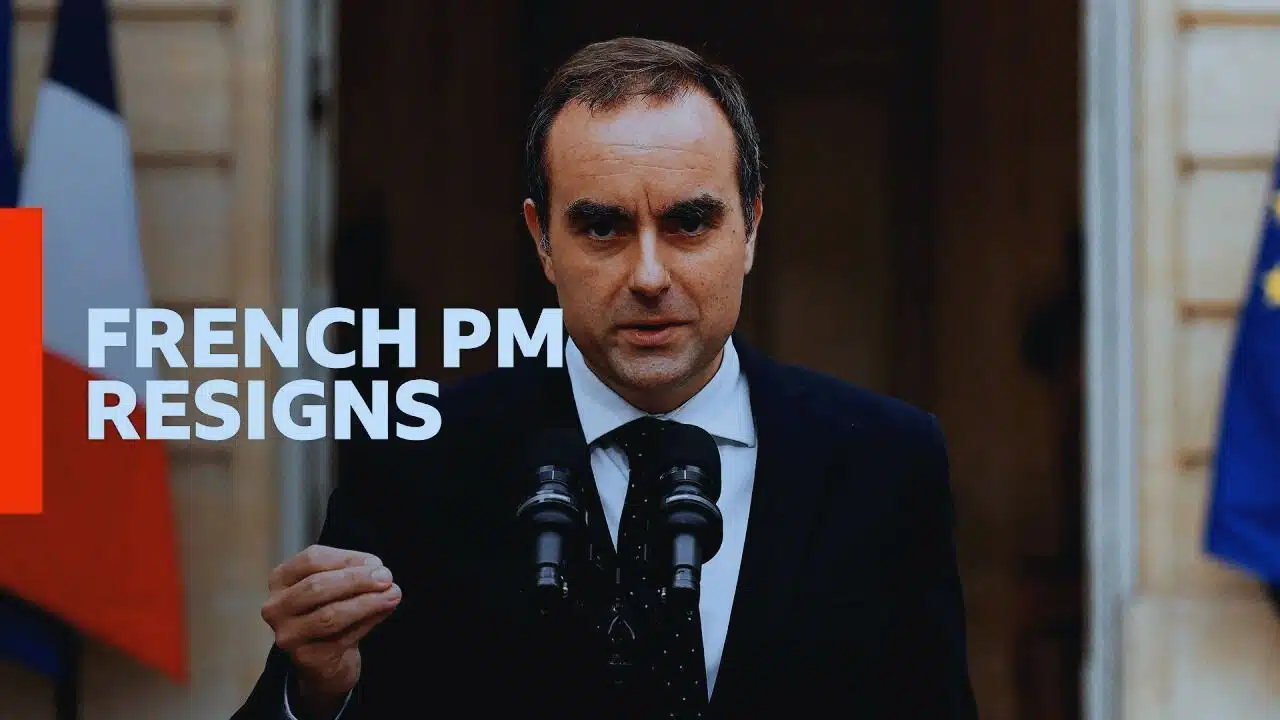
In a dramatic escalation of France’s rolling political crisis, Prime Minister Sébastien Lecornu abruptly resigned on Monday, October 6, 2025, less than a month after his appointment and just hours after unveiling his new government. The shock move, which makes him the shortest-serving premier in modern French history, has left the nation’s leadership in disarray, sent tremors through financial markets, and placed immense pressure on President Emmanuel Macron to find a viable path out of parliamentary deadlock.
Mr. Lecornu, a close ally of the President, tendered his resignation after failing to build a stable coalition in the deeply fractured National Assembly. In a somber address from the steps of the Matignon, the Prime Minister’s residence, he lamented that the “conditions were no longer fulfilled” for him to govern, squarely blaming the “egos” and “partisan appetites” of opposition parties for the impasse.
The resignation is the latest and most severe symptom of the political paralysis that has gripped France since President Macron’s gamble on snap legislative elections in June 2024 backfired, resulting in a hung parliament with no single bloc holding a majority. The country has now seen a succession of short-lived governments, with Mr. Lecornu’s administration collapsing before it could even formally begin its work.
President Macron has asked Mr. Lecornu to remain in a caretaker capacity and conduct “final negotiations” over the next 48 hours to find a potential “platform for action and stability.” However, with opposition parties emboldened, the prospects for a breakthrough appear slim, leaving the Eurozone’s second-largest economy facing profound uncertainty.
The Unraveling of a Government
The crisis came to a head just hours after Mr. Lecornu announced his new cabinet on Sunday evening. The lineup, which retained many familiar faces from previous Macron governments, was immediately met with fierce criticism for failing to represent the “profound break” with the past that Lecornu had promised.
The fatal blow came from the conservative Les Républicains party, whose support was essential for any potential majority. Its leader, Bruno Retailleau, who had served as Interior Minister, publicly decried the lack of trust and transparency in the cabinet’s formation. This opposition made it clear that Mr. Lecornu’s government would almost certainly be toppled by a no-confidence vote, prompting his pre-emptive resignation.
In his resignation speech, Mr. Lecornu expressed his frustration with the political gridlock. “I was ready to compromise, but each political party wants the other political party to adopt its entire program,” he stated, decrying the inability of factions to place national interest above partisan maneuvering.
The sentiment of chaos was captured succinctly by one of the now-outgoing ministers. Agnès Pannier-Runacher, who had been reappointed as ecology minister, posted on the social media platform X: “I despair of this circus.”
Latest Data & Statistics: Markets React to Instability
The political turmoil was immediately reflected in France’s financial markets, a clear sign of investor concern over the country’s fiscal health and governability.
- Stock Market Decline: France’s benchmark stock index, the CAC 40, fell sharply on the news. It closed at 7,972.71 points on October 6, 2025, a decline of 1.35% from the previous trading day, wiping out billions in market value.
- Rising Borrowing Costs: The yield on France’s 10-year government bonds, a key indicator of the country’s borrowing costs, rose amidst the uncertainty. The yield climbed to 3.57% on October 6, an increase of nearly 6 basis points during the day, signaling that investors demand a higher premium to hold French debt
- Chronic Budget Deficit: The crisis is fundamentally linked to the government’s struggle to pass a budget. At the end of the first quarter of 2025, France’s public debt stood at 114% of its GDP, one of the highest ratios in the Eurozone, posing a significant long-term economic challenge.
Official Responses & Opposition Demands
President Macron’s office released a terse statement accepting the resignation, before later tasking Mr. Lecornu with the 48-hour negotiation mission in a last-ditch effort to avert a total collapse.
Opposition leaders, however, seized the moment to corner the President.
Marine Le Pen, the leader of the far-right National Rally, declared that Macron must “return to the polls.” In a statement, her party was unequivocal: “Macron must now choose: dissolution or resignation, and quickly.” Her party’s president, Jordan Bardella, echoed the sentiment, stating, “There can be no return to stability without a return to the polls and the dissolution of the National Assembly.”
On the hard left, Mathilde Panot of the France Unbowed party was even more direct, stating: “The countdown has begun. Macron must go.”
Macron’s Hazardous Options
Political analysts describe President Macron as being trapped with no easy exit. His authority has been severely weakened, and his next steps are fraught with risk.
Mujtaba Rahman, Managing Director for Europe at the Eurasia Group consultancy, outlined three potential courses of action for Macron, all described as “hazardous.”
“The French president can name another prime minister who will have to navigate the same minefield, or Macron can call new legislative elections,” Rahman noted. He added that early elections “might bring Marine Le Pen’s far right to power.” The third option is to attempt to muddle through, but as Rahman warns, “another PM could be toppled within weeks.” (Paraphrased from )
The core of the problem remains the parliamentary arithmetic. The 577-seat National Assembly is split into three irreconcilable blocs: Macron’s centrist alliance, a left-wing coalition, and the far-right National Rally. This structure has created a political stalemate where building a durable, governing majority has proven impossible.
What to Watch Next
The coming days will be critical for the future of France’s government. The primary focus will be on the outcome of Mr. Lecornu’s final negotiation attempts, due to conclude by Wednesday evening.
- A New Prime Minister? If negotiations fail, Macron will be forced to appoint a sixth Prime Minister in just over two years. Finding a candidate who can win the confidence of the assembly will be an immense challenge.
- The Dissolution Gamble: The pressure to dissolve the National Assembly and call new elections is immense. However, polls suggest a new vote could result in a similar stalemate or, more alarmingly for the establishment, an outright majority for the National Rally, which would force Macron into a “cohabitation” with a far-right government.
- Budget Deadline: Looming over the political chaos is the urgent need to pass a 2026 budget. Failure to do so could further spook markets and lead to a downgrade of France’s credit rating, increasing the cost of borrowing and exacerbating the country’s debt problems.
Sébastien Lecornu’s record-short tenure as Prime Minister is a stark illustration of the ungovernable state of French politics. The crisis is no longer about a single minister or a single policy but about the fundamental stability of the Fifth Republic’s political system. President Emmanuel Macron, once seen as a disruptive force who could reshape France, now finds himself presiding over a period of unprecedented instability. His next decision will not only determine the fate of his presidency but could also set the political direction of France for years to come, with profound implications for the European Union.