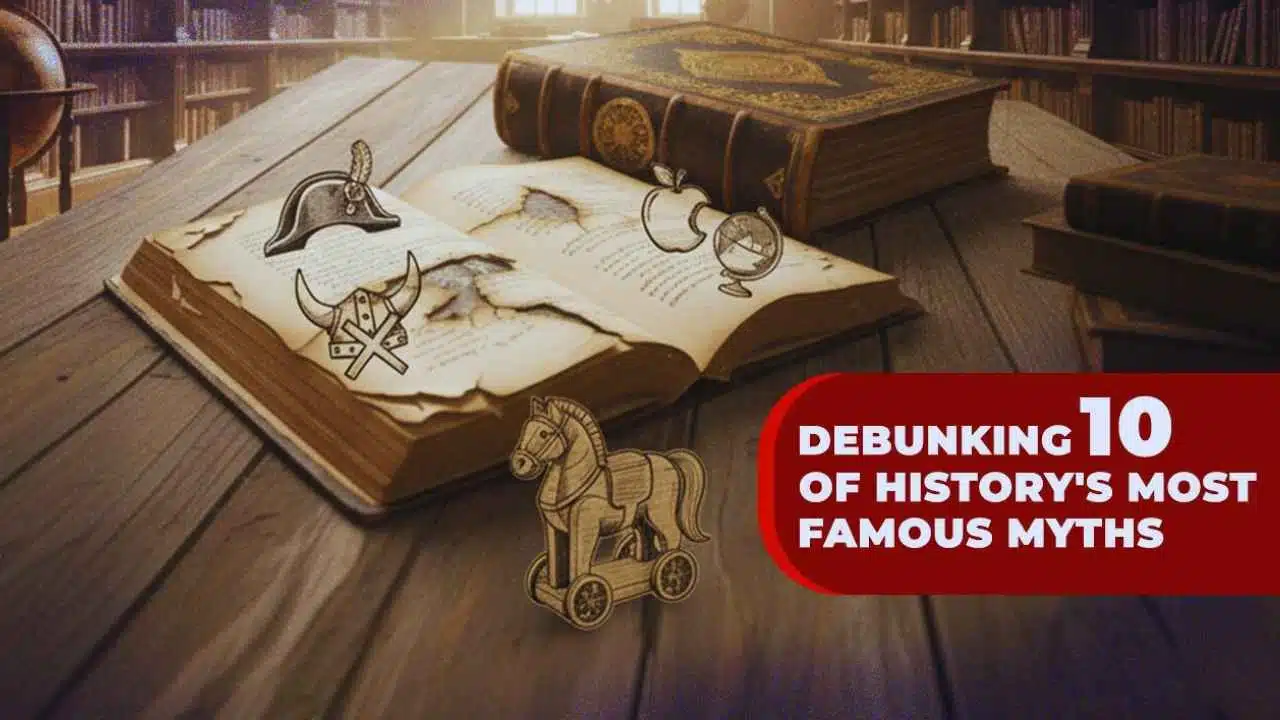
Some famous historical myths are harmless party trivia. Others shape national identity, politics, education, and even how we judge entire eras of people. The tricky part is that these myths rarely arrive as obvious lies. They usually show up as neat, memorable stories: a cruel queen sneering at starving peasants, a flat-earth Middle Ages, a cartoonishly short emperor, or Vikings charging into battle with horns on their helmets.
In reality, history is messy. Records conflict. Measurements change. Quotes get reassigned. Artists exaggerate. Propaganda does what propaganda does. And by the time a myth has been repeated for a century or two, it can feel as solid as fact.
This article debunks 10 of history’s most famous myths using credible historical scholarship, primary-source context where possible, and evidence from archaeology, measurement standards, and documented records. Along the way, you’ll also see a pattern: the myths that survive are the ones that make a better story than the truth.
Why Do Historical Myths Persist?
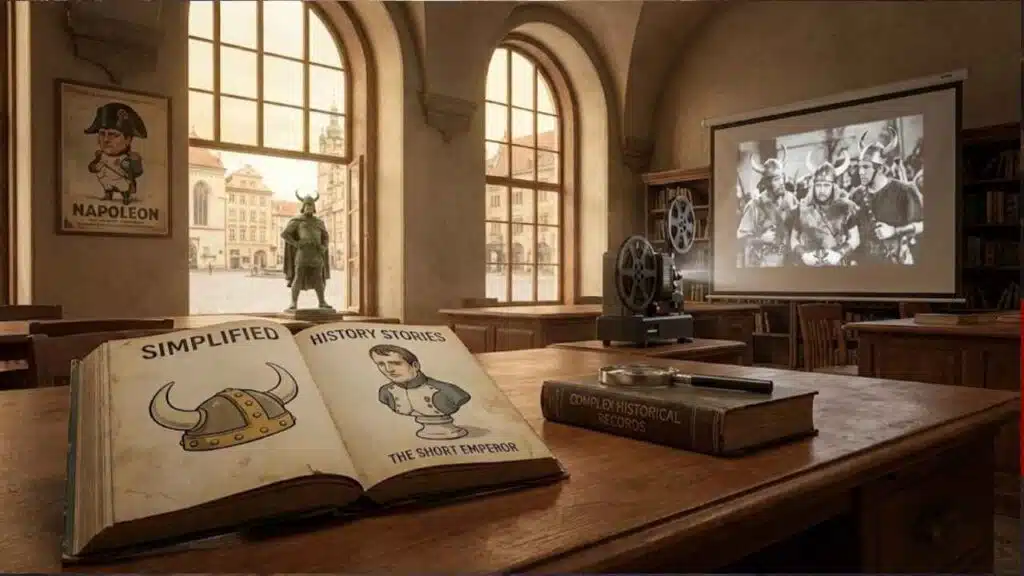
Historical myths survive because they often meet emotional, political, or educational needs rather than factual ones. Simplified narratives are easier to teach, remember, and repeat than nuanced explanations. Over time, repetition across textbooks, films, and popular culture gives myths the appearance of truth. Once embedded in collective memory, correcting them can feel like challenging identity rather than updating knowledge. This resistance allows myths to persist even when evidence clearly contradicts them.
Storytelling beats complexity
A myth usually has a simple moral: “People were ignorant,” “Leaders were cruel,” “Progress was inevitable,” or “That group was barbaric.” Those morals are easy to remember and easy to teach. Nuance is harder to fit into a sentence.
Propaganda has a long afterlife
Some myths were born as political weapons. Napoleon’s “shortness,” for example, was useful for enemies who wanted to mock him. Once that image is everywhere, it outlives the politics that created it.
Translation and measurement errors travel fast
When units change, or when people read old measurements through modern assumptions, mistakes become “common knowledge.” Napoleon’s height is a classic example of a real measurement misunderstood across systems.
Pop culture standardizes the wrong picture
Operas, films, cartoons, and novels can lock a myth into a single iconic image—horned Viking helmets being one of the best-known cases.
Education sometimes repeats what’s easy
Simplified lessons aren’t always malicious; they’re often designed to be memorable. But simplifications can harden into inaccuracies, especially when no one revisits the original sources.
With that in mind, let’s get into the myths.
Myth 1: People in the Middle Ages Believed the Earth Was Flat
This myth paints the Middle Ages as intellectually stagnant, reinforcing a false contrast between “dark” history and “enlightened” modernity. It overlooks centuries of scholarly continuity from ancient Greece through medieval Europe. By reducing a complex era to ignorance, the myth distorts how knowledge was preserved and transmitted. It also misrepresents the relationship between science and religion during the period. Understanding this myth helps correct broader misconceptions about medieval life and learning.
If you’ve ever heard that Christopher Columbus had to “prove” the Earth was round, you’ve met one of the most persistent historical misconceptions.
What the myth claims
Medieval Europeans supposedly believed the Earth was flat, and brave thinkers battled religious ignorance to restore the truth.
What the evidence shows
Most educated medieval Europeans knew the Earth was spherical. The idea that the Middle Ages were broadly “flat-earth believers” is widely recognized as a modern misconception rather than an accurate description of medieval scholarship.
The “flat Middle Ages” story was fueled heavily in the 19th century. Writers and popularizers shaped a narrative of “science vs religion” that turned the medieval period into a cartoonish backdrop for modern progress stories.
Why it stuck
It’s a satisfying story: modernity defeats darkness. The problem is that it flattens centuries of real medieval learning into a stereotype. The truth is less dramatic but more interesting: knowledge moved through institutions, translations, universities, and scholarly networks. Misconceptions persist when we replace that complexity with a single “before vs after” plot.
Myth 2: Napoleon Bonaparte Was Extremely Short
Napoleon’s supposed short stature has become shorthand for insecurity and overcompensation. This interpretation relies more on caricature than documented reality. The myth demonstrates how easily physical traits can be exaggerated to undermine political authority. It also shows how later psychology terms can retroactively reshape historical reputations. Separating measurement facts from propaganda reveals how character myths are constructed.
Napoleon’s reputation as “tiny” is so widespread it helped inspire the phrase “Napoleon complex.” But the history is more about rulers of measurement than rulers of empires.
What the myth claims
Napoleon was unusually short, and his ambition was compensation.
What the evidence shows
Napoleon’s height was recorded in French units, and converting those units correctly changes the story. Multiple sources discuss how confusion between French and English measurement systems helped shrink Napoleon in the public imagination.
HISTORY.com notes that French measures and the “pouce” versus Imperial inches played a role, and that he was probably closer to average height for his time than the myth suggests.
Why it stuck
Mocking a powerful enemy is timeless. British caricatures and political propaganda helped cement the “little Napoleon” image as a symbol of ridicule. And once a stereotype becomes a visual shorthand—tiny hat, hand-in-coat, towering opponents—it’s hard to erase.
Myth 3: Vikings Wore Horned Helmets
The horned helmet myth transforms Vikings into theatrical caricatures rather than historically grounded people. It distracts from what actually made Viking culture distinctive, such as seafaring skill, trade networks, and social organization. By focusing on costume fantasy, popular culture overshadows archaeological evidence. This myth also illustrates how 19th-century nationalism reshaped earlier histories. Correcting it encourages a more accurate understanding of Norse society.
If you picture Vikings, you probably see horns. That image is iconic—just not historical.
What the myth claims
Vikings wore horned helmets into battle.
What the evidence shows
The horned helmet stereotype isn’t supported by Viking Age archaeological evidence. Instead, a major boost came from 19th-century stage and costume design—especially in productions connected to Wagner’s operas—where dramatic visuals mattered more than accuracy.
HISTORY.com traces the popularization to costume designer Carl Emil Doepler’s designs for Wagner’s “Der Ring des Nibelungen” in the 1870s, which helped turn horns into a “Viking” signature.
Why it stuck
Horns are an instant silhouette. They communicate “wild,” “fearsome,” and “ancient warrior” in one second. Pop culture loves symbols that read quickly—especially symbols that look great on posters, sports logos, and Halloween costumes.
Myth 4: The Great Wall of China Is Visible from Space

This claim is often repeated as a symbol of human achievement rather than a factual observation. It reflects misunderstandings about scale, distance, and human vision. The myth persists because it sounds scientifically impressive and is rarely challenged. In reality, visibility from space depends on contrast, lighting, and altitude—not just size. Examining this myth helps clarify how science facts are often oversimplified in education.
This myth is often repeated as a “fun fact,” but it misunderstands both human vision and what “from space” even means.
What the myth claims
The Great Wall is visible from space, sometimes even from the Moon.
What the evidence shows
Britannica is blunt: you typically can’t see the Great Wall of China from space with the naked eye, and the “visible from the Moon” claim has been disproved.
The “from space” part also hides a big range of meanings. Low Earth orbit is very different from the Moon. Even from low orbit, visibility depends on lighting, contrast, atmosphere, and where exactly you’re looking. Britannica notes it is only sometimes visible from low orbit under certain conditions.
Why it stuck
The Great Wall is massive, and people assume “massive = visible.” But visibility is about contrast and resolution, not just size. The myth survives because it feels intuitive and because it’s often taught as inspirational trivia.
Myth 5: Marie Antoinette Said “Let Them Eat Cake”
This quote has become a powerful symbol of elite indifference, regardless of its authenticity. The myth reduces a complex historical figure into a single moment of alleged cruelty. It also demonstrates how revolutionary narratives often rely on symbolic villains. Once attached to a person, such quotes are difficult to dislodge from public memory. Understanding this myth reveals how political storytelling shapes reputations.
Few quotes have done more reputational damage than a sentence someone probably never said.
What the myth claims
When told peasants had no bread, Marie Antoinette replied, “Let them eat cake,” showing cruel indifference.
What the evidence shows
Encyclopaedia Britannica explains that the quote is famous but not reliably attributed to Marie Antoinette.
The phrase is linked to Jean-Jacques Rousseau’s writings, appearing in a context that predates the Revolution and long before Marie Antoinette would plausibly be the speaker.
Why it stuck
It’s a perfect villain line. Revolutions run on stories as well as bread shortages. A quote like this compresses complex social anger into a single image: a pampered aristocrat who simply doesn’t get it. Whether or not it’s true becomes secondary once it’s useful.
Myth 6: Columbus “Discovered” America in 1492
The word “discovered” frames history from a narrow, Eurocentric perspective. This myth minimizes Indigenous presence and knowledge that existed long before European arrival. It also oversimplifies global exploration into a single event and individual. Reframing this narrative allows for a more inclusive and accurate historical timeline. Addressing this myth is central to modern historical reassessment.
This is less a single myth than a framing problem—one that can erase entire histories.
What the myth claims
Columbus discovered America, full stop.
What the evidence shows
Indigenous peoples lived across the Americas for thousands of years before 1492. So “discover” only works if you define discovery as “Europeans arriving and documenting it for Europe,” which is a narrow and controversial definition.
Also, Columbus was not the first known European to reach North America. Britannica notes that archaeological discoveries at L’Anse aux Meadows proved Vikings reached North America centuries before Columbus.
Scientific work has even pinned down a precise Norse presence date in the early 11th century, reinforcing that transatlantic contact occurred long before 1492.
A more accurate way to say it
Columbus’s 1492 voyage connected Europe to the Caribbean in a way that triggered sustained colonization and catastrophic consequences for Indigenous populations. That’s historically significant. But it’s not “discovery” in the sense most people casually mean.
Why it stuck
Nation-building loves origin stories. A single hero date is easy to teach, easy to celebrate, and easy to put in rhyme (“In 1492…”). Correct history is harder, because it requires multiple timelines and perspectives.
Myth 7: Ancient Egyptians Built the Pyramids Using Slave Labor
The slave labor myth reflects modern assumptions more than ancient realities. It suggests that monumental architecture can only result from extreme oppression. Archaeological findings instead point to organized, skilled labor systems. This myth also blurs distinctions between different forms of labor across history. Correcting it deepens understanding of ancient social and economic organization.
This myth appears constantly in pop culture: endless lines of enslaved workers dragging stones under whips. The archaeology paints a different picture.
What the myth claims
The pyramids—especially at Giza—were built primarily by slaves.
What the evidence shows
Harvard Magazine’s coverage of archaeologist Mark Lehner’s work describes evidence for a worker settlement—often framed as a city or organized community of laborers—undercutting the simple “slave labor” narrative.
The article’s framing is direct: “Not slaves,” and it highlights discoveries pointing to organized, supported workers rather than a disposable enslaved mass.
What the more nuanced reality looks like
Large ancient projects often used a mix of labor types: skilled specialists, rotating laborers, and systems of obligation. “Not slaves” doesn’t mean “easy,” “equal,” or “modern labor rights.” It means the story is more structured and socially complex than the whip-and-chain cliché.
Why it stuck
The slave image is cinematic. It also fits a modern assumption that ancient rulers could only build gigantic monuments through brutal mass enslavement. Sometimes that assumption is true in history; in this case, the evidence points elsewhere.
Myth 8: Shakespeare Wrote All His Plays Alone
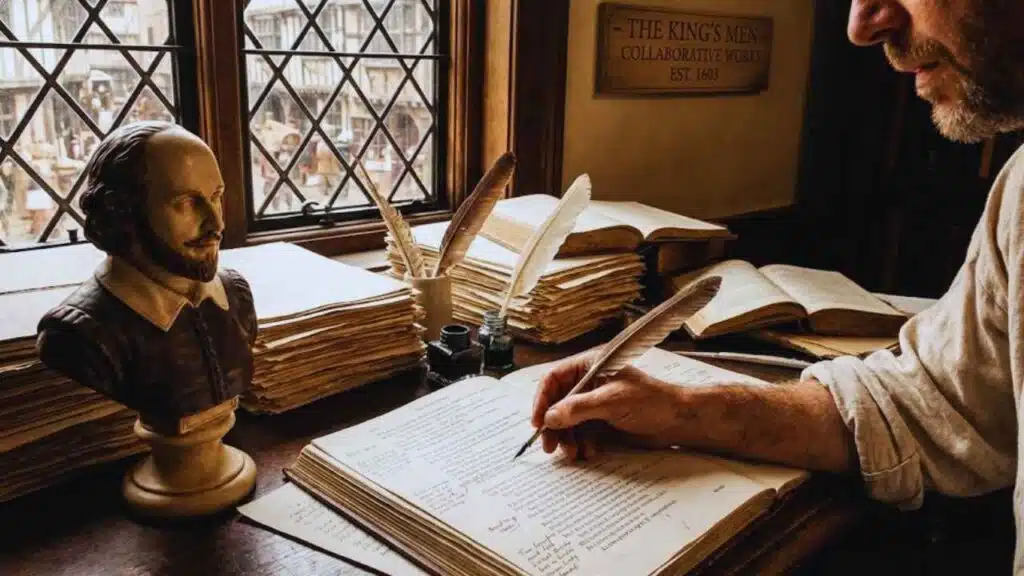
The lone-genius myth simplifies how creative industries actually functioned in Shakespeare’s time. Elizabethan theater was collaborative by necessity, not exception. Ignoring co-authorship distorts how plays were produced and revised. This myth also reflects modern preferences for individual authorship over collective creation. Recognizing collaboration does not diminish Shakespeare’s talent—it contextualizes it.
We love the “lone genius” story. But Elizabethan theatre was a collaborative business, and scholarship reflects that.
What the myth claims
Shakespeare single-handedly wrote every play attributed to him.
What the evidence shows
Oxford University Press summarizes scholarly evidence that Shakespeare co-authored multiple plays, naming collaborators and specific works often argued to involve shared writing.
The Shakespeare Birthplace Trust also discusses collaborations, including work with John Fletcher and others, reflecting how theatre companies actually operated.
Why it stuck
A single author is easier for branding, education, and literary worship. Collaboration complicates the narrative: it turns a genius into a working professional inside a creative industry. But that’s exactly what Shakespeare was—a dramatist writing for performance, deadlines, actors, and audiences.
Myth 9: Medieval People Never Bathed
This myth reinforces the idea that technological progress equals cleanliness. It ignores archaeological and textual evidence of hygiene practices in medieval Europe. Bathing habits varied widely depending on region, class, and time period. The stereotype often blends later historical developments with earlier ones. Challenging it restores realism to everyday medieval life.
This myth turns an entire millennium into a dirty joke.
What the myth claims
People in the Middle Ages were universally filthy and never bathed.
What the evidence shows
Notes that hygiene in the Middle Ages is often mischaracterized and that medieval people did care about cleanliness, with bathing practices and cultural attitudes more developed than the stereotype suggests.
The article also points out an important twist: the decline in some bathing habits can be associated with later periods in parts of Europe, which may have influenced retrospective stereotypes about the Middle Ages as a whole.
What’s a better mental picture?
Think variation. Practices differed by region, class, infrastructure, water access, and local customs. Public bathhouses existed in many cities at different times. People washed in ways that made sense within their environment. The “never bathed” claim is too absolute to survive contact with real evidence.
Why it stuck
Modern people associate cleanliness with modern plumbing, so they imagine earlier societies as universally dirty. Add a few dramatic plague-era images and some later moral panics about bathhouses, and the stereotype becomes “history.”
Myth 10: The Salem Witch Trials Were “About Witches”
Reducing Salem to superstition alone oversimplifies a complex social crisis. The trials reflected fear, power struggles, and institutional failures rather than genuine belief in magic alone. Viewing Salem only as irrational hysteria misses its human and legal dimensions. This myth can prevent meaningful lessons about justice and moral panic. A clearer understanding makes Salem relevant beyond its era.
When people hear “witch trials,” they often picture communities genuinely hunting supernatural villains. Salem is better understood as a crisis of fear, power, and social fracture.
What the myth claims
The Salem Witch Trials happened because Salem had a real witch problem—or because people were simply foolish and superstitious.
What the evidence shows
Source describes Salem as an enduring historical mystery, and it emphasizes that the trials were shaped by broader forces and a cascading miscarriage of justice.
There have also been competing theories—like ergotism (a poisoning from fungus-infected grain)—but even Britannica treats it as debated and not a complete explanation, noting that social and political unrest is central to understanding what happened.
What Salem was really “about”
Salem was about how accusations spread in a tense community, how authorities handled claims, and how fear can become a system. It’s a case study in mass suspicion, social conflict, and institutional failure—less a story about magic and more a story about humans.
Why it stuck
A “witch” explanation feels tidy. “A complex blend of factional conflict, social pressure, religious anxiety, and legal breakdown” is harder to fit into a Halloween episode.
The Bigger Pattern: How Famous Historical Myths Get Made
Across cultures and centuries, the same mechanisms repeatedly generate myths. Visual symbolism often replaces evidence, while moral storytelling overrides nuance. Political usefulness frequently determines which version of history survives. Over time, repetition hardens speculation into certainty. Recognizing these patterns helps readers question future claims more effectively.
Across these cases, the same mechanisms repeat:
1) A memorable image beats a documented record
Horned helmets and whip-driven pyramid builders are images, not arguments. Once the image dominates, evidence becomes background noise.
2) A political or moral lesson drives repetition
“Marie Antoinette was cruel,” “Napoleon was compensating,” “Medieval people were ignorant,” “Salem was superstition.” Each myth carries a moral that makes it useful.
3) Simplification turns into certainty
Textbooks and popular history often simplify for speed. But repetition turns “simplified” into “definitely true,” even when historians treat the topic more carefully.
4) Small technical errors scale into big myths
Measurement conversions, translation shifts, and ambiguous phrasing can reshape an entire story.
If you want a practical rule: whenever a historical claim sounds like a perfect one-line punchline, it’s worth double-checking.
What We Gain by Debunking History Myths
Debunking myths strengthens historical literacy rather than undermining tradition. It encourages readers to value evidence over familiarity. Correcting errors also humanizes historical figures instead of flattening them into symbols. This process builds better analytical skills applicable beyond history. Ultimately, it fosters a healthier relationship with facts in an age of misinformation.
Better critical thinking
Debunking is not about being smug. It’s about practicing the skill of asking: What is the source? When did this claim appear? Who benefits from it? Does the evidence match the confidence level?
More respect for the past as real life
When you strip away myths, you get something more human: medieval scholars debating astronomy, theatre writers collaborating under deadlines, Egyptians organizing labor systems, and communities like Salem unraveling under fear.
A healthier relationship with “facts”
History rarely offers perfect certainty. But it does offer better and worse claims, stronger and weaker evidence, and more or less honest framing. Debunking myths moves us closer to the strongest version of what we can reasonably say.
Takeaways
The point of debunking isn’t to drain history of fun. It’s to replace convenient fiction with more honest understanding. When we discard the flat-earth Middle Ages, we recover medieval scholarship. When we drop horned helmets, we see how modern art reshaped Norse identity. When we stop calling 1492 “discovery,” we make room for Indigenous histories and earlier contacts. And when we treat Salem as a social crisis rather than a spooky story, we gain a serious lesson about fear and justice.
FAQs About Historical Myths
What are the most common history myths people still believe?
Some of the most persistent include the flat-earth Middle Ages, horned Viking helmets, “Let them eat cake,” and the Great Wall being visible from space. These myths survive because they’re easy to remember and widely repeated.
Why do historical myths spread so easily?
Because they’re simple, emotional, and often useful—especially for propaganda, education shortcuts, or entertainment. Myths also spread when people repeat claims without checking original context or evidence.
How can I tell if a historical quote is real?
Look for the earliest traceable appearance of the quote in primary or near-primary sources, and check whether reputable references consider it reliably attributed. In Marie Antoinette’s case, major references explain there’s no solid evidence she said it.
Are movies and TV usually accurate about history?
They often prioritize drama and visual symbolism, which can solidify myths (like Viking horns). If you enjoy historical media, treat it as a starting point, not a source.
Ask: Is this claim unusually neat? Does it reduce a complex era or person into a punchline? If yes, check a reputable reference (Britannica, academic publishers, museum pages, JSTOR-backed writing, or well-cited scholarship) before repeating it.