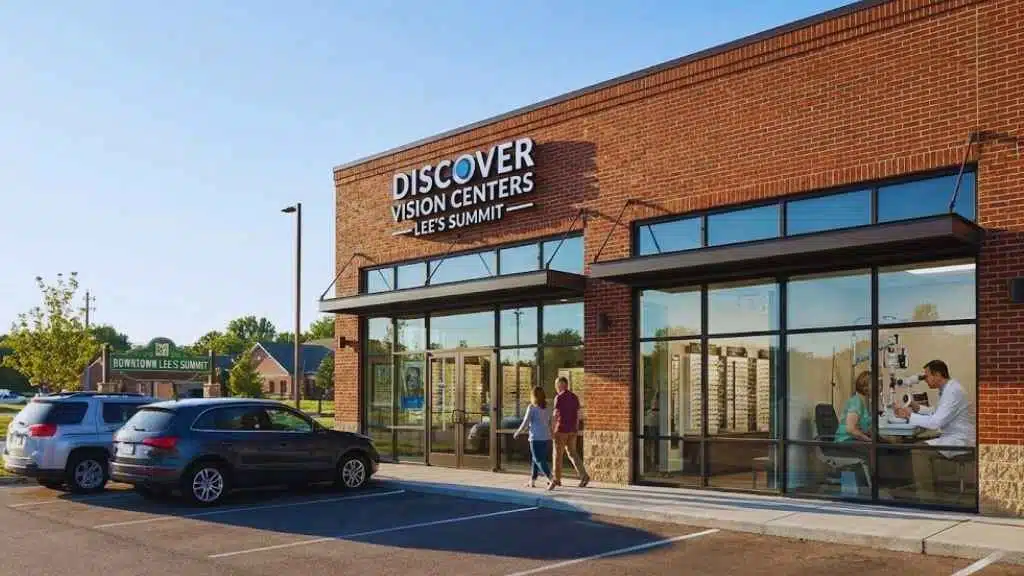
Visiting an eye doctor in Lee’s Summit can look like a small, tactical errand: you book an appointment, read some letters on a wall, maybe update your glasses, and go back to your day. In reality, that “simple” visit behaves a lot like a system health check in the tech world. It does not just tune the front end of your vision. It quietly inspects the deeper architecture of your eyes and, in many cases, your overall health.
Discover Vision Centers in Lee’s Summit has operated on that principle since the early 1970s, growing from a single ophthalmologist and a handful of staff into a multi-location team with ophthalmologists and optometrists working together. That scale matters because modern eye care is less about one doctor in one room and more about an integrated service stack that can move from routine exams to complex surgical care when needed.
Regular eye exams do more than update prescriptions. They help detect eye conditions such as glaucoma, cataracts, and macular degeneration at earlier stages, when treatment options are broader, and outcomes are typically better. Large eye health organizations consistently emphasize that many of these conditions develop slowly and painlessly, so people do not notice changes until vision is significantly affected.
A useful way to think about it is this: your annual exam is a preventive maintenance window. If you skip it, you are not just tolerating a slightly blurry monitor. You are letting key hardware run without monitoring, and that can carry real risk over time.
How modern eye care in Lee’s Summit fits into your overall health
Discover Vision Centers in Lee’s Summit approaches ophthalmology as part of whole-body care, not an isolated specialty. Many systemic conditions, including diabetes and hypertension, leave early signatures in the blood vessels and structures at the back of the eye. A comprehensive dilated exam gives your doctor a direct, non-invasive way to inspect living blood vessels, nerve tissue, and the lens.
For patients living with diabetes, that matters a lot. Diabetic retinopathy is one of the leading causes of vision loss in working-age adults, and it often progresses with few symptoms until substantial damage has occurred. Early detection through routine eye exams and timely treatment has been shown to reduce the risk of severe vision loss.
When you schedule a visit with a Lee’s Summit eye doctor, you are not just “checking your eyes.” You are adding a high-resolution sensor to your personal health dashboard.
Why busy adults tend to delay appointments and what that really costs
In practice, many adults push eye exams to the bottom of the to-do list. Work, kids, and other health appointments feel more urgent. From the outside, postponing an eye exam looks like a harmless optimization of a crowded schedule.
The hidden cost is that vision changes are often gradual. Your brain learns to compensate. Street signs look a little softer. Night driving feels a little more stressful. Screens cause more strain. It is easy to normalize each change and assume it is “just getting older.” By the time you feel something is wrong enough to act, the underlying condition may be further along than you think.
In the same way that a business exposes itself to risk by skipping regular system audits, people expose their future independence and quality of life by letting years slip between eye exams.
Meet The Type Of Eye Doctor Team You Want On Your Side
What it means to see both optometrists and ophthalmologists in one place
Discover Vision Centers in Lee’s Summit combines optometrists, who focus on primary eye care and vision correction, with ophthalmologists, who are medical doctors trained to diagnose and treat eye disease and perform surgery. That combined model gives patients a smoother path from “routine” to “specialized” without switching organizations.
On a practical level, it means you can have your annual exam, update your glasses, and, if something more complex appears, you are already inside a system that can manage cataracts, glaucoma, retinal disease, or surgical questions. The handoff does not require you to start over with a new clinic, new forms, and a new care philosophy.
How long-term relationships with your eye doctor protect your vision
In a tech environment, the teams that understand your codebase best are the ones that have lived with it longest. Vision care is similar. When the same practice follows your eyes over the years, you see patterns that a one-off visit cannot reveal.
Discover Vision Centers builds that longitudinal view through repeated exams, imaging, and careful notes on how your eyes respond to glasses, contact lenses, or treatments. Over time, small changes that might look random in isolation start to form trends. Those trends help your doctor decide when it is time to talk about options like cataract surgery, laser vision correction, or specialized retina care.
A long-term relationship with an eye doctor is not just about familiarity. It is about building a personalized data set that can guide better decisions when the stakes rise.
What Really Happens During A Lee’s Summit Eye Exam
Simple tests that quietly catch serious eye conditions early
Your visit to an eye doctor in Lee’s Summit will feel straightforward, but behind the scenes, each test is designed to answer very specific questions. Vision tests, refraction, eye pressure measurements, and examination of the front and back of the eye are all structured to identify problems long before you would notice them on your own.
For example, measuring eye pressure and examining the optic nerve help screen for glaucoma, a condition where increased pressure or other factors damage the nerve that carries visual signals to the brain. Many people with glaucoma have no noticeable symptoms until their peripheral vision is already compromised. Identifying subtle changes early allows treatment to begin while vision is still good.
How technology helps your doctor see more than you feel
Discover Vision Centers uses advanced diagnostic tools to add extra layers of detail. Optical coherence tomography, wide-field retinal imaging, and modern visual field testing function much like high-resolution sensors in engineering: they reveal structural and functional changes too small to see with basic instruments.
From a patient’s perspective, these tests are quick and non-invasive. From a medical perspective, they create a detailed map of your eye’s condition at a specific point in time. On future visits, your doctor can compare new images to previous ones, spotting microscopic changes in the retina, optic nerve, or macula that might suggest early disease.
In complex fields like ophthalmology, technology is not about replacing the physician. It is about giving the physician better, earlier information to act on.
When A Routine Visit Turns Into Life-Changing Treatment
How cataract, LASIK, and retina care connect back to your first exam
For many patients at the Lee’s Summit location, the path to advanced care starts with a routine complaint: more glare at night, trouble reading fine print, or frustration with dependence on glasses. During the exam, the doctor may find cataracts beginning to cloud the lens, corneal issues that make you a candidate for procedures like LASIK or SMILE, or retinal changes that warrant closer follow-up.
Discover Vision Centers offers consultations for cataract surgery, LASIK, PRK, SMILE, and lens-based procedures such as Light Adjustable Lens and refractive lens exchange. It also provides subspecialty care for retina and vitreous problems, diabetic eye disease, and glaucoma. That stack of services allows the practice to match treatment to each individual rather than offering a single default path.
In Dr. Doug O. Dehning’s words, “At Discover Vision Centers, we use ophthalmology not just to fix problems after they appear, but to plan the surgical and medical care that gives each patient the best chance at long-term sight.”
Why early referrals to a specialist can save sight and stress
Because retina, glaucoma, and cataract subspecialists practice under the same organizational roof, your Lee’s Summit eye doctor can loop them in early when needed. Early referrals mean more options, calmer decision-making, and often simpler procedures.
In vision care, timing functions a lot like timing in engineering projects. The earlier you identify a structural issue, the more choices you have to address it with minimal disruption. The later you catch it, the more the conversation shifts from optimization to damage control.
How To Prepare So Your Visit Feels Smooth, Not Stressful
The information to bring so you get better answers in less time
Preparing for an eye exam is less about memorizing medical terms and more about bringing the right inputs. A current list of medications, any over-the-counter supplements, your glasses or contact lens prescriptions, and a short description of what bothers you most about your vision gives your doctor a clear starting point.
If you live with conditions such as diabetes, hypertension, or autoimmune disease, share how long you have had them and how they are being managed. That context helps your Lee’s Summit eye doctor interpret what they see inside your eyes and decide how often you should be monitored.
When you show up with good data, your doctor can spend more time analyzing and less time guessing.
Questions to ask if you are nervous about eye drops or dilation
Many people delay appointments because they worry about dilation, bright lights, or unfamiliar equipment. Bringing a simple list of questions can turn that anxiety into a productive conversation.
You might ask how long dilation will last, whether you will be comfortable driving afterward, what each test is looking for, and how often your doctor recommends repeating the exam. At Discover Vision Centers, the team is accustomed to explaining each step and helping patients decide what makes sense for their comfort and safety.
One of the most powerful shifts you can make is to treat the visit less like a test you might “fail” and more like a strategy session where you and your doctor are on the same side of the table.
Signs It Is Time To Schedule With A Lee’s Summit Eye Doctor Now
Every day vision changes you should not ignore
Certain changes are strong signals that waiting another year is not a good option. If you notice persistent blurry or cloudy vision, increased glare or halos around lights, difficulty driving at night, needing much more light to read, or frequent changes in your glasses prescription, a comprehensive eye exam is due.
These are common symptoms of cataracts and other age-related eye conditions. Cataract surgery is one of the most frequently performed and successful surgeries in medicine, and outcomes are best when patients seek care before their vision loss severely limits daily life.
When to call sooner if you live with diabetes or glaucoma
If you already live with glaucoma, diabetes, or other eye disease, your follow-up schedule should be driven by your doctor’s recommendations, not by convenience. Sudden changes such as flashes of light, a curtain over part of your vision, new floaters, eye pain, or rapid loss of vision warrant an urgent call.
Patients with diabetes are usually advised to have at least yearly dilated eye exams, since diabetic retinopathy can progress silently. People with glaucoma or at high risk for glaucoma need regular monitoring of eye pressure, optic nerve appearance, and visual fields to keep track of disease progression.
In these situations, an eye exam is not optional maintenance. It is core risk management for your future independence.
Turning One Appointment Into A Long-Term Vision Plan
How to build a follow-up schedule that protects the future you
The most effective eye care strategy in Lee’s Summit is not a single “perfect” appointment. It is a recurring plan tailored to your age, health, and risk profile. At the end of your visit, ask your doctor how often they recommend you return and what specific changes they are watching for.
Discover Vision Centers can map out timelines for routine exams, diabetic eye checks, glaucoma monitoring, or post-surgical care so you know what to expect over the next few years. Framing your vision care as a roadmap, rather than a series of isolated visits, makes it easier to budget time and attention for it.
A good follow-up plan turns eye care from a reactive chore into a proactive investment.
Simple habits that make your next visit faster and easier
Between appointments, a few simple habits will keep your next visit efficient. Protect your eyes from UV light with sunglasses when you are outdoors. Take breaks from screens to reduce eye strain. Follow any treatment plan you have been given for dry eye, glaucoma, or other conditions, and note any changes in your vision so you can report them clearly.
When your next Lee’s Summit eye exam comes around, you will have cleaner data, better questions, and a clearer view of how your eyes have behaved since the last check.
In the end, visiting an eye doctor in Lee’s Summit is not just about sharper text on a screen or a new set of lenses. It is about building a durable relationship with a team that understands ophthalmology, knows your eyes over time, and uses both expertise and technology to protect the way you see the world.