The European Union is preparing to deepen its financial and political engagement with the Palestinian Authority (PA) as it works to rebuild Gaza and stabilize Palestinian governance. To advance this effort, the EU is hosting a major Palestinian donor conference in Brussels on Thursday, November 20, bringing together roughly 60 international delegations. The meeting includes representatives from multiple Arab states, European governments, and international development institutions.
The primary goal is twofold:
- Help prepare conditions for Gaza’s reconstruction, and
- Strengthen the PA’s capacity so that it can eventually govern Gaza, replacing the fractured and conflict-driven structures that dominate today.
The PA’s new Prime Minister, Mohammad Mustafa, is expected to brief donors about the reforms his administration has already initiated, what remains pending, and how these reforms will improve governance. Donors are keen to understand whether the PA is ready to implement the changes required to ensure accountability and transparency, especially as they consider releasing significant financial support.
The EU remains the single largest provider of financial assistance to Palestinians. It has already announced a €1.6 billion aid package covering 2025 to 2027, but it has made clear that large parts of this funding will only be disbursed if the PA follows through on agreed reforms. According to an EU spokesperson, the bloc will tie financial support to specific structural improvements, particularly in the education system and the contentious welfare payments for families of Palestinians imprisoned by Israeli forces.
This marks a shift from past years, when the EU regularly delivered budget support with fewer conditions. Now, with the Palestinian political landscape under strain and Gaza’s future unresolved, European officials want assurance that their aid will contribute to credible, long-term governance, not short-term patchwork fixes.
A Key Part of the EU’s Strategy: Strengthening Palestinian Security and Policing
A major component of the EU’s updated assistance strategy involves enhancing Palestinian security forces so that the PA can eventually take control in Gaza. Since 2006, the EU has worked with the PA through the EU Police Mission for the Palestinian Territories (EUPOL COPPS), helping train officers, modernize policing practices, and improve adherence to rule-of-law principles.
Now, European foreign ministers are assessing whether to significantly expand this mission. The proposal under discussion includes training as many as 3,000 Palestinian police officers. These officers would later form part of a restructured security presence inside Gaza, working in parallel with the stabilization arrangements envisioned in the recent US-proposed ceasefire plan. Some EU member states, such as France, have already expressed willingness to take part in the training.
This expansion would align with the US plan, which calls for the creation of an International Stabilization Force (ISF) to vet, support and professionalize Palestinian police units. These forces would be expected to operate in a transitional Gaza setting, where civilian institutions would gradually return as security improves.
Experts note that the EU has already been training Palestinian battalions in the West Bank and Jordan, though these units have not been deployed for Gaza. Analysts suggest that deployment will not begin until Gaza is handed over to a new administrative authority — possibly a technocratic Palestinian committee tasked with temporary governance. Such a structure is part of the US-proposed framework, which envisions an apolitical group overseeing day-to-day public services and municipal functions while broader political arrangements are negotiated.
For now, however, the political and territorial map of Gaza remains fractured. Roughly 47% of the Gaza Strip remains under Hamas control, while Israeli forces maintain control over the remaining 53%, separated by what has become known as the “yellow line.” This line marks Israeli-controlled military zones, and crossing it has proven deadly: Gaza’s media office reports that at least 240 Palestinians have been shot while attempting to return to their homes in areas they believed safe.
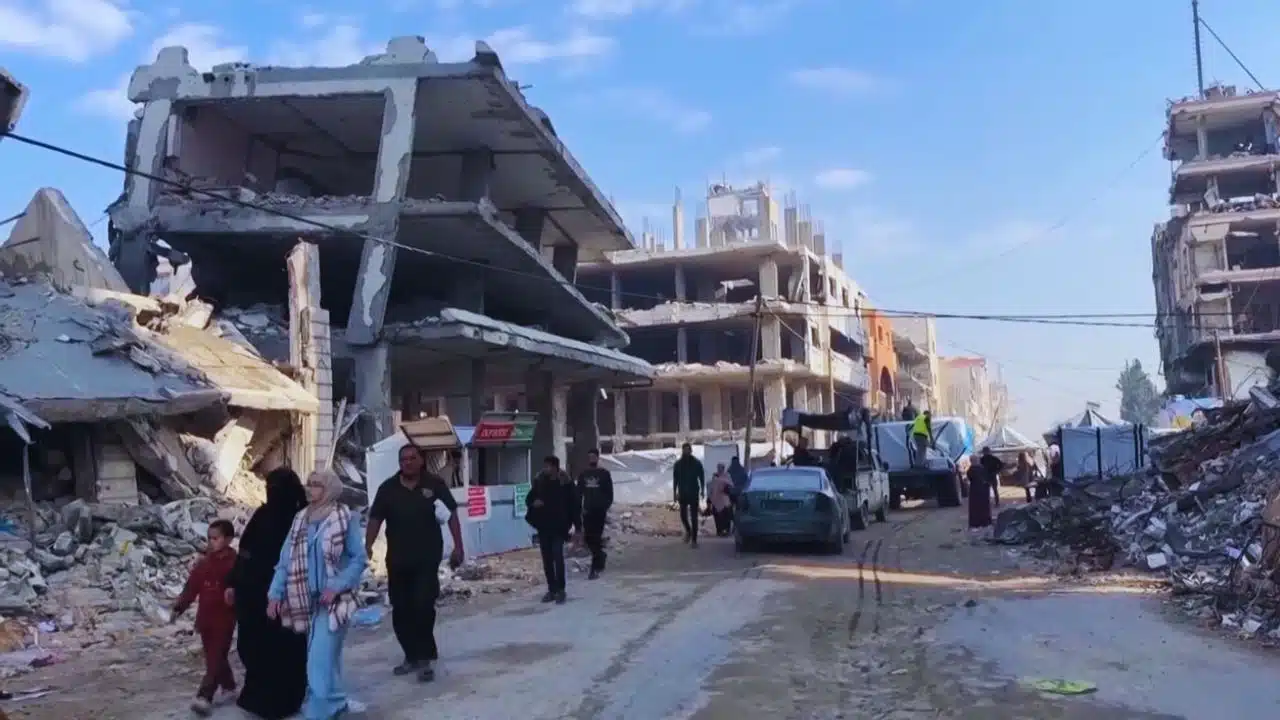
The EU says it is prepared to play a major role in reconstruction. But donor governments are unwilling to invest tens of billions of euros in rebuilding homes and infrastructure within territories still controlled by Hamas. As long as Hamas maintains its hold, large-scale reconstruction funding is likely to be withheld. PA Prime Minister Mustafa has acknowledged that initial EU funds may have to flow into zones currently controlled by Israel, despite most Gazans living outside those areas.
Reform Demands at the Heart of the Donor Conference
A central theme of the upcoming donor conference will be reforms demanded of the Palestinian Authority. Earlier this year, France and Saudi Arabia convened a high-level meeting to revive support for the two-state solution, where participating states called on the PA to implement a broad package of institutional reforms.
Many of these reforms align with long-standing Israeli concerns. Israel has criticized Palestinian textbooks, claiming they promote anti-Israel sentiment and glorify violence. The PA disputes these claims, asserting that its curriculum reflects Palestinian history and identity under occupation. The debate escalated into a public disagreement between Israeli and French foreign ministers on social media, highlighting the charged political environment surrounding education reforms.
Another major reform area concerns the PA’s welfare payments to the families of Palestinians jailed by Israel. Critics have labeled this the “pay-for-slay” system. Earlier this year, PA President Mahmoud Abbas announced that the programme had been repealed and replaced with a needs-based system. According to French officials, the programme officially ended on August 1, and changes to the education curriculum are already underway.
These reforms are central for the EU because they influence donor confidence. European officials have stated that while humanitarian support will continue, budgetary assistance will be conditional on measurable progress. This marks one of the EU’s strongest attempts in years to leverage its financial influence to push for political and administrative change.
One sensitive issue remains largely unaddressed: elections. President Abbas has promised that national elections will be held within a year after the conflict ends. However, EU officials have not made elections a condition for financial aid. Analysts believe the EU fears that free elections may produce another Hamas victory, similar to the sweeping win in 2006. As several diplomats privately noted, the EU is concerned that insisting on elections now may backfire, destabilizing the PA further and undermining future peace efforts.
Obstacles to Rebuilding Gaza and the Political Realities on the Ground
Even though many donor states express a desire to participate in rebuilding Gaza, they remain cautious. The split control between Hamas and Israel makes reconstruction a complex and politically charged undertaking. International donors do not want their contributions to strengthen Hamas’s influence nor be diverted by corrupt or inefficient management structures.
This has resulted in a paradox: Gaza urgently needs reconstruction, yet the political conditions required for large-scale rebuilding are not yet in place. The PA asserts that it should lead future governance in Gaza, but it lacks administrative reach, security access, and political legitimacy within the Strip after years of division.
At the same time, international actors are planning ahead. The EU has deployed senior diplomats to the Civil-Military Coordination Center (CMCC) in southern Israel. This center, created in partnership with the United States, is preparing various scenarios for Gaza’s next phase, including security arrangements, infrastructure access, humanitarian logistics, and governance transition. Diplomats from more than ten EU member states are present, participating in discussions with global agencies and regional partners.
Still, notable absences remain: no Palestinian officials or civil-society representatives are part of this planning process. This exclusion raises concerns about legitimacy and long-term ownership of the reconstruction strategy and may complicate future implementation once the situation on the ground begins to stabilize.
What Lies Ahead for the EU, the PA, and the Region
The EU’s approach reflects a broader strategy: reinforcing the PA as the primary representative of the Palestinian people, enhancing its administrative capacity, and paving the way for the two-state solution to remain viable. With waning prospects for peace and deepening territorial fragmentation, the EU sees the PA as a crucial partner — even if imperfect.
Despite this, the road ahead is filled with obstacles. The PA needs to demonstrate real progress on reforms. Donors require clear signs of accountability before releasing billions in reconstruction funds. Gaza’s political future is still unsettled, and the division between Hamas-held and Israeli-held areas limits what can be done.
The donor conference in Brussels will be a critical test:
- If reform commitments are strong, donors may unlock new funds.
- If progress appears insufficient, financial support may be delayed or scaled back.
- And if Gaza remains divided, reconstruction will be slow, uneven, and difficult to sustain.
For now, the EU is positioning itself as a central player in shaping Gaza’s postwar future, attempting to rebuild Palestinian institutions, and keeping diplomatic pathways open — even as the region faces one of its most complex periods in decades.