
The era of “collect everything, sort it later” is officially over. As we settle into 2026, the digital marketing landscape has undergone a seismic shift, driven not just by technology but by a fundamental rewriting of the social contract between brands and consumers. For years, marketers relied on the silent machinery of third-party cookies and pixel tracking to populate their CRMs. But today, effective Ethical Lead Generation is no longer just a “nice-to-have” compliance checklist; it is the only viable strategy for sustainable growth.
The businesses that are winning in this new environment have realized a crucial truth: privacy is not a hurdle; it is a filter for quality. By pivoting to privacy-first marketing, brands are finding that while their raw traffic numbers might dip, their conversion rates are climbing. They are no longer capturing “ghost leads”, users who were tricked into clicking, but are instead building high-intent audiences who chose to engage.
This guide will walk you through the exact strategies, from zero-party data to server-side tracking, required to navigate this new world without starving your sales team of qualified opportunities.
The Post-Cookie Panic: Why the Old Playbook is Broken
Despite the clear benefits of this shift, the transition has not been painless. The question every Chief Marketing Officer (CMO) and demand generation leader is asking is identical: “How do I maintain my lead volume when I can no longer track my users?”
This fear is understandable. For a decade, we equated “tracking” with “performance.” We believed that without a pixel following a user from a shoe store to a news site, we were flying blind. However, with the EU AI Act looming over the horizon for August 2026 and the CCPA’s strict 2026 amendments already in force, the old playbooks are now active liabilities.
The “Post-Cookie Panic” stems from a reliance on GDPR compliant lead generation methods that were actually just “barely legal” workarounds. In 2026, those workarounds are being dismantled by regulators and ad-blockers alike.
The 2026 Regulatory Landscape: More Than Just Cookies
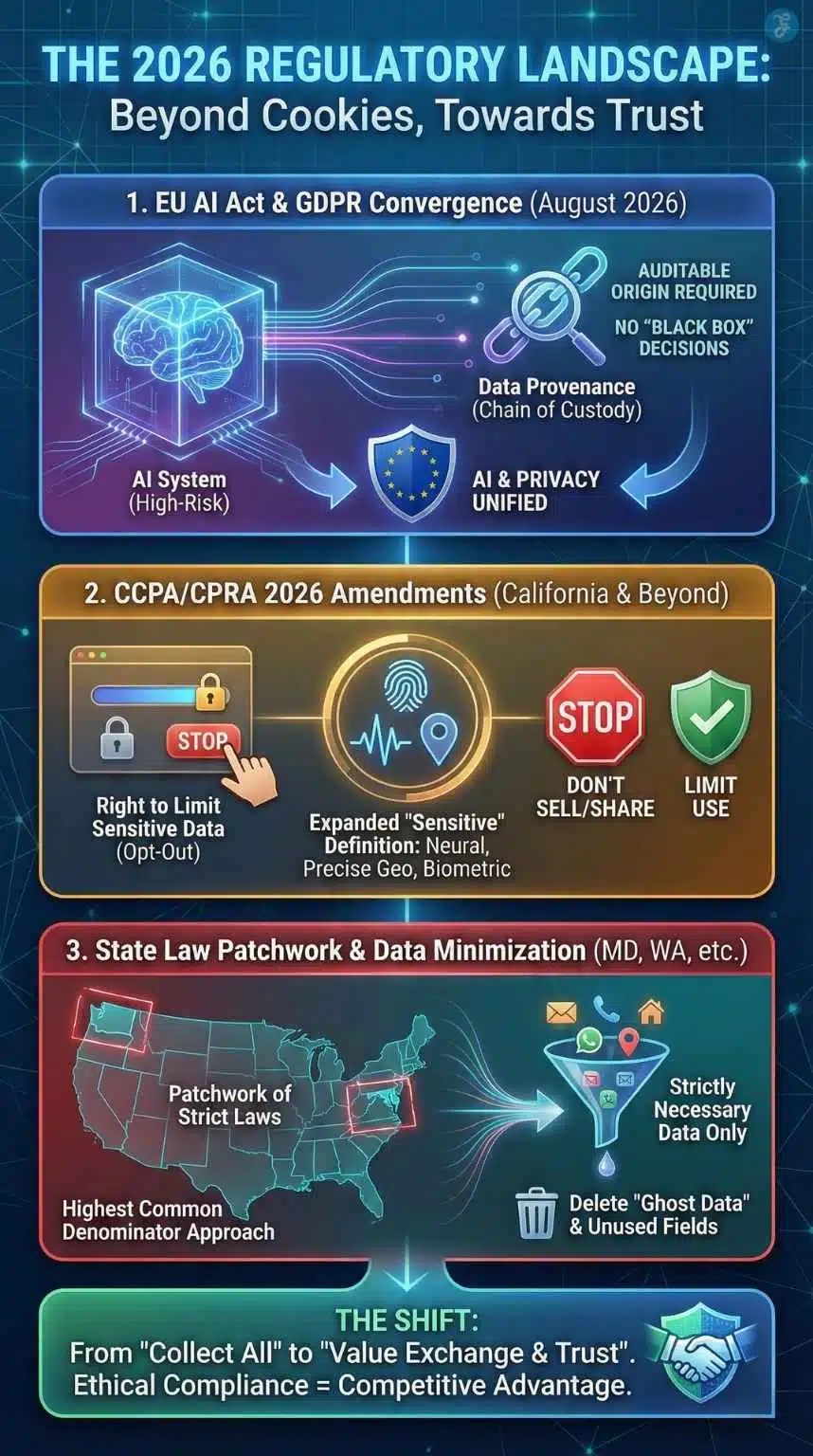
To understand the solution, we must first diagnose the environment. The regulatory framework of 2026 is vastly more complex than the early days of GDPR (2018). It is no longer just about where you store data; it is about how you derived it and what you intend to do with it.
1. The Convergence of GDPR and the EU AI Act
As of January 2026, we are in the final countdown to the full applicability of the EU AI Act in August. This regulation has fundamentally changed how we look at lead scoring and automated marketing.
- Data Provenance is King: It is no longer sufficient to say, “I have consent to email this person.” If you are feeding that lead’s data into an AI model (like a predictive lead scoring algorithm or a personalized content generator), you must prove Data Provenance. You need a documented chain of custody showing that the user consented not just to “marketing,” but specifically to “automated decision-making” or “AI processing.”
- The “Black Box” Ban: High-risk AI systems (which can include certain employment or credit-related marketing filters) now require transparency. You cannot reject a lead or alter their pricing based on an opaque algorithm without being able to explain why to the regulator.
2. CCPA/CPRA (California): The “Right to Limit” Revolution
While Europe focuses on AI, the United States, specifically California, has doubled down on the granularity of control. The amendments to the California Consumer Privacy Act (CCPA) that went live on January 1, 2026, have introduced a game-changer: the Right to Limit Sensitive Personal Information.
- Beyond “Do Not Sell”: Previously, users could tell you not to sell their data. Now, they can tell you to stop using their sensitive data for anything other than the bare minimum required to provide the service.
- Sensitive Data Expansion: In 2026, “sensitive data” has been expanded to include precise geolocation (often used for localized ads) and, critically, “neural data” or inferred biometric data. If your marketing platform infers a user’s emotional state or health status, that is now sensitive data requiring explicit opt-in.
- The “Age Gate” Reality: Data from minors (under 16) requires even stricter protocols. If you cannot prove the user is over 16, you must default to the highest privacy settings.
3. The State Law Patchwork [Washington, Maryland, and Beyond]
It is not just California. States like Washington and Maryland have enacted privacy laws that are, in some aspects, stricter than the CCPA.
- Maryland’s Data Minimization: Maryland’s law effectively bans the collection of data that is not “strictly necessary” for the product. This kills the practice of asking for a phone number “just in case” on a whitepaper download form. If you don’t need it to deliver the PDF, you cannot ask for it.
Key Takeaway: The “highest common denominator” approach is the only viable strategy for 2026. You cannot build fifty different funnels for fifty states. You must build one ethical funnel that meets the strictest standards globally.
The Business Case: Why Ethical Leads Are More Profitable
Before diving into the “how,” we must address the “why.” Many stakeholders view privacy compliance as a cost center, a tax on doing business. This view is outdated. In 2026, ethical data collection is a competitive advantage.
1. Quality Over Quantity
In the era of third-party tracking, we were obsessed with volume. We celebrated 10,000 leads, even if 9,000 of them were accidental clicks or bots. Ethical lead generation forces a value exchange. When a user voluntarily gives you their data (Zero-Party Data), they are signaling high intent.
| Metric | Old Way (Third-Party Tracking) | New Way (Ethical/Zero-Party) |
| Lead Volume | High (often inflated) | Moderate (Clean) |
| Cost Per Lead | Low | Higher (Initially) |
| Conversion to Sale | Low (<1%) | High (5-10%) |
| Customer Lifetime Value | Unpredictable | Higher (Trust-based) |
2. Brand Trust as Currency
Consumer skepticism is at an all-time high. A 2025 study showed that 84% of consumers are more likely to share personal data if they clearly understand the value exchange and see “trust signals.”
By implementing transparent forms and “easy-out” unsubscribe options, you are signaling that you are a premium brand. You are telling the customer, “We don’t need to trap you; our product is good enough that you’ll want to stay.”
3. Risk Mitigation
The fines for GDPR violations can reach €20 million or 4% of global turnover. The CCPA allows for statutory damages per user. If you have a database of 100,000 users collected unethically, you are sitting on a potential liability of millions of dollars. Cleaning your list and collecting data ethically is, effectively, an insurance policy.
Strategy 1: The Zero-Party Data Revolution
This is the core of the 2026 strategy. Zero-party data is data that a customer intentionally and proactively shares with a brand. Unlike first-party data (which is passive, like purchase history), zero-party data is active. It is the user telling you what they want.
The “Value Exchange” Equation
The golden rule of zero-party data is simple: Ask = Value. You cannot ask for a user’s data without giving them something of equal or greater perceived value immediately.
Tactic A: Interactive Content & Quizzes
Static PDF whitepapers are losing their power. In 2026, interactive content is the primary driver of zero-party data.
- Example: A B2B cybersecurity firm.
- Old Way: “Download our 2026 Security Report.” (Requires Email).
- New Way: “Take the 2-Minute Security Maturity Quiz.”
- The Process: The user answers 5 questions about their current tech stack (this is gold-standard data).
- The Reward: The user gets an instant “Maturity Score” and a customized roadmap.
- The Result: The user wants to give you the data to get the result. You have collected their pain points, tech stack, and budget bracket without ever “tracking” them.
Tactic B: Preference Centers
Most “Unsubscribe” pages are retention killers. They offer two options: “Stay” or “Go.” The ethical marketer uses a Preference Center.
- How it works: When a user signs up or clicks “manage preferences,” they are presented with granular options.
- [ ] Monthly Newsletter
- [ ] Product Updates
- [ ] Partner Offers (Third-Party)
- The Strategic Win: This allows you to retain a user who might be tired of daily emails but wants monthly updates. It also ensures you have specific consent for specific topics, which is crucial for GDPR compliance.
Tactic C: The “Waiting List” Launch
For e-commerce and SaaS, the “Waitlist” is a powerful tool.
- The Hook: “We are launching Feature X in May. Join the waitlist for early access.”
- The Data: You can ask specific questions here. “What is your primary use case for Feature X?”
- Why it works: The user has a selfish reason to provide accurate data; they want the product to work for them.
Strategy 2: Progressive Profiling & Granular Consent
One of the biggest mistakes marketers make is asking for too much too soon. In 2026, requesting a phone number on a first-touch interaction is almost a guarantee of abandonment.
The “Breadcrumb” Technique
Progressive profiling is the art of building a user profile over multiple interactions. Most modern marketing automation platforms (HubSpot, Marketo, Salesforce) support this natively.
Step-by-Step Workflow:
- Touchpoint 1 (The Blog Post):
- Offer: “Subscribe to our Weekly Digest.”
- Ask: Email Address only.
- Rationale: Low friction, high conversion.
- Touchpoint 2 (The Webinar):
- Offer: “Join our Live Masterclass.”
- Ask: Name + Job Title. The system already knows the email.
- Rationale: The user trusts you now; they are willing to share professional details.
- Touchpoint 3 (The Case Study Download):
- Offer: “Unlock our Enterprise ROI Report.”
- Ask: Company Size + Phone Number.
- Rationale: This is high-value content. The user understands that a sales call might be part of the exchange.
Granular Consent: No More Bundling
Under GDPR and the updated CCPA, bundled consent is illegal. You cannot have a single checkbox that says “I agree to Terms of Service and to receive Marketing Emails.”
- The Requirement: You must separate the legal terms from the marketing opt-in.
- The “Soft Opt-In”: In some jurisdictions (like the UK), you can rely on “Soft Opt-In” for existing customers, but for new leads, you must use explicit, unchecked boxes.
- Visual Trust: Users in 2026 are savvy. When they see pre-checked boxes or bundled consent, they perceive it as a “dark pattern.” Clear, separate boxes actually increase trust and long-term retention.
Strategy 3: Contextual Targeting 2.0
As behavioral tracking (cookies) dies, we are seeing a massive resurgence of Contextual Targeting. This is marketing without personal data, and it is 100% privacy-safe.
Going Back to Basics
In the “Cookie Era,” we targeted people. We would follow User A (who likes golf) onto a cooking website and show them a golf ad. This felt creepy to the user.
In the Contextual Era (2026), we target the content.
The Strategy: instead of finding “Golfers,” we place ads on “Golf Articles.”
Why it works:
- Relevance: The user is thinking about golf right now.
- No Consent Needed: You do not need to know who the user is. You just need to know what the page is about.
- Brand Safety: You have total control over where your brand appears.
Semantic Matching with AI
Modern contextual targeting is not just keyword matching. It uses AI to understand the sentiment of an article.
Example: You are selling a CRM tool.
- Keyword Match: Places ad on an article titled “CRM disasters.” (Bad).
- Semantic Match: Places an ad on an article titled “How to scale your sales team efficiently.” (Good).
This approach bypasses the entire GDPR/CCPA consent headache because no PII (Personally Identifiable Information) is processed.
Privacy UX: Designing for Humans and AI Agents
While legal compliance is written in code, trust is earned in design. In 2026, “Privacy UX” has evolved from annoying banners to helpful, context-aware interactions. Furthermore, you are no longer just designing for human eyes; you are designing for AI Agents that browse on behalf of users.
1. The “Just-in-Time” Notice
Stop burying your reasons in a 4,000-word privacy policy. The highest-converting forms in 2026 use “Just-in-Time” notices, small, helpful tooltips that appear at the exact moment data is requested.
- The Old Way: A generic link to “Terms” at the bottom of the page.
- The New Way: A small information icon next to the “Phone Number” field. When hovered, it says: “We only use this to SMS you the webinar link. No cold calls.”
- The Result: This micro-transparency reduces anxiety and can lift form completion rates by up to 15%.
2. Designing for Agentic Web Browsing
By late 2026, a significant portion of your traffic will not be humans, but their personal AI assistants (e.g., an automated agent scouting for software vendors).
- The Challenge: If your site attempts to trick a user with “Dark Patterns” (like a hidden reject button), the AI agent will flag your domain as “Non-Compliant” and may block the user from seeing your site entirely.
- The Fix: Implement Global Privacy Control (GPC) signals. Ensure your privacy settings are machine-readable so an AI agent can instantly negotiate consent without user intervention.
3. The “Unsubscribe” Experience
The “Unsubscribe” button is often the last interaction a user has with your brand. Make it positive.
- Toxic Design: Asking users to log in to unsubscribe, or waiting 48 hours to process.
- Ethical Design: One-click unsubscribe with an optional (and polite) survey: “Was our content not relevant? Tell us, and we’ll improve.”
The B2B vs. B2C Divide: Tailoring the Strategy
While the laws (GDPR/CCPA) are the same, the application differs wildly between Business-to-Business (B2B) and Business-to-Consumer (B2C) markets.
B2B: The “Enrichment” Approach
In B2B, asking for too much data is a conversion killer. The 2026 standard is Data Enrichment.
- The Strategy: Ask for only a corporate email address.
- The Backend: Use a compliant enrichment API (like Clearbit or ZoomInfo) to instantly pull public data associated with that email (Company Size, Industry, Role) and populate your CRM.
- The Ethical Check: Ensure your enrichment provider verifies their data sources. You are liable if they scraped data illegally.
B2C: The “Identity” Approach
In B2C, enrichment is risky due to strict consumer privacy laws. Instead, rely on Federated Identity.
- The Strategy: Lean heavily on “Sign in with Google/Apple” or “Passkeys.”
- The Benefit: Apple and Google act as a privacy shield. They authenticate the user and share only what is necessary (often a masked email), satisfying the user’s desire for anonymity while giving you a verified lead.
Technical Implementation: The Privacy Stack
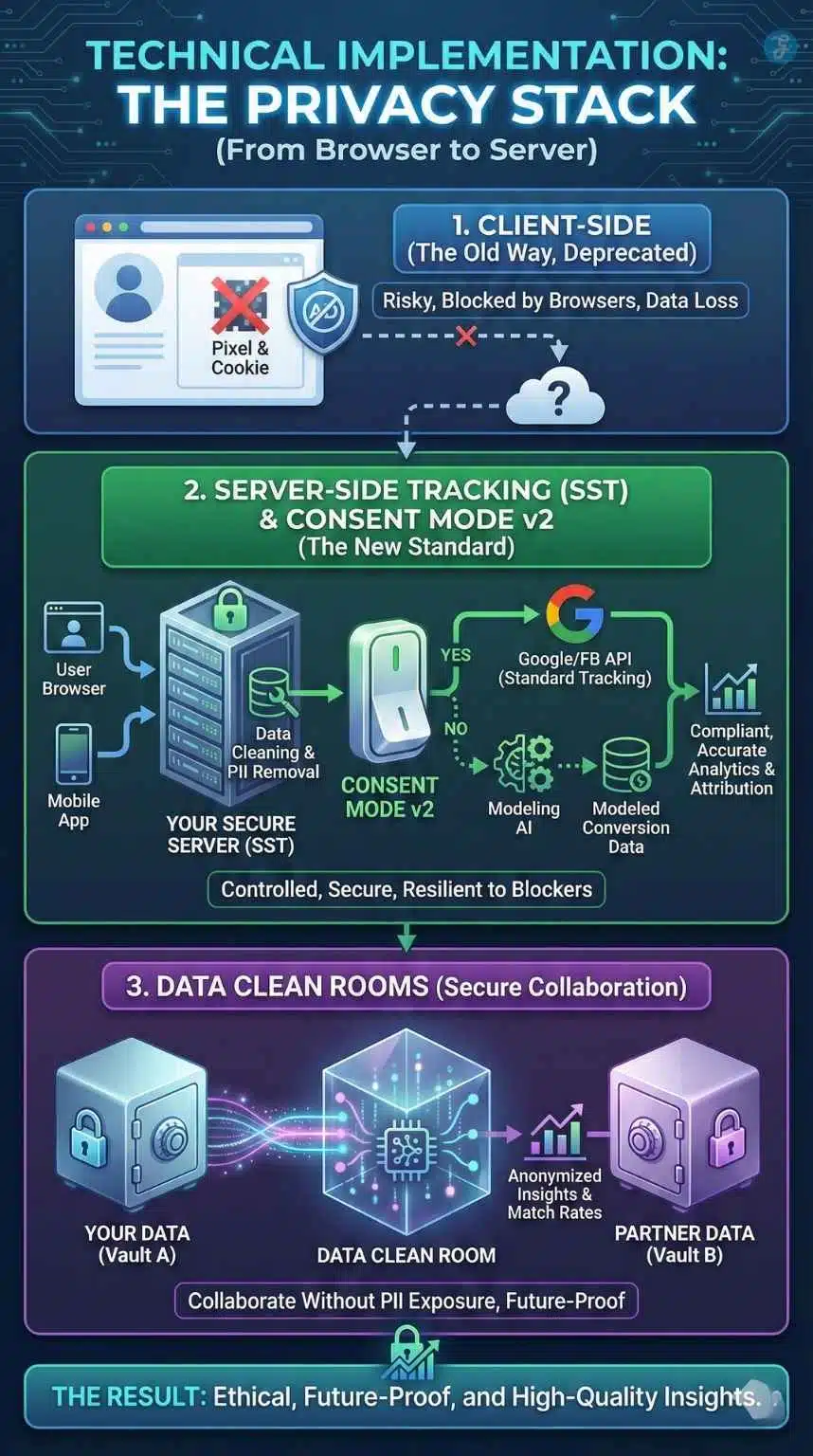
To execute these strategies, your technology stack needs an upgrade. The browser-based pixel is dying; the server is taking over.
1. Server-Side Tracking (SST)
Client-side tracking (the old way) relies on the user’s browser sending data to Facebook/Google. This is easily blocked by ad blockers, Safari’s ITP, and browser privacy settings.
- The Solution: Server-Side Tracking.
- How it works: The user’s browser sends data to your secure server (e.g., tracking.yourdomain.com). Your server then cleans the data, removes sensitive PII, and forwards only the compliant data to Facebook/Google.
- The Benefit:
- Compliance: You control exactly what is shared. You can strip out IP addresses before they reach Google.
- Accuracy: It bypasses ad blockers, recovering 10-20% of lost data.
2. Consent Mode v2 [Google]
Google’s Consent Mode v2 became the industry standard in late 2024/early 2025. It acts as a bridge between privacy and data.
- Function: It listens to your cookie banner.
- If the user says YES, it tracks normally.
- If the user says NO, it sends “pings” (anonymized signals) without cookies. Google’s AI then uses these pings to model conversion data.
- Why you need it: Without it, a “No” consent means a black hole in your data. With it, you get modeled data that fills the gap, allowing you to optimize ads without violating privacy.
3. Data Clean Rooms
For large enterprises, Data Clean Rooms (like those from InfoSum, Snowflake, or AWS) are the new standard for collaboration.
- Scenario: You want to see if your customers are also shopping on Amazon.
- Old Way: You upload your email list to Facebook (hashing is secure, but regulators are skeptical).
- New Way (Clean Room): You put your data in a secure vault. Amazon puts its data in a secure vault. The Clean Room software compares them and says “Overlap: 20%” without either side ever seeing the other’s raw data.
How to Audit Your Current Lead Gen Funnel
If you are reading this and worrying about your current setup, here is a practical audit to run immediately.
The “Ethical Lead Gen” Checklist
- Map Your Data Entry Points: List every form, chatbot, and pop-up. Where is data entering your system?
- The “Strict Necessity” Test: Look at every field on your forms. Ask: “Do we need this to fulfill the user’s request?” If the answer is “We might need it later,” delete the field.
- Review “Ghost Data”: Are you storing data you don’t use? (e.g., birthdays collected 5 years ago). Delete it. It is a liability, not an asset.
- Check Your Cookie Banner: Does it have a “Reject All” button that is just as visible as “Accept All”? (Required by many EU regulators).
- Audit Your Privacy Policy: Is it written in legalese or human language? Does it explicitly mention AI processing if you use it?
- Test Your Unsubscribe Flow: Click your own unsubscribe link. How many clicks does it take to leave? Ideally, it should be one or two clicks max.
- Verify Vendor Compliance: Ask your email provider and CRM: “Where is your server located? How do you handle Data Provenance?”
- Implement Age-Gating (If applicable): If there is any chance minors are visiting, ensure you have an age-gate or treat all data as sensitive.
Future Trends: AI Agents & Automated Privacy
Looking ahead to late 2026 and 2027, the next frontier is Personal AI Agents. Users will soon have their own AI assistants (like an advanced Gemini or ChatGPT) that browse the web for them.
- The Scenario: A user tells their AI, “Find me the best CRM software.” The AI visits your site.
- The Privacy Challenge: The AI is not a human. It will automatically negotiate privacy settings based on the user’s pre-set preferences.
- The Opportunity: Your site needs to be “machine-readable” for privacy. Using standards like Global Privacy Control (GPC) signals will allow these agents to instantly trust your site. If your site tries to trick the AI with dark patterns, the AI will likely block you entirely.
The future of SEO and Lead Gen isn’t just about convincing a human; it’s about convincing their AI guardian that you are a safe, ethical destination.
Final Thoughts: The Trust Economy
We are witnessing the birth of the Trust Economy. In the past, data was extracted; now, it must be earned. The “Ethical Data Collection” framework is not a set of shackles; it is a filter that separates the noise from the signal.
By adopting a Zero-Party Data strategy, respecting the Right to Limit, and implementing robust Server-Side Tracking, you are doing more than just avoiding fines. You are building a database of individuals who want to hear from you. You are future-proofing your brand against the inevitable tightening of laws. And most importantly, you are treating your customers not as “leads” to be captured, but as humans to be served.
The winners of 2026 won’t be the ones with the biggest data lakes. They will be the ones with the cleanest rivers.