Sweden is rapidly emerging as the global lighthouse for the ethical integration of artificial intelligence into the private sector. While larger nations focus purely on speed and scale, the Swedish tech ecosystem prioritizes trust and transparency as its competitive advantage. This approach aligns perfectly with the National AI Strategy released in February 2026, which emphasizes societal benefit alongside innovation.
By embedding democratic values directly into their technical architectures, companies like Spotify and Ericsson are proving that Ethical Generative AI Adoption actually accelerates long-term growth
How We Selected Our 5 Best Ethical AI Strategies for 2026
Selecting the most effective methods for responsible innovation requires looking beyond simple corporate policy statements. We analyzed the Swedish market based on how deeply these ethical principles are woven into the actual software development lifecycle. Our team evaluated these strategies based on the following specific filters to ensure they meet modern standards of accountability.
-
Verifiable Transparency: The method must provide clear evidence of AI usage to the end user.
-
Data Sovereignty: The strategy should ensure that sensitive information remains within secure European jurisdictions.
-
Human Augmentation: The focus must remain on empowering employees rather than simply replacing them with automated agents.
-
Sustainability: Every AI initiative must align with Sweden’s rigorous carbon neutrality goals for 2026.
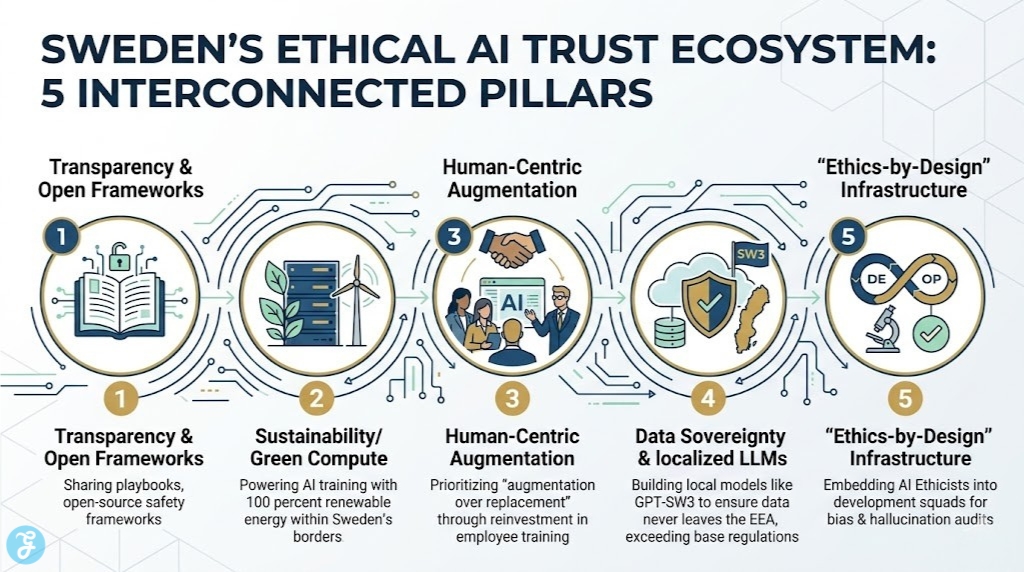
5 Leading Strategies for Ethical Generative AI Adoption
The following list highlights the most successful frameworks currently deployed by Swedish tech giants to ensure their AI systems remain safe and reliable. These methods represent a shift from experimental pilot programs to fully operationalized value systems that respect user privacy and creative ownership.
1. Indestructible Metadata Watermarking for Media
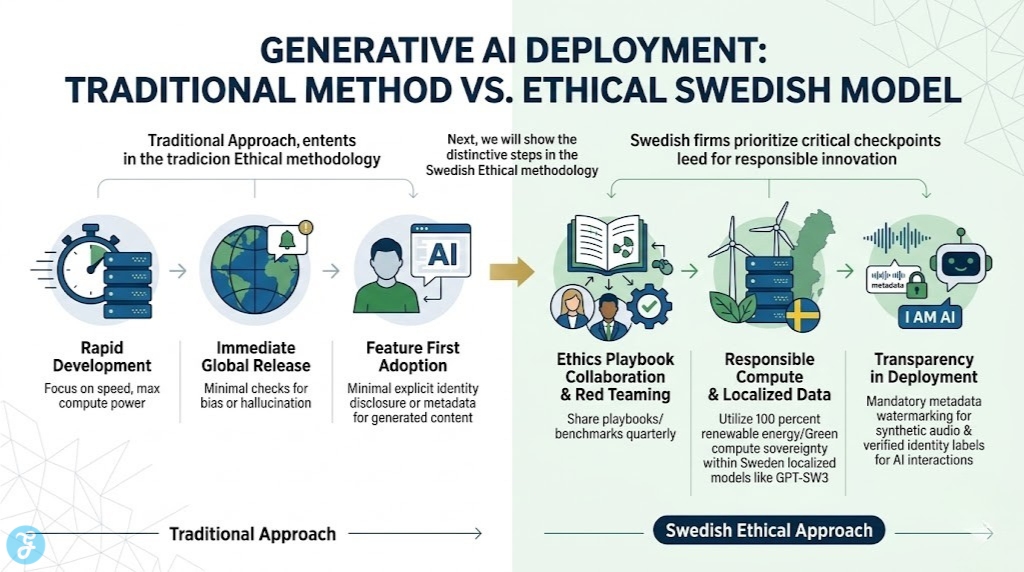
Spotify has pioneered a new standard for digital provenance that ensures every AI-generated audio track contains a permanent identification tag. This technology uses cryptographic signatures to verify the origin of content even if the file is compressed or recorded over another device. It protects the integrity of the platform while giving human creators the credit they deserve in an increasingly synthetic world.
Best Feature/For: Protecting artist intellectual property in the music streaming industry.
Why We Chose It:
-
It provides a technical solution to the problem of deepfake audio.
-
The system integrates seamlessly with global distribution standards.
-
It empowers users to make informed choices about the media they consume.
-
This method is now being adopted by other European media giants as a gold standard.
Things to consider:
-
Bad actors may eventually develop tools to simulate these signatures.
2. The Green Compute Sovereignty Framework
Ericsson is leading the way in ethical AI by focusing on the physical infrastructure that powers these complex models. By utilizing the 2026 Mimer AI Factory and local edge-cloud architectures, they ensure that AI training occurs using 100 percent renewable energy within Swedish borders. This strategy prevents the drain of data to non-EU jurisdictions while keeping the carbon footprint of large language models to an absolute minimum.
Best Feature/For: Enterprises requiring high-security and low-carbon AI operations.
Why We Chose It:
-
It solves the tension between massive compute needs and environmental goals.
-
The framework keeps sensitive telecommunications data under strict Swedish legal oversight.
-
It utilizes heat recovery systems from data centers to warm local homes.
-
This approach exceeds the requirements of the 2026 EU AI Act.
Things to consider:
-
Localized compute capacity can sometimes be more expensive than global public clouds.
3. Human-in-the-Loop Recruitment Protocols
Major fintech firms like Klarna have implemented a strict policy where AI agents only handle the initial screening of massive applicant pools while humans retain final decision-making power. This protocol includes a bias-detection layer that audits the AI for any demographic skew before the hiring team sees the results. It ensures that the speed of generative AI does not lead to a less diverse or unfair workforce.
Best Feature/For: Maintaining fairness and diversity during high-volume hiring cycles.
Why We Chose It:
-
The system uses skills-based assessments rather than just scanning CV keywords.
-
It provides a transparent audit trail for every candidate rejected by the algorithm.
-
The protocol includes regular red teaming to check for emerging biases.
-
It keeps the human touch central to the company culture.
Things to consider:
-
Constant human oversight can slow down the speed of the recruitment process.
4. Open-Source Ethics Playbooks for Startups
Through the Team Sweden AI initiative, larger companies are sharing their internal safety frameworks with the broader ecosystem for free. This strategy democratizes the high cost of ethical research by providing pre-vetted templates for bias mitigation and risk assessment. It allows smaller Swedish startups to compete globally by being ethical by default from their very first day of operation.
Best Feature/For: Rapidly scaling small businesses that lack dedicated ethics departments.
Why We Chose It:
-
It fosters a collaborative environment rather than a secretive one.
-
The playbooks are updated in real-time based on new legislative changes.
-
It lowers the barrier to entry for responsible innovation.
-
This collective knowledge base strengthens the entire Swedish economy.
Things to consider:
-
Generic templates may not cover every niche technical scenario.
5. Verified Identity Labels for AI Interaction
Swedish customer service leaders are now required to start every interaction with a clear declaration of identity. If a user is speaking with a generative AI agent, the system must state this fact and provide an immediate option to switch to a human representative. This radical honesty prevents the erosion of consumer trust and ensures that users never feel deceived by an algorithm.
Best Feature/For: Building long-term brand loyalty through total communication transparency.
Why We Chose It:
-
It prevents the uncanny valley effect in digital interactions.
-
The system provides an immediate exit path for complex or sensitive issues.
-
It sets clear expectations for what the AI can and cannot do.
-
This transparency is highly valued by the Swedish public according to recent surveys.
Things to consider:
-
Some users might automatically dismiss the AI before it has a chance to help.
An Overview Of 5 Ethical Generative AI Adoption Methods
The Swedish model proves that transparency and sustainability are not just moral choices but are essential for technical leadership. The following table provides a quick comparison of the most successful methods currently being used to manage AI risks while maximizing the benefits for society.
| Strategy Name | Primary Focus | Best Implementation | Key Benefit |
| Media Watermarking | Provenance | Spotify | Protects Intellectual Property |
| Green Compute | Sustainability | Ericsson | Zero-Carbon AI Training |
| Recruitment Protocols | Fairness | Klarna | Reduces Algorithmic Bias |
| Open Playbooks | Collaboration | Team Sweden AI | Supports Small Business Growth |
| Identity Labels | Transparency | PostNord / Banks | Maintains Consumer Trust |
Our Top 3 Picks and Why?
While all five strategies are vital for a healthy ecosystem, we believe that Media Watermarking, Green Compute, and Identity Labels are the most critical for 2026. Watermarking is the only defense against the coming wave of synthetic misinformation that threatens our social fabric. Green Compute is essential because AI cannot scale if it destroys our climate goals. Finally, Identity Labels are the foundation of the trust economy which is the only way consumers will continue to engage with digital brands.
Buyer’s Guide: How to Choose the Right Ethical Generative AI Adoption by Yourself?
Selecting a framework for your own organization requires a deep understanding of your specific industry risks and regulatory requirements. You should look for systems that are modular so you can adapt them as the 2026 legal landscape continues to evolve. Use the following guide to determine which path is right for your business.
-
Auditability: Does the framework provide a clear record of how the AI arrived at its conclusions?
-
Scalability: Can the ethical guardrails keep up with the speed of your technical deployment?
-
User Feedback: Does the system allow your customers to report issues or give feedback on AI performance?
-
Local Compliance: Does the strategy specifically address the nuances of the Swedish National AI Strategy.
The following matrix helps you visualize which ethical pillar aligns most closely with your current operational goals and organizational structure.
| Choose This Strategy if… | Choose That Strategy if… |
| You handle creative content or media. | You should prioritize Media Watermarking. |
| You process high volumes of sensitive user data. | You should prioritize Green Compute Sovereignty. |
| You use AI for customer-facing communication. | You should prioritize Verified Identity Labels. |
| You are a small startup with limited resources. | You should prioritize Open-Source Playbooks. |
The Final Checklist: 5 Steps Before You Deploy
-
Verify that your training data was acquired with explicit consent from the creators.
-
Ensure your AI agent identifies itself as non-human within the first three seconds of interaction.
-
Confirm that your compute provider uses 100 percent renewable energy for model inference.
-
Perform a third-party bias audit to check for demographic or cultural inaccuracies.
-
Create a human override protocol for any decision that impacts a person’s legal or financial status.
Leading the Charge Toward a Trustworthy AI Economy
The Swedish tech sector is currently providing the blueprint for a future where technology and ethics exist in perfect harmony. By choosing transparency over secrecy and sustainability over raw power, these companies are building an AI economy that truly serves the people. The strategies outlined here are not just trends for 2026 but are the permanent pillars of a trustworthy digital society.