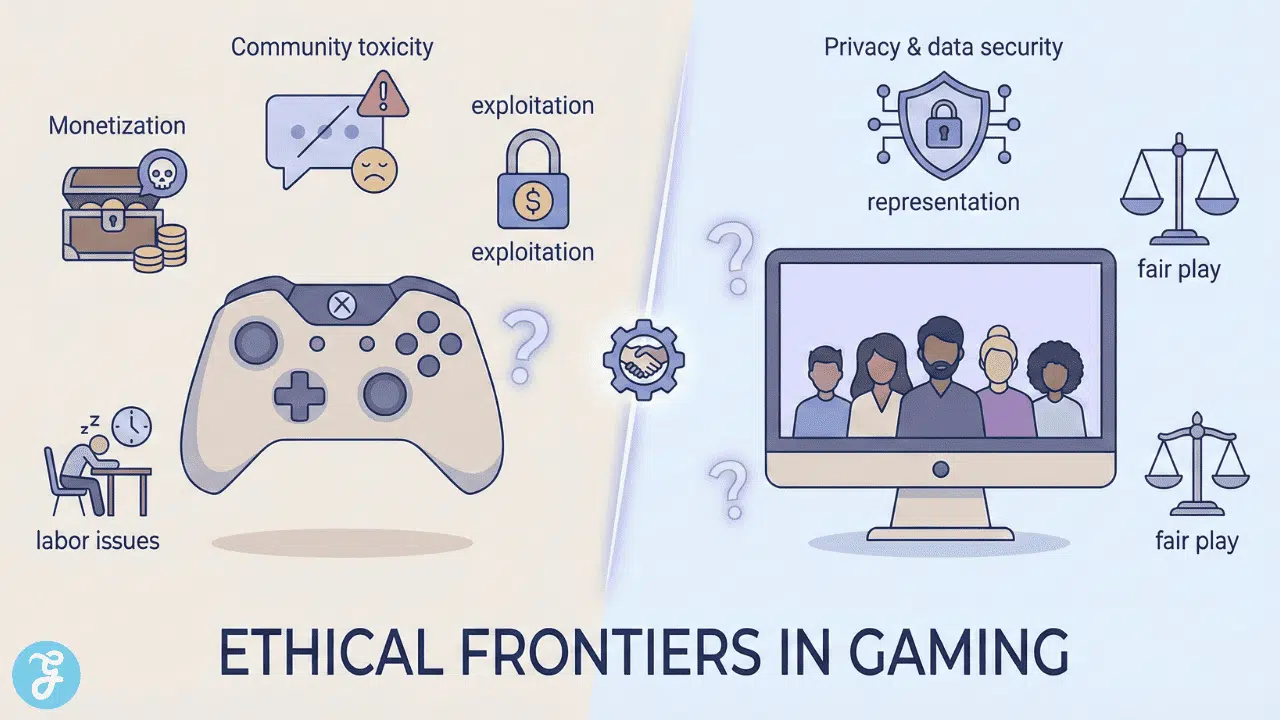
Gaming is no longer a niche hobby. It is a global industry, a social space, a storytelling medium, and a source of identity for millions of players. With that growth comes a web of ethical questions that do not have simple answers. If you care about games, these questions are not side issues. They shape the experience for players, the work conditions for developers, and the public image of gaming as a whole.
This guide looks at key ethical challenges in gaming and then offers practical ways to think about them. The goal is not to hand you ready-made answers but to give you tools to form your own.
Why Does Ethics Matter in Games?
Games are powerful because they are interactive. They do not only tell stories. They invite you to make choices, repeat actions, and build habits. They also mix social interaction, money, and emotion in real time.
That combination means design decisions can:
- Encourage healthy play or push people toward compulsion
- Build welcoming communities or normalise abuse
- Challenge harmful stereotypes or reinforce them
- Respect players’ time and money or exploit them
Thinking about ethics is not about sucking the fun out of games. It is about protecting the space where fun and creativity can actually thrive.
Monetization: When Does Earning Become Exploiting?
Modern games use many ways to make money. Some are straightforward; others are more controversial.
Common models include:
- One-time purchase
- Downloadable content
- Cosmetics and skins
- Loot boxes and card packs
- Battle passes and subscriptions
Ethical questions appear when:
- The game hides the true cost of staying competitive
- Progress feels intentionally slow unless you pay
- Random rewards encourage repeated spending like slot machines
- Games target children with systems they cannot understand yet
A useful way to think about monetization is to ask three questions:
Is the value clear?
Does the game show honestly what you are paying for, or is it wrapped in confusing bundles and odds?
Is there pressure?
Does the design try to nudge you into spending through fear of missing out, social pressure, or frustration-based grind?
Who is being targeted?
Are the most aggressive tactics aimed at kids or people who are more vulnerable to compulsive spending? Ethical monetization treats players as long-term partners, not as numbers in a spending funnel.
Addiction, Time, and the Design of Compulsion
Many games use loops that feel rewarding: you complete a task, get a reward, unlock the next challenge, and so on. This is not wrong by itself. It is part of what makes games engaging.
The ethical problem appears when:
- Rewards are tuned to keep people online for as long as possible instead of giving them meaningful play in reasonable sessions
- Daily streaks, login bonuses, and endless grinds punish players for taking breaks
- Games ignore the fact that some players will struggle with self-control more than others
Healthy design:
- Let players pause, save, and return without harsh penalties
- Avoids tying key progress to long, repetitive grinds
- Sends clear signals about playtime and breaks, especially in games popular with children
As a player, it helps to ask yourself: Does this game feel like I am choosing to play or like I am being dragged along by fear of losing progress?
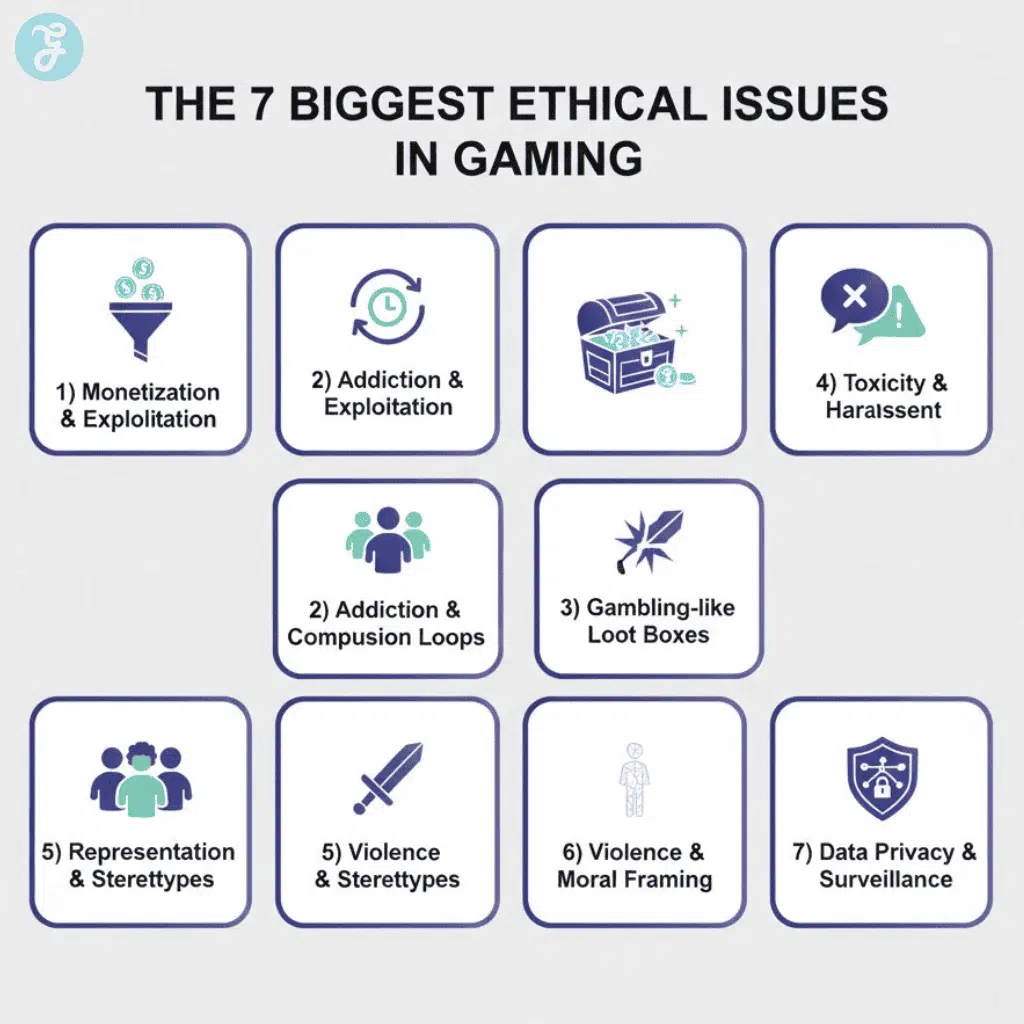
Gambling Like Mechanics and Loot Boxes
Loot boxes, gacha systems, and random card packs raise one of the sharpest ethical debates in gaming. The core issue is that you pay real money for a chance at a desired item, not a guarantee.
This matters because:
- The emotional pattern of “near misses” and rare wins looks a lot like gambling
- Some players spend far more than they planned chasing specific items
- Children can be exposed to these systems long before they can understand odds and self-control
A simple ethical test is: if this exact mechanic were in a gambling app, would it be regulated? If the answer is yes, then a game that uses a similar pattern with a friendlier skin deserves serious scrutiny.
Many players and regulators now call for:
- Clear disclosure of odds
- Stronger age controls around high-risk spending systems
- Options to turn off these features, especially for child accounts
Toxicity, Harassment, and Community Culture
Online multiplayer spaces can be wonderful: teamwork, shared triumphs, and friendships across borders. They can also become hostile, sexist, racist, or deeply abusive.
Ethical concerns include:
- Verbal harassment and slurs in voice and text chat
- Targeted bullying of women, queer players, or players from certain regions
- Doxxing, stalking, and threats that spill into offline life
- Normalization of hateful language as “just how games are.”
Responsibility sits in several places at once:
- Players who decide what they tolerate or amplify
- Developers who design moderation tools, reporting systems, and penalties
- Platforms, which set the tone with their policies and enforcement
An ethical community is not one where everyone is polite all the time. It is one where people can play without fear of identity-based abuse and where harmful behavior is clearly rejected, not silently accepted.
Representation: Who Gets to Exist in Game Worlds?
Games tell stories and create worlds. Which bodies, cultures, and identities appear in those worlds sends a message. So does how they appear.
Ethical questions around representation include:
- Are women always side characters, love interests, or overly sexualized heroes?
- Are certain ethnic or religious groups always cast as enemies or stereotypes?
- Are queer characters present only as jokes or vague hints?
- Do disabled characters exist only as tragic backstories or moral lessons?
Better representation does not mean every game must include every group. It means:
- When a group appears, it is treated as fully human, not as a punchline
- Big genres and platforms make room for more than one kind of hero
- Creators with diverse backgrounds have real power in studios, not only as consultants
As a player, you can ask: whose stories do I keep seeing, and whose stories are almost never told? That awareness is the first step toward demanding richer, more honest worlds.
Violence, Morality, and Emotional Distance
Violence is common in games, from cartoon slapstick to realistic war simulations. Most players know the difference between pixels and real life. Research on direct links between games and real-world aggression is mixed and often overstated.
Ethical questions are more subtle:
- How does the game ask you to feel about violence?
- Is harm treated as serious or as pure spectacle?
- Are there chances to see consequences, regret, or alternative solutions?
- Does the game glorify cruelty or mock victims?
It is not about banning fighting or conflict in stories. Humans have told such stories for thousands of years. It is about how thoughtfully those stories handle power, suffering, and choice.
Data, Privacy, and Surveillance
Modern games often track a lot: play time, click patterns, chat logs, and even voice data. Free-to-play models, live service games, and mobile apps depend heavily on data.
Ethical concerns arise when:
- Players do not clearly know what is being collected
- Data is sold to third parties without meaningful consent
- Voice and image recordings are stored in ways that could be misused
- Children’s data is handled like adults’ data
Good practice includes:
- Plain language privacy policies
- In-game prompts that explain key data uses
- Clear controls for opting out where possible
- Stricter handling of minors’ data
Players can protect themselves by checking permissions, limiting what they share, and speaking up when a game demands access that feels unrelated to play.
Labor, Crunch, and the Human Cost Behind Games
Behind every game you love are teams of artists, programmers, writers, testers, producers, and support staff. Ethical questions do not end at the player. They include:
- Repeated “crunch” periods where staff work long hours with little rest
- Job insecurity in studios that rely on constant hits
- Harassment and discrimination inside workplaces
- Outsourcing to low-paid teams without fair recognition
When you think about the ethics of a game, it is fair to ask: Was this fun built on the back of burnout and exploitation, or on sustainable work?
More players now pay attention to studio reports, worker unions, and public investigations. That pressure can encourage better labor standards and more humane production schedules.
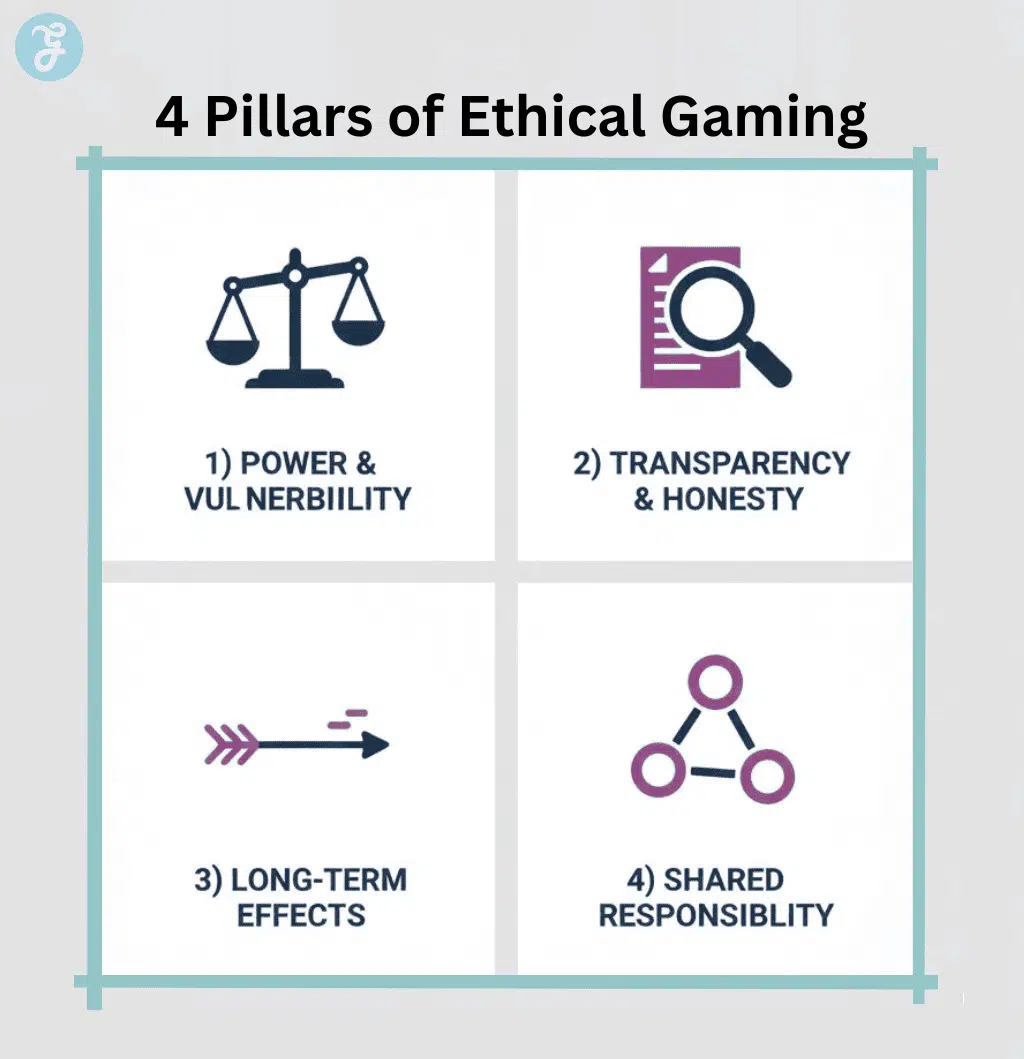
How to Think About Ethical Challenges in Gaming?
Ethical questions are rarely all or nothing. Here are some practical frames you can use to think more clearly.
Look at Power and Vulnerability
Ask who has more power in a situation and who is more vulnerable. For example:
- A large studio designing monetization for children
- An adult player using voice chat with a minor
- A platform deciding how hard to crack down on hate speech
Ethical choices usually push toward protecting the more vulnerable side.
Follow Transparency and Honesty
Is the game or company clear about what it is doing? Hidden odds, buried fees, vague privacy policies, and misleading marketing are strong warning signs. Honest design and honest communication show basic respect.
Think About Long-Term Effects
Ask what happens if a given pattern becomes normal across the whole industry. For instance:
- If every game used gambling like loot boxes, what would that mean for young players?
- If every multiplayer lobby ignored hate speech, what kind of culture would that reward?
Ethical thinking looks beyond one title to the larger habits we are building.
Players, developers, publishers, governments, and parents all have roles. It is easy to place all blame on “the industry” or “the consumers.” Real change usually needs pressure from many sides at once.
As a player, you can:
- Support games with fair monetization and good communities
- Report abuse and back up people who are targeted
- Offer feedback to studios instead of only complaining in private
As a developer or designer, you can:
- Push for clearer odds, fairer systems, and healthier play patterns
- Raise concerns inside your team when something feels off
- Advocate for better work conditions and ethical guidelines