
British-Albanian pop star Dua Lipa, one of the world’s most streamed artists, recently found herself at the center of a media storm. Several UK tabloids claimed that she had fired her agent at William Morris Endeavor (WME), David Levy, over his alleged involvement in a campaign to remove the Irish rap trio Kneecap from the Glastonbury Festival lineup.
According to those reports, Levy signed a confidential email sent to Glastonbury organizers Michael and Emily Eavis and circulated among more than 30 industry professionals. The email allegedly pressured the festival to cancel Kneecap’s set, citing their outspoken pro-Palestinian stance.
The story claimed Dua Lipa, who has consistently positioned herself as an advocate for Palestinian rights, decided that Levy’s reported actions were incompatible with her values. “She is very openly pro-Palestine, and that doesn’t align with David,” one source reportedly told the Mail on Sunday.
However, soon after the story spread, both Dua Lipa and WME strongly denied the claims, calling them misleading and “categorically false.”
Who Are Kneecap and Why the Controversy?
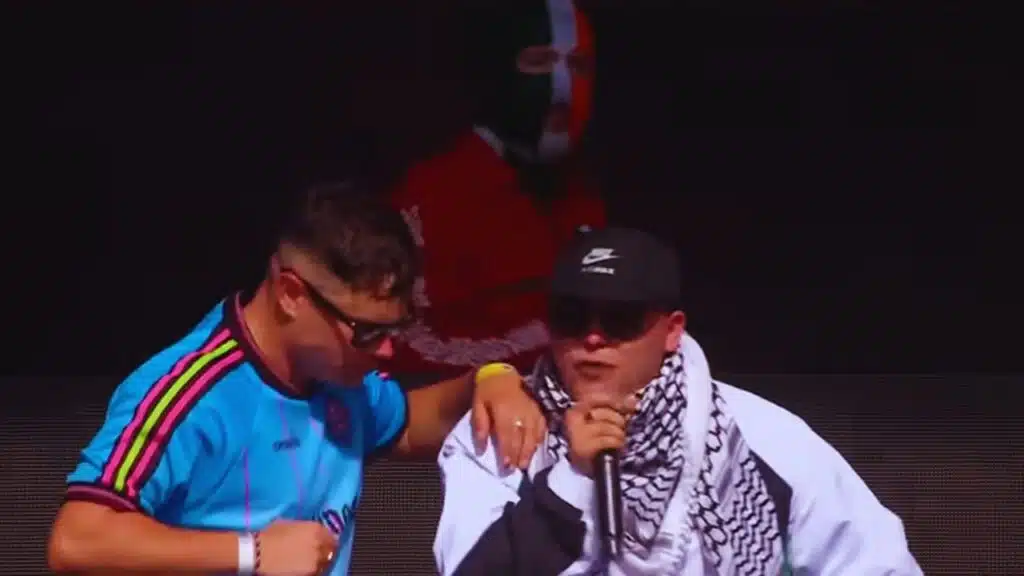
Kneecap is a Belfast-based hip hop trio known for politically charged lyrics that mix Irish and English. Their music frequently criticizes colonialism, police abuse, and, more recently, Israel’s military campaign in Gaza.
- The group’s outspoken support for Palestine has won them praise from activists but also backlash from pro-Israel campaigners.
- In the run-up to Glastonbury 2025, a leaked petition circulated in the music industry, urging organizers to cancel Kneecap’s slot.
- Despite the pressure, Kneecap performed at the festival as scheduled. The BBC chose not to broadcast their set, but thousands watched live at Worthy Farm.
- Following the performance, British police received complaints accusing the band of inciting hatred. After investigation, authorities dropped the case, citing a lack of evidence of any criminal offense.
Kneecap themselves have faced additional challenges beyond Glastonbury: they were previously banned from entering Canada, accused of “glorifying terrorism” — a charge they strongly deny.
What Was Alleged Against David Levy
David Levy, a long-time music agent at WME, reportedly signed the private email pushing for Kneecap’s removal. The letter was said to highlight concerns that the group’s public support for Palestine and criticism of Israel amounted to crossing a line into promoting extremism.
While this email was never officially published, reports suggested it was circulated widely within the industry and later leaked. This raised questions about who initiated the pressure campaign and how much influence agents like Levy could have in shaping festival line-ups.
Adding to the storm, British trip-hop band Massive Attack also cut ties with Levy, citing differences over Gaza. The group has been one of the most outspoken musical acts against Israel’s military actions and has gone further by removing their catalog from Spotify in protest of CEO Daniel Ek’s investment in a defense AI company.
Dua Lipa’s Official Response
As the story gained traction, Dua Lipa issued a direct public statement.
- She branded the headline and reporting as “completely false” and “deliberately inflammatory.”
- She accused sections of the British media of exploiting a humanitarian crisis for clickbait.
- While she condemned any campaign to silence artists like Kneecap, she insisted she had not dismissed David Levy in the way described.
Her agency WME also stepped in with clarification:
- Levy had not been her active agent since 2019, when he moved from London to a different role.
- Since then, he only acted in an advisory capacity and officially removed himself from her project earlier in 2025.
- Therefore, claims that Dua “fired” him this September were misleading — the professional relationship had effectively ended years ago.
Dua Lipa’s Long Record on Palestine
The controversy didn’t come out of nowhere. Dua Lipa has consistently spoken out about the humanitarian crisis in Gaza and has become one of the few global pop stars to openly call out world leaders on the issue.
- In May 2025, she co-signed an open letter urging UK Prime Minister Keir Starmer to end arms sales to Israel, warning that “burning children alive can never be justified.”
- She also joined hundreds of artists, including actors like Jessica Chastain and musicians like Michael Stipe, in demanding a ceasefire in Gaza and the safe release of hostages.
- Her Instagram posts and interviews have repeatedly condemned what she has described as “Israeli genocide” and the killing of civilians.
- Back in 2021, she criticized media outlets for smearing her as antisemitic simply for voicing solidarity with Palestinians.
This history explains why she was so quickly linked to the Kneecap controversy — her advocacy has made her a lightning rod in debates over music, politics, and activism.
Wider Industry Reactions
The story reflects a bigger trend in the entertainment industry: artists and agents are increasingly being judged for their political positions.
- Massive Attack has been consistent in their boycott of Israel, cutting ties with Spotify and demanding their label withdraw music from Israeli platforms.
- Other global artists, including Lorde, Roger Waters, and Macklemore, have faced both backlash and support over similar pro-Palestinian stances.
- On the other side, several artists and executives have openly defended Israel, creating deep divides in the music business.
For Kneecap, the controversy has paradoxically raised their profile, introducing them to new audiences who may not have encountered their politically charged music before.
While early reports painted a dramatic picture of Dua Lipa firing her agent in protest over Kneecap, the truth is more complicated.
- The firing claim is false — both Dua and WME confirmed Levy had stepped away years earlier.
- What is true is that Levy was linked to an email campaign against Kneecap, and that his stance on Gaza has led other artists, like Massive Attack, to distance themselves.
- Dua Lipa remains one of the most prominent pop stars speaking out on Palestine, continuing to use her platform to highlight the humanitarian crisis.
The situation illustrates how music, politics, and global conflicts are colliding more openly than ever — with artists expected to take stands, and their teams being scrutinized for their positions as much as their clients’ own.
The Information is Collected from BBC and MSN.