
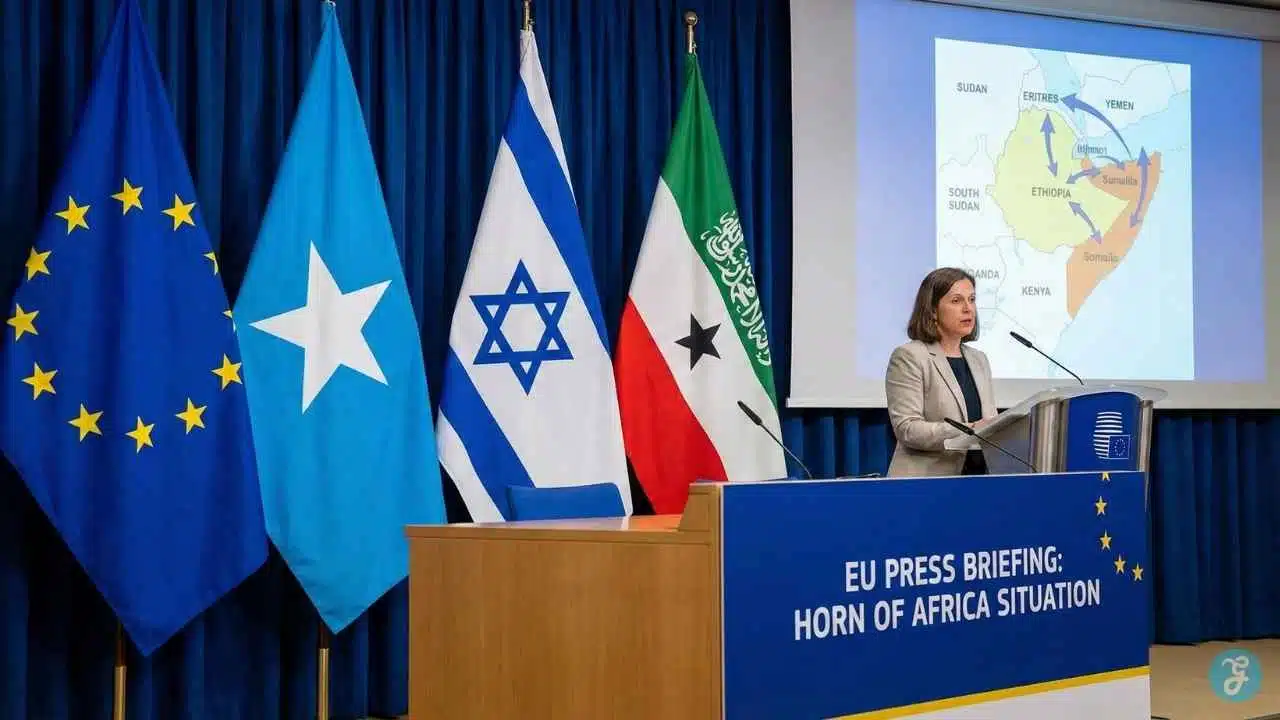
MOGADISHU — In a move that has sent shockwaves through the Horn of Africa and the Middle East, Israel recognizes Somaliland. It has officially become the first United Nations member state to formally recognize Somaliland as an independent, sovereign nation. The historic declaration, signed on December 26, 2025, has triggered an immediate and furious diplomatic backlash, with the European Union (EU) urging calm and throwing its weight behind the Federal Government of Somalia.
The recognition ends 34 years of diplomatic isolation for the breakaway region but has ignited fears of renewed instability in one of the world’s most strategically vital maritime corridors.
The Historic Declaration
The agreement was formalized in Jerusalem, where Israeli Prime Minister Benjamin Netanyahu and Somaliland President Abdirahman Mohamed Abdullahi signed a joint declaration establishing full diplomatic ties. Prime Minister Netanyahu framed the decision as a natural extension of the “spirit of the Abraham Accords,” the U.S.-brokered normalization agreements between Israel and several Arab nations.
“This is a historic milestone,” Netanyahu stated. “Israel and Somaliland share a commitment to freedom, democracy, and security in a volatile region. Our partnership will unlock new opportunities in agriculture, technology, and counter-terrorism.”
For Somaliland, which declared unilateral independence from Somalia in 1991 after the collapse of the Siad Barre regime, the move is the culmination of decades of lobbying. Celebrations erupted in the capital, Hargeisa, where citizens waved Israeli and Somaliland flags, viewing the recognition as a gateway to international loans, foreign investment, and legitimacy.
Somalia’s Fury: “Illegal Aggression”
The reaction from Mogadishu was swift and uncompromising. Somalia’s Federal Government, which considers Somaliland an integral part of its territory, denounced the move as an act of “illegal aggression” and a “direct assault on sovereignty.”
President Hassan Sheikh Mohamud convened an emergency cabinet meeting, promising to pursue all available diplomatic and legal avenues to nullify the recognition. “Somalia’s borders are non-negotiable,” declared a government spokesperson. “Any attempt by a foreign power to carve up our nation will be met with the full weight of our diplomatic resistance. This is a deliberate attempt to legitimize secession and sow discord.”
Mogadishu has also recalled its ambassadors for consultations and threatened to sever ties with any other nation that follows Israel’s lead.
The EU and International Backlash
The European Union moved quickly to contain the diplomatic fallout. In a statement issued Saturday, EU foreign affairs spokesman Anouar El Anouni reaffirmed the bloc’s unwavering support for the “unity, sovereignty, and territorial integrity of the Federal Republic of Somalia.”
“The European Union is following the situation with concern,” El Anouni said. “Respecting existing borders is key to the peace and stability of the entire Horn of Africa region. We encourage meaningful dialogue between Somaliland and the Federal Government of Somalia to resolve long-standing differences, rather than unilateral actions that may exacerbate tensions.”
The EU’s stance mirrors a wave of condemnation from regional powers:
-
Turkey: A close ally of Somalia, Ankara condemned the recognition as “overt interference” and warned that it violates international law.
-
Egypt: Cairo, deeply involved in Horn of Africa geopolitics, rejected the move, viewing it as a threat to the stability of the Red Sea corridor.
-
African Union (AU) & IGAD: Both bodies reiterated their long-standing policy of respecting colonial-era borders to prevent a “domino effect” of secessionist movements across the continent.
-
United States: Despite the “Abraham Accords” framing, the U.S. State Department clarified that it continues to recognize Somalia’s territorial integrity within its 1960 borders.
The Proxy War: A New Front for Turkey and Egypt
While the European Union focuses on diplomatic norms, the reaction from regional heavyweights Egypt and Turkey reveals a deeper, more volatile power struggle. For both nations, Israel’s presence in Somaliland is not just a diplomatic annoyance—it is a direct strategic threat.
Turkey’s Deep Entrenchment
Turkey has spent over a decade cultivating a role as Somalia’s primary patron. Ankara operates its largest overseas military base, Camp TURKSOM, in Mogadishu and manages the capital’s port and airport.
-
The Threat: Turkish officials view Israel’s recognition of Somaliland as a hostile attempt to outflank Turkey’s influence in the Horn. By engaging with Somaliland, Israel effectively bypasses Mogadishu, undermining the central government that Turkey has spent billions to prop up.
-
The Statement: The Turkish Foreign Ministry did not mince words, accusing Israel of “expansionist policies” intended to encircle Turkey’s allies. Analysts warn that this could lead to a “proxy confrontation,” where Ankara increases advanced drone shipments to Mogadishu to counter any Israeli military buildup in Hargeisa.
Egypt’s Nile Anxiety
For Cairo, the stakes are existential and tied to the waters of the Nile. Egypt is already locked in a bitter cold war with Ethiopia over the Grand Ethiopian Renaissance Dam (GERD).
-
The Alignment: Ethiopia has long been Somaliland’s closest partner, relying on its ports for trade. Egypt fears that an Israel-Somaliland-Ethiopia axis is forming, which could encircle Egypt from the south.
-
The Red Line: Egyptian President Abdel Fattah el-Sisi has previously warned that Somalia is a “red line” for Egyptian national security. With Israel now formally entering the fray, Cairo fears a “security pincer” in the Red Sea, where Israeli intelligence could operate unchecked on both sides of the Bab el-Mandeb strait (from Eilat in the north and Berbera in the south).
Strategic Analysis: Why Now?
Analysts suggest Israel’s move is driven by hard-nosed security calculations rather than pure diplomacy. Somaliland sits on the Gulf of Aden, bordering the Bab el-Mandeb strait—a critical choke point for global shipping that has been besieged by Houthi attacks from Yemen.
By recognizing Somaliland, Israel gains a potential strategic ally with 460 miles of coastline, offering a vantage point to monitor Red Sea traffic and counter threats from Iran-backed groups. Additionally, Somaliland’s Port of Berbera is emerging as a major logistics hub, offering an alternative trade route to the Suez Canal.
However, the gamble is high. The move risks alienating Israel further from the Muslim world at a time when it is seeking to normalize relations with Saudi Arabia and others.
Port Politics: The Battle for Berbera and the Death of Djibouti’s Monopoly
Beyond the diplomats and generals, the loudest alarms are ringing in the boardrooms of global logistics giants. The recognition of Somaliland threatens to upend the maritime economy of East Africa, specifically endangering the monopoly long held by the tiny nation of Djibouti.
The Berbera Breakout
Somaliland’s crown jewel is the Port of Berbera, a deep-water facility that has received hundreds of millions of dollars in investment from UAE-based logistics giant DP World.
-
The Israeli Angle: With formal recognition, Israel can now openly invest in linking Berbera to the wider global economy. Israeli technology firms have reportedly already proposed modernizing the port’s digital customs infrastructure, aiming to turn it into a high-tech rival to Djibouti’s Doraleh Container Terminal.
-
Economic Independence: For decades, landlocked Ethiopia has been forced to ship 95% of its trade through Djibouti, paying billions in fees. An Israeli-backed Somaliland offers Ethiopia a viable, cheaper alternative. This economic shift would devastate Djibouti’s economy, potentially destabilizing another key Western ally in the region.
China’s “Iron Silk Road” Concern
Beijing is watching with undisguised hostility. China maintains its only overseas military base in Djibouti, just a few hundred miles from Somaliland.
-
The Surveillance Fear: Chinese intelligence officials have reportedly briefed counterparts in Beijing that an Israeli presence in Somaliland could serve as a “listening post” to monitor Chinese naval movements in the Gulf of Aden.
-
The Debt Trap Reversal: Somaliland has aggressively courted Taiwan (which also maintains a representative office in Hargeisa). Israel’s entry strengthens this “anti-Beijing” coalition, offering African nations a development model that doesn’t rely on Chinese loans, a narrative Beijing is desperate to squash.
Rumors and Radicalization: The Al-Shabaab Threat
While the diplomatic world debates borders, the situation on the ground risks descending into violence due to a potent mix of rumors and radicalization.
The “Resettlement” Conspiracy
In the weeks leading up to the announcement, unverified reports circulated widely on social media claiming that Israel’s recognition was part of a secret deal to resettle Palestinians from Gaza into Somaliland.
-
The Denial: Both Hargeisa and Jerusalem have vehemently denied these claims, calling them “malicious disinformation” designed to incite anger. Somaliland’s Foreign Minister stated on record: “Our land is for our people; we are not a dumping ground for the world’s displaced.”
-
The Damage: Despite the denials, the rumor has taken root in the radical fringes of the region, providing fresh fuel for anti-Somaliland sentiment in the south.
Al-Shabaab’s New War Cry
For the Al-Qaeda-linked terror group Al-Shabaab, Israel’s move is a propaganda gift. The group, which has been losing ground to Somali government offensives, has immediately pivoted its messaging.
-
The Message: In a chilling audio broadcast released shortly after the signing, Al-Shabaab leadership declared Somaliland an “occupied zone of the Zionists” and vowed to target anyone collaborating with the “new colonizers.”
-
The Risk: Security experts fear this will lead to a spike in suicide bombings in Hargeisa, a city that has been remarkably safe for over a decade. The recognition may have bought Somaliland legitimacy, but it has also painted a target on its back, forcing Israel to likely commit intelligence and security assets to protect its new partner from terror reprisals.
What Comes Next?
As the dust settles, the focus shifts to whether other nations will follow Israel’s lead. Somaliland officials have expressed hope that the “taboo” of recognition has been broken, potentially paving the way for the UK or smaller nations to upgrade ties.
For now, however, the Horn of Africa faces a new period of uncertainty. With Somalia vowing to defend its territory and Somaliland emboldened by its first major diplomatic win, the path to the “meaningful dialogue” urged by the EU looks steeper than ever.