In the next wave of digital transformation, decentralized identity tools are quietly becoming as important as emails and logins once were. Passwords are leaking, centralized databases keep getting hacked, and AI-generated deepfakes are blurring the line between real and fake.
At the same time, regulators want stronger know-your-customer (KYC) checks, while users demand more privacy and control. That tension is exactly where self-sovereign identity platforms and blockchain-based digital identity step in.
Instead of trusting one big provider to hold everyone’s data, decentralized identity lets people carry their own verifiable credentials in secure digital wallets. They share only what is needed, only when it is needed, and they can prove it cryptographically.
Why Decentralized Identity Is Suddenly Everywhere
For years, digital identity meant logging into a website with a password or a social login.
That model is under pressure from several directions:
- Data breaches have exposed billions of records.
- AI deepfakes can mimic faces and voices.
- Regulators demand stricter privacy, consent, and data minimization.
- Users want more control over their personal information.
Decentralized identity flips the model:
- Credentials are issued by trusted entities (universities, employers, banks).
- Users store those credentials in their own digital identity wallets.
- Verifiers check cryptographic proofs instead of pulling raw data from a central database.
This creates a “trust triangle”: issuer, holder, verifier. The trust does not come from a single platform but from cryptography, open standards like W3C Decentralized Identifiers (DIDs), and verifiable credentials (VCs).
The result is a new breed of decentralized ID platforms that work across borders, apps, and even blockchains.
How We Chose These 12 Decentralized Identity Tools
The market for decentralized identity is crowded and evolving fast.
To focus this list, we used four simple criteria:
- Standards-first approach: Tools that support or align with open standards such as W3C DIDs and verifiable credentials.
- Real-world adoption or strong pilots: Enterprise deployments, government trials, or active use in Web3 ecosystems.
- Ecosystem and developer traction: SDKs, APIs, integrations, and partnerships that signal long-term viability.
- Privacy and user control: Clear attention to data minimization, selective disclosure, and user consent.
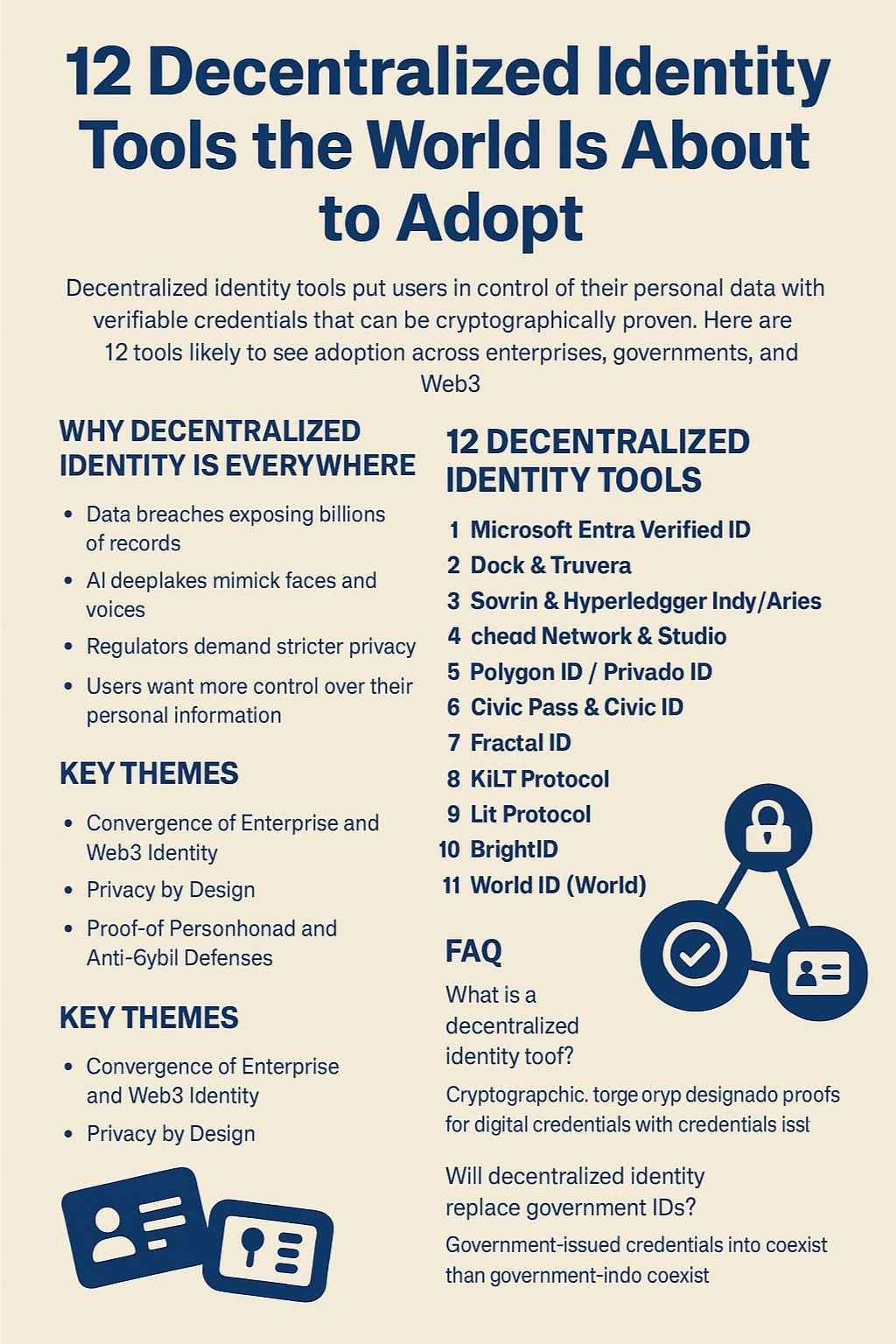
With that lens, here are 12 decentralized identity tools that are likely to be adopted at scale – from large enterprises to Web3-native communities.
Enterprise & Government-Grade Decentralized Identity Tools
Let’s introduce decentralized identity platforms designed for large organizations, public institutions, and regulated industries. These tools focus on scalability, compliance, verifiable credentials, and seamless integration with existing identity systems—making them suitable for governments, enterprises, and high-trust environments.

1. Microsoft Entra Verified ID – DIDs Inside the Enterprise Stack
Microsoft’s Entra Verified ID brings decentralized identity directly into the corporate IT world. It is built to work with Azure and the broader Microsoft ecosystem.
How it works
- Organizations issue verifiable credentials to employees, partners, or customers.
- These credentials are stored in a user-controlled wallet.
- When needed, the user shares a proof (for example, “I work at X” or “I’m over 18”) without handing over raw documents.
Why it matters
- It integrates with existing identity and access management tools.
- IT teams can adopt decentralized identity without replacing everything.
- Use cases range from employee credentials and visitor passes to education certificates.
Adoption potential
Microsoft already sits at the center of many identity flows. By embedding decentralized identity tools into familiar services, it lowers the barrier for enterprises and governments that want to experiment with self-sovereign identity while staying in a managed environment.
2. Dock & Truvera – Full-Stack SSI for Business
Dock focuses on making self-sovereign identity platforms practical for real-world organizations. Its Truvera offering adds user-friendly tools on top of the underlying protocol.
Key features
- Issue and manage verifiable credentials through dashboards or APIs.
- Verify credentials instantly without storing sensitive data.
- Support for compliance-heavy use cases like healthcare, HR, and supply chain.
Why businesses like it
- It offers a clear path from “Web2 spreadsheets and PDFs” to decentralized identity.
- Developers can integrate Dock’s SDKs to add privacy-preserving identity verification to existing apps.
- Non-technical teams can still manage credential lifecycles via no-code interfaces.
Dock and Truvera are strong contenders for companies that want an enterprise decentralized identity without building everything from scratch.
3. Sovrin & Hyperledger Indy/Aries – The Public Utility Model
Sovrin, built on Hyperledger Indy and Aries, represents an early and influential vision: a global public utility for identity.
What sets it apart
- Designed as a public permissioned ledger for DIDs and credentials.
- Places governance at the core, with stewards and trust anchors maintaining network rules.
- Strong alignment with open standards and interoperability.
Use cases
- Government-backed digital credentials.
- Cross-border education and professional certifications.
- Identity scenarios where trust frameworks and legal compliance matter as much as cryptography.
Sovrin may not be the easiest starting point for startups, but its model is important: it shows how decentralized identity can be treated as shared infrastructure rather than a proprietary product.
4. cheqd Network & Studio – Business Models for Credentials
cheqd is a decentralized network purpose-built for verifiable credentials and decentralized identifiers. On top of it, cheqd Studio provides tools for issuing and managing credentials.
Core ideas
- Allow organizations to issue reusable, privacy-preserving credentials.
- Let issuers and verifiers build sustainable business models around trust – for example, paying for verified data while respecting user control.
- Support multiple DID methods and flexible credential schemas.
Why it’s interesting
Cheqd is not just a tech stack; it experiments with tokenized incentives for identity data. In a world where data is valuable but heavily regulated, this approach could help align businesses, users, and verifiers.
Web3 Identity Infrastructure & Developer Stacks
You’ll find decentralized identity solutions built specifically for blockchain ecosystems, smart contracts, and digital assets. These tools power trustless verification, zero-knowledge proofs, and cross-chain identity. They enable developers to embed identity features inside dApps, DeFi platforms, and metaverse applications.
5. Polygon ID / Privado ID – Zero-Knowledge Identity for Web3
Polygon ID (now evolved as Privado ID) brings zero-knowledge proofs into decentralized identity. It targets Web3 developers who need strong privacy and compliance at the same time.
How it works
- Identities are represented as DIDs.
- Attributes (like age, residency, or KYC status) become verifiable credentials.
- Users can prove facts about themselves without revealing underlying data, thanks to zero-knowledge cryptography.
Why Web3 cares
- DeFi projects can enforce “KYC-verified only” or “one human, one account” rules.
- Gaming and NFT platforms can restrict access by region or age without collecting sensitive documents.
- Compliance is possible without recreating centralized KYC silos.
For developers, Polygon/Privado ID functions as a Web3 identity infrastructure layer that plugs directly into smart contracts and dApps.
6. Civic Pass & Civic ID – Regulated Web3 Onboarding
Civic has evolved from “identity startup” to a provider of decentralized identity tools for regulated Web3.
Key components
- Civic Pass – reusable identity credentials for KYC, AML, and sanctions screening.
- Civic ID – a user-centric identity layer that works across multiple chains.
- Wallet-based login and credential checks integrated into DeFi, NFT, and gaming platforms.
Why it matters
- Makes compliance more manageable for Web3 protocols.
- Reduces the need for every project to run its own KYC operation.
- Users can reuse their credentials instead of repeating checks each time.
Civic sits at the intersection of decentralized identity, financial regulation, and mainstream adoption of crypto.
7. Fractal ID – Chain-Agnostic KYC, KYB & Proof of Personhood
Fractal ID positions itself as a chain-agnostic identity stack for decentralized applications. It combines traditional verification with privacy-preserving identity.
What it offers
- KYC (individuals) and KYB (businesses) verification.
- Identity data is encrypted and stored in a dedicated data layer, often described as an “identity operating system”.
- Credentials and proof-of-personhood that users can reuse across multiple dApps.
Why it stands out
- Works across multiple chains and ecosystems.
- Designed to avoid centralizing raw identity data while still providing strong verifications.
- Supports use cases like token sales, gated communities, and on-chain reputation.
Fractal ID reflects a broader shift towards decentralized ID platforms that serve both compliance and user autonomy.
8. KILT Protocol – Polkadot’s Identity Powerhouse
KILT Protocol is a blockchain built specifically for self-sovereign, verifiable credentials within the Polkadot ecosystem.
Core features
- Issue, hold, and verify credentials in a decentralized way.
- Support for selective disclosure and revocation.
- Integration with wallets and parachains for a seamless user experience.
Use cases
- Identity for DeFi projects on Polkadot.
- Reputation in DAOs and online communities.
- Credentials for gaming, metaverse projects, and beyond.
KILT shows how an entire ecosystem can standardize on one decentralized identity protocol to reduce fragmentation.
9. Lit Protocol – Programmable Encryption as Identity Infrastructure
Lit Protocol is not an identity wallet or a credential issuer in the traditional sense. Instead, it provides decentralized key management and access control – a crucial building block for identity-centric applications.
How it fits into decentralized identity
- Data is encrypted and can only be decrypted when certain conditions are met.
- These conditions can be on-chain (token ownership, DAO roles) or linked to verifiable credentials.
- As a result, access to content or actions depends on who you are and what you hold – not on a central server.
Why is it on this list?
As more apps rely on privacy-preserving identity verification, having a decentralized way to enforce rules is essential. Lit functions as a programmable gatekeeper, making identity a core part of encryption and access.
Proof-of-Personhood & Social Identity Networks
These identity tools focused on proving human uniqueness rather than legal identity. These platforms combat bots, fraud, and Sybil attacks by verifying individuals through networks, biometrics, or social connections. They’re becoming essential as AI makes distinguishing real users from automated ones increasingly difficult.

10. BrightID – Social Graph-Based Proof of Uniqueness
BrightID is a decentralized social identity network focused on one thing: proving each person is unique without asking for documents or biometrics.
How it works
- Users connect with friends and contacts inside the BrightID network.
- The resulting social graph is analyzed to detect clusters and suspicious patterns.
- Projects can then use proof-of-personhood checks to avoid Sybil attacks and fake accounts.
Why it matters
- Useful for airdrops, voting, reputation systems, and UBI experiments.
- Preserves privacy because it does not require passports, selfies, or iris scans.
- Offers an alternative approach to “human verification” in an AI-driven world.
BrightID demonstrates that proof-of-personhood protocols do not have to rely on government IDs or sensitive biometrics.
11. World ID (World) – Biometric Identity Under the Microscope
World ID, developed by the team behind Worldcoin (now increasingly branded as “World”), uses biometric proof-of-personhood to create a global identity graph.
Basic concept
- Users scan their iris using a device known as the Orb.
- The biometric pattern is turned into a unique cryptographic code.
- The system issues a credential that can be used to prove “I am a unique human” without revealing who you are.
Why is it controversial
- Critics worry about biometric data collection, consent, and long-term safety.
- Regulators in several regions have raised questions or imposed restrictions.
- Supporters argue it could provide a robust defense against bots, fake accounts, and AI-driven identity fraud.
Whatever its final form, World ID forces a global conversation about how far decentralized identity tools should go in verifying humans.
Identity as Naming & Presence in Web3
Let’s explain how naming systems act as the “username layer” of decentralized identity. These tools turn cryptographic addresses into human-readable identities, helping users build reputation, social presence, and cross-chain discoverability throughout the Web3 ecosystem.
12. SPACE ID – Cross-Chain Naming as an Identity Layer
SPACE ID focuses on Web3 naming services, but its role in decentralized identity is bigger than it looks at first glance.
What it does
- Offers human-readable names that map to wallet addresses and profiles.
- Works across multiple chains, helping unify cross-chain identity.
- Provides SDKs and APIs so dApps can use names instead of raw addresses.
Why it matters for identity
- Names make identity more understandable and memorable for humans.
- Combined with decentralized ID platforms, names can carry reputations, credentials, and social presence.
- It helps build a layer where people, brands, and communities can be recognized across the wider Web3 landscape.
In many ways, naming systems like SPACE ID act as the “username layer” for decentralized identity.
What These 12 Tools Tell Us About the Future of Identity
Looking across these decentralized identity tools, a few clear themes emerge.
1. Convergence of Enterprise and Web3 Identity
Large players like Microsoft and emerging platforms like Dock and cheqd target enterprises and governments. At the same time, tools like Polygon ID, Fractal ID, KILT, and Lit Protocol focus on Web3-native use cases.
Over time, those worlds are likely to merge:
- Employees will use decentralized identity wallets to access both corporate resources and Web3 services.
- The same credentials could unlock office buildings, banking apps, and decentralized finance platforms.
2. Privacy by Design
Almost all tools emphasize privacy-preserving identity verification:
- Zero-knowledge proofs for selective disclosure.
- Off-chain storage for sensitive data.
- Minimal on-chain footprints to avoid tracking.
Instead of collecting more data, the trend is toward proving only what is necessary.
3. Proof-of-Personhood and Anti-Sybil Defenses
BrightID and World ID show that identity is no longer just about names or passports. In a world full of bots, the most important question becomes: Is this a real person, and are they unique?
Future decentralized ID platforms will likely mix:
- Social graph approaches (BrightID).
- Biometric or hardware-based proofs (World ID and similar).
- Credential-based proofs (Polygon ID, Fractal ID).
Key Risks, Open Questions, and Policy Battles
Despite the progress, decentralized identity is far from a solved problem.
Privacy and Surveillance Concerns
If misused, even privacy-focused tools could become engines of surveillance.
The biggest risks include:
- Centralized control over wallets or key infrastructure.
- Hidden tracking through metadata or on-chain patterns.
- Pressure from governments or corporations to link all credentials together.
The promise of self-sovereign identity depends on genuine user control and transparent governance.
Governance and Interoperability
There is still no single global standard for:
- How governance should work in identity networks.
- Which DID methods will dominate?
- How different wallets, chains, and protocols will interoperate in practice.
If each ecosystem builds its own closed silo, users will lose many benefits of decentralized identity tools.
UX and Key Management
From a user standpoint, key management is still a challenge:
- What happens when someone loses their wallet or device?
- How can recovery work without recreating centralized authorities?
- How do we design simple, friendly interfaces for complex cryptography?
Until UX improves, many people will still rely on traditional logins, even if better options exist.
How Businesses, Governments, and Users Can Prepare
Even though this space is evolving, there are practical steps different stakeholders can take now.
What Businesses Can Do
- Start small with verifiable credentials: Use cases like employee IDs, supplier certifications, or training records are low-risk entry points.
- Integrate with existing IAM systems: Tools like Microsoft Entra Verified ID and Dock reduce the need for disruptive overhauls.
- Think in terms of ecosystems, not just apps: Design identity flows that work across partners, supply chains, and customer journeys.
What Governments and Regulators Can Do
- Encourage open standards rather than vendor lock-in.
- Build digital identity frameworks that allow self-sovereign identity platforms to interoperate with national IDs.
- Set clear rules for biometric data, consent, and data portability.
What Users Should Look For
When choosing decentralized ID platforms or digital identity wallets, users can ask:
- Who controls the keys – me or the platform?
- What goes on-chain, and what stays off-chain?
- Can I move my credentials to another wallet if I want to?
A simple rule of thumb: the more control you have over your keys and data, the closer you are to true self-sovereign identity.
FAQ: Decentralized Identity Tools and the Future of Digital Trust
What is a decentralized identity tool?
A decentralized identity tool is any platform, wallet, or protocol that lets you create, store, and present digital credentials without relying on a single central authority. It uses technologies like DIDs, verifiable credentials, and sometimes blockchains to provide secure, verifiable proofs of identity.
How is decentralized identity different from traditional single sign-on (SSO)?
Traditional SSO (like logging in with a social account) relies on a central provider that holds your data and can see where you log in. Decentralized identity lets you store your own credentials and present proofs directly to services. You control what you share, and there is no single provider tracking all your activity.
Are decentralized identity platforms compatible with privacy laws like GDPR?
Many decentralized identity tools are designed with privacy laws in mind. By keeping personal data off-chain, reducing data sharing, and enabling selective disclosure, they can support data minimization and user consent — key principles in regulations like GDPR.
Will decentralized identity replace government IDs?
In most cases, it is more likely to coexist. Governments can become issuers of verifiable credentials that people store in their own wallets. Those credentials then work alongside other proofs, such as employer IDs, education records, and Web3 reputations.
How can users safely manage their decentralized ID wallets and credentials?
Best practices include:
- Use reputable wallet apps from known decentralized ID platforms.
- Backing up recovery phrases or keys securely.
- Enabling multi-factor or hardware-based protections where possible.
- Regularly review which apps and services have access to your credentials.
Bottom Line: Decentralized Identity Tools the World Is About to Adopt
As data breaches rise and AI-generated identities grow more convincing, trust is becoming the most valuable currency online. The 12 decentralized identity tools hint at what comes next: a world where users hold their own digital identities, credentials cross borders and platforms, and trust is verified cryptographically—not guessed or assumed.