The idea of a “console generation” used to feel clean and predictable. A new box launched. Graphics jumped. Developers learned the hardware. Exclusive games arrived to prove the upgrade. Then, years later, the cycle repeated.
That rhythm is breaking. Not because consoles vanish, but because the box no longer sits at the center of the strategy. In 2026, the real competition is not device versus device. It is ecosystem versus ecosystem.
An ecosystem is bigger than a console. It is your account, your friends list, your library, your cloud saves, your subscription perks, your cross-play access, your store wallet, and the way your games follow you from living room to laptop to handheld to phone. When that layer becomes the primary value, “generations” stop being the organizing principle.
This article explains why 2026 is the year of ecosystems, what forces pushed gaming here, what it means for players and creators, and how to think about your next hardware decision in a world that no longer resets every seven years.
What “Console Generation” Used To Mean

A console generation was a shared agreement between platform holders, publishers, retailers, and players.
A company released new hardware with a clear performance jump. Games moved to a new baseline. The old console kept getting support for a while, then slowly faded. At the end, late-generation blockbusters squeezed every last drop out of the machine, and the next leap began.
That structure gave everyone clarity.
Players knew when it made sense to upgrade. Developers knew which target mattered. Stores knew which shelf space to prioritize. Marketing teams knew how to frame the story, because “next gen” did half the work for them.
The Classic Cycle
Most generations followed a familiar arc.
The first year focused on launch titles and upgraded versions of popular franchises. The next phase brought the first wave of true exclusives built for the new hardware. Later came price cuts, bundles, and a larger install base. Toward the end, developers shipped their most ambitious projects, often after years of learning the system’s strengths.
This cycle rewarded patience. It also rewarded loyalty, because switching platforms often meant leaving a library behind.
The Hidden Cost Of Generations
The traditional model had friction baked in.
It split communities. Friends upgraded at different times. Multiplayer games fractured into older and newer pools. Cross-generation play helped, but it rarely solved everything.
It also punished purchases. Players rebuilt libraries through remasters, re-releases, and upgraded editions. Controllers, headsets, storage expansions, and accessories often needed replacement. Even when backward compatibility existed, it did not always feel seamless.
As digital storefronts grew, the psychological cost became clearer. People stopped thinking in terms of “games I own on a disc” and started thinking in terms of “my account library.” Once that shift happened, a hard reset began to feel like a bad deal.
Why 2026 Marks The Turning Point
Gaming did not wake up one morning and abandon generations. This change arrived through a series of small expectation upgrades that stacked into something bigger.
By 2026, those expectations have matured into a new baseline. Players want continuity, not resets. They want the freedom to play across devices. They want their purchases, progress, and social graphs to persist.
Most importantly, platform companies want recurring engagement more than one-time hardware spikes. That incentive drives everything.
Ecosystems Beat Devices On Convenience
Convenience is the quiet killer of old models.
If a game lets you move from TV to handheld to laptop without restarting, you will value that more than a small graphics boost. If your progress follows you automatically, you will notice the platforms that make it painless.
Cross-save and cross-progression used to be premium features. Now they are table stakes for many major titles. The more players experience that continuity, the less they tolerate closed walls.
The same is true for social systems. People expect unified friends lists, parties, messaging, and voice that function across devices. When your group chat lives in the ecosystem, not the box, the ecosystem becomes the home.
Subscription Gravity Changes Player Behavior
Subscriptions reshape how people choose games.
In a buy-first world, players researched more, waited for reviews, and purchased fewer titles at full price. In an access-first world, people sample more, churn faster, and follow trends through discovery feeds.
Subscriptions also change risk tolerance. A player may try a niche strategy game or a smaller narrative title because it costs nothing extra in the moment. That behavior boosts engagement inside the ecosystem. It also strengthens the subscription’s perceived value.
By 2026, many players treat subscriptions as the default way to explore. They still buy favorites, expansions, and cosmetics, but discovery happens through access.
Cloud And Remote Play Stop Being “Extra”
Cloud gaming does not need to replace local hardware to change the market. It only needs to extend the ecosystem.
In 2026, the cloud functions as a bridge. It helps players continue a session when they leave the living room. It lets someone try a game before downloading. It supports quick access on lower-power devices. It turns a phone into a portal to the same library.
Remote play reinforces the same pattern. Even when the game runs locally on a console in your home, the experience feels like “my games follow me.” That feeling trains players to value ecosystem continuity more than a single device’s identity.
Handheld PCs And Hybrid Devices Blur The Category
Handheld gaming exploded as a mainstream category because it solved a simple need: play anywhere without sacrificing depth.
These devices also blur the line between PC and console experiences. They boot into game-friendly interfaces. They support controllers natively. They stream from cloud services. They dock to TVs. They normalize switching contexts.
The result is not “handheld replaces console.” The result is “hardware becomes a shape,” while the ecosystem becomes the constant.
The Creator Economy Pulls Platforms Toward Services
Modern gaming lives on feeds.
Clips, highlights, streams, community challenges, mods, and user-generated content push attention through social platforms. That environment favors games and platforms that treat content as a service layer, not an afterthought.
When a platform helps you capture, edit, share, and discover content effortlessly, it strengthens the ecosystem. When a game supports creator tools, in-game events, and community hubs, it keeps players engaged longer.
This is another reason generations fade. Creator-driven attention does not reset with new hardware. It flows wherever the community lives.
The Big Shift: From Hardware Wars To Ecosystem Wars
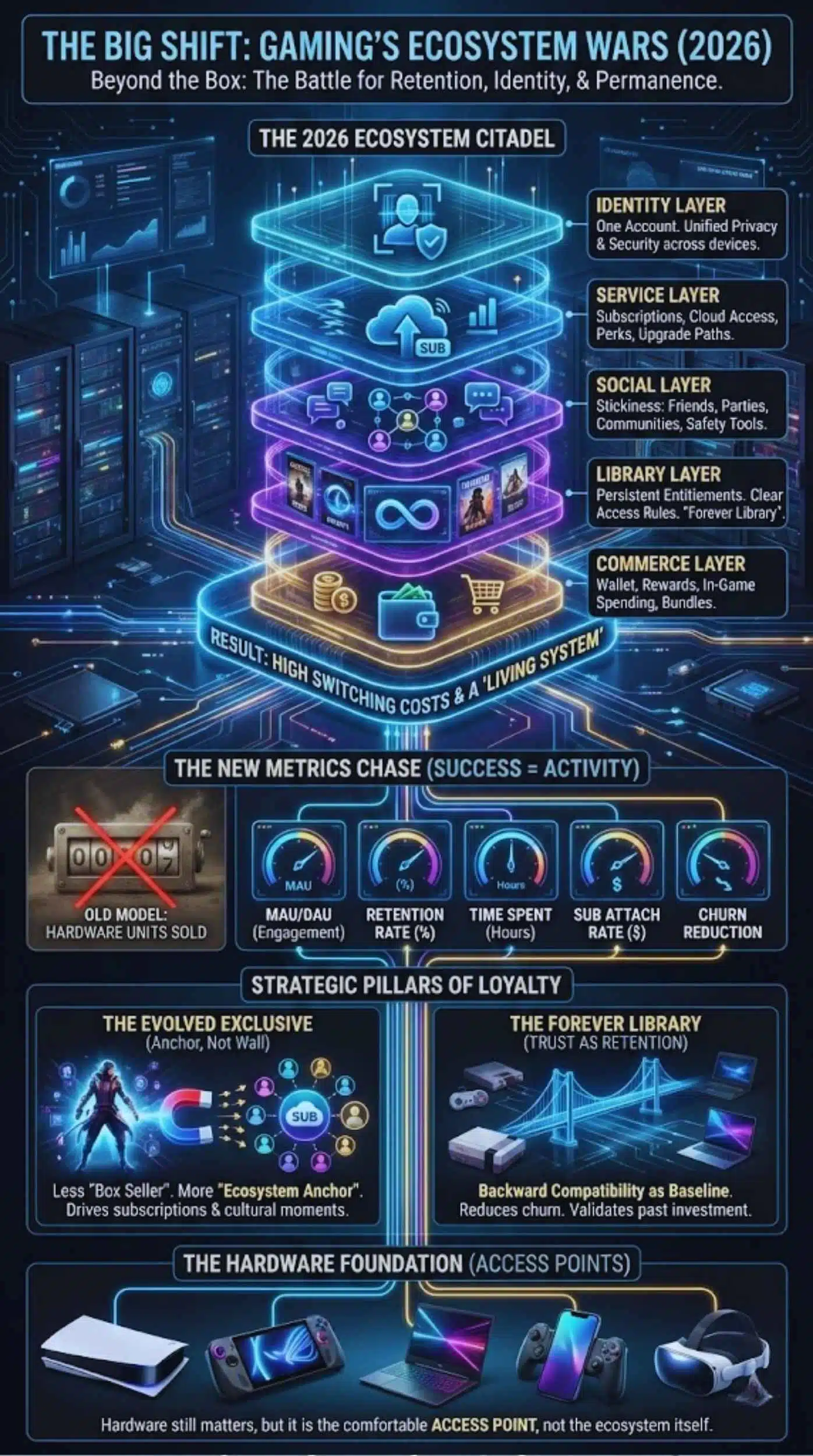
The industry still markets boxes, but the strategy centers on retention.
An ecosystem war is a battle for identity, library permanence, social stickiness, and recurring revenue. Hardware still matters, but it often functions as the most comfortable way to access the ecosystem, not the ecosystem itself.
What Defines An Ecosystem In 2026
A strong gaming ecosystem typically includes these layers:
- Identity Layer: One account across devices, with unified privacy and security.
- Library Layer: Purchases and entitlements that persist, plus clear access rules.
- Service Layer: Subscriptions, cloud access, perks, and upgrade paths.
- Social Layer: Friends, parties, messaging, communities, and safety tools.
- Commerce Layer: Wallet, rewards, bundles, add-ons, and in-game spending.
When these layers work together, the platform becomes a living system. Players invest time and money into it, which raises switching costs. That is exactly what companies want.
The Metrics Companies Actually Chase Now
In a generation model, success looked like hardware units sold. In an ecosystem model, success looks like activity.
Platforms focus on monthly active users, daily engagement, retention, time spent, and subscription attach rate. They measure how many players return, how often they play, and what keeps them inside the ecosystem.
This shift changes product decisions. A platform may prioritize features that reduce friction, because friction hurts retention. It may prioritize backward compatibility, because library loss drives churn. It may push subscriptions, because recurring revenue smooths the business cycle.
Why Exclusives Matter Less, And More
Exclusives have not disappeared. Their job changed.
Less: Exclusives As A “Box Seller” Decline
A platform can reach more people by releasing games across multiple devices and storefronts. It can also support a longer tail of revenue by meeting players where they already spend time.
In that context, exclusives matter less as a reason to buy a box on day one. They matter less as a hard wall.
More: Exclusives As An “Ecosystem Anchor”
Exclusives matter more as a reason to subscribe, stay, and engage.
A flagship title can drive a wave of sign-ups. It can also create a cultural moment that pulls friends into the same ecosystem. Even timed exclusives can serve this function, because the early window often captures the strongest attention.
In 2026, the key question is not “does this game sell consoles.” The key question is “does this game deepen ecosystem loyalty.”
The Role Of Backward Compatibility And “Forever Libraries”
Library permanence is one of the most powerful ecosystem promises.
Players now expect their purchases to survive hardware transitions. They want to trust that the library they build today still matters years from now. When that trust breaks, people hesitate to buy digitally.
Backward Compatibility As The New Baseline
Backward compatibility is no longer a nice feature. It is a retention tool.
When a platform supports older titles smoothly, players keep their library active. They revisit classics. They try games they missed. They stay subscribed longer because the catalog feels deeper.
Backward compatibility also supports cross-generation communities. It reduces the pain of staggered upgrades. That makes the whole ecosystem more resilient.
“Entitlements” Replace Physical Discs
Digital ownership runs on entitlements. Your account holds the license. Your device simply verifies access.
That model enables portability, but it also introduces new anxieties. Games can be delisted. Online checks can fail. Terms can change. Players respond by trusting platforms that communicate clearly and preserve access reliably.
In 2026, “forever library” messaging is not just marketing. It is a competitive advantage.
PC’s Quiet Takeover Without Killing Consoles Overnight
PC did not win by defeating consoles head-on. It won by becoming the flexible center of the ecosystem era.
PC supports more storefronts, more devices, more input options, and more upgrade paths. It also pairs naturally with handheld PCs and streaming.
Still, consoles remain strong because they offer simplicity, optimization, and living room comfort. The relationship is not binary. It is convergent.
PC As The Universal Ecosystem Hub
PC acts like a hub because it adapts.
Players can build a setup that fits their budget. They can upgrade over time. They can play with keyboard and mouse or controller. They can stream, mod, and create content using the same machine.
The drawback is fragmentation. Multiple launchers, stores, and account systems can create friction. That friction opens space for ecosystems that unify experiences across devices.
Consoles Becoming “Curated PCs”
Modern consoles increasingly resemble curated PC experiences.
They offer streamlined interfaces, standardized performance targets, and simple social features. They prioritize instant resume, couch-friendly navigation, and predictable optimization.
For many players, that reliability matters more than raw specs. It also fits the ecosystem era, because a console can become the best “living room endpoint” for the same account and library.
Mobile Is The Missing Piece Of The Ecosystem Puzzle
Mobile does not need to run every blockbuster game locally to matter. It just needs to connect.
In 2026, mobile devices often serve as companion screens, streaming endpoints, social hubs, and commerce tools. That role reinforces ecosystem identity.
Why Mobile Integration Changes Everything
Mobile integration creates constant contact.
A player can download a game remotely, manage storage, message friends, redeem rewards, or continue a session through cloud play. Those touchpoints keep the ecosystem present throughout the day.
That presence drives retention. It also drives spending, because purchases become easier when the store lives in your pocket.
Cross-Play Is Not Optional In 2026
Cross-play has shifted from a marketing bullet to an expectation.
Players want to play with friends, regardless of device. When a game blocks that, it feels outdated. Developers now solve the hard parts through input-based matchmaking, optional pools, and stronger anti-cheat strategies.
Cross-play also reinforces ecosystems. Even if players join from different hardware, they often unify around shared accounts, shared progression, and shared social spaces.
The Business Model Revolution Powering Ecosystems
Ecosystems thrive because they align with modern revenue models.
A generation spike is volatile. A service model is smoother. Companies prefer predictable income, and ecosystems deliver it.
Subscriptions, Bundles, And Multi-Tier Access
Subscriptions often use a tier structure, which helps platforms serve different budgets.
Here is a simple way to think about what those tiers usually try to do:
| Tier Type | Primary Goal | Typical Player Fit |
| Core Tier | Keep users active monthly | Casual and budget-focused players |
| Premium Tier | Increase time spent and engagement | Enthusiasts and frequent players |
| Family Tier | Reduce churn through shared value | Households and shared devices |
Add-ons also play a role. Cloud hours, expanded catalogs, and premium perks can nudge upgrades without forcing them.
Free-To-Play And Live Service As Ecosystem Fuel
Live service games drive long-term engagement. They also create recurring spending through cosmetics, season passes, and expansions.
From an ecosystem perspective, a strong live service title does three things:
- It keeps players returning weekly.
- It anchors friend groups inside the ecosystem.
- It creates a reliable content rhythm that supports subscriptions and store sales.
This is why ecosystems invest heavily in live operations tools, community teams, and event pipelines.
Advertising And Sponsorships Expand In Gaming
Advertising grows where attention grows.
Some games integrate brand partnerships through cosmetics, events, and collaborations. Others explore in-game placements that fit the world’s logic.
These strategies work best when they feel additive, not intrusive. When done well, they fund ongoing development and keep games updated. When done poorly, they erode trust. Ecosystems that manage this balance protect long-term retention.
What This Means For Gamers In 2026
Players face a new kind of choice. It is less about “which box is strongest” and more about “which ecosystem matches my life.”
How To Choose The Right Ecosystem
Start with your habits.
If you mostly play on the couch and want a frictionless experience, a living room endpoint that ties tightly into an ecosystem may feel best.
If you travel often, a handheld and cloud-friendly approach may matter more.
If you care about competitive play, you may prioritize the ecosystem that delivers stable matchmaking, strong anti-cheat support, and consistent performance.
If you care about variety and discovery, you may prioritize subscription value and a deep catalog.
A helpful mental model is to pick one primary ecosystem that fits your daily routine, then a secondary option that covers edge cases like travel, exclusives, or specific friend groups.
How To Protect Your Library
In an ecosystem era, your library is an account asset.
You can reduce risk by favoring platforms that support backward compatibility, clear licensing terms, and strong account security. Use multi-factor authentication. Keep recovery methods updated. Track purchases through receipts and account history.
Also pay attention to access rules. Some platforms make offline access easy. Others require regular online checks. Understanding that up front helps you avoid surprises.
The Best Way To Spend Your Money
Players often waste money when they chase hype hardware instead of matching real habits.
Consider a simple spending order:
- Upgrade your comfort and display first if needed, because it improves every session.
- Invest in storage and controllers next, because they reduce daily friction.
- Choose subscriptions based on how often you try new games.
- Buy games you truly replay, especially when you value ownership over access.
In 2026, the smartest value usually comes from combining access for discovery with ownership for long-term favorites.
What This Means For Developers And Publishers
Developers now build for continuity.
They design account systems that support cross-progression. They plan live updates. They optimize for multiple endpoints. They also negotiate distribution strategies that balance storefront revenue with subscription deals.
Distribution Strategy: “Where Your Players Are”
More teams launch across multiple platforms because the audience expects it. That approach can increase reach, but it also increases complexity.
Publishers weigh trade-offs like platform fees, marketing support, subscription deals, and timed windows. In an ecosystem era, distribution becomes part of the product strategy, not just a release checklist.
Live Ops Becomes Mandatory For Growth
Even single-player games now consider post-launch plans, because attention cycles move fast.
Live operations do not always mean endless seasons. It can mean quality updates, new modes, community events, and smart content drops that keep a title visible.
For multiplayer titles, live ops is essential. It supports balance changes, anti-cheat updates, and community trust.
Cross-Progression And Account Systems Are Non-Negotiable
Cross-progression raises the floor for technical and security work.
Teams must handle account linking safely. They must protect player data. They must prevent fraud. They must also build customer support systems that resolve account issues quickly.
When done well, this work pays off. It expands the potential audience and reduces churn.
Winners And Losers Of The Ecosystem Era
Ecosystems reward certain strategies and punish others.
Likely Winners
Platforms that combine strong subscriptions, cloud access, and cross-device endpoints tend to win. They meet players where they are and reduce friction.
Publishers with evergreen live service portfolios also benefit, because they can thrive inside multiple ecosystems while keeping direct relationships with players.
Likely Losers
Hardware-only strategies struggle because they rely on infrequent spikes.
Closed systems with weak portability also risk losing loyalty, especially as players build larger digital libraries and expect continuity.
The Wildcards
Handheld entrants, OS-level aggregators, and new cloud partnerships can reshape the landscape quickly.
Telecom bundles and regional pricing strategies can also shift ecosystem adoption in specific markets. Ecosystems that adapt fast tend to capture new audiences.
Common Myths About “The Death Of Consoles”

The phrase “death of consoles” creates confusion. Here are the real answers.
Myth 1: Consoles Are Dying
Reality: Dedicated consoles can remain strong because they deliver simple, optimized living room gaming. What changes is their role. They become one endpoint inside a larger ecosystem.
Myth 2: Cloud Gaming Replaces Hardware
Reality: Most players will use hybrid access. Local hardware remains best for latency-sensitive play, competitive gaming, and high fidelity. Cloud expands reach and convenience.
Myth 3: Exclusives Are Over
Reality: Exclusives still exist, but their purpose shifts toward ecosystem growth, subscription retention, and cultural relevance, not just console unit sales.
The Next 3 To 5 Years: What Comes After 2026
If 2026 cements the ecosystem era, the next few years will deepen it.
The Rise Of Unified Gaming Accounts
Players will increasingly expect one identity across store, social, cloud, creator tools, and devices. Platforms that reduce account friction will feel modern. Platforms that force separate silos will feel old.
Account security and recovery will also become more important, because the account is the library.
The Living Room Evolves
The living room will likely become more flexible.
Some households will rely on consoles. Others will use streaming devices, smart TVs, or compact PCs. Many will mix endpoints.
The consistent thread will be the ecosystem layer. Players will care that they can resume instantly, access their library, and join friends without friction.
Bundled Entertainment Ecosystems
Expect broader bundles that combine games with other services. These bundles can increase value perception and reduce churn.
For players, bundling can be a win if it matches real usage. It can also be a trap if it inflates cost for features you never use. The ecosystem era will reward informed choices.
Takeaways
The console generation is not disappearing because consoles stop existing. It is disappearing because the industry no longer revolves around a single device lifecycle.
In 2026, ecosystems define the experience. Your account, your library, your social graph, your saves, and your access follow you across devices. That continuity matters more than a clean generational reset.
The winning strategy for players is to choose ecosystems that protect your library, match your lifestyle, and reduce daily friction. The winning strategy for platforms is to build trust, preserve purchases, and make playing feel effortless anywhere.
Generations once told you when to upgrade. Ecosystems now tell you where you belong.