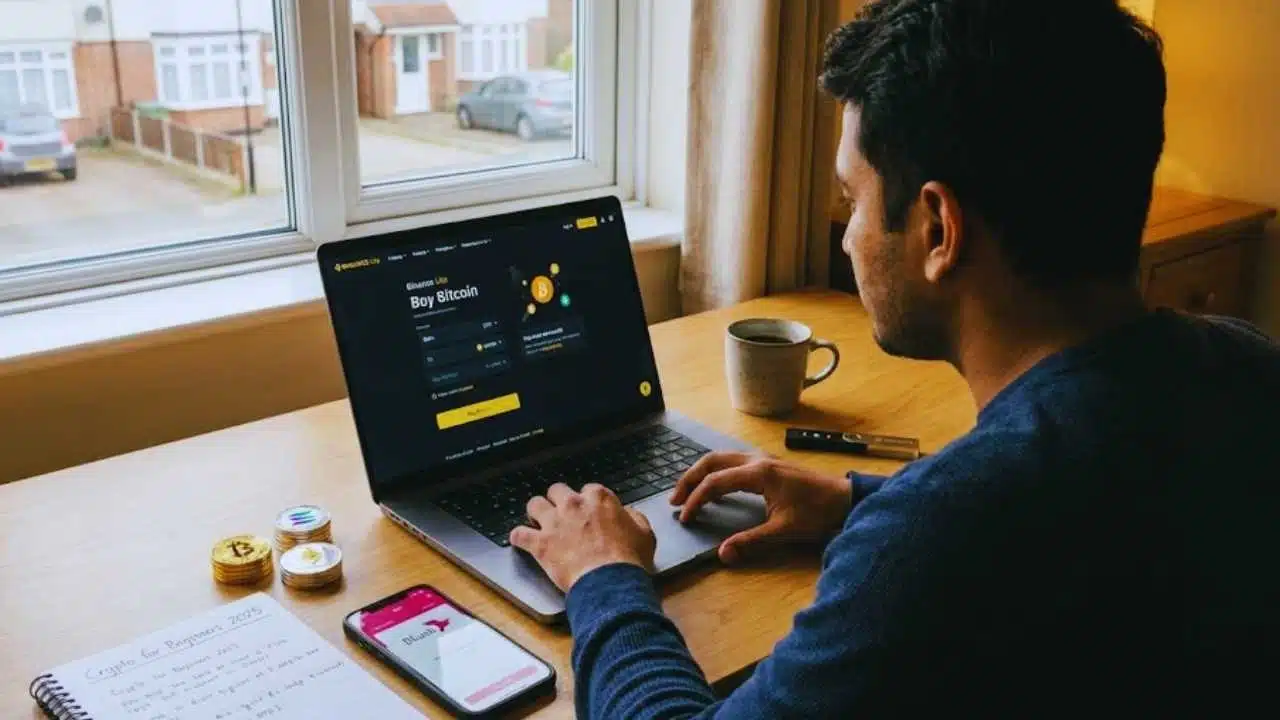
Crypto trading for beginners can feel scary and hard to grasp. Many new traders lose money because they jump in without the right tools or know-how. They often buy coins based on hype or tips from friends, which leads to costly mistakes and lost funds.
Did you know that experts suggest new traders should only put 1% to 5% of their money into crypto? This small start helps you learn without risking too much. Starting small lets you get used to how markets move without the panic when prices drop.
This guide will walk you through key steps to start trading crypto safely. You’ll learn how to pick good exchanges, set clear goals, and manage risks. We’ll share simple tools that help spot market trends and show you how to build a mix of coins that can grow over time.
Let’s get started.
Key Takeaways
- Start with just 1% to 5% of your money in crypto to learn safely without risking too much.
- Pick exchanges with strong security like two-factor authentication and check user reviews before choosing one.
- Set clear trading goals and use stop-loss orders to limit losses to 1-2% of your total funds per trade.
- Spread your investments across different coins instead of putting everything in one cryptocurrency.
- Use tools like RSI and MACD to spot market trends, and check trusted news sites like CoinDesk daily.
Start with a Clear Trading Plan
A clear trading plan sets the path for your crypto success. Your plan must include specific goals, risk limits, and entry/exit points for each trade.
What goals should I set for crypto trading?
Clear goals help you stay on track in crypto trading. Start with small, simple targets like learning one trading tool each week or making a 1-2% profit per trade. Money goals should match your life needs, not what others are doing.
Many new traders fail by chasing huge profits too fast. Focus first on not losing money and getting trading experience. Set goals to learn market patterns and price trends since trading is about buying low and selling high.
Your trading plan should include how much you’ll risk per trade, which coins you’ll trade, and when you’ll take profits. Good goals build skills for the long run rather than quick cash.
How do I set and stick to a trading budget?
Setting a crypto trading budget starts with knowing what money you can truly invest. This means using funds that won’t affect your daily needs, emergency savings, or debt payments.
Smart traders never put in more cash than they can afford to lose. Before jumping into crypto, build a small emergency fund and pay off any high-interest debts first.
For beginners, invest only 1% to 5% of your total assets in crypto. Make small, regular purchases instead of one big buy. This approach helps manage risk better and keeps your finances safe.
Your budget should be money you won’t need soon, allowing you to ride out market ups and downs without panic selling.
Choose a Reliable Cryptocurrency Exchange
Picking the right crypto exchange is a key step for trading success. You need a platform that offers strong security, fair fees, and coins you want to trade.
What factors should I consider when choosing an exchange?
Choosing the right crypto exchange makes a big difference in your trading success. You need to pick one that fits your needs and keeps your money safe.
- Security measures must be top priority. Look for exchanges that use two-factor authentication (2FA) to protect your account from hackers.
- Government regulation gives you more protection. Coinbase, Gemini, eToro, and Kraken all follow rules set by financial authorities.
- Fee structure can eat into your profits. Compare trading fees, deposit fees, and withdrawal costs before picking an exchange.
- Liquidity affects how fast you can buy or sell. Higher trading volume means your orders get filled faster at fair prices.
- Track record shows if an exchange is stable. Pick platforms that have been around for 5-10 years with good service history.
- User experience matters for daily trading. The platform should be easy to use with clear charts and simple order placement.
- Asset protection policies keep your coins safe. Check if the exchange holds most funds in cold storage away from online threats.
- Reputation among other traders tells you a lot. Read user reviews and check if the exchange has faced major hacks or problems.
- Transparency about how they work builds trust. Good exchanges share info about their security practices and company leadership.
- Compliance with laws helps avoid future problems. Exchanges that follow rules are less likely to get shut down suddenly.
Why is security and user feedback important for exchanges?
Security matters a lot when picking crypto exchanges. Your money stays safe only if the exchange has strong protection. Good exchanges offer two-factor authentication (2FA) and push you to create strong passwords.
They also help you back up recovery phrases so you never lose access. User feedback tells you how an exchange really works. Other traders share if they had problems with withdrawals or customer service.
Many users leave coins on exchanges, which can be risky. The best practice is to move your crypto to a non-custodial wallet like MetaMask or Trust Wallet for better control.
Phishing attacks target crypto users daily. Exchanges with good security warn you about fake websites and emails. They teach you to store recovery phrases offline, away from hackers.
Your private keys control all your funds. Custodial exchanges hold these keys for you, while non-custodial wallets give you direct control. Most new traders start with exchanges for ease, then move to secure wallets as they learn more.
This step-by-step approach keeps your crypto safe while you gain trading skills.
Understand Market Trends and Timing
Market trends tell you when to buy or sell crypto. You need to watch price charts and news to spot good trading chances.
How can technical analysis help me find trading opportunities?
Technical analysis works like a map for crypto traders. It uses charts and patterns to spot good times to buy or sell. You can track price moves with tools like candlestick charts and moving averages.
These tools show where prices might go next. Bollinger Bands help you see when a coin is trading outside its normal range, which could signal a chance to trade.
Key indicators give you clues about market health. The RSI shows if a coin is bought too much or sold too much. MACD tracks momentum shifts that might lead to price changes. Volume tells you how strong a trend is.
With these tools, you can find better entry points, set smart exit points, and manage your risk with stop-loss orders. Good timing is vital in crypto trading, and these tools help you make more informed choices.
How do I interpret market sentiment and crypto news?
Market sentiment drives crypto prices in big ways. Tweets from famous people and breaking news can make prices jump or drop fast. You need to watch social media trends and news sites to spot these shifts.
Tools like sentiment analysis can help you track what most traders think about a coin. Look at trading volume too, since more trades often mean strong feelings about a crypto.
On-chain analytics show what’s happening with coins in real time. This data tells you if big investors are buying or selling. For better results, mix technical charts with sentiment data.
Price charts show patterns, while sentiment shows why those patterns happen. This combo helps you make smarter trades when the market moves quickly.
Diversify Your Portfolio
Spreading your crypto investments across different coins helps you avoid big losses. You can mix high-risk coins with stable ones to create a safer portfolio.
Why should I spread investments across different cryptocurrencies?
Putting all your money in one crypto is like putting all eggs in one basket. If that coin crashes, you lose everything at once. Smart traders split their funds across many coins to guard against big losses when markets drop.
This safety net works because not all cryptos move the same way at the same time. Your portfolio stays more stable during market ups and downs.
Crypto markets change fast, and spreading your money lets you grab growth chances in many projects. You might miss the next big winner if you stick to just one or two coins. A mix of stable coins like Bitcoin and newer projects gives you both safety and growth chances.
This balance helps your money grow while keeping risks lower than betting on a single crypto asset.
How do I balance between high-risk and stable crypto assets?
Smart crypto traders keep most of their money in stable coins like Bitcoin and Ethereum. These big coins have stood the test of time and don’t swing wildly in price as often as smaller coins.
Put only a small part of your money into risky altcoins that might make big gains or big losses. This way, you can try for high returns without risking too much of your total funds.
Your crypto mix will change as prices move up and down. Check your portfolio often and adjust it back to your planned levels. If Bitcoin grows from 60% to 70% of your holdings, you might sell some to get back to your target.
This helps lock in profits and keeps your risk at the right level for your goals.
Practice Risk Management
Risk management helps you protect your money in crypto trading. You need clear rules for when to exit trades and how much to risk on each one.
How do stop-loss orders help minimize trading losses?
Stop-loss orders act as safety nets in crypto trading by selling your assets if prices drop to a set level. They work on autopilot, so you don’t need to watch charts all day. For example, if you buy Bitcoin at $40,000, you might set a stop-loss at $38,000 to limit your loss to 5%.
This tool helps you stick to your risk plan of only risking 1-2% of your total money per day.
These orders take emotion out of trading choices. Markets can swing wildly, and it’s hard not to panic sell or hold too long during drops. With stop-losses in place, your exit happens based on your calm, planned choice rather than fear.
They also help lock in profits on winning trades by moving the stop-loss up as prices rise, which guards your gains against sudden market turns.
How can I avoid making emotional trading decisions?
Crypto markets can make you feel like your money is under attack. When your $100 drops to $70, it often feels like a personal failure rather than a market shift. This is where trading psychology matters most.
Smart traders set clear rules before they buy or sell. They decide on exit points for both profits and losses. They stick to these plans even when fear or greed kicks in. Market volatility will test your financial discipline, but having firm rules helps you stay calm.
Small, regular investments can help you avoid panic during market swings. Instead of putting all your money in at once, spread it out over time. This approach lets you learn the market without the stress of big losses.
Many new traders make choices based on hype or fear of missing out. Don’t chase after coins just because they’re trending on social media. Good risk assessment means looking at facts, not feelings.
Take breaks from checking prices if you notice your emotions taking control of your trading choices.
Leverage Trading Tools and Indicators
Trading tools and indicators give you an edge in the crypto market. Smart traders use RSI, MACD, and moving averages to spot trends before others do.
How do RSI, MACD, and moving averages work in trading?
Trading tools help you make smart choices in the crypto market. These key indicators can show you when to buy or sell based on price trends and market momentum.
- RSI (Relative Strength Index) tracks price momentum on a scale from 0 to 100. A reading above 70 signals an overbought market that might drop soon, while below 30 suggests an oversold market ready to rise.
- The RSI helps spot market shifts before they happen in price charts. Traders watch for times when the RSI moves in a different direction than the price, which can signal a coming trend change.
- MACD (Moving Average Convergence Divergence) shows trend direction and strength. It uses two moving lines, the MACD line and signal line, plus a histogram that shows the space between them.
- When the MACD line crosses above the signal line, many traders see this as a buy sign. A cross below often means it’s time to sell or be careful.
- The MACD histogram grows taller when a trend gains strength. The bars shrink as momentum slows down, which can warn you of a possible trend change.
- Simple Moving Averages (SMA) add up prices over a set time and divide by that number of days. This smooths out price data to show the main trend direction.
- Exponential Moving Averages (EMA) work like SMAs but give more weight to recent prices. This makes EMAs react faster to new price changes than SMAs.
- Moving averages create support and resistance levels on charts. Prices often bounce off these lines, making them key points to watch for buy or sell choices.
- Traders look for crossovers between short-term and long-term moving averages. A short-term average crossing above a long-term one often signals an uptrend starting.
- Price action above a moving average tends to show bullish trends, while prices below suggest bearish trends. This simple check helps confirm which way the market is heading.
What tools help with sentiment analysis and market monitoring?
Market tools can help you spot trends before they happen. Sentiment analysis tools track what people say about crypto on social media and news sites. These tools show if most traders feel good or bad about a coin.
On-chain analytics look at what’s happening on the blockchain right now, not just price charts. This gives you an edge in your trades.
Trading volume tools tell you how much of a coin is being bought and sold. High volume often means big price moves are coming. News aggregators collect crypto news in one place so you don’t miss key info.
For beginners, portfolio tracking apps make it simple to watch all your coins at once. These tools take the guesswork out of crypto trading and help you make smarter choices based on real data.
Stay Disciplined and Patient
Trading success needs time and a cool head. You must stick to your plan even when the market gets wild.
How can I avoid overtrading and impulsive trades?
Trading too much hurts your profits. Set a clear trading schedule and stick to your plan. This helps you make smart choices based on facts, not feelings. Your plan should list when to buy and sell each crypto, with exact entry prices and profit goals.
Check your progress once a month to learn from wins and losses. Write down price changes and how you felt during trades. This record shows if you’re making choices based on facts or emotions.
Good traders know that patience pays off more than jumping in and out of the market too often. Strong discipline and solid risk management will keep your crypto trading on track.
Why is focusing on long-term success better than short-term gains?
Long-term success in crypto trading gives you more stable results than chasing quick profits. When you hold assets for months or years, you build a stronger portfolio over time. This method works better for beginners since it doesn’t need constant market watching.
Your money has time to grow through market ups and downs.
Market drops won’t scare you as much with a long-term view. Many new traders panic and sell when prices fall, locking in losses. Patient traders stick to their plans and avoid making choices based on fear.
This steady approach helps you make smarter choices with your money and builds good trading habits. Consistent, disciplined investing leads to better results than trying to get rich quick.
How do I monitor and adjust my crypto trading strategy?
Check your trade history often to see how well you’re doing. This helps you spot what works and what doesn’t. You should also rebalance your portfolio so no single coin makes up more than 70% of what you own.
Many traders use portfolio tracking tools to watch their assets and make smart changes. As you learn more about crypto trading, you can change how much money you put in based on your comfort with risk.
Look at both technical charts and market feelings when you update your plan. Market analysis tools can show you trends that help you decide when to buy or sell. Your strategy should grow as you gain more skills in crypto trading.
How can I keep learning and stay updated on crypto trading?
The crypto market changes fast, so you need to keep up with news and trends. You can read top crypto sites like CoinDesk and Cointelegraph for daily updates on market moves.
Which trusted crypto news sources and market updates should I follow?
CoinDesk and Cointelegraph stand out as top news sources for crypto market updates. These sites offer fresh news that can help you spot market trends before they happen. Many traders check these sites daily to stay ahead of price changes.
You can also use social media and special tools that track what people are saying about crypto. These tools help you see if most traders feel good or bad about certain coins. Getting news from many places gives you a fuller picture of what’s going on in the crypto world.
Market news often leads to big price swings, so staying informed helps you make smarter trades.
What courses and resources can improve my trading skills?
Many top schools offer crypto trading courses that can boost your skills. Coursera’s Financial Technology Innovations program covers key trading concepts with expert teachers. For formal proof of your skills, look into getting certified through C4 programs (CEP, CBP, CCSSA) or the Blockchain Council’s Certified Crypto Trader (CCT) program.
These courses teach you both the basics and complex parts of crypto markets. You’ll learn how to read charts, spot trends, and make smart trades.
Blockchain courses are very helpful for traders at all levels. They teach you how the tech works behind crypto coins, which helps you make better trading choices. These classes explain market trends and show you how to use trading tools the right way.
Most courses include practice sessions where you can test strategies without using real money. This hands-on practice builds your skills before you risk actual funds in the market.
What common mistakes should I avoid in crypto trading?
New traders make costly mistakes in crypto trading. You can avoid big losses by learning from these common errors.
Why is over-leveraging risky and how much should I invest?
Trading with borrowed money can hurt you fast in crypto markets. Over-leveraging means using too much borrowed cash to make bigger trades. If prices drop even a little, you could lose all your money.
New crypto traders should never start with leverage until they fully grasp how it works. The market’s high price swings make leverage extra risky for beginners.
Smart traders limit their risk by investing small amounts. If you’re just starting, put in only $50 to $100 at first. Never risk more than 1-5% of your total money on any single trade.
This rule helps protect your funds from big losses. Many pros use this same approach to stay in the game long-term. Your goal should be to learn the market before trying to make huge profits.
What happens if I ignore market research and analysis?
Skipping research in crypto trading can lead to major money losses. You might put cash into scam projects or tokens with poor performance records. Without proper market checks, you can’t spot red flags or tell good projects from bad ones.
Many new traders lose funds because they rush into trades based on hype or tips from social media.
Market research helps you make smart choices instead of risky guesses. Using both technical charts and market mood analysis gives you a clear picture of where prices might go next.
Good research lets you find solid projects with real uses and strong teams. This cuts down your risk and boosts your chances of making profit in the crypto market.
What are the best tools and platforms for beginner crypto traders?
Choosing the right tools can make your crypto trading journey easier and more profitable. We picked the top platforms that offer simple interfaces, good security, and helpful features for new traders.
Which exchanges and apps are easiest for beginners to use?
Coinbase and Binance stand out as the most user-friendly exchanges for crypto beginners. These centralized platforms offer simple signup steps and clean layouts that make buying your first digital assets less scary.
Many new users enjoy the $5-$10 signup bonuses these sites often provide, giving you free funds to start your trading journey. The clear fee details help you know exactly what you’ll pay for each trade.
For the smoothest start in crypto trading, pick regulated platforms with strong security and simple designs. Apps like [our recommended trading platform] crypto trading app combine easy onboarding with helpful guides that explain basic terms.
The best beginner platforms also offer small minimum deposits so you can start with just a few dollars while you learn the basics of cryptocurrency investing.
What portfolio tracking tools simplify crypto management?
Crypto portfolio trackers make managing your digital assets much easier. These tools show your account balances, asset mix, and how well your investments are doing in one place. You can see all your coins across different exchanges without logging into each one.
Many trackers link to multiple exchanges and wallets, so you get a full picture of what you own. This saves you time and helps you make better choices about your crypto.
Tax time gets less scary with portfolio tracking apps too. They track your trades and can create tax reports for you. This helps you stay legal without the headache of manual record keeping.
Good trackers also let you watch market trends and check how your assets grow over time. For new traders, these tools turn complex crypto management into something simple and clear.
Takeaways
Starting with a clear plan and small investments helps you learn crypto trading without big risks. You must pick safe exchanges, study market trends, and spread your money across different coins.
Smart traders use stop-loss orders and trading tools to protect their cash and spot good deals. Staying patient and keeping up with crypto news will build your skills over time. Your success in crypto trading comes from good habits, not luck, so focus on learning and making careful choices every day.
FAQs
1. What are the most important things to know before trading crypto?
Learn about the crypto market first. Start with small amounts of money you can afford to lose. Pick trusted trading platforms with good security. Watch the market trends before making big moves.
2. How do I manage risk in crypto trading?
Never put all your money in one coin. Set clear stop-loss orders to limit losses. Only use money you won’t need for bills or daily life. The crypto market can change fast, so be ready for ups and downs.
3. What trading strategies work best for crypto beginners?
Dollar-cost averaging is great for new traders. This means buying small amounts over time instead of all at once. Long-term holding can also work well if you believe in a project. Avoid day trading until you have more skill.
4. How can I spot good crypto investment chances?
Look at the team behind the coin and their track record. Check if the project solves a real problem. Review the trading volume and market cap to see if others are interested. Always do your own research rather than following tips from social media.