You know the feeling: you need to launch a new feature fast, but your legacy system feels like a tangle of wires that no one wants to touch. That hesitation is exactly why the “monolith” era is ending. A composable enterprise is the answer—a modular, flexible way for companies to build their technology stack using interchangeable blocks rather than a single, rigid structure.
This isn’t just a trend; it’s a survival strategy. Gartner predicts that by 2026, 70% of enterprises will adopt composable technologies to outpace their competition. The reason is simple: speed. Instead of waiting months for a full system update, teams can swap out a billing engine or add a new search feature in days.
At the heart of this shift are API-first tools. These connectors allow different pieces of software to talk to each other, turning complex code into accessible services. Organizations now see massive value in making every part of their system—from Yext Answers Platform to payment gateways—fast and easy to update.
In this guide, I’ll break down exactly how this architecture works, why 2026 became the tipping point for adoption, and the practical steps you can take to start building a system that actually keeps up with your customers.
What is a Composable Enterprise?
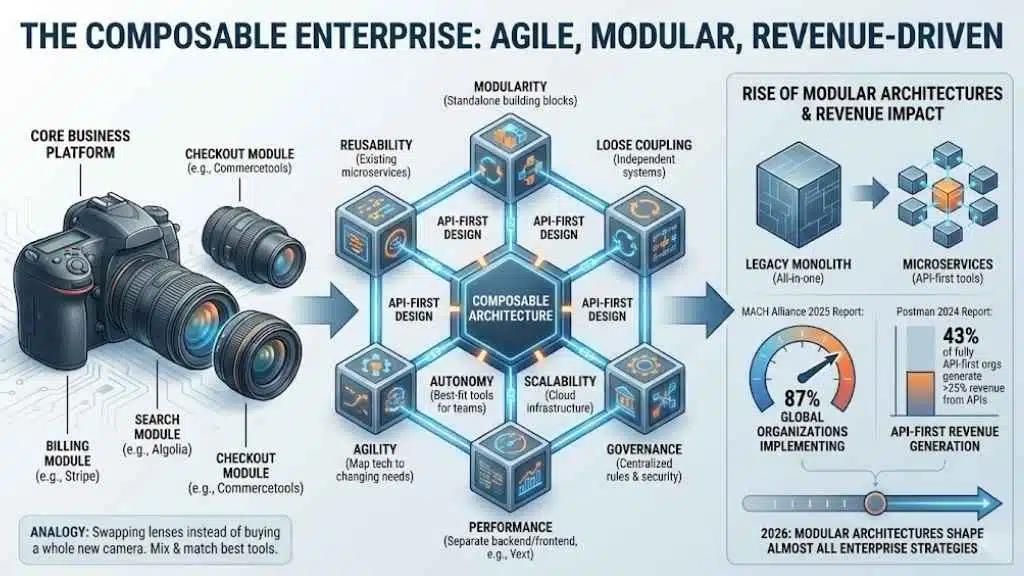
A composable enterprise breaks massive, all-in-one systems into smaller, independent parts. Think of it like swapping out a lens on a camera instead of buying a whole new body every time you need a better zoom. You mix and match the best tools for the job.
According to the MACH Alliance’s 2025 Annual Report, 87% of global organizations have already started implementing these technologies. They aren’t doing it just to be modern; they are doing it because it drives revenue.
Key principles of composability
Composable enterprise architecture helps businesses adapt to change instantly. API-first tools and modular architectures support this shift by ensuring every piece of software is designed to connect.
- Modularity: Each business capability, like billing or search, functions as a standalone building block. You can upgrade your “Check Out” cart without risking a crash on your “Home Page.”
- API-first design: This is non-negotiable. It means APIs expose business services from day one, linking all tools and platforms together for true integration.
- Loose coupling: Systems stay flexible because they don’t depend heavily on each other. If one module fails or needs maintenance, the rest of the business keeps running.
- Reusability: Developers stop reinventing the wheel. Teams use existing microservices or packaged applications rather than building new ones for every project.
- Discoverability: People across business and IT can find and connect reusable blocks quickly through clear documentation, speeding up solutions to new needs.
- Autonomy: Different teams can choose the best-fit digital tools for their specific goals while maintaining system interoperability through standard APIs.
- Agility: This approach lets companies map technology to changing requirements instantly.
- Governance: Centralized rules make sure these digital blocks meet security standards and follow company policies even as they get reused in many places.
- Scalability: Cloud infrastructure lets composable apps grow on demand without reworking everything from scratch.
- Performance: MACH-certified solutions like Yext Answers Platform prove how composable DXPs deliver speed for users by keeping heavy backend processes separate from the frontend experience.
The rise of modular architectures
Modular architecture has fundamentally changed how companies build technology. Today, firms use small parts called microservices instead of large single systems. Each part works on its own but connects with others using API-first tools.
This shift is backed by hard numbers. A 2024 report from Postman found that 43% of fully API-first organizations generate more than 25% of their total revenue directly from APIs. This proves that modularity isn’t just a technical detail; it is a business model.
By 2026, modular architectures will shape almost all enterprise strategies. Groups like Yext lead the way with MACH-certified solutions that make modular apps easy to connect. This setup supports business agility by making it simple for IT and business teams to respond quickly when needs change.
The Role of APIs in Building a Composable Enterprise
APIs are the glue that holds a composable enterprise together. They act as bridges, connecting different systems and making each part work together seamlessly.
API-first strategy: A foundational approach
An API-first strategy places APIs at the center of software development. Teams design and document APIs using standards like the OpenAPI Specification (OAS) before building features or writing code. This ensures that every new piece of software is ready to connect with others from the moment it is born.
“In my experience, the biggest difference between struggling teams and successful ones is that successful teams treat their APIs as products, not just technical projects.”
This method speeds up digital transformation by enabling seamless integration across systems. Financial firms and platforms like Yext Answers use this foundation to stay agile. With clear APIs, both IT and business teams work together smoothly, moving closer to true system interoperability.
Decoupled architecture for flexibility
Decoupled architecture lets each part of your system work on its own. You can switch, update, or scale one app or service without slowing down the whole business. This is often managed by API gateways like Kong or Apigee, which handle the traffic between your services so your developers don’t have to.
Gartner points out that setting a long-term vision for modularity is the key first step. Big names utilize MACH-certified solutions to prove how decoupling supports growth. With API management tools at the center, companies gain better system interoperability. Each team gets the freedom to pick technology that fits best while everything stays connected through modern APIs.
Core Benefits of API-First Tools in a Composable Enterprise
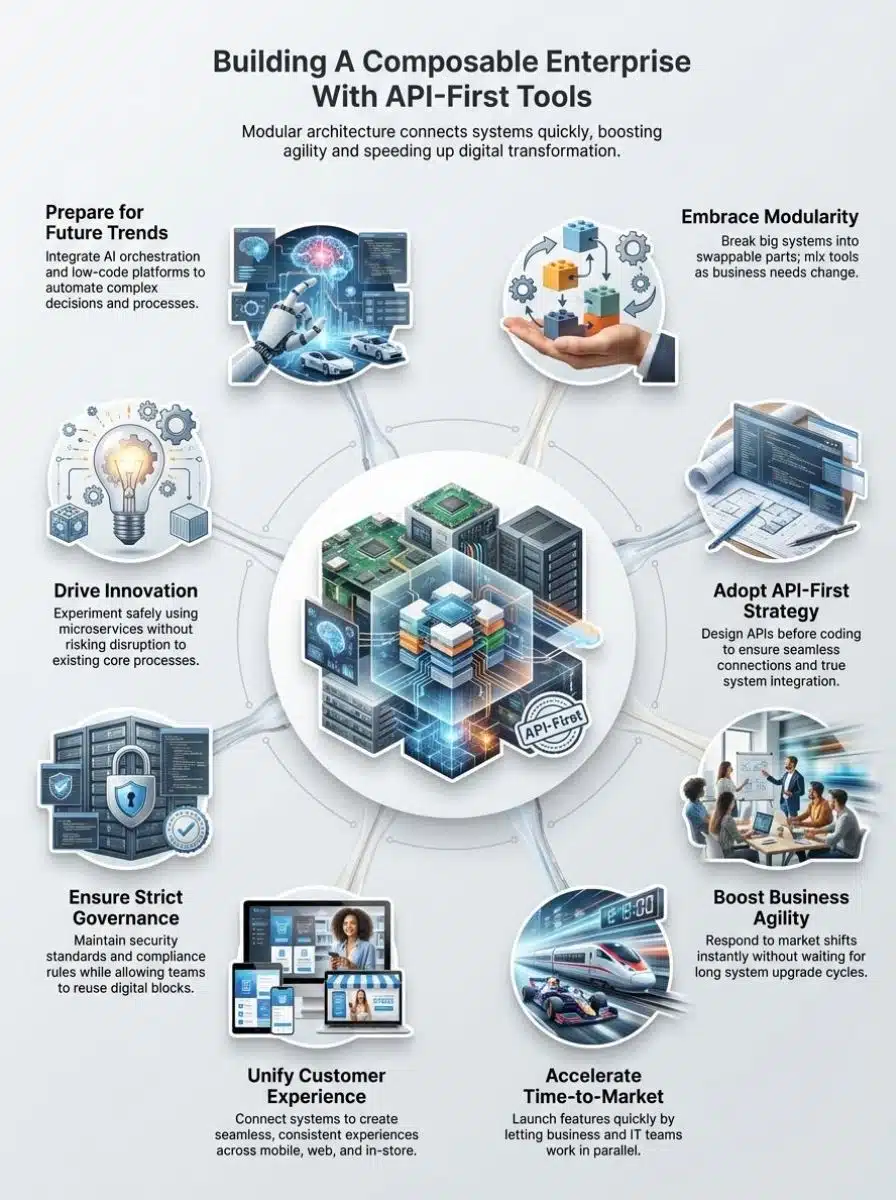
API-first tools help teams work smarter. They open new doors for growth and change, making the whole business more flexible. With these tools in place, companies can keep up with trends and customer needs faster than before.
| Benefit Category | Traditional Monolith | Composable Enterprise |
|---|---|---|
| Update Speed | Weeks or Months (High Risk) | Hours or Days (Low Risk) |
| Scalability | Must scale entire system | Scale only what is needed |
| Innovation Cost | High (Requires full rebuilds) | Low (Swap individual parts) |
Enhanced business agility
Companies can move fast and make changes easily with a composable enterprise. This approach uses modular architecture, microservices, and API management to connect digital tools quickly. Teams respond to shifting business needs without waiting for long upgrade cycles.
Data from the 2025 MACH Alliance Report confirms this, showing that organizations using composable tech report a 50% increase in organizational agility. The Yext Answers Platform shows how these solutions allow businesses to swap components as needed. Modular systems let both IT and business teams roll out updates much faster than before.
Faster time-to-market
API-first tools speed up digital transformation. With modular architecture, teams build and launch new features faster than with legacy systems. The composable enterprise model breaks technology into smaller parts, allowing business and IT professionals to work in parallel.
For example, while one team updates your checkout flow using a tool like Stripe, another can revamp your product search with Yext. Neither team has to wait for the other. APIs expose business capabilities as services, which means updates reach customers sooner without waiting for large releases.
Improved customer experiences
Customers expect fast service and clear answers. A composable enterprise helps meet those needs. Businesses can connect systems to create seamless experiences across all touchpoints.
Modular architecture lets teams update services quickly as customer demands shift. 55% of IT leaders cite improved customer experience as the top benefit of switching to MACH technologies. This flexibility leads to fewer delays and happy customers who get what they want without hassle.
Empowering innovation and experimentation
API-first tools give teams freedom to try new things fast. In a composable enterprise, every business capability works as its own piece. Teams no longer need to wait for long IT cycles or complex updates.
Using microservices and modular architecture, developers and business professionals test ideas in short sprints. For example, the Yext Answers Platform is MACH-certified and fully composable, letting companies build digital experiences quickly. This approach supports innovation strategies while making scaling up simple if an idea takes off.
Best Practices for Implementing an API-First Strategy
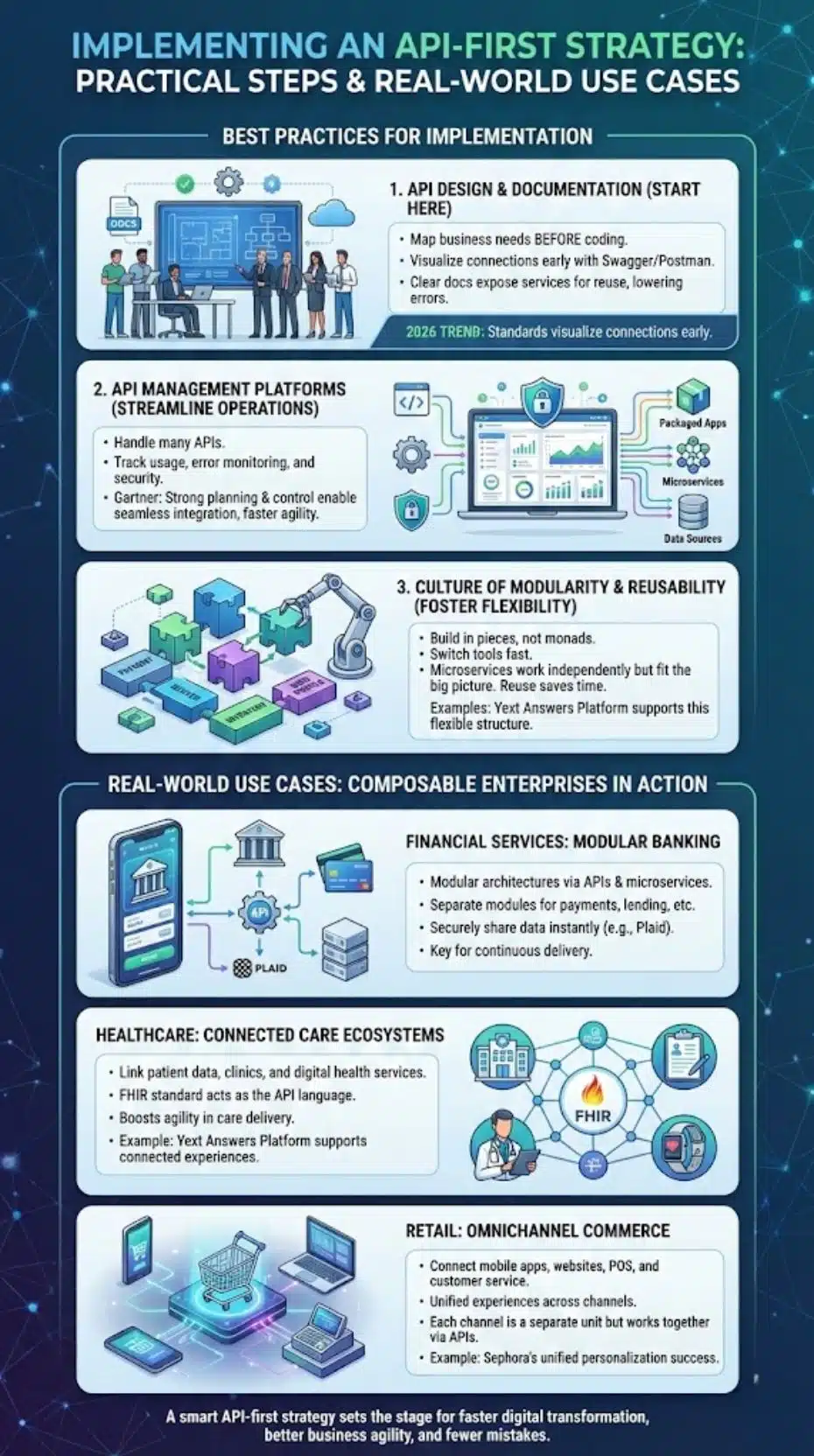
Want to make your systems faster and more flexible? A smart API-first strategy sets the stage for real change. Here are the practical steps that work.
Start with API design and documentation
Start with clear API design. Teams map out business needs before any code is written. This helps developers, business leaders, and IT professionals work together from the start. In 2026, the most successful companies use standards like Swagger or Postman Collections to visualize these connections early.
Good documentation explains how APIs expose key business services. For example, MACH-certified platforms such as Yext Answers Platform make integration easy by describing every feature up front. Strong documentation makes it simple for teams to reuse modules or connect apps across systems, lowering errors and speeding up digital transformation.
Use API management platforms to streamline operations
API management platforms help teams handle many APIs at once. These tools track API usage, watch for errors, and keep data safe. Large companies use them to connect many packaged applications in a modular architecture.
Gartner research shows that moving to a composable enterprise starts with strong planning and control. An API management platform makes this easy by supporting seamless integration between systems. This means faster digital transformation, better business agility, and fewer mistakes as changes happen.
Foster a culture of modularity and reusability
Encourage teams to build technology in pieces instead of all at once. This makes it easy to switch out tools and respond quickly to changing business needs. The API-first model helps by exposing business functions as simple services.
Using microservices lets each part work on its own but still fit into the bigger picture. Tools like the Yext Answers Platform support this flexible structure. Teams can reuse these small parts again and again, which saves time and increases business agility.
Real-World Use Cases of Composable Enterprises
You can find many businesses using this model in creative ways. These examples highlight practical solutions that support growth and change.
Financial services: Modular banking
Banks build modular architectures using APIs and microservices. Each piece can offer a different banking service, like payments or lending. Services like Plaid have become the industry standard for this, allowing banks to securely share financial data with other apps instantly.
For example, one team can work on improving online account opening while another focuses on fraud detection. A composable enterprise approach lets banking services connect with other platforms through seamless integration. Gartner highlights this model as key for continuous delivery in financial services.
Healthcare: Connected care ecosystems
Healthcare teams increase efficiency by using API-first tools to link patient data, clinics, and digital health services. The adoption of the FHIR (Fast Healthcare Interoperability Resources) standard acts as the API language for the entire industry, allowing different hospital systems to finally understand each other.
Research shows that a composable enterprise model boosts business agility in healthcare. The Yext Answers Platform stands out as a MACH-certified solution that supports connected digital experiences for both patients and providers. With seamless integration powered by APIs, healthcare organizations respond swiftly to shifts in care delivery.
Retail: Omnichannel commerce
Retailers use omnichannel commerce to meet shoppers where they are. API-first tools help connect mobile apps, websites, point-of-sale systems, and customer service fast. A major win for this approach was seen with Sephora, a winner at the 2025 MACH Impact Awards, which used composable tech to unify their online and in-store personalization.
A modular architecture is key here. Each sales channel acts as a separate unit but works together with the others using APIs. Composable enterprise solutions power this approach. The Yext Answers Platform is one example of a tool that helps build these flexible systems. With strong API management, retailers reach shoppers faster across more channels.
Overcoming Challenges in Adopting Composable Architectures
Growing pains can slow down change, but the right plan keeps progress steady. Smart choices set the stage for smoother moves.
Legacy system integration
Old systems often create barriers in digital transformation. Integrating these legacy platforms with modern API-first tools removes data silos. A popular technique here is the “Strangler Fig Pattern.” This involves building new microservices around the edges of an old system and gradually retiring the old parts one by one, rather than trying to replace everything overnight.
This approach speeds up transition timelines. Yext Answers Platform offers MACH-certified solutions for seamless integration across different environments. With proper API management, teams can maintain system interoperability while also empowering multidisciplinary groups of business and IT professionals.
Governance and security concerns
Strong governance and security are vital for any composable enterprise. APIs expose key business capabilities, which can make them an attractive target for cyber threats. Adopting a “Zero Trust” security model ensures that every service must verify its identity before connecting to another.
For example, platforms like the MACH-certified Yext Answers Platform use strict API management features that monitor data access. Gartner research shows that smart risk planning includes continuous audits and assigning clear roles for system oversight. Teams must work together to reduce risks as new modules plug into existing structures.
Organizational resistance to change
Teams in both business and IT can push back against new approaches. Shifting to a composable enterprise requires people to rethink old habits. Some staff may fear losing control or see the move toward agility as risky.
3 Steps to Reduce Resistance
- Start Small: Don’t overhaul the main core first. Pick a non-critical pilot project to prove success early.
- Invest in Training: Developers often resist because they lack skills in new tools like GraphQL or Kafka. Upskilling builds confidence.
- Show the Wins: Highlight examples like Yext Answers Platform to show how flexible integration makes their daily work easier, not harder.
Giving teams support can break down resistance fast. Showing how APIs open up choices helps everyone get on board with continuous delivery and system interoperability.
Future Trends in Composable Enterprise Architecture
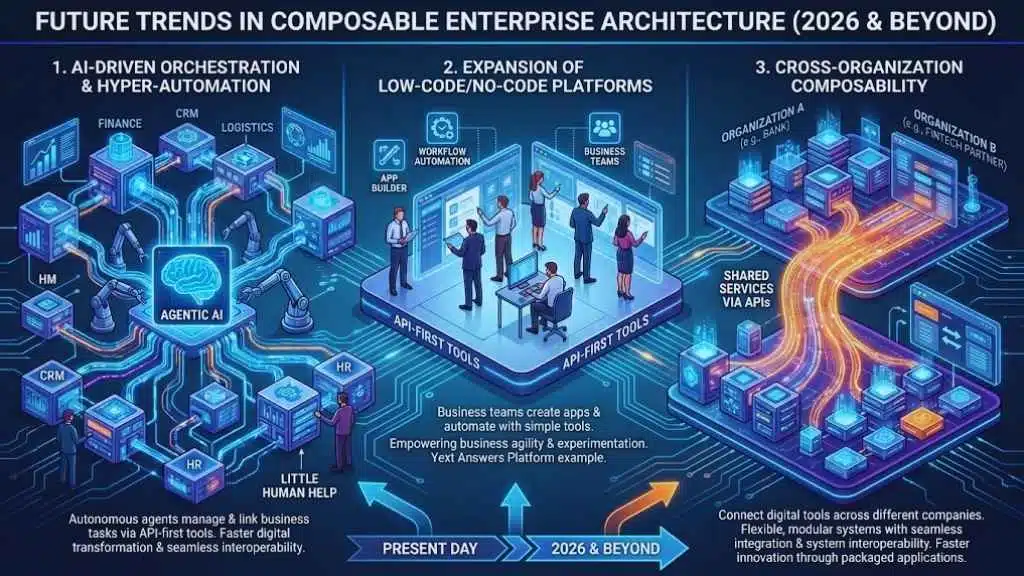
New technologies now shape how businesses connect, automate, and grow. Here is what is coming next.
AI-driven orchestration and hyper-automation
AI-driven orchestration uses smart software to manage and link many business tasks with little human help. This speeds up digital transformation, as AI can connect different systems quickly using API-first tools. Forrester predicts that by 2026, we will see the rise of “Agentic AI“—autonomous agents that use APIs to perform complex tasks across different software without human clicking.
In a composable enterprise, automation finds the fastest path for work to move across modular applications. Banks and healthcare use these methods now to improve system interoperability and keep operations flexible.
Expansion of low-code/no-code platforms
Low-code and no-code platforms are gaining speed. Business teams can now create apps or automate tasks with simple tools, even without deep coding knowledge. This growth supports composable enterprise principles by making it easier for both IT and business users to map technology with changing needs.
2026 is set as a key year for this trend. Lowcode development lets organizations react fast and experiment more often. Research from Gartner highlights that these platforms help define long-term visions of composability. The Yext Answers Platform stands out as an example, offering solutions for building flexible digital experiences on top of API-first tools.
Cross-organization composability
Cross-organization composability means different companies or teams can connect their digital tools with each other. This approach uses API-first strategies to create flexible, modular systems. A bank might share certain services with a fintech partner using APIs, while both sides keep control of their own systems.
Research by Gartner points to 2026 as an important year for making this shift. Businesses need seamless integration and system interoperability to compete today. APIs let these groups offer packaged applications that others can access when needed, which makes innovation faster.
Final Thoughts
A composable enterprise thrives with an API-first approach, making systems flexible and simple to connect. Teams gain speed, agility, and control by using modular tools that adapt as business needs change.
From the agility stats in the 2025 MACH report to the success stories of major retailers, the evidence is clear. These strategies cut down on complexity and help you deliver better customer experiences while boosting innovation across your company. Take the first step today. Switching to API-first tools could be what sets your business apart tomorrow.